
Travel Log Episode 6: I should have minored in Archeology aka Madrid, Merida, the Semana Santa, and a lot of Roman Ruins
Timestamps:
Intro: 0:07
Exhausting travel day(s) to Spain: 0:39
Settling into Spanish Life: 10:09
Tourist at the Prado: 15:19
Museums and Processions: 20:59
From Madrid to Merida: 28:11
Good Friday and the Via Crucis: 36:26
Lazy Saturday and Easter Sunday: 49:49
Roman Theatre, Amphitheater, and Citadel: 59:29
More Roman Ruins and Factoria Joven: 1:07:37
This Girl likes a Museum: 1:14:44
Another Museum and Even More Ruins: 1:18:15
From Merida to Madrid: 1:25:26
Outro: 1:28:41
My flight to Spain was early the next morning, back on Turkish Air. After a few hours in my hotel freshly showered and with a bit of sleep, I re-packed the few items I had taken out of my bag and went downstairs to get in my taxi. I was dropped at the International Terminal with about 2 hours until my flight. Checking in and dropping my bag was pretty straightforward. Then I headed up to passport control.
I was ushered into a line that took foreign passports and waited. It was a SLOW line. As we got closer to boarding time, I definitely started to get nervous. Some folks even switched over to the other line. Briefly I was told to switch, and then switch back - luckily no one else came up and I didn’t lose my place.
I sat and waited, inching forward, even though it was a pretty short line. Then a family, two parents and a boy and a girl, got ushered through to the front of our line. This was obnoxious, why were they getting to cut the line? I too had a plane to catch. While they were up there the girl, probably 9 or 10, followed by her mom stepped away. I could hear the mom say, “the trash is this way”, but then not even 50 yards away from me the girl went to her knees and barfed. I felt bad but also…ew. Middle of the damn floor. The mom walked away and the poor girl emptied her stomach.
Once she was done, her soft cry for mom was a bit haunting - but her mum did come back. Gave her some napkins to wipe her face with and they headed back to finish their go through passport control. The pile of stomach contents did remain there all through the rest of my wait, getting my outward stamp, and through security.
I did have some time once I got through and bought some candy and a magnet (which is my usual thing to collect when traveling) and went to my gate. Waiting there was the family that had cut in line previously. Man I hoped she had bad food/ non bottled water and not something contagious.
After a short time we went to board. This went as usual, same with the flight. I caught some shut eye, had some coffee and breakfast (pancakes), watched more Night Court and read. This time I did have only a 90 minute layover, so I was prepped and ready to get off that plane and head to my next gate as fast as possible. I popped up from the seat and pulled down my bag from the overhead and waited.
We started deplaning, but my already short window of layover was quickly closing as the plane was an hour behind schedule. As soon as I was off the aircraft I started to run. I scooted around other passengers on the gangway. Once out to the main airport there was really no signage. I had to ask the attendant at the gate the best way out. He pointed down a long corridor and said it was far. Welp I really had no choice but to book it. I ran down the corridor, on the moving walkways too. Then down an escalator but I still had to go through customs. Again signage was bad, it wasn't clear what was and was not open. Bless the cleaning lady who saw my panicked face and pointed me in the direction of the open gates.
Going through the security I had to take off my shoes and my jacket, but luckily did not have to take my devices out. The security agent asked, “short layover” and when I said yes he pushed it through the x-ray belt quickly. Once through I put my backpack back on, shoved my jacket through the strap and kept running. I made it to an escalator up, and then, was only at the Bazaar midpoint. So I continued my run. I was sweating through my clothes, I could barely breathe (I do have activity induced asthma) and definitely thought I might pass out while taking an escalator down to my gate area.
Of course the gate is not with the rest, it was another escalator down. Again, another airport staff person pointed me in the right direction. I got to my gate, huffing and puffing. They checked my passport and ticket and then out I went…to a bus. I ended up not being the last to make my gate, as the bus didn’t leave to get to the plane for at least another 15-20 minutes. On the plus side I had time to cool down.
Eventually I did get on the plane, and found my seat, an empty row, which was nice since I probably smelled kinda bad after my run and it would have sucked for whoever was sitting next to me. The plane took off, some guy took the other three seats next to me before I even had a chance to spread out. Fine, I watched Sinners (for the second time) and then started a mystery series from the BBC (that I will have to finish when I get home).
Finally, I made it to Madrid, and it was around 1:00pm. I was not in a rush this go, but disembarkment did not happen right away. Why was this taking so long? No one was moving, they were not opening the doors. And then they made an announcement - they needed to escort someone off the plane from the back. This was one of the large planes with two aisles and three sections of seats. A minute later a flight attendant and a woman made their way through the waiting passengers on the opposite aisle.
Eventually we were allowed to disembark. As I walked through the gangway I noticed passengers looking out and crowding around one side. I looked over, and the woman who was escorted off the plane was standing behind a police car, the trunk open, her bags inside and was about to be searched…oh.
I continued on quickly, because I had gotten a notification from the airline that my bag had not made the transfer and I wanted to get it dealt with sooner rather than later. I am not surprised at all considering the 90 minute layover and delayed plane, but didn’t mean it wasn’t annoying. I went directly to the desk at baggage claim and after a short wait was helped by the woman behind the counter. It would be on the next flight in, which was later in the evening. First off, great! Second, why could I not have booked that flight?! It was not an option given when I was booking and this would have been a non issue.
Regardless, I opted to come get in the next day since that would be faster than waiting for it to be delivered. So I got in a cab, found my hotel and then went out to get some basics. I did have deodorant on me but no pajamas, or underwear and the shirt I was wearing was just a t-shirt with a cut neck and not something I’d want to wear for the next 24 hours. I first went to Primark, it wasn’t an American company (why shop somewhere I could at home) and seemed like it was cheap.
Primark is a department store - floors of clothes, lots of old disney themed stuff (they had a bug’s life pajama sets), racks of workout clothes, and shoes. It was packed to the brim with shoppers. After wandering awhile I found some pj pants with strawberries, a cute pink knit top I could wear with the pants I had worn on the plane, and a pack of underwear. I went back to the hotel and dropped my stuff.
Then I went to find food. I hadn’t had dairy in 2 weeks, and was craving cheese. I found a little spot that served pizza just a few blocks from my hotel. It was perfect. I had a margarita, personal pizza and a sprite. I realized I did not have a warm/comfy sweatshirt (all in my checked bag) so I stopped at another store to grab one.
This was an interesting checkout process, you put the clothes on the sensored tabletop and then use the touch screen to pay. It’s not a great system because I put one item on the table and it tried to say I had a pair of pants and two of the same sweatshirt. I deleted what I thought were the incorrect items and then headed to leave. The security alarm went off, and the guard checked my receipt, and said the number on it and my item did not match. He asked if I had switched it for another one. I did not, told him as much and he said that I had to go to checkout and have them fix it. Ooookay.
I went back to the checkout, explained that the receipt and item did not match, and she sent me up to the top floor. Once there, that person said she could not help me, and then sent me back down to the ground floor to the original checkout. There was a new person manning the stations and she after about 10 scans and 2 devices somehow made the item and receipt match. I headed back to the entrance and had no problem leaving.
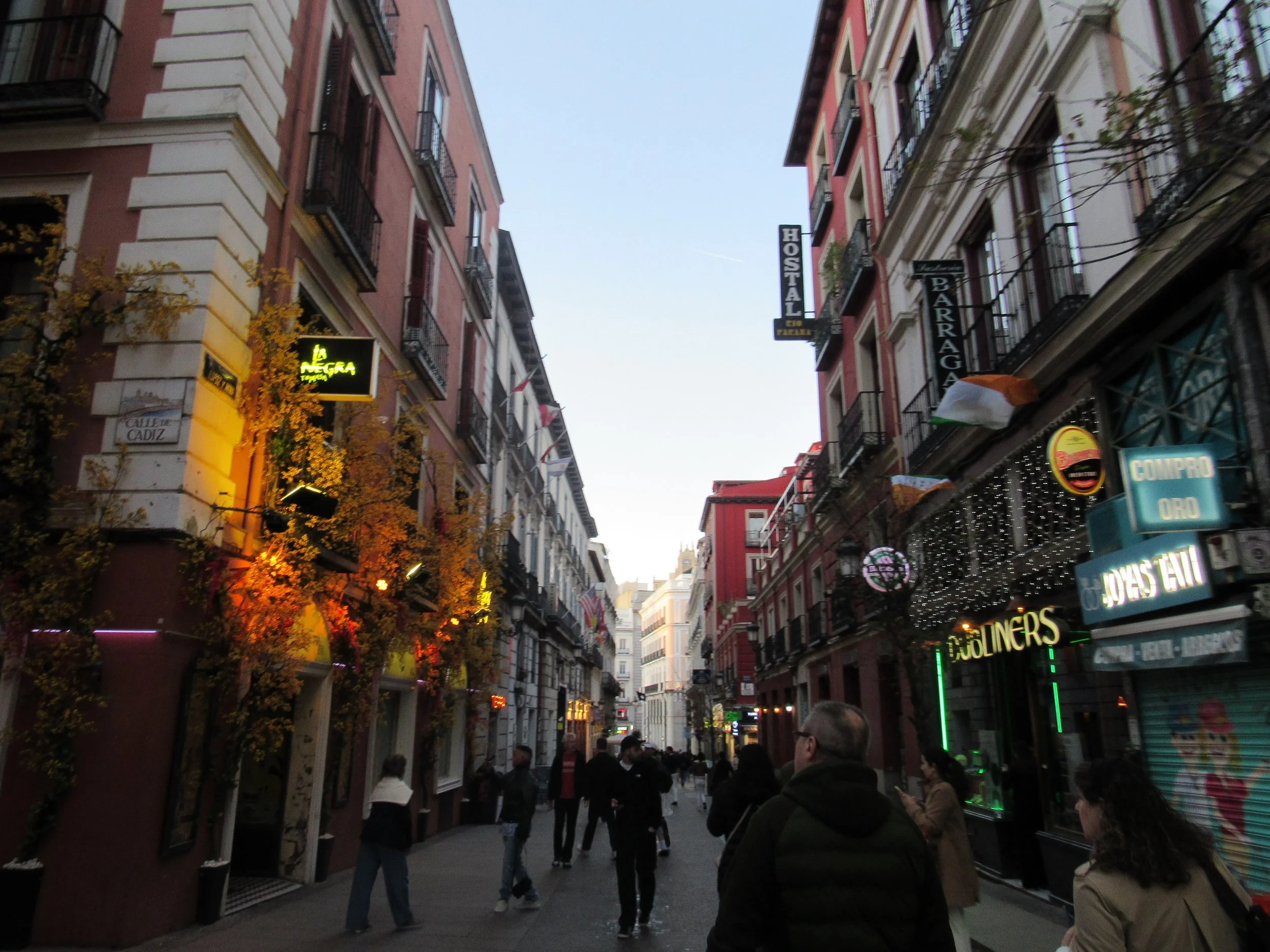
At this point I was exhausted and did not expect the sweatshirt to be such a hassle so I went back to the hotel to shower, and get some much needed sleep. The hotel was in the center, just down the sidestreet from Sol close to everything. The entrance was a door beside a tapas restaurant. Once inside was a long hallway which led to the hotel lobby. It was a modern space with a desk and a metal staircase down to the area which held tables, snacks, coffee and vending machines.
If you walk past the desk around the staircase is the back entrance to the left and a short hallway to the right, with banquette seating in an angular alcove and a luggage scale. There is an elevator at the end and this leads up to the rooms. The hallways are dark and moody, with more angular banquettes lit from underneath, almost spaceship-like.
Entering the room it's noticeably white and bright, and no art or decoration on the walls. Tucked into a mirrored niche the sink was directly to the right as you walked in, an open cabinet below with hand towels. There was a long hallway which opened up to the rest of the room. The stacked toilet room and shower were through a door on the left right before the main space. Along the left wall are tall open cabinets, with a wood laminate for clothes, and a desk of the same laminate protruding from the side. The modern chair is made of white formed plastic and wood legs matching the rest of the space.
In the main area the king bed sits against the wall to the right, taking up all the rest of the space, the black headboard /sidetable combo the only contrast in the room. A TV is on the opposite wall. To the left is a window looking out to an interior courtyard. Behind the headboard and the bathroom area are both lit by color LEDs, which I of course set to purple for the duration of my stay.
—
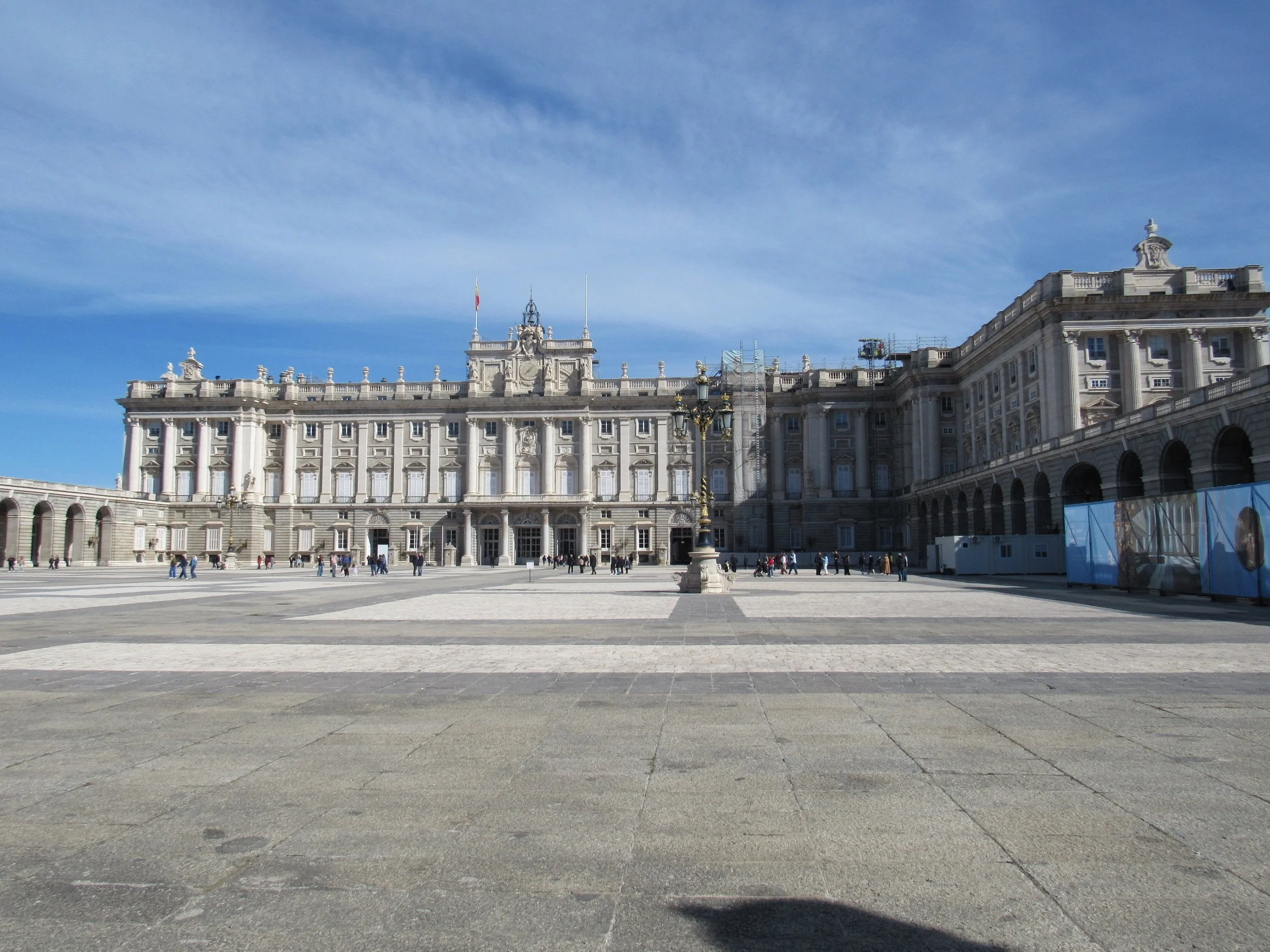
The next morning I went to meet one of my oldest friends who happened to be in town, and was leaving the next day. Her mom (who I had not seen in forever) was with her, along with her fiance who I had yet to meet even though I’d be back in Madrid for their wedding later in the year. Appropriately we met up for bagels, and then I spent some time catching up with my friend and her mom as we walked around the Palacio Real of Madrid.
We didn’t go in, but it was strange to see a Transformer (Bumblebee) and a panda bear dancing for tips. What a weird juxtaposition of people in costumes that had nothing to do with the royal palace and the architecture. By the time we left Stitch had joined the dancing costume. Such a weird way for the old world and new world to be thrust together.
After I left them, I returned to the airport to pick up my bag. I had a special paper that got me back into baggage claim, and after a slightly longer wait headed back to the hotel with my checked bag. First thing first, was laundry. So I shoved pretty much 2/3rds of my clothes into the plastic laundry bag I usually travel with and the rest in one of the paper bags I had gotten with my clothes purchases.
I had found a laundrette that was supposed to be just around the corner from me. I walked to it, it was down a side street. There were plenty of restaurants, a bike rental, apartment doors but nowhere to do laundry. I walked around the block with my two bags hoping maybe Google had the entrance wrong. It was a bust so I found another of the same company just 5 minutes away, behind the Primark I had been in just the day before.
It was a long and skinny space. Machines on the left, and a folding table and seating to the right. At the back was an alcove with a large table surrounded by storage lockers.
There were just 4 people, including me, for the 6 machines and there should have been plenty of room. One was a couple who were finishing up their wash load, but one guy was doing multiple loads (like 4 machines worth) of hotel towels and taking up half of the space. I walked in and tried to use the only open machine, but the other guy who was already there said he was going to use it. Fine, he was there first. He even moved his blue carry-on size suitcase in front of it.
So I waited about 3-5 minutes and two of the towel loads finished. The towel guy transferred the first load over to the dryer and I immediately took it. I threw everything in my machine, navigated the touch screen which had you pick the machine number, and temperature, then an easy tap to pay, detergent was automatically added in for you. Once it started I then sat and waited.
The Towel guy transferred his second load to the dryers, and then the blue suitcase guy took that washer instead, so not sure why he told me he was using it. Either way mine was going and that worked for me. I had 40 minutes of wash time, so I doom scrolled for a bit. People watched as some came in and out to drop or pick up their luggage. An old woman came in just to use the dryers, and another gal who had a couple loads of her own to do.
The couple moved their load to the dryer and then went to fold, and had to ask the towel guy to make space. He, by the way, had started another load of towels during this time, and was folding almost the entire time I was there. The couple finished up, and there was one open dryer. The problem was me and the suitcase guy’s wash loads were going to finish about the same time. I watched my machine like a hawk and as soon as it was done, I switched over. Again navigated the touch screen and had another 20 minutes to go while my clothes dried.
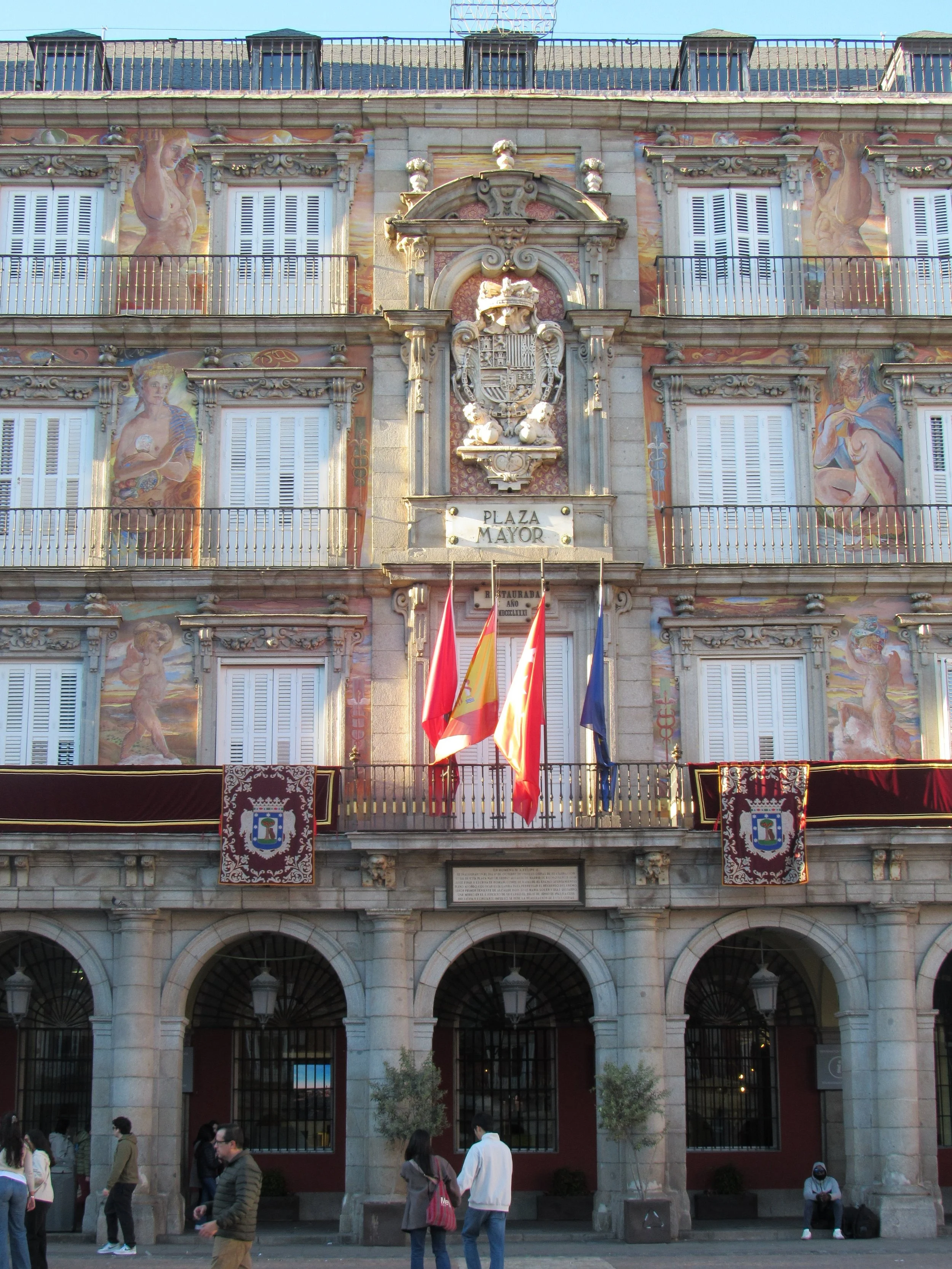
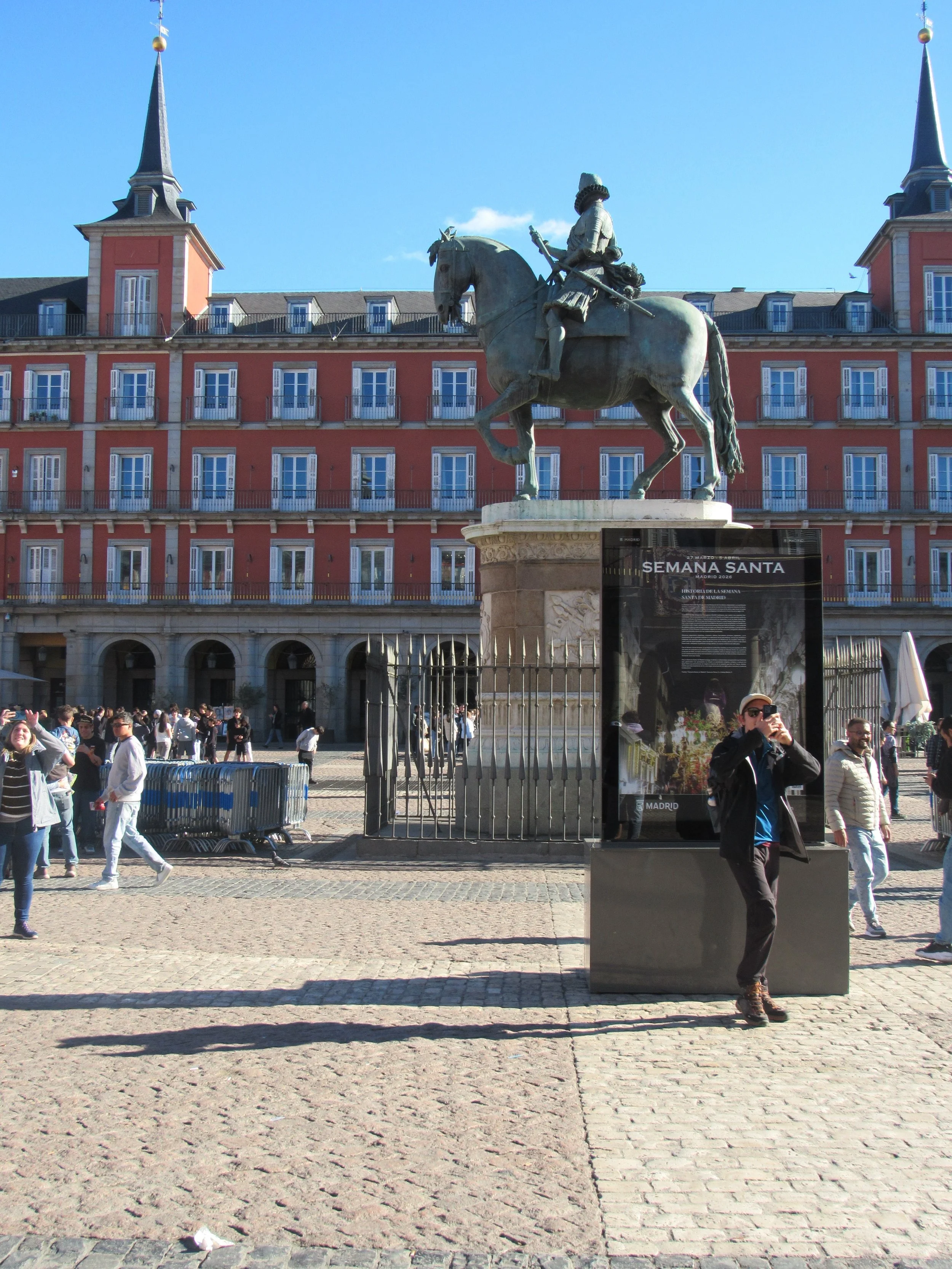
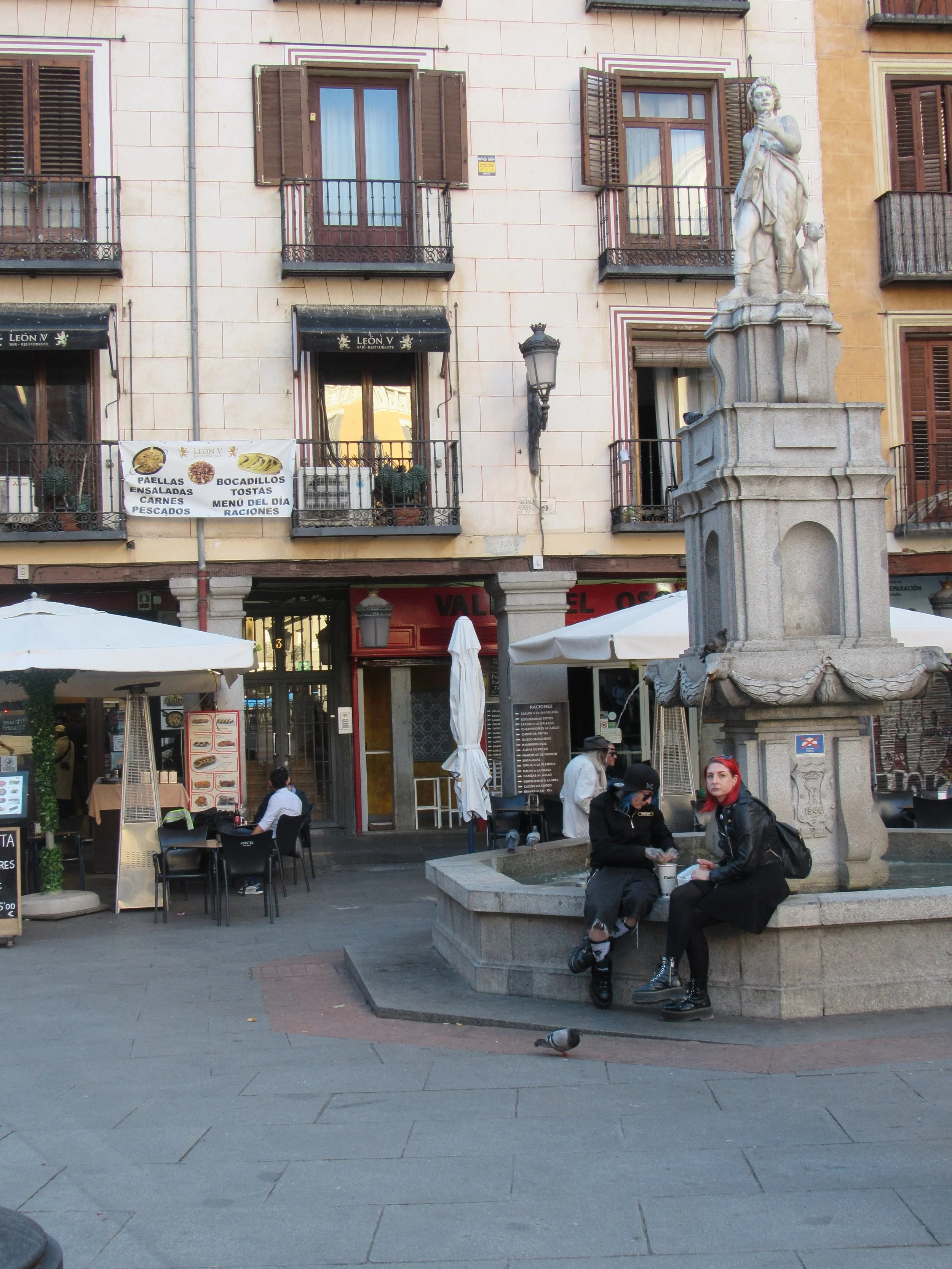
I do feel a bit bad because the suitcase guy’s load finished and he had to wait like 10-15 minutes for a dryer to open up. He got to drying, the towel guy was still folding his loads when my load finished drying. I had no desire to fold there so I shoved everything back into my bags. The plastic one decided this was the time to rip, luckily it was just along the top so I did what I could and walked back to the hotel. After folding my laundry I decided to explore a bit. I was close to Plaza Mayor, so I walked over there and spent a good hour just taking street / architecture photos. They also had a bunch of information on Semanta Santa but it was all in Spanish so I navigated to the website to get more info on when I could catch a procession.
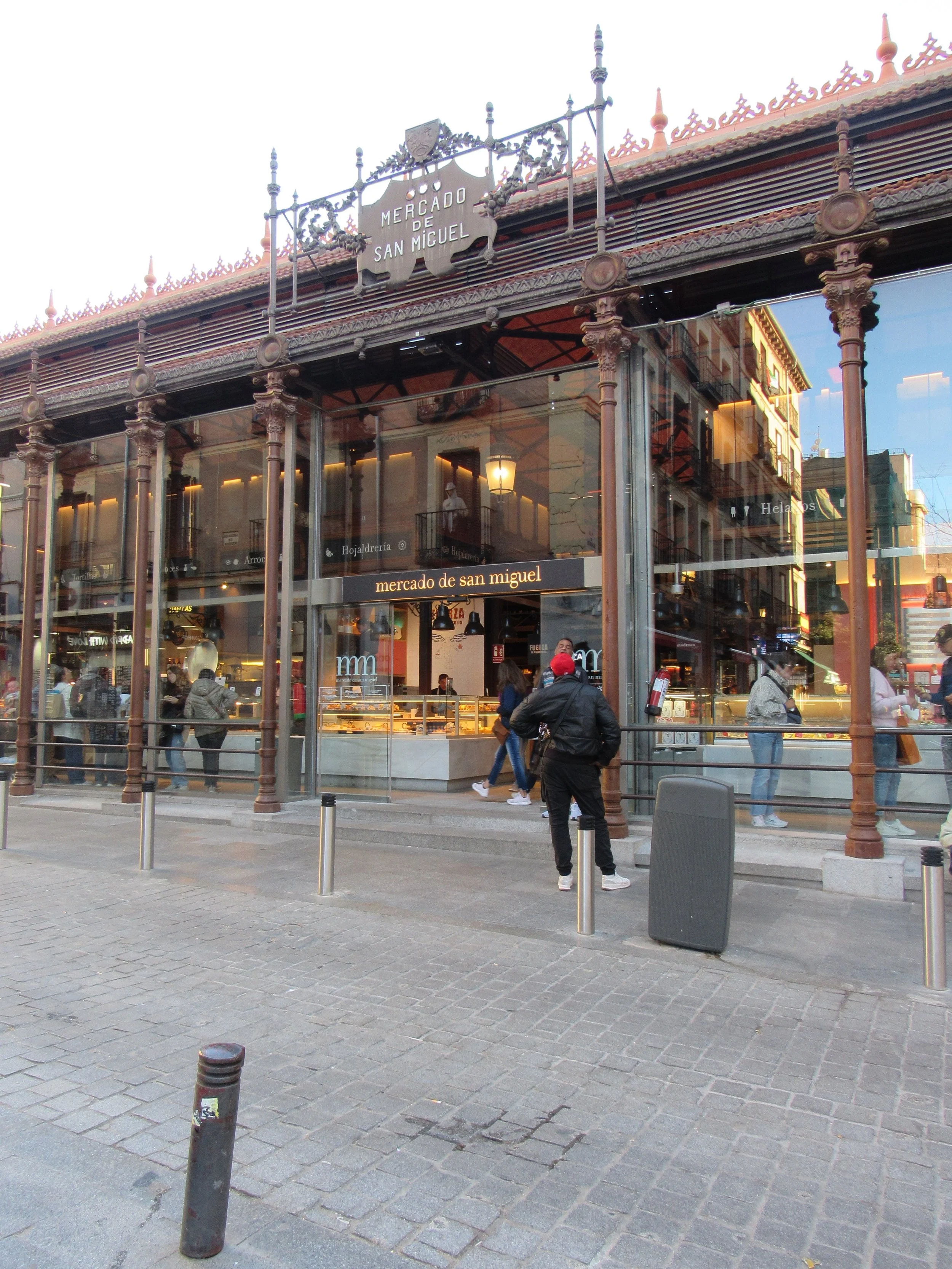
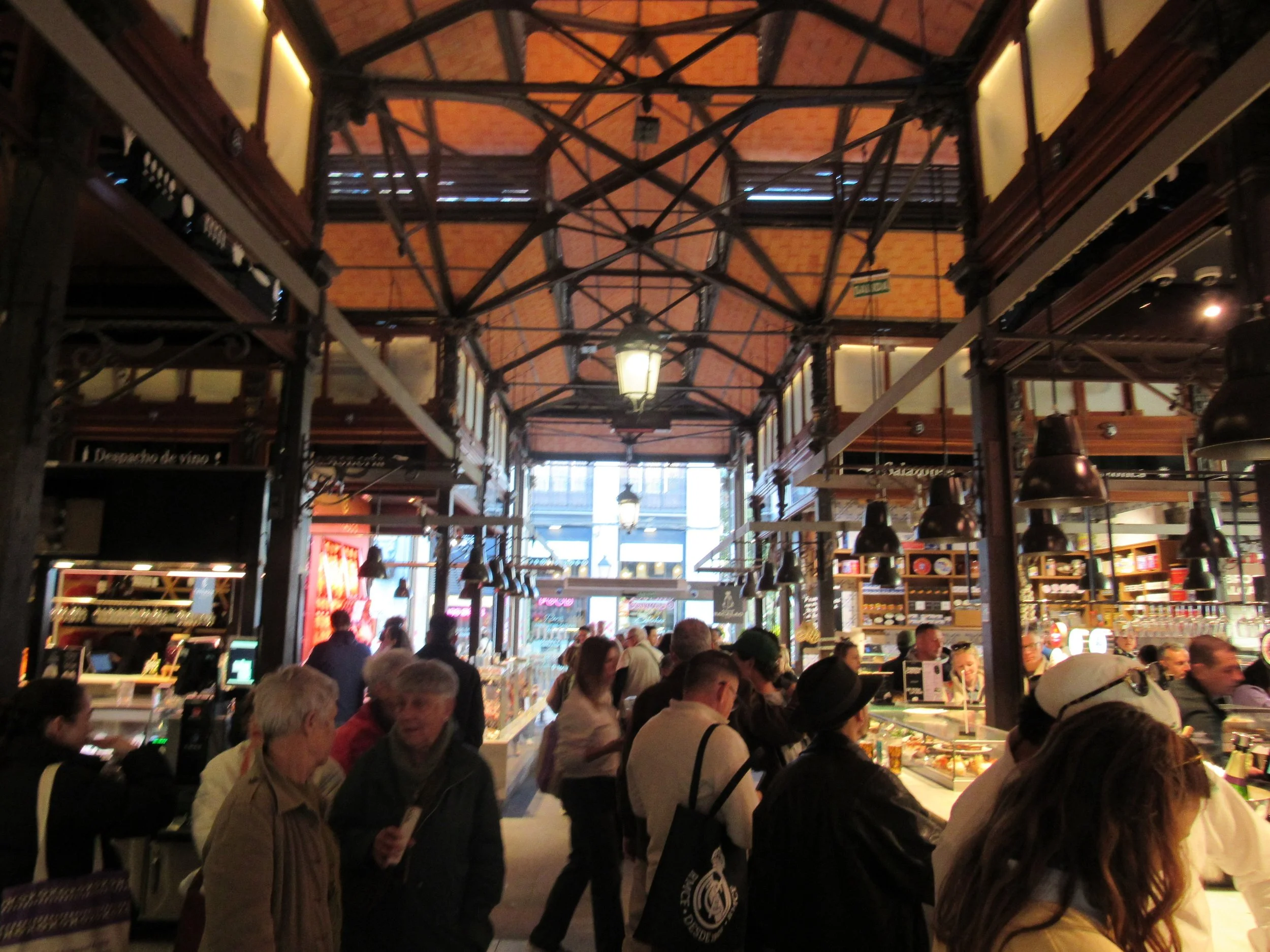
I was starting to get hungry so I went down the street (really next door) to the Mercado de San Miguel. It’s an open market with food options galore. Including Jamon (ham), seafood, empanadas, desserts, and more and plenty of drink options too. I decided on a little prosciutto baguette and a fruity mocktail. The place was packed, really no open space. People were shoulder to shoulder finding their own food, or a place to eat either in the seating in the middle or standing along its edges, where there is a small counter. I had my lunch and then took some photos while I was there.
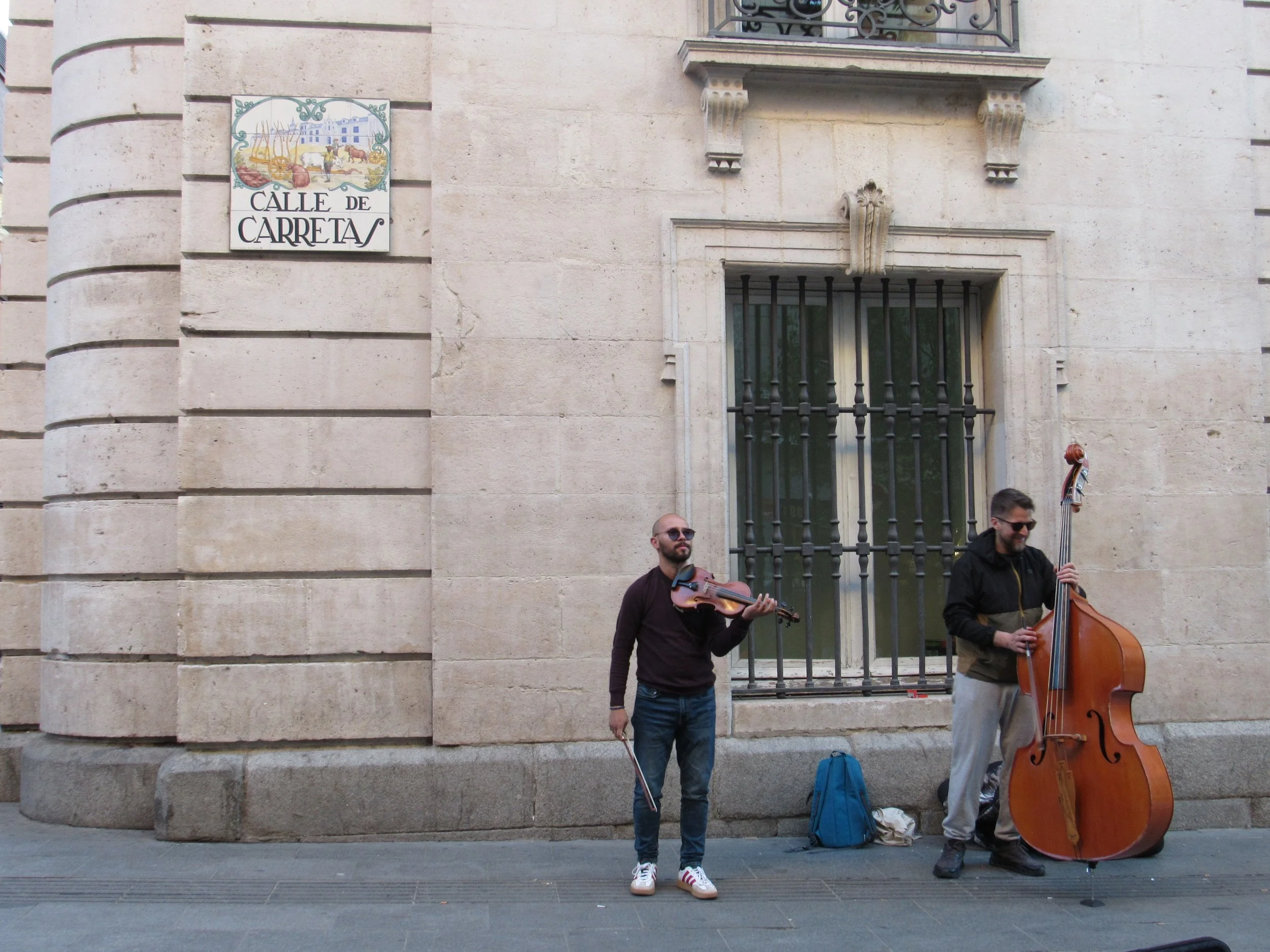
I then walked around the general area for the next few hours, checking out different churches, statues, plaza’s and architecture that were easily accessible. A few times I came across street musicians and used that time to rest my feet and watch. Eventually I did need something more substantial so I found a burger place near my hotel and got takeout. Even though there was a procession that night I was still tired from the travel and just watched some TV before crashing.
—
The next day the first thing I did was get coffee. Now I realize I was in Spain, but there was a Dunkin Donuts and since it is not something you find in Seattle I immediately went down the street for an Americano con leche. I took that back to my hotel, since they provide pastry each morning and planned my day.
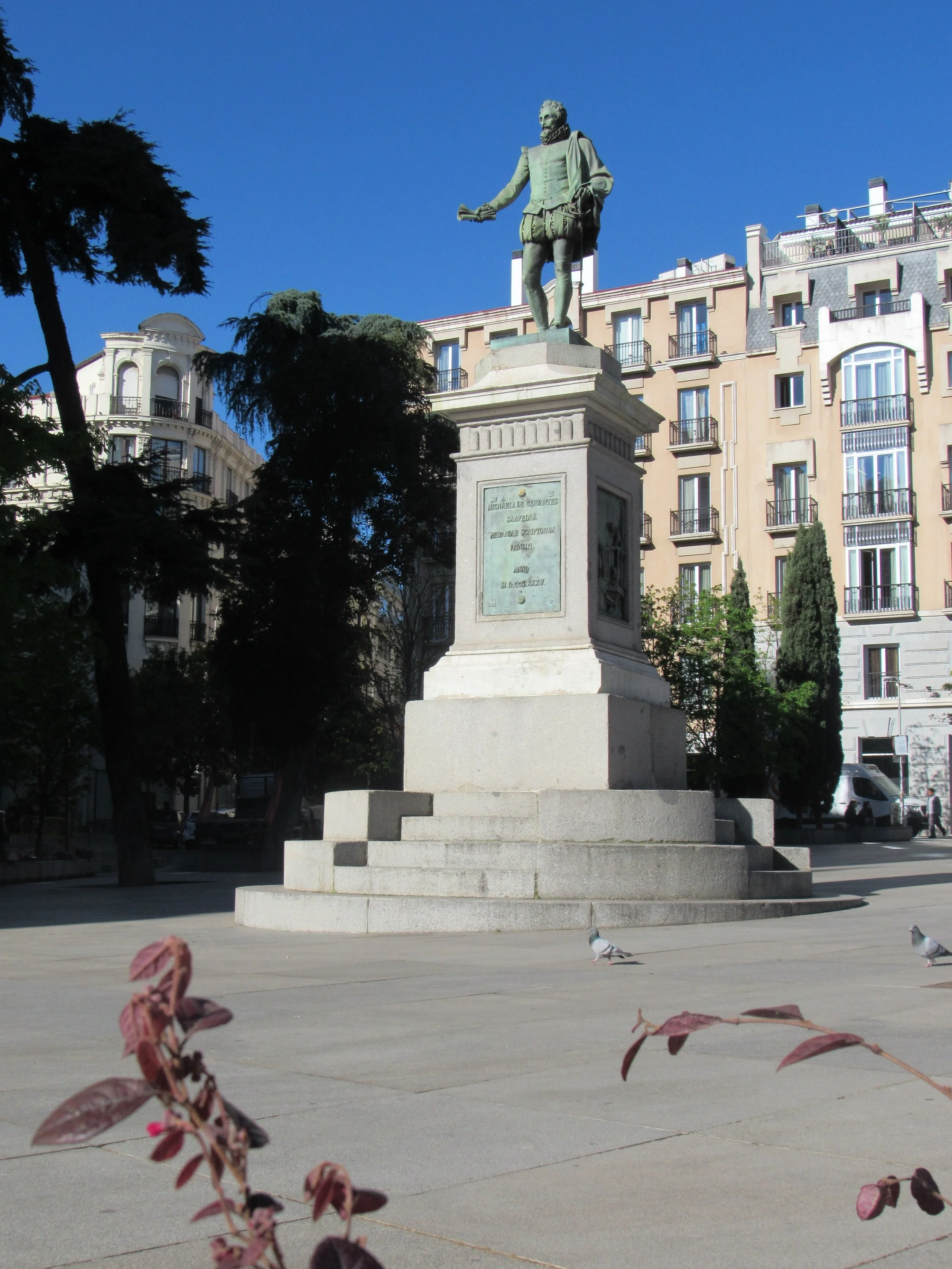
I had heard from the architects the week before, they were not going to be in Madrid because of the holiday week leading up to Easter Sunday. Since there was also not a procession to watch or any sort of day event, I decided to check out the Prado Museum. I LOVE museums. Fine art is one of those things that I wish I could afford to have in my own home. I walked 20 minutes and on my way found the park dedicated to Miguel de Cervantes Saavedra, the playwright and poet who wrote Don Quixote. I love the ballet, and the book so I finished my coffee under his statue before heading to the Prado entrance.
I arrived around 11am. If you don’t have pre-bought tickets you do have to wait in line. It was only about 35 minutes before I was up at the ticket counter and then walking up the steps to the entrance. There are no photos allowed inside, but I did sneak a selfie and some detailed photos of the architecture, like the handrails had braille at either end.
I walked through and looked at everything I could. I read every description and stood in front of some paintings I had only ever seen in art history class. Adoration of the Magi by Peter Paul Rubens, Sisyphus and Tityus by Titan, Clothed Maja and Naked Maja (side by side!)by Goya, and the reason I was really there was The Garden of Earthly Delights by Bosh. After lunch at their cafeteria, I headed to the Bosh room. Un surprisingly it was packed and it took at least 15 minutes of waiting for others to leave, and move out of the way so I could get to the front and see it un blocked.
I’ve seen a few famous pieces of art in my travels before; the Mona Lisa was disappointing, but this, this was anything but. I probably spent a good half hour just trying to take it all in. Triptics are one of those things, that they are usually religious and I enjoy them, but this was spectacular. No matter what portion you looked at, something interesting was happening. I’ve seen images before (so much Art History) but in person it was different. Something about the actual piece gives it texture and subtlety. There are parts that are photographed in detail but others get less press and seeing those up close and personal was a dream.
Eventually I did have to move on, so I scoped out the rest of the exhibits, including more Goya - the dark period was pretty great in my opinion, and a stop at the gift shop I headed out. By this time it was getting to be around 4:00. Not enough time to get to another museum, but plenty to check out the El Retiero Park. I would call it the Central Park of Madrid.
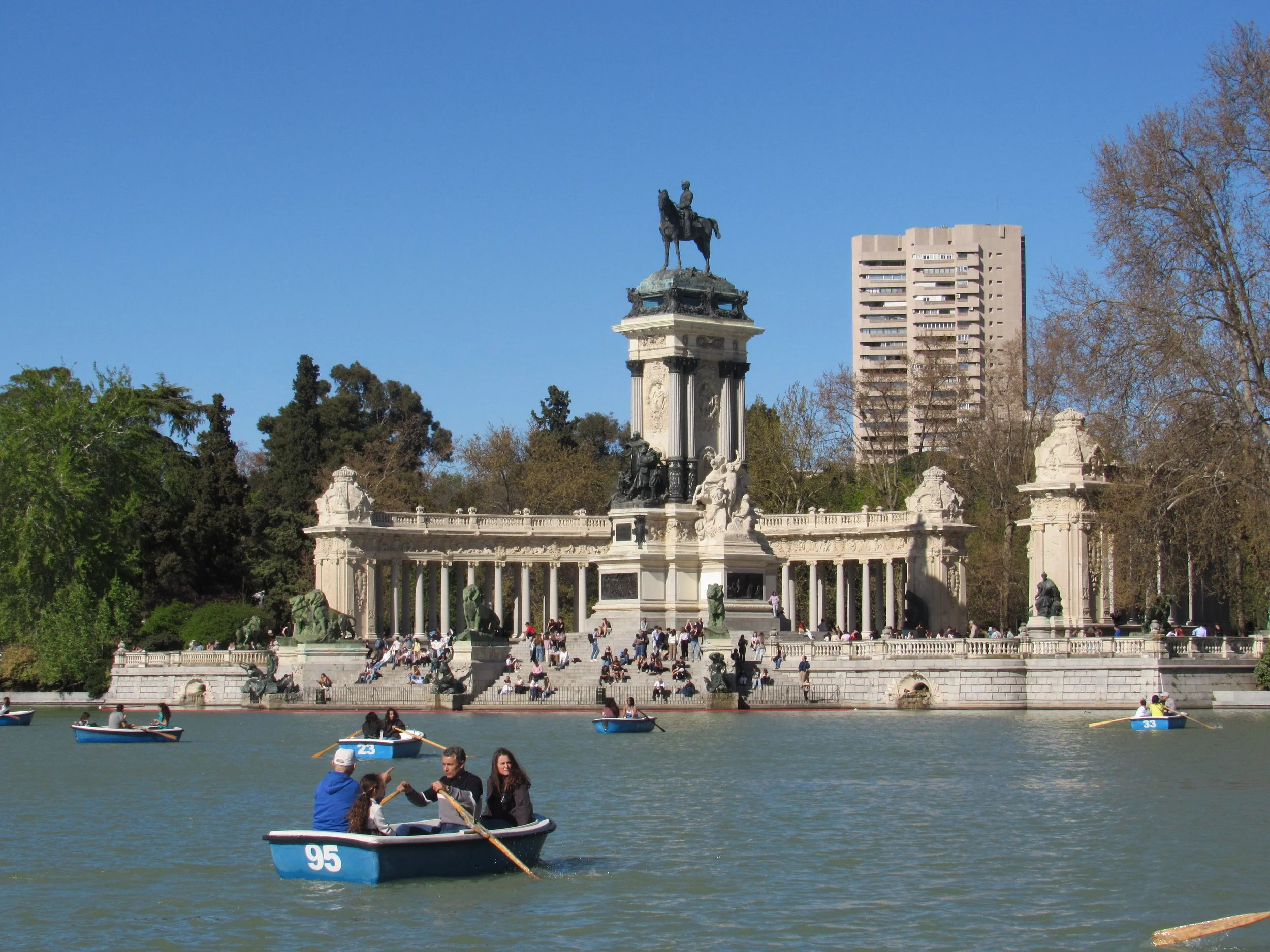
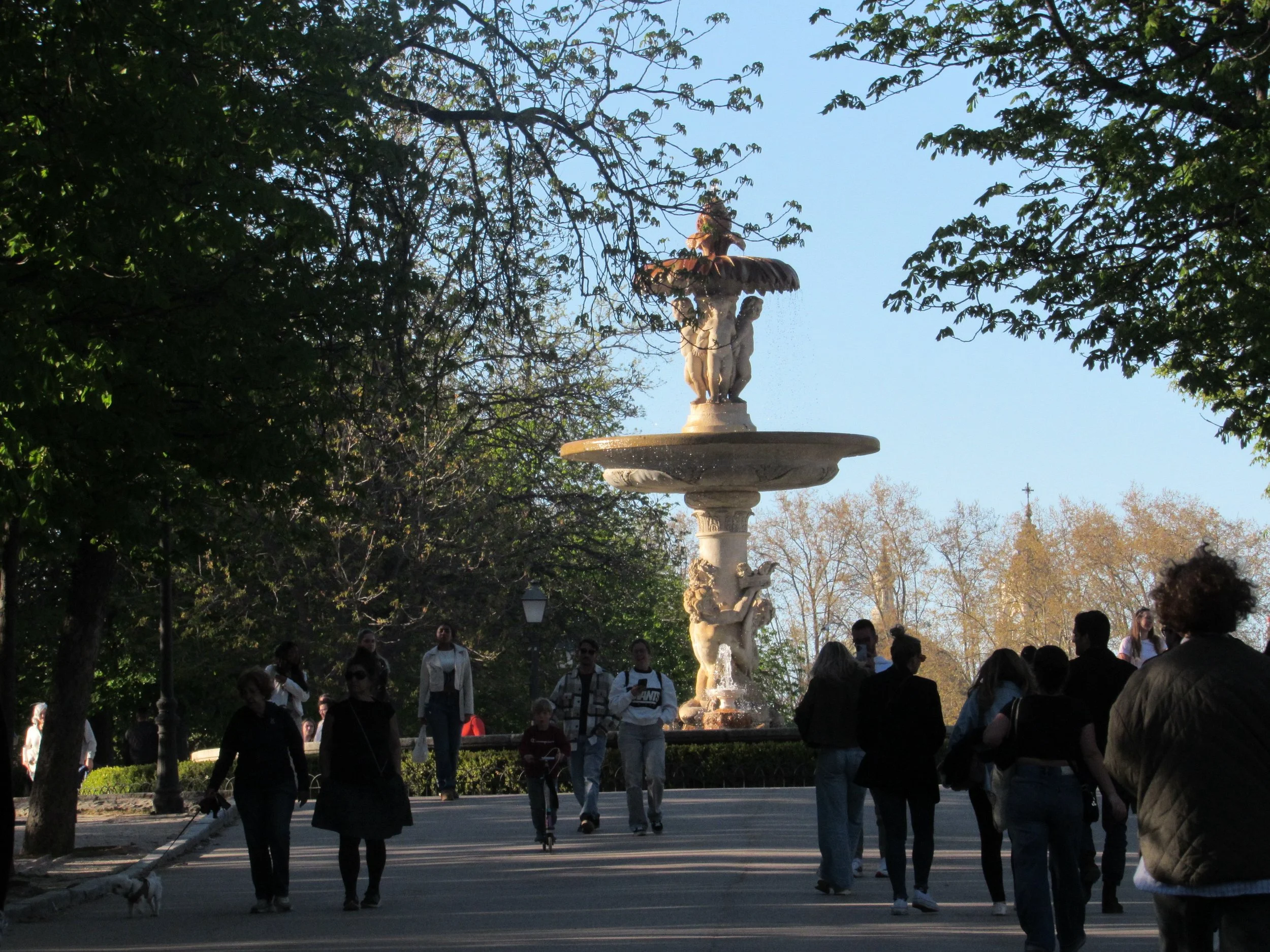
It was huge with lots of walkways, both small side paths and large grand promenades, big enough for rental carts and bikes to make their way through. There were grassy sections full of folks just sitting in the sun or playing badminton, or crafting, or just families gathering for picnics. I also saw kids kicking soccer balls around or making tik toks, some folks just reading or using the workout equipment. Birds chirping and flying in the trees, ducks, swans, and turtles in the ponds.
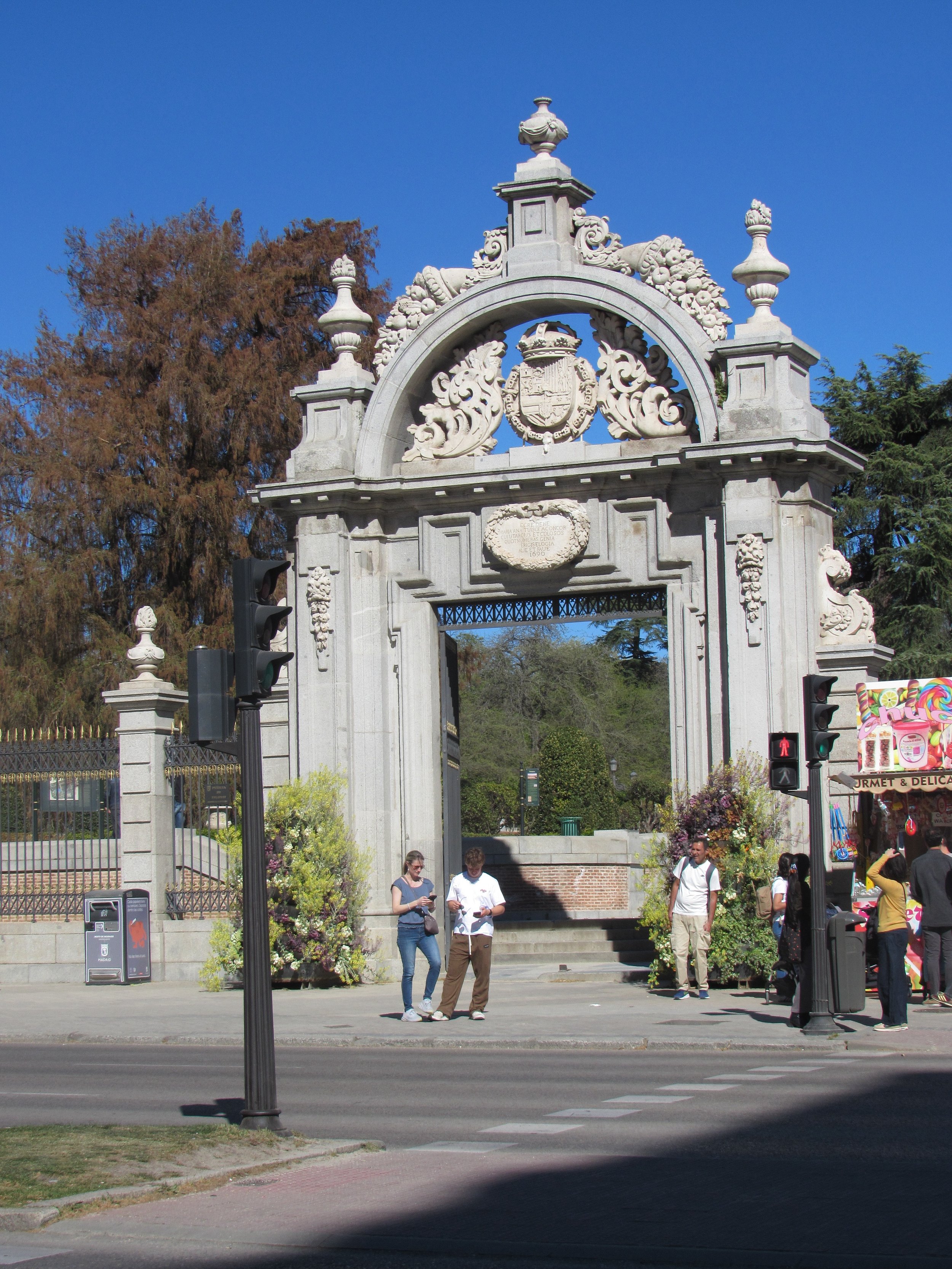
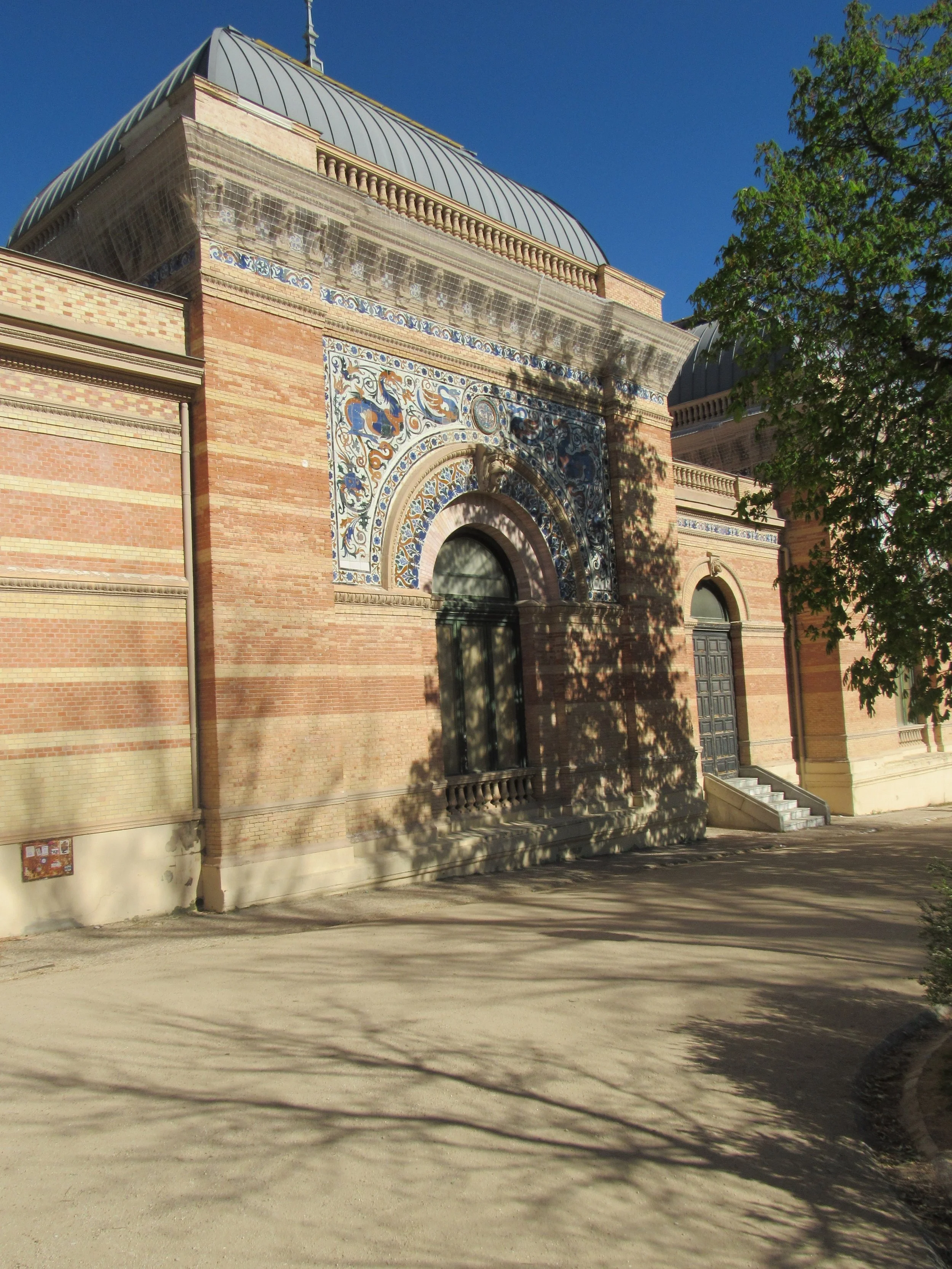
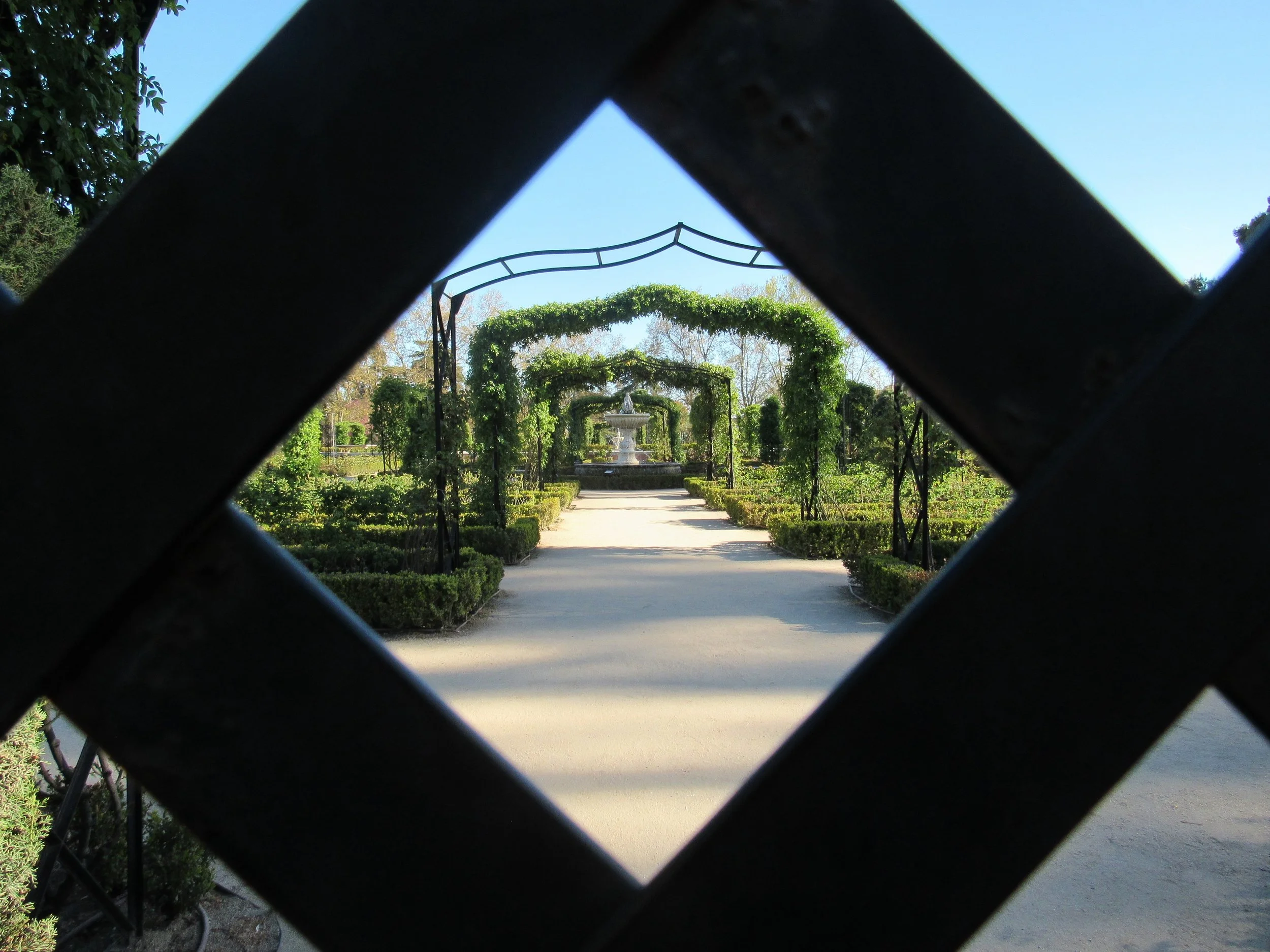
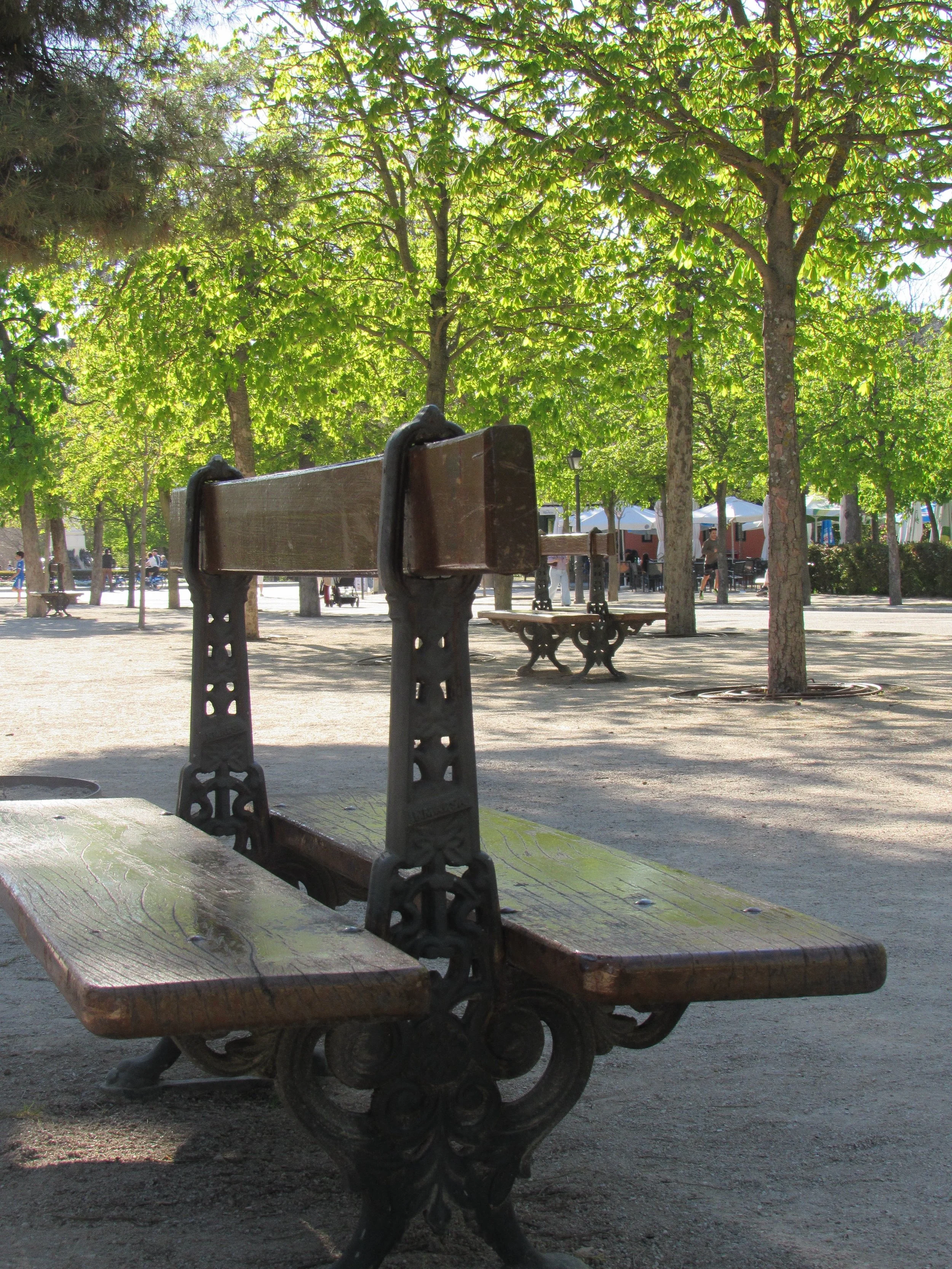
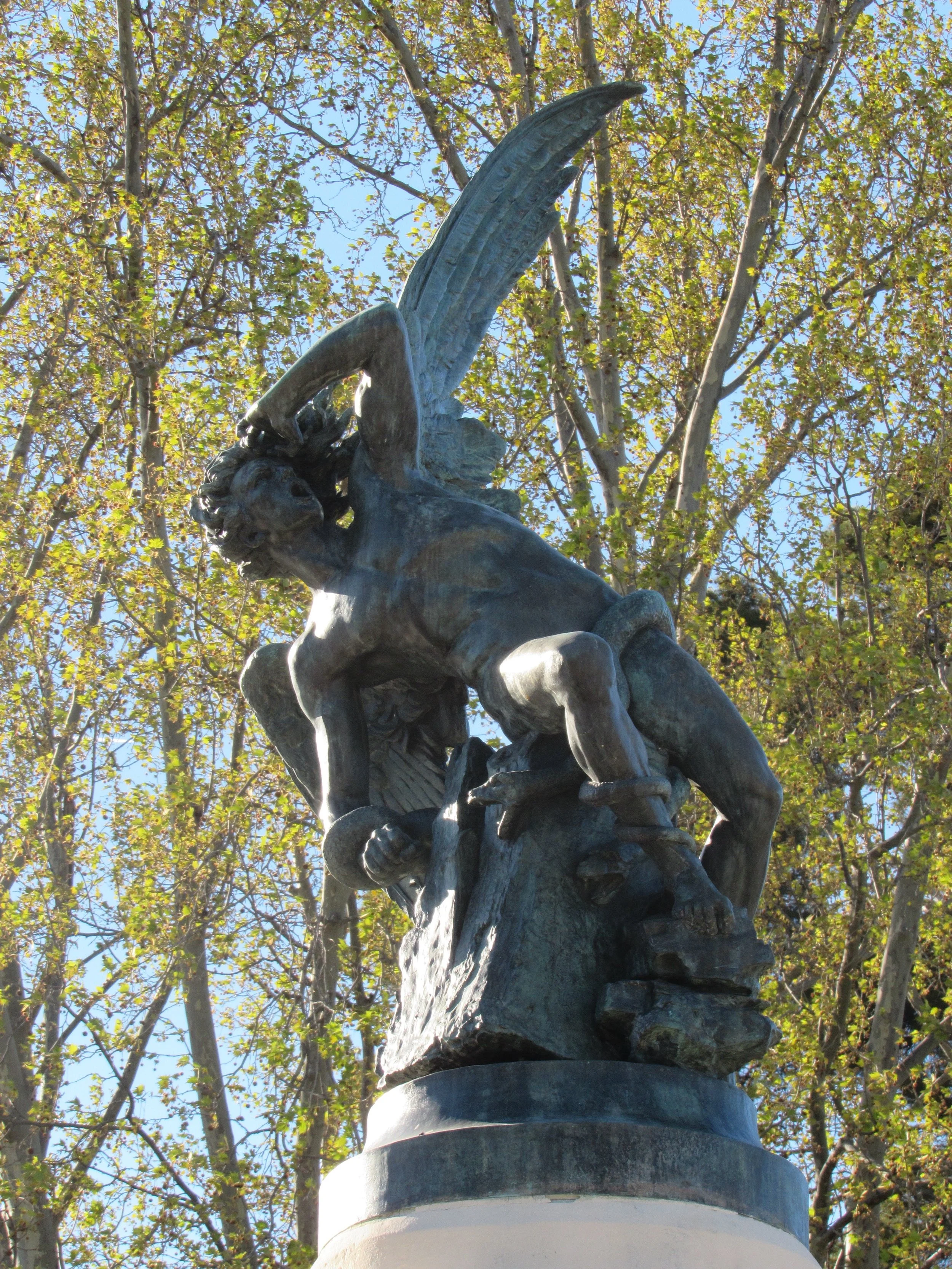
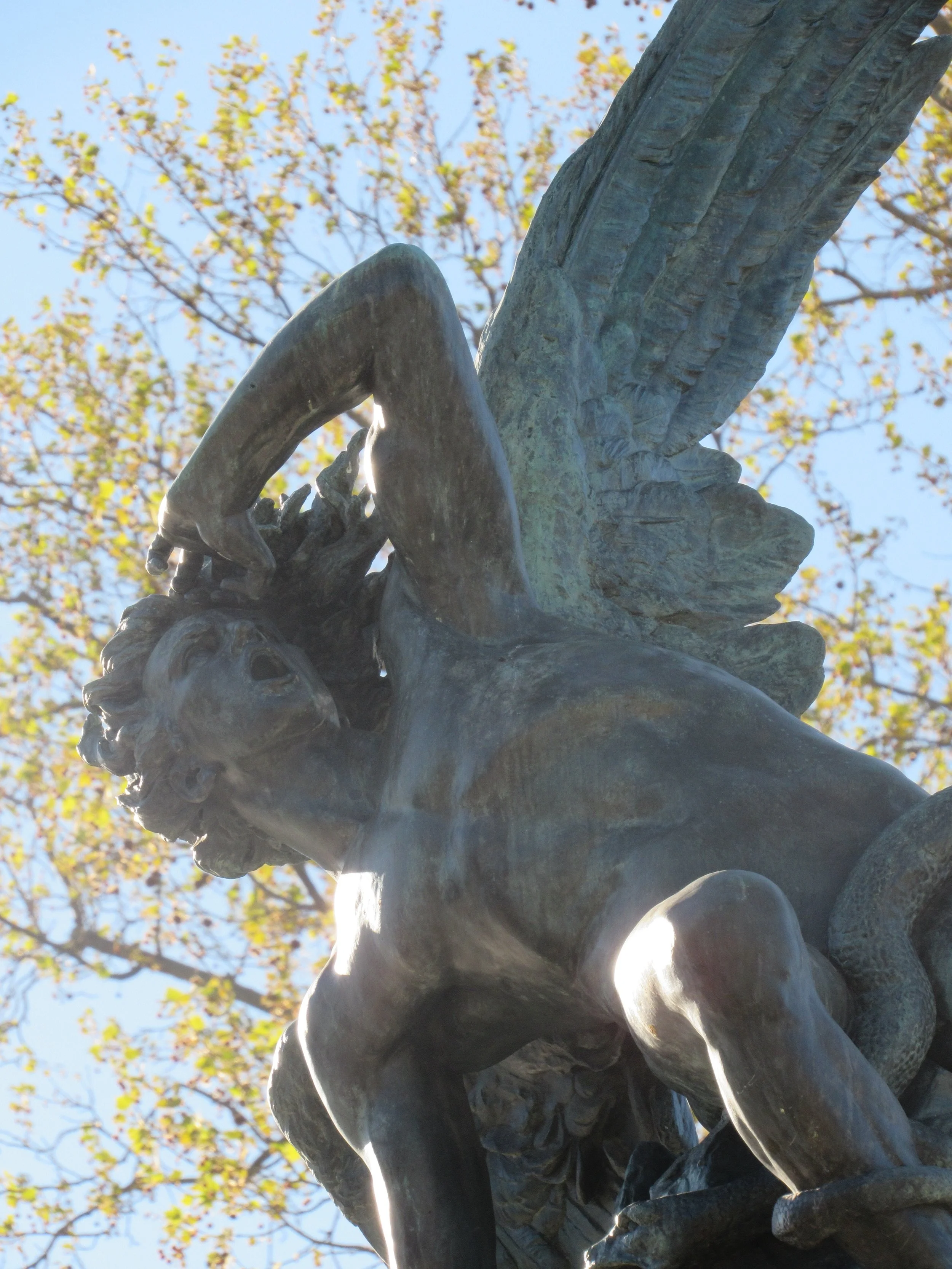
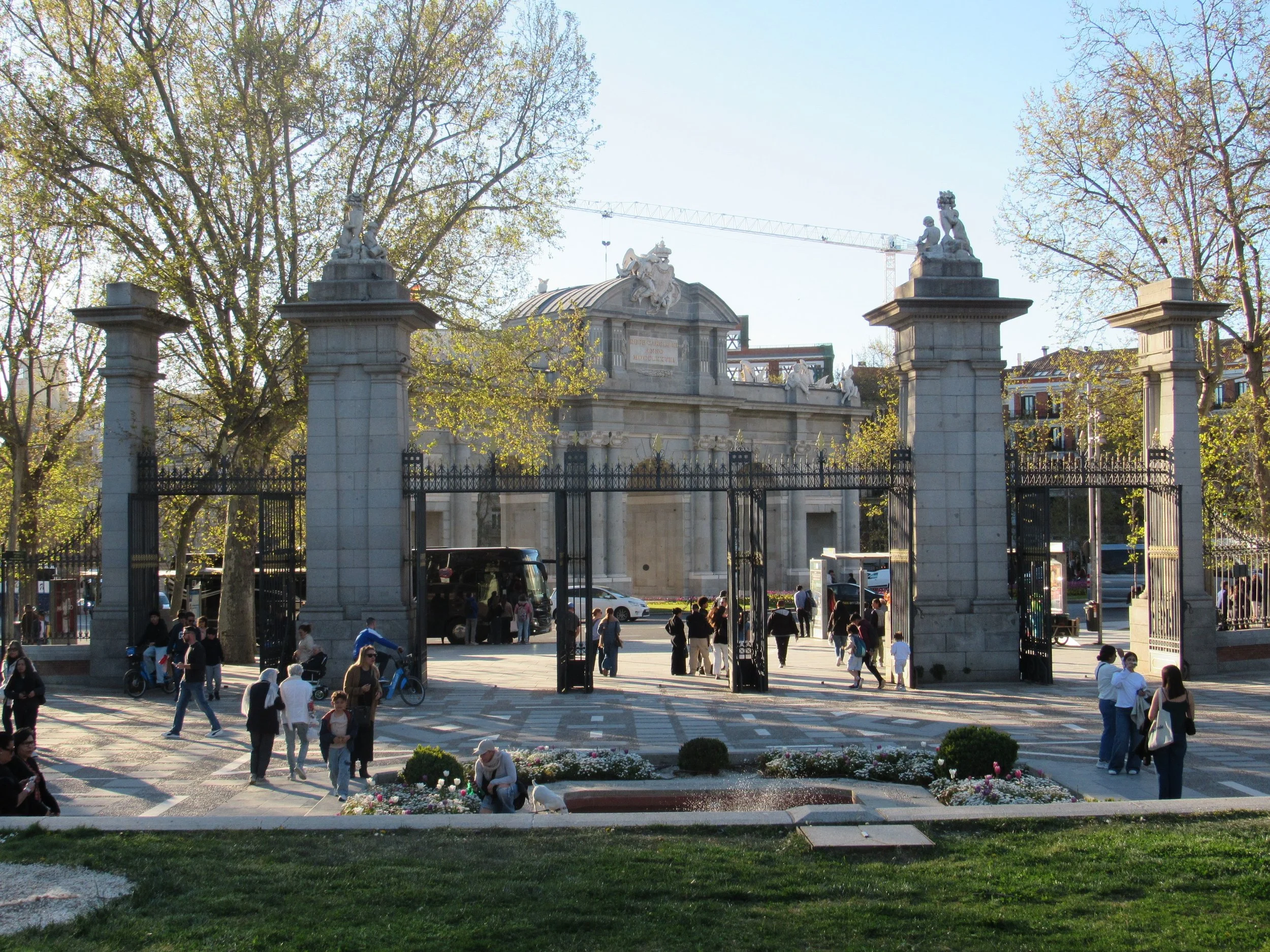
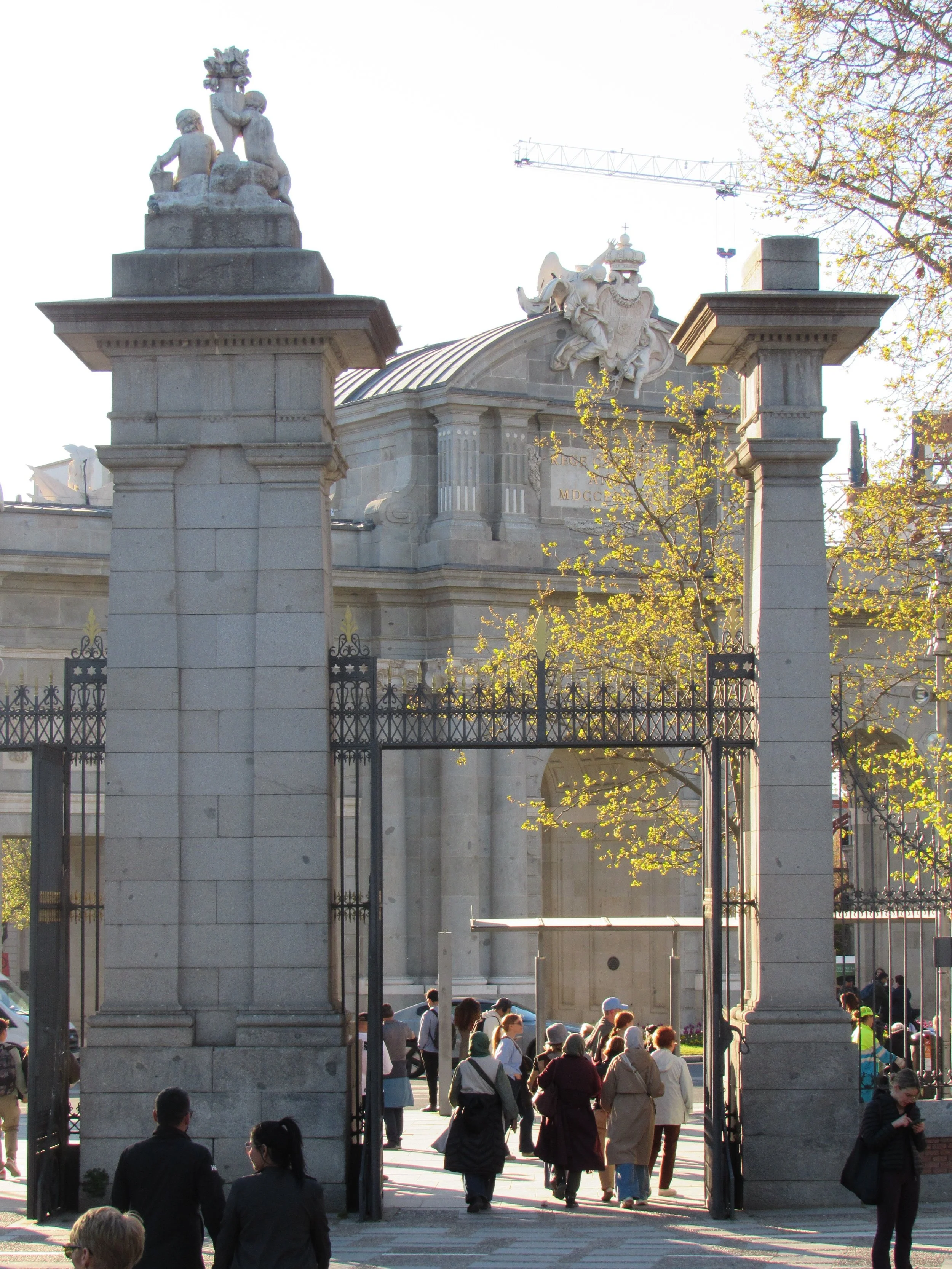
I entered at the center of the park,at the Puerta de Felipe the 4th (IX) behind the Prado so I worked my way left to the big pond filled with folks in rental boats rowing their way around under the monument of Alfonso the 12th (XII)Then looped left to the (temporarily closed) Crystal Palace. I peeked in the Rose Garden, which was also not open. I people watched from the many benches scattered on every walkway. Took photos of the Fountain of the Fallen Angel.
As the day rounded on about 6:00 I realized I was getting hungry. Now this would be early for someone from Spain to eat, but I knew if I went back to my hotel I would just end up with takeout again. So I found a spot near the Mariano De Cavia Gate and did some internet searches. Every guide for Spain will tell you to get Tapas. So that is where I started searching. Per some solo travellers blog I found a spot well recommended. I made a reservation for 7:30. I sat for a bit longer and then made my way over.
It was well designed, lots for patterned tile, industrial vibe with the lights and bronze metal accents. Mismatched furniture and greenery everywhere. I picked a table and looked at the menu. I ordered a fruity rum drink - that came out on fire. The waiter (who called me baby face the whole time) warned me not to burn myself). For dinner I picked out some pork escalopes with a smoked mozzarella sauce and a roasted head of a cauliflower. Now this was Tapas in the sense that each dish came with enough to share not small portions, which was not the vibe given in the blog but so it goes. When I went to order the waiter warned me they were big portions, but also I was here and needed to eat something.
I started with just the pork, but halfway through I was out of the mozzarella sauce, still hungry and wanted not just a deep fried piece of meat - plus I needed a vegetable at some point. So I ordered the cauliflower. One big roasted head, that I did pretty much eat most of. There were leftovers of both and the waiter did convince me to wrap them up and take them back for leftovers. I did not really want them, but he insisted, although I did dump them in the first trash I saw. Back at the hotel I dipped into some of the candy and chocolate I had bought in the airports before this and then crashed.
—
This would be my last full day in Madrid, and a chance to check out a Semanta Santa procession later in the evening. After my Dunkies and pastry from the hotel, I started my day with two smaller museums. First was the Museo Del Romantico. This was a museum in what was clearly once a home. It did have a bit of a confusing layout with dead ends that meant you had to backtrack. I got stuck finding the second half of the museum because there was a do not enter sign where you had to walk through, since other parts of the museum were closed off.
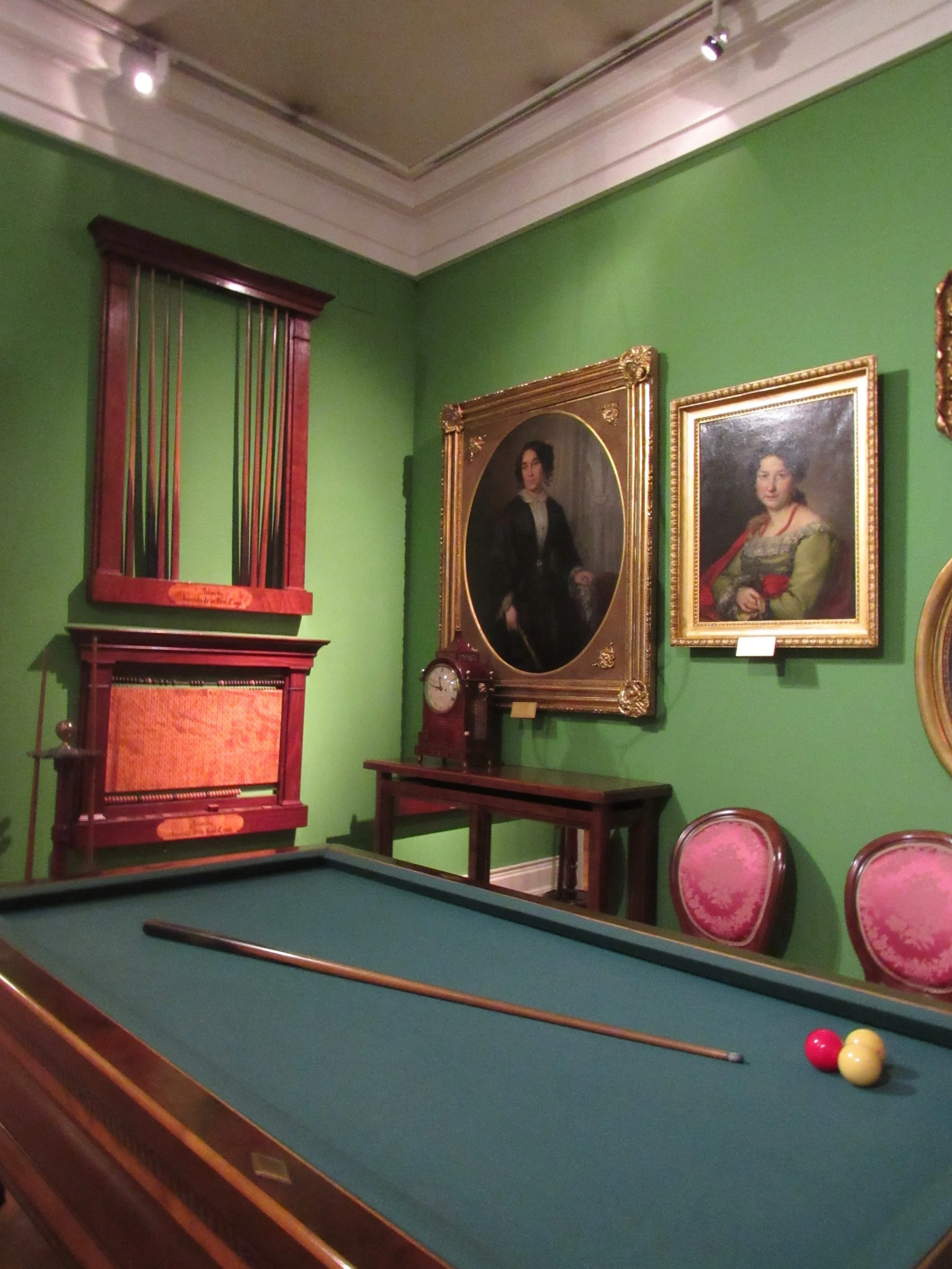
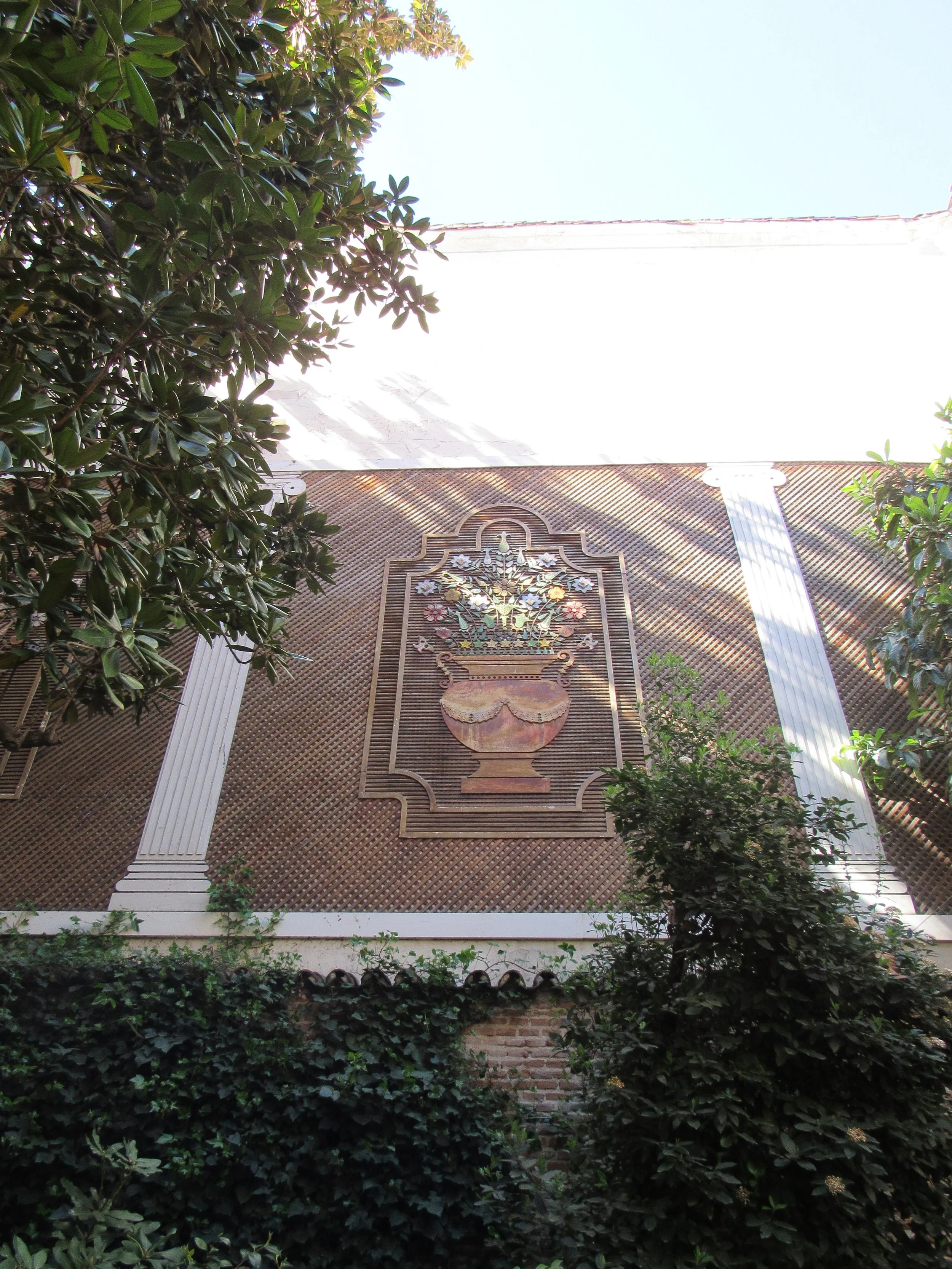
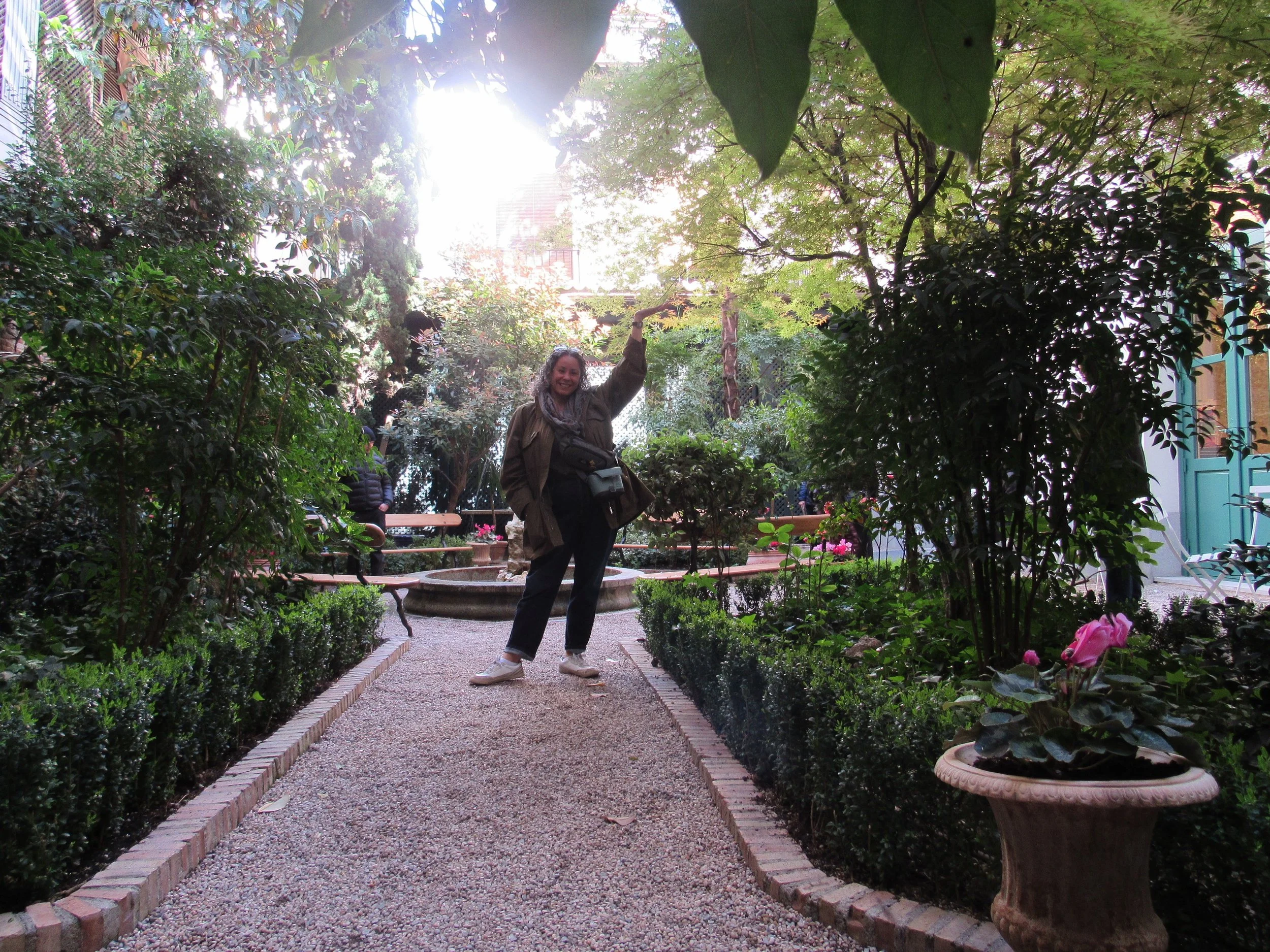
In the end I figured it out and enjoyed myself. The chandeliers, furniture and details of the home finishes were immaculate. There was a fashion exhibit throughout, with traditional gowns, to modern dresses. There was even a lush garden in the back with a fountain and benches.
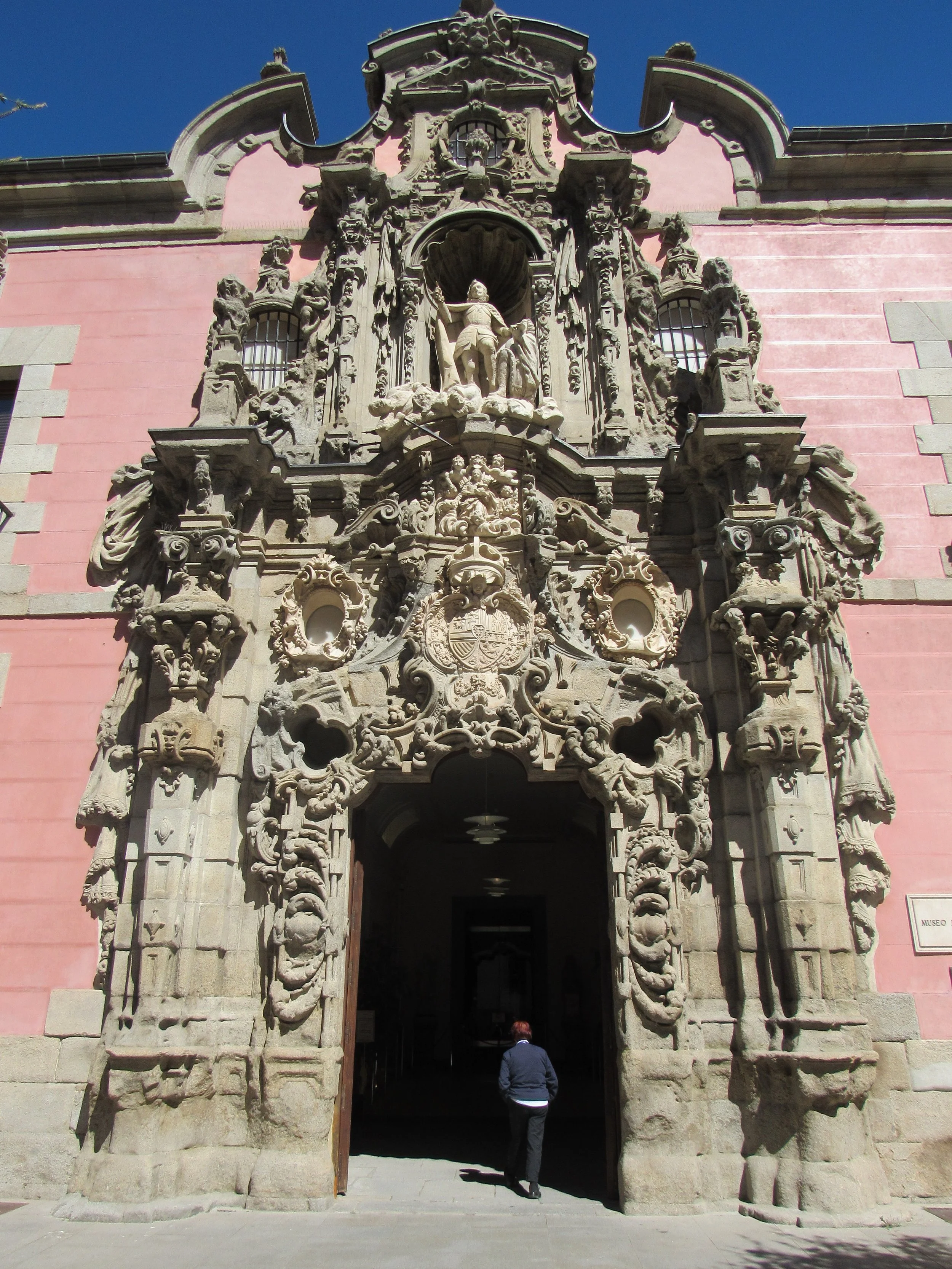
From there I went to the museum of Madrid History. The exterior of this building was a bright pink brick, with quoin (coin) at the windows. Surrounding the triple height entry is a spectacular piece of carved stone. Columns flank the opening and above is a crest, some small busts and a large niche flanked in more columns, with a full figure out front. All of this is covered in intricate arabesque designs, floral motifs, animal heads, and more. I probably stood with my mouth open for a whole minute.
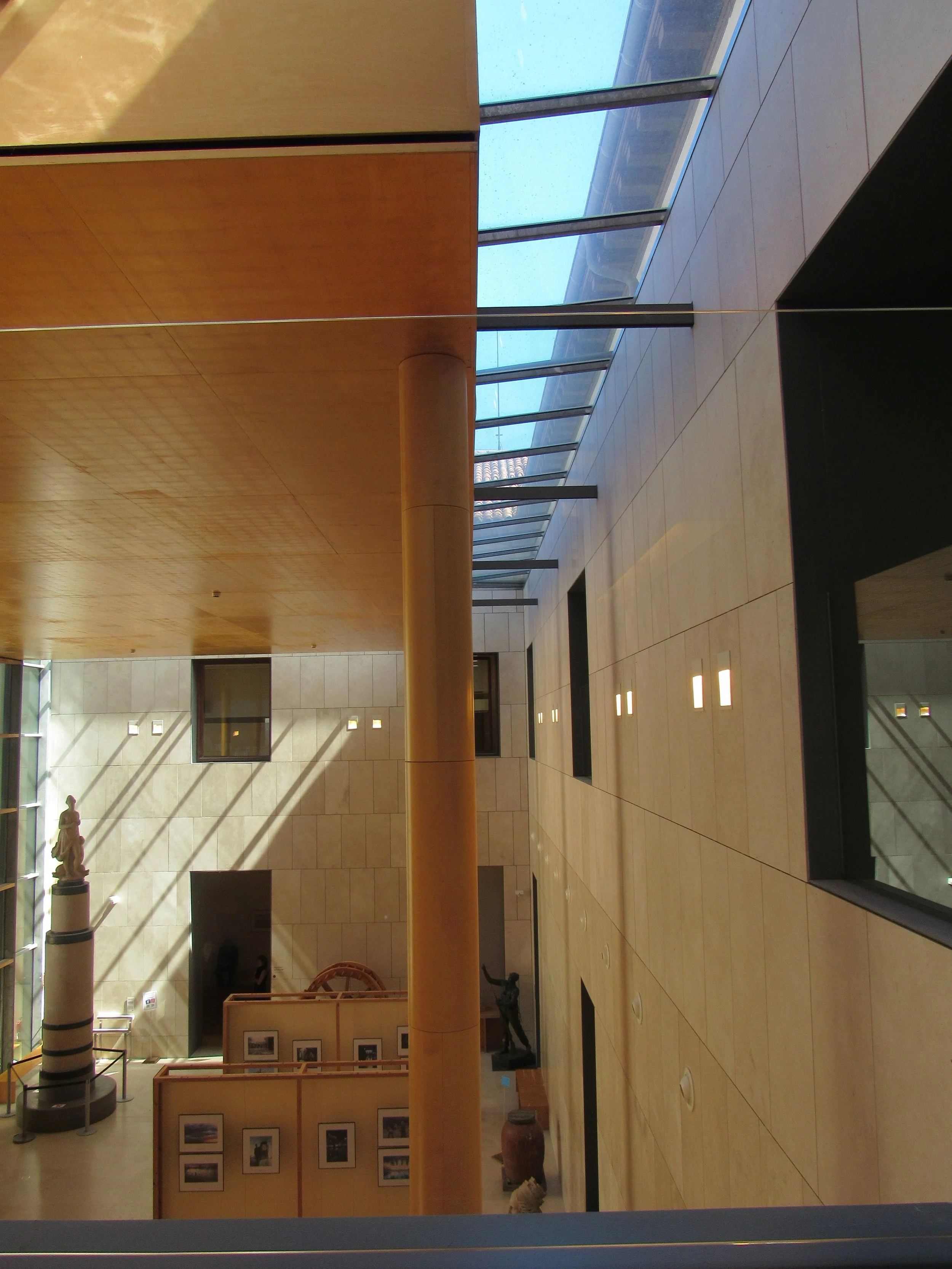
Upon entering, the main, ground floor, double height space feels incredibly modern compared to its exterior. The main materials are a glossy rectangular stone, a light tan, stacked vertically offset floor to ceiling. Window and door openings punched throughout. The floor is a lighter stone and laid 90 degrees from the walls. An orange/yellow wood column, and plank ceiling brings some warmth to the space. Natural light streams through the long skinny skylights around the perimeter.
Using google translate I walked myself through the history of Madrid timeline in the main space, which also had a modern artwork display. From there I started my walk through of the rest of the museum. Fortunately the rest of the information was both in English as well as Spanish.
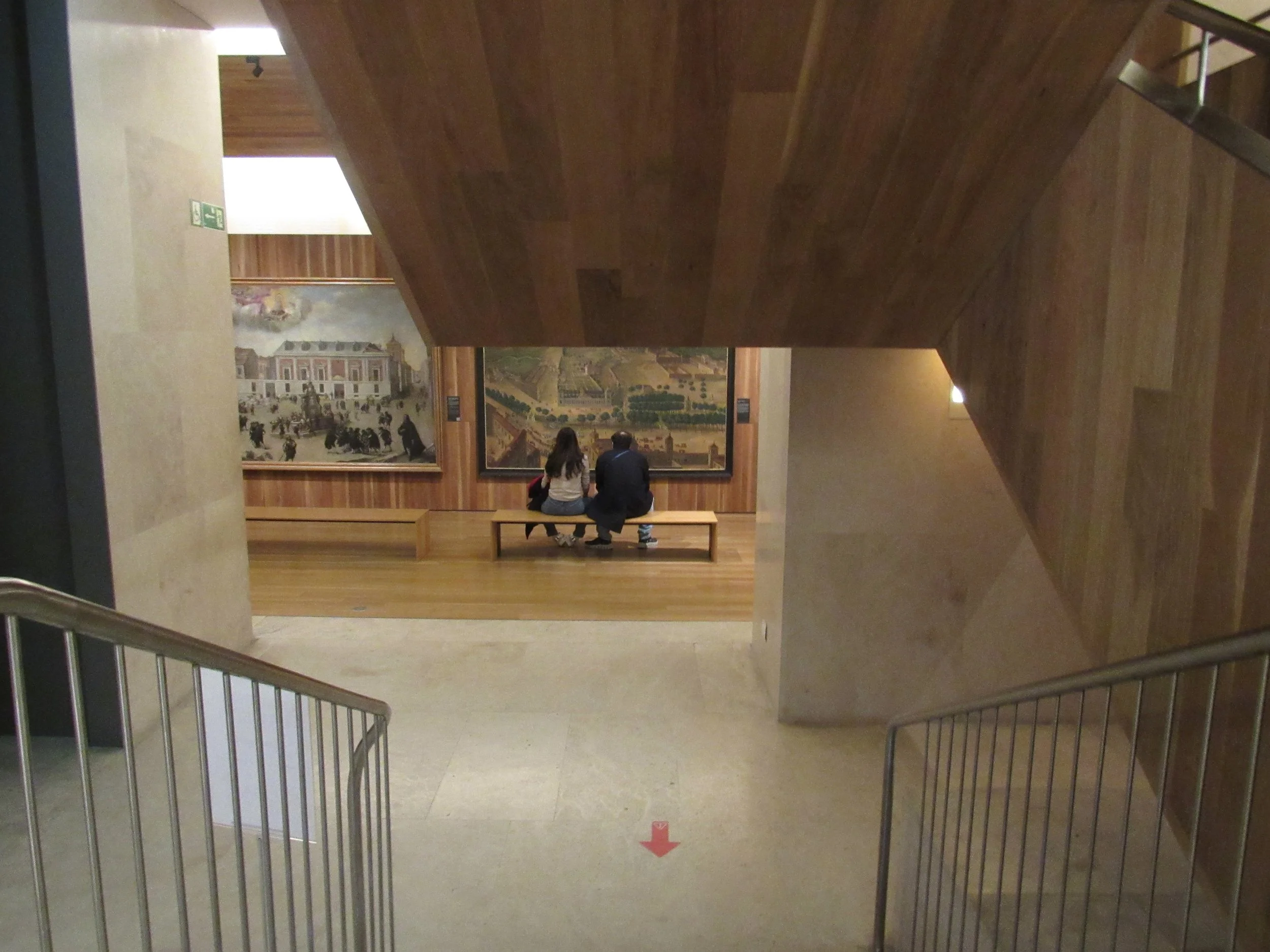
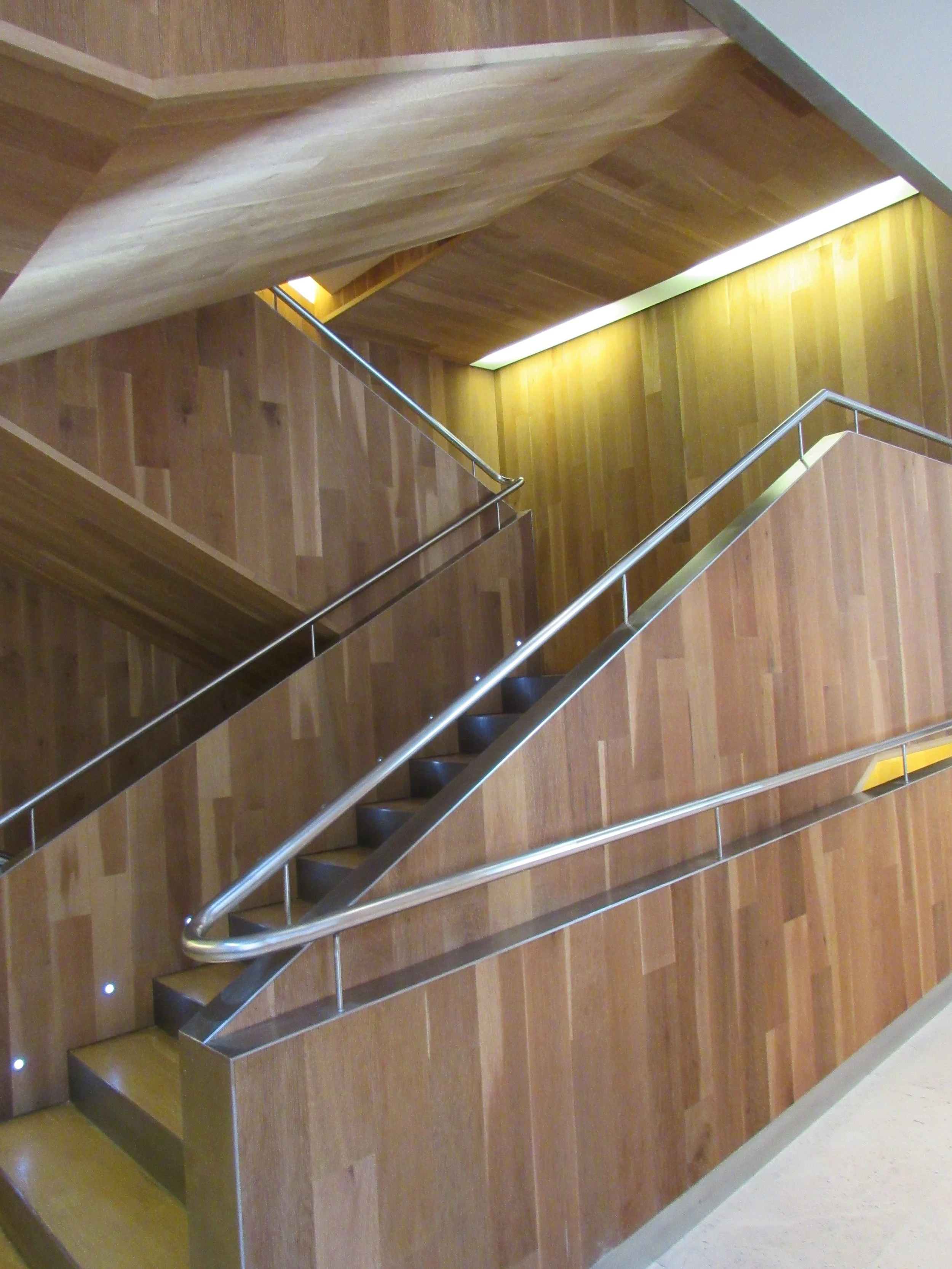
Moving through the museum the spaces became more human scaled. The white gypsum walls are broken up by vertical brown wood planks as accent walls and ceilings throughout. Giving a warmth and rhythm to the spaces. There are 4 floors, I believe, of art and artifacts in this museum accessed by an elevator or the central stair, wrapped in more wood planks in a vertical application, chrome accents, and handrails, lit by light alcoves above and dots of lights along the stairs.
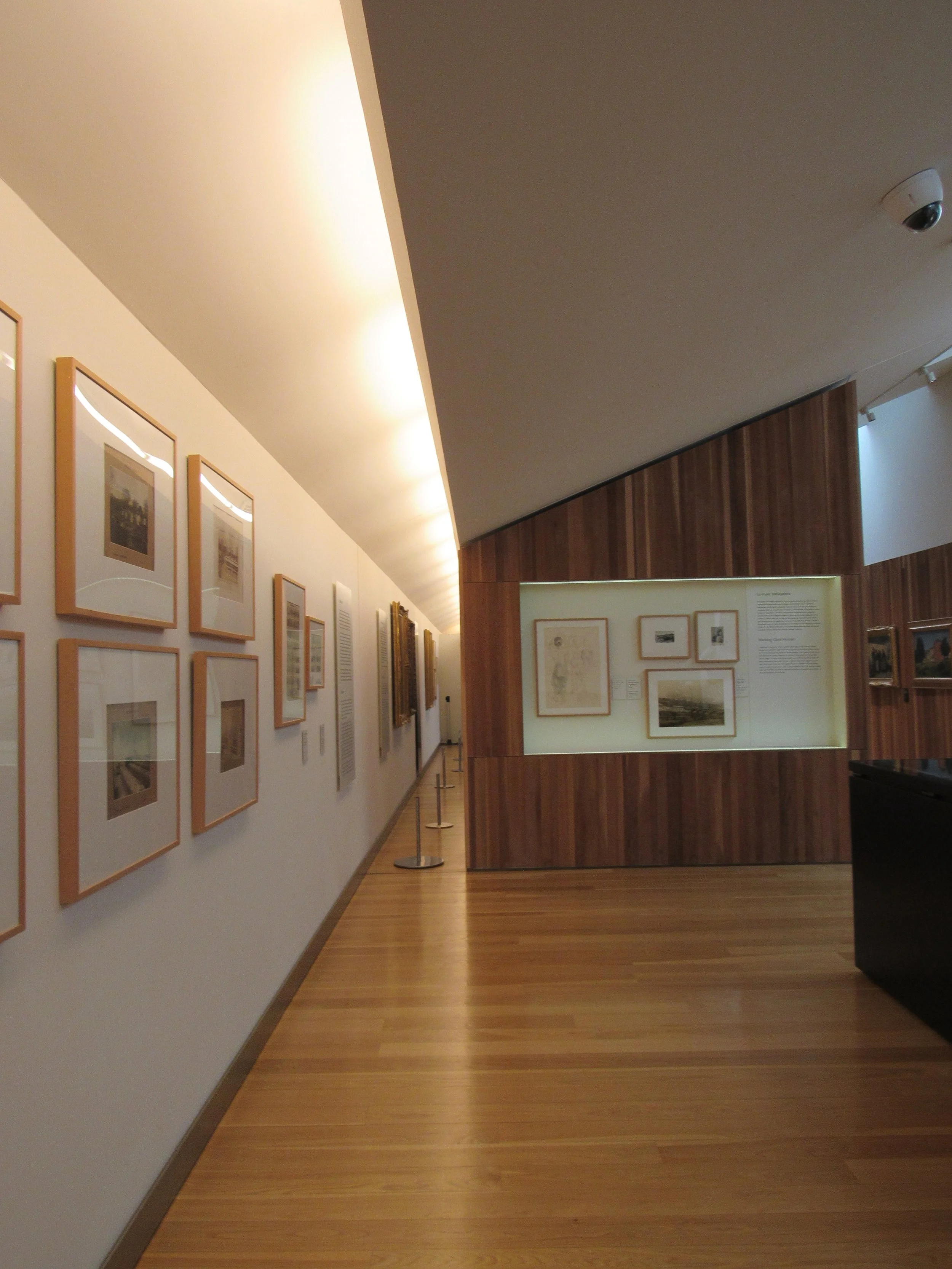
From paintings, to photographs, flamenco costumes, and bullfight posters, political cartoons and cases full of silver, porcelain and other items used by the people of Spain for dining, fun, and grooming. I spent a long time here. So much history, and info about Spanish culture. The modern architecture enhances art and artifacts its showcasing.
After grabbing some things from the giftshop on the ground floor on my way out, I went back to Mercado de San Miguel for an empanada and fruity aperol. I also grabbed some fruit which did not disappoint considering my fresh fruit the weeks before. I took a siesta and uploaded some photos, and then headed back out for the procession.
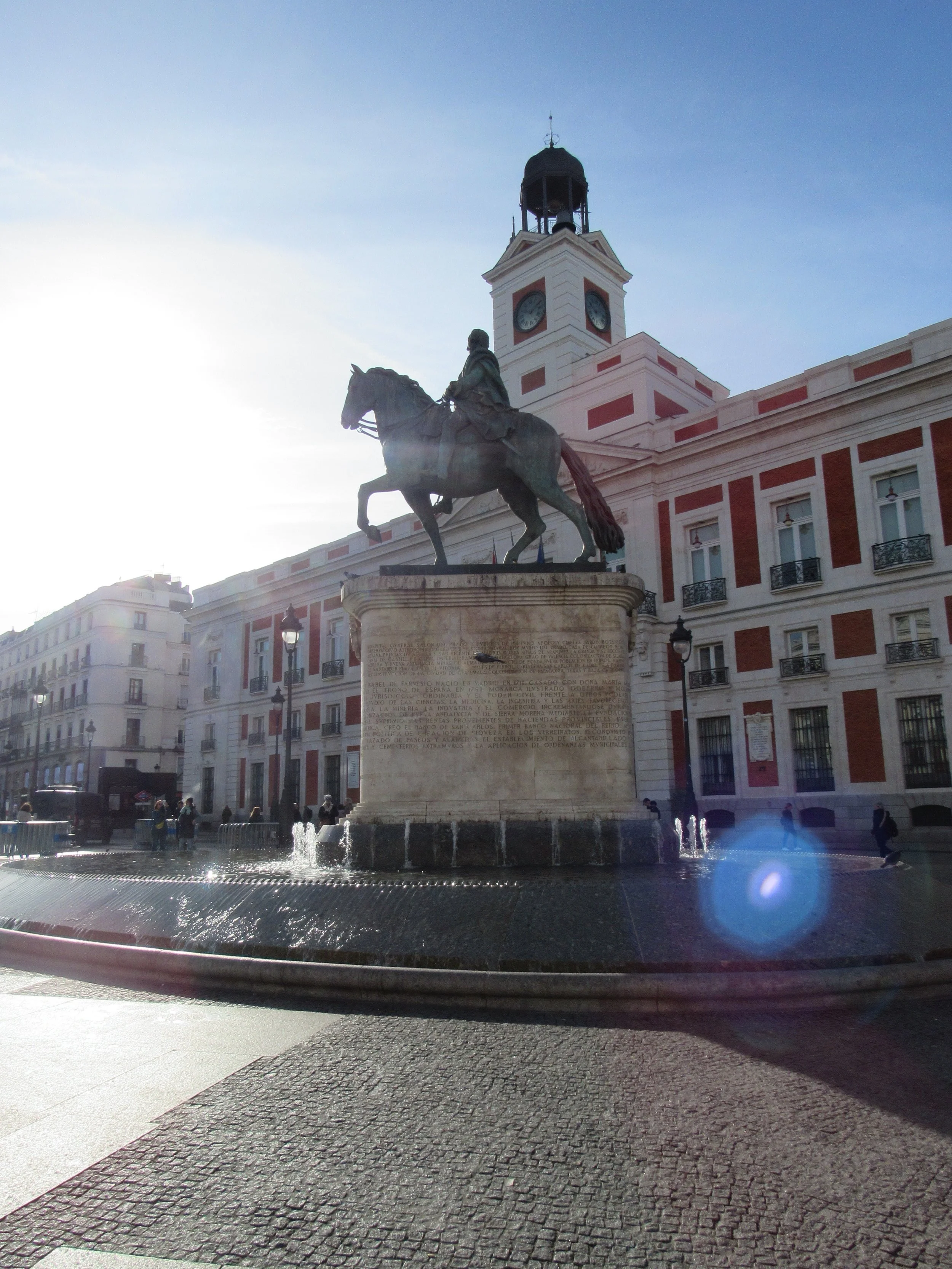
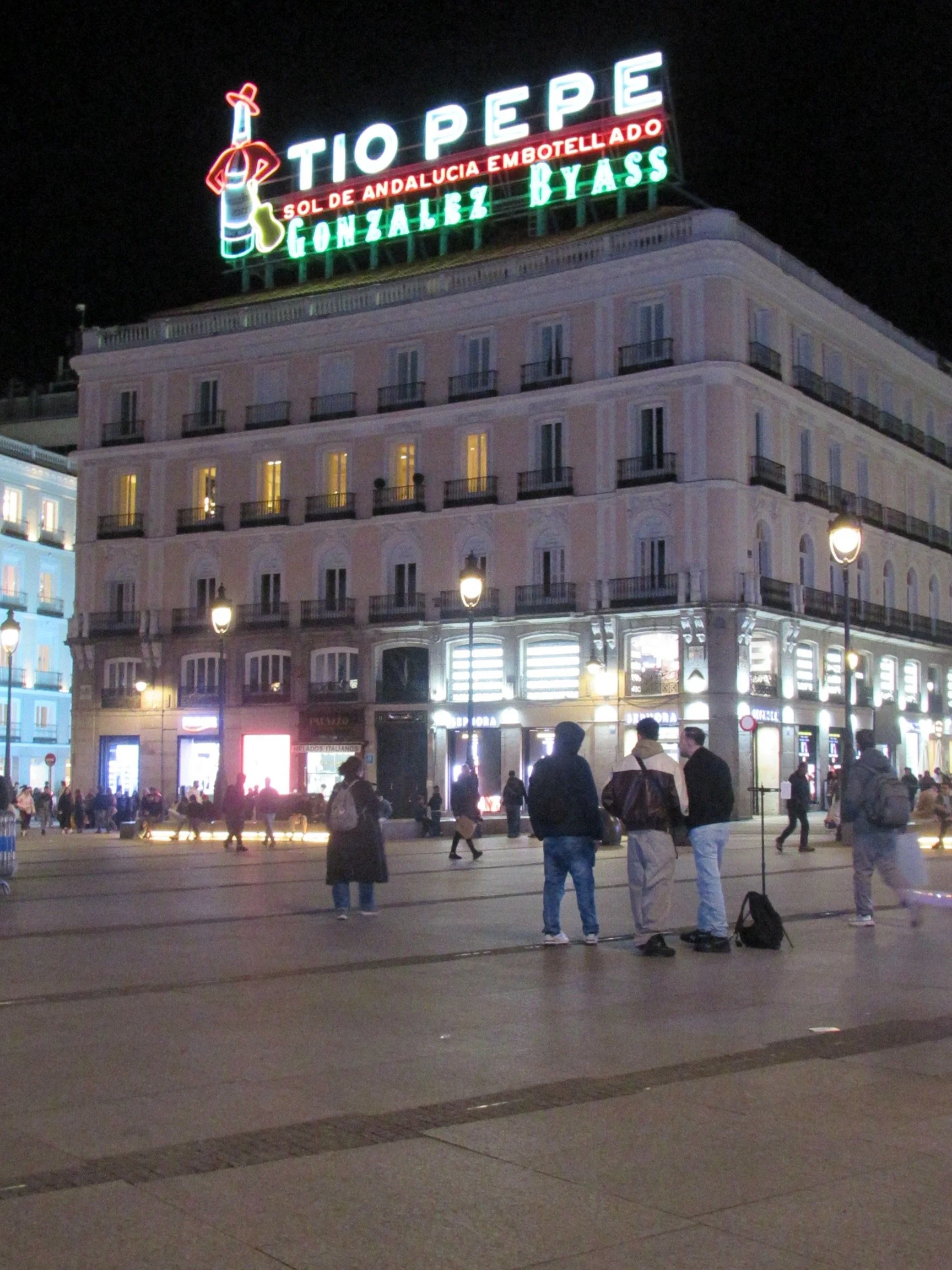
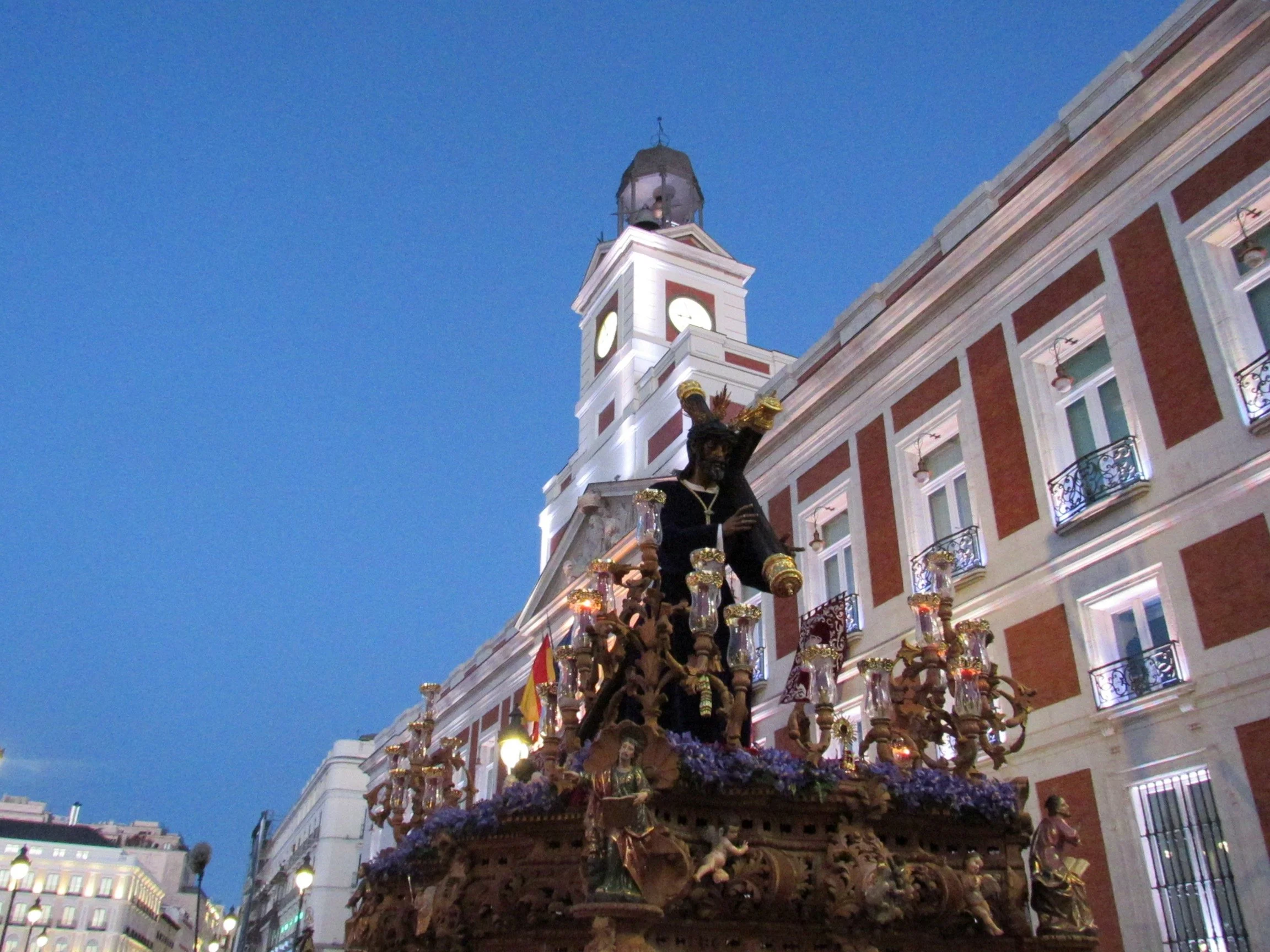
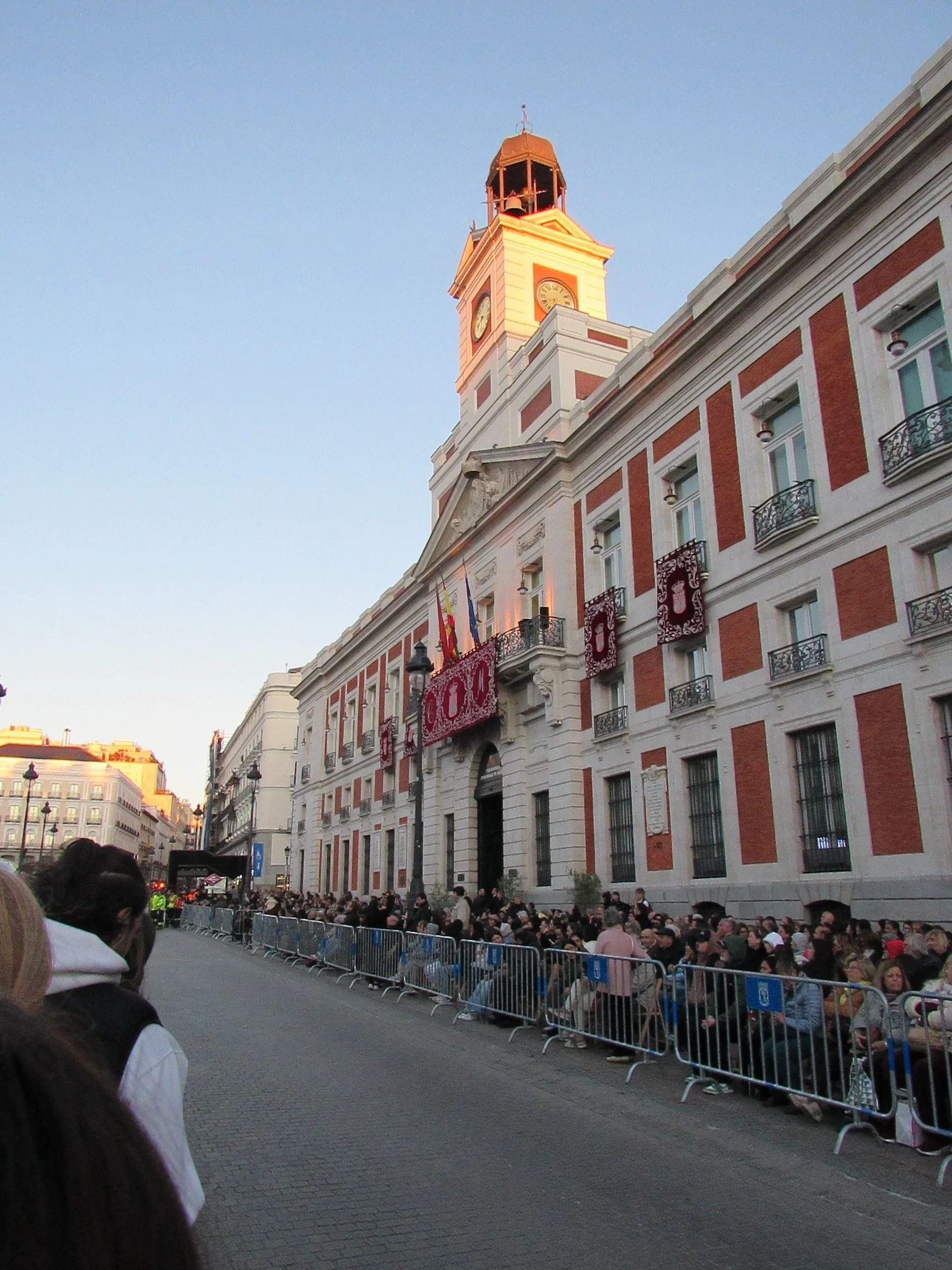
I went to the Sol plaza. I walked around and scoped out the area. The plaza is pretty large. It's long and thin, one side of the plaza making a large arch, with streets and alleyways branching out from all directions as this is the central hub of the network of streets. There are a couple statues in this plaza along with transit entrances and tourist kiosks.
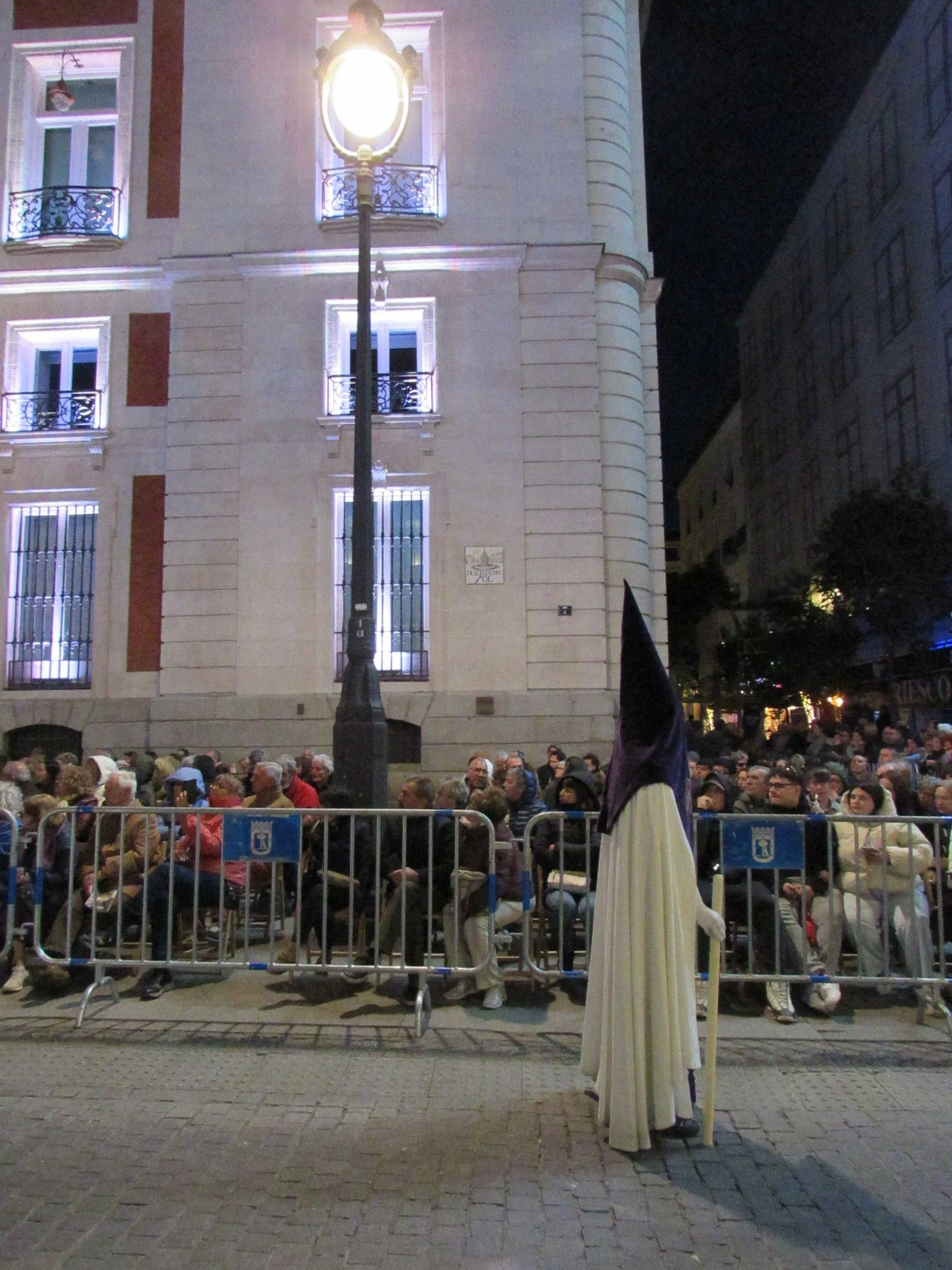
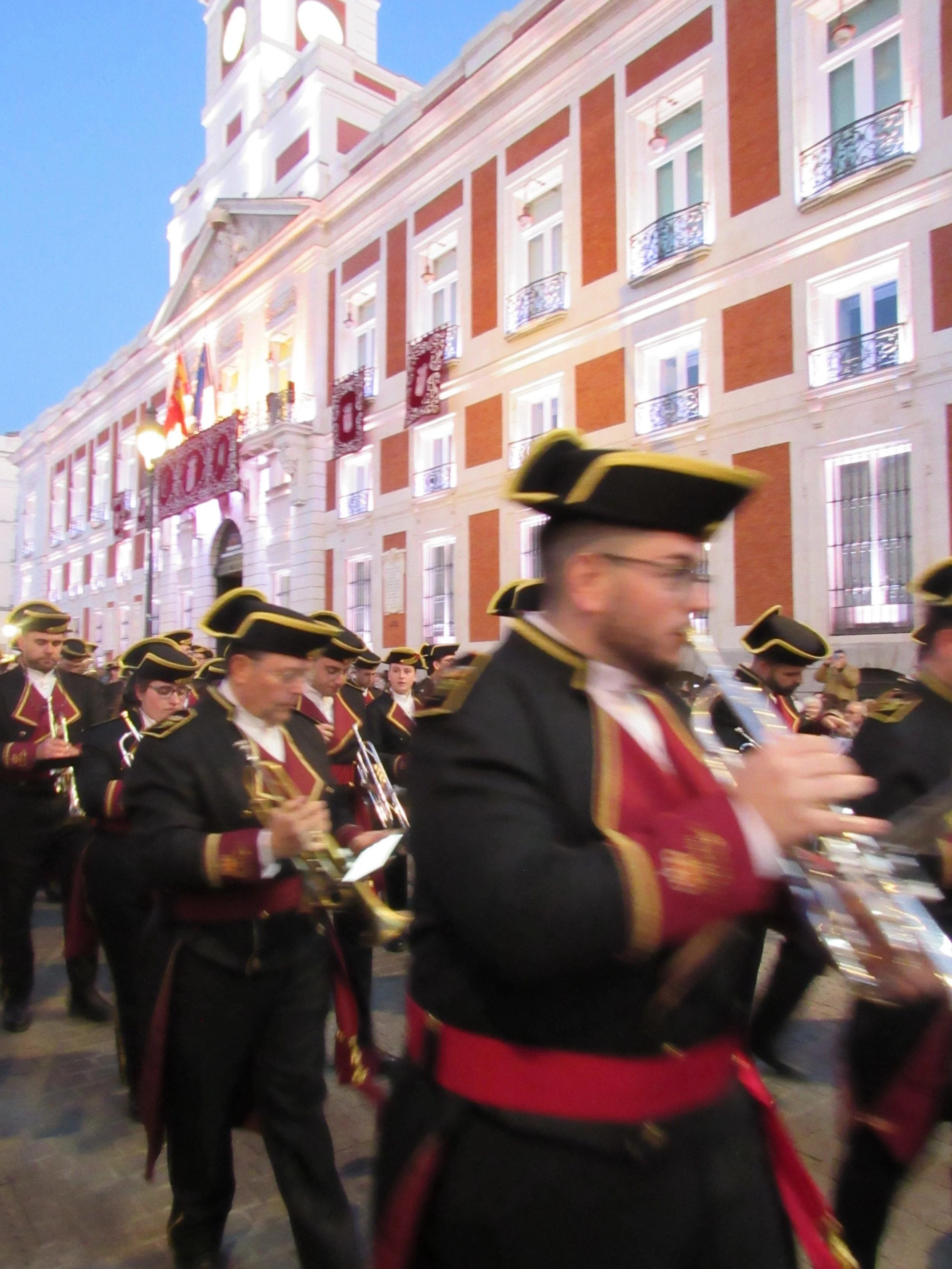
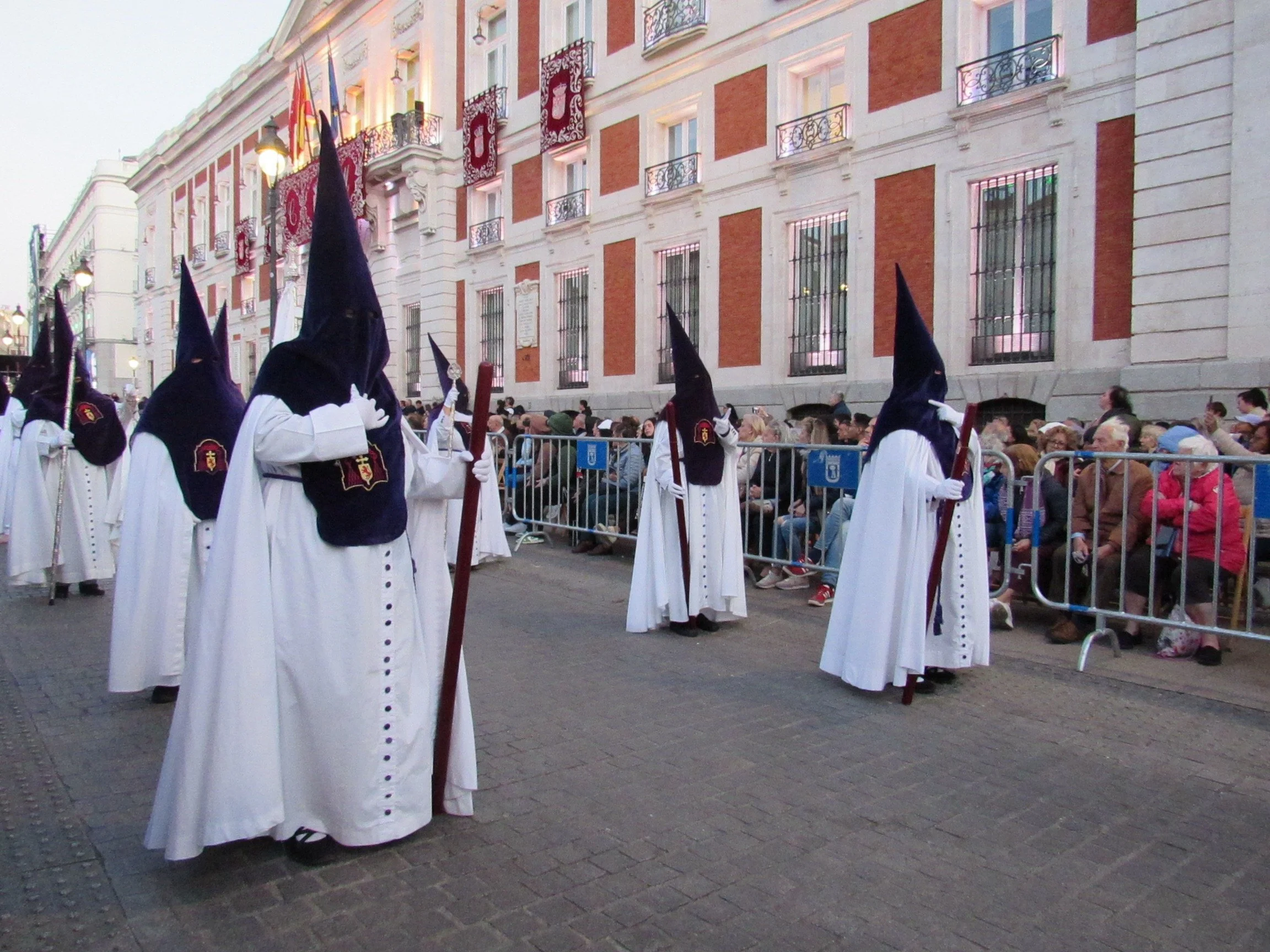
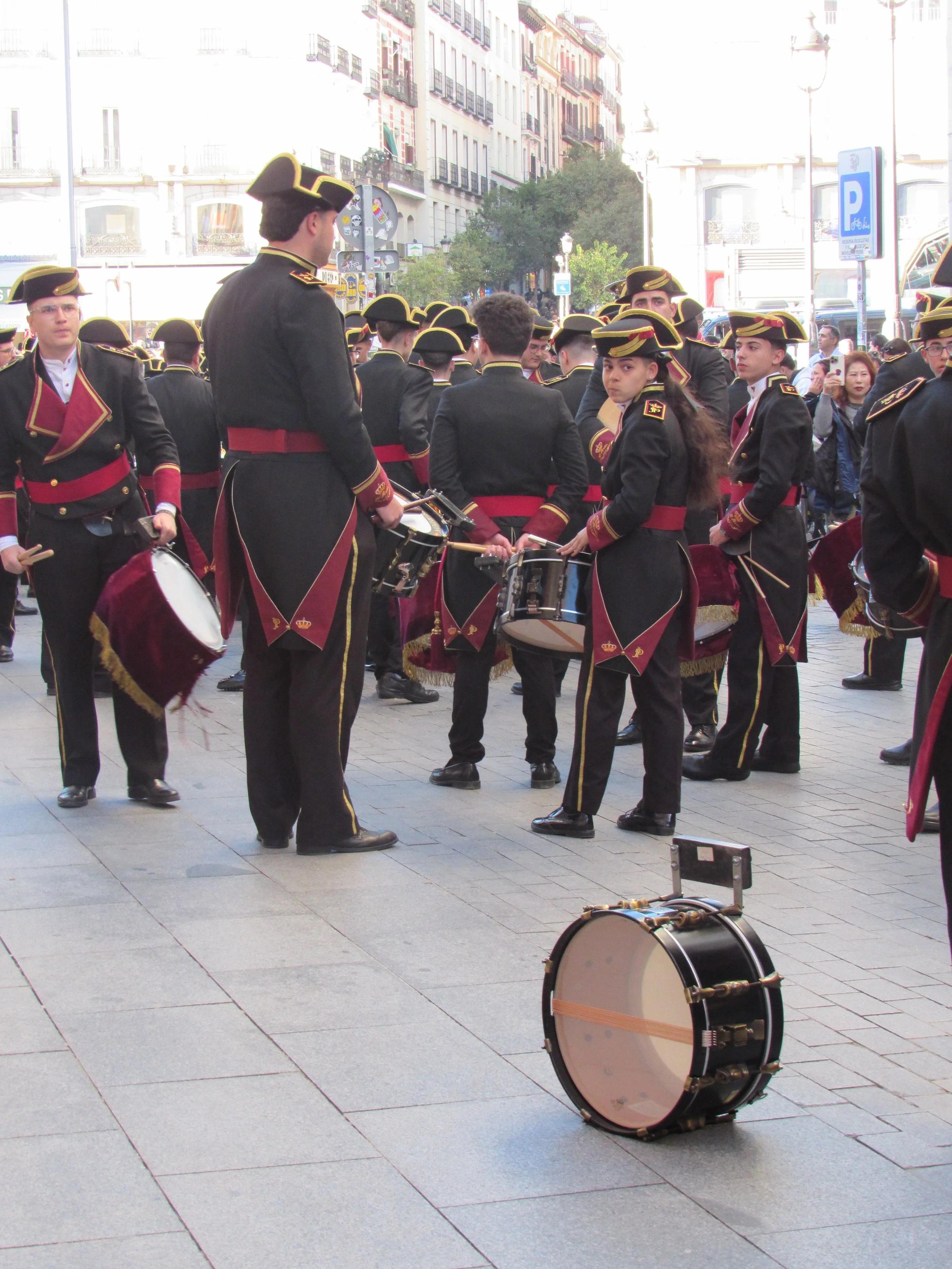
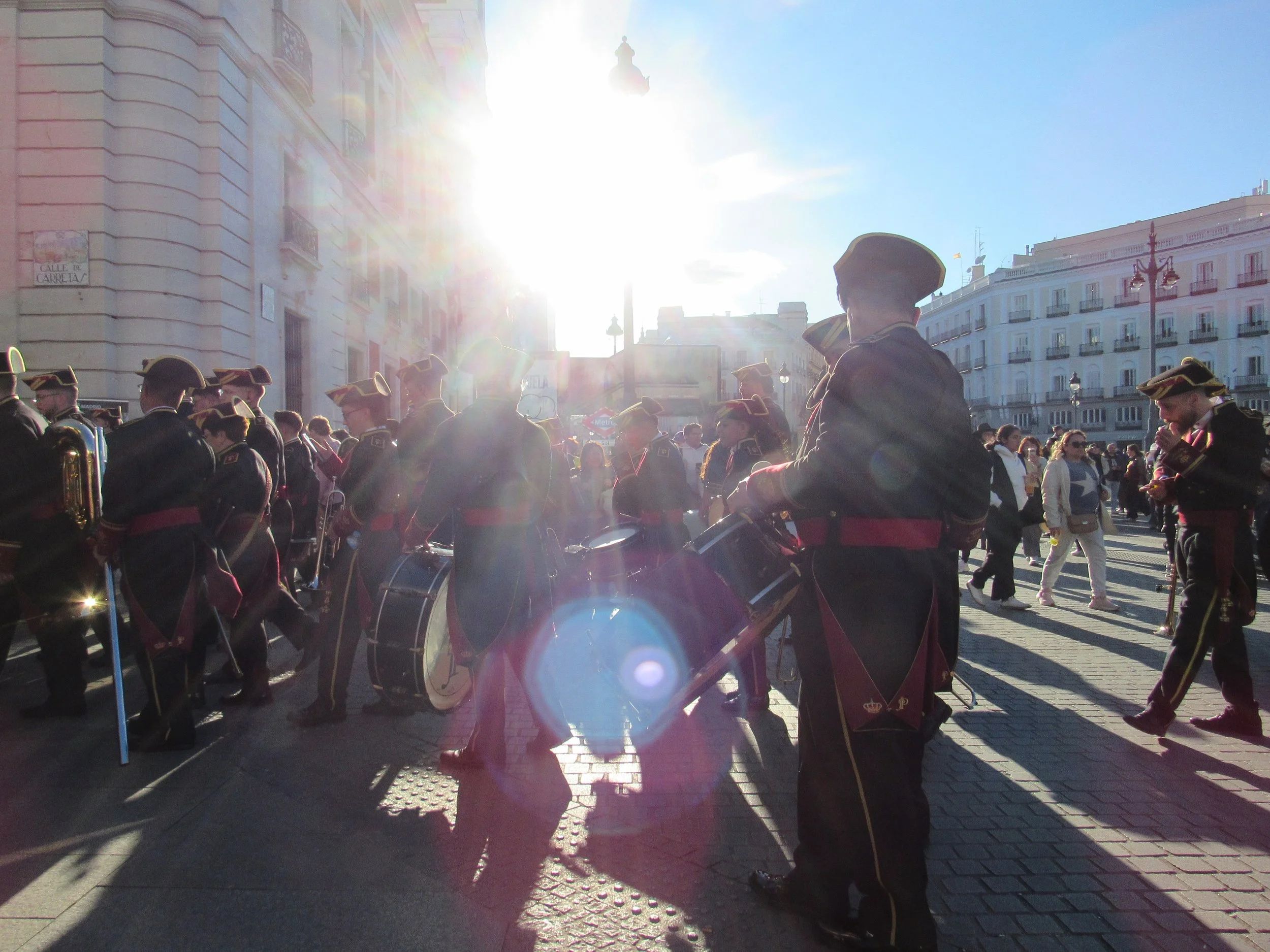
The band was waiting to head to the start of the parade, practicing a bit and taking pictures. Barriers were erected along the route, and large platforms in strategic areas for news cameras and their operators to get video from above the crowd.
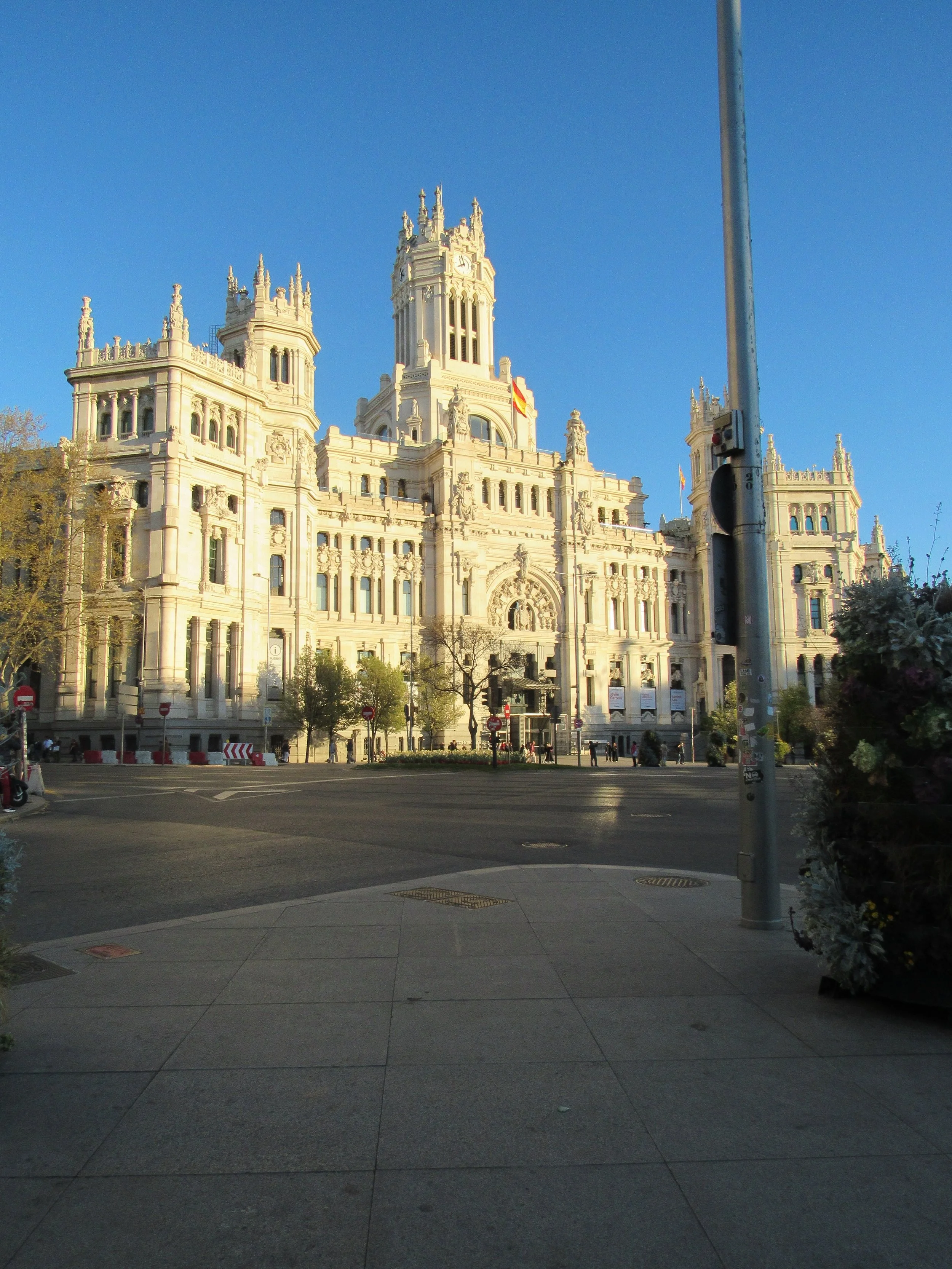
The most known structure in the plaza is the Royal Post Office, now the office of the President of Madrid with a clock above. Fun fact this is where the 12 grapes at midnight on new years originated.
I found a spot in front right along the route right across from the post office. Right in front a seating area was cordoned off, with first come first serve access. It was already pretty full when I settled in. The temperature began to drop as the evening went on. People filled in along the barriers and they closed off the walk way, shooing pedestrians to outside the route.
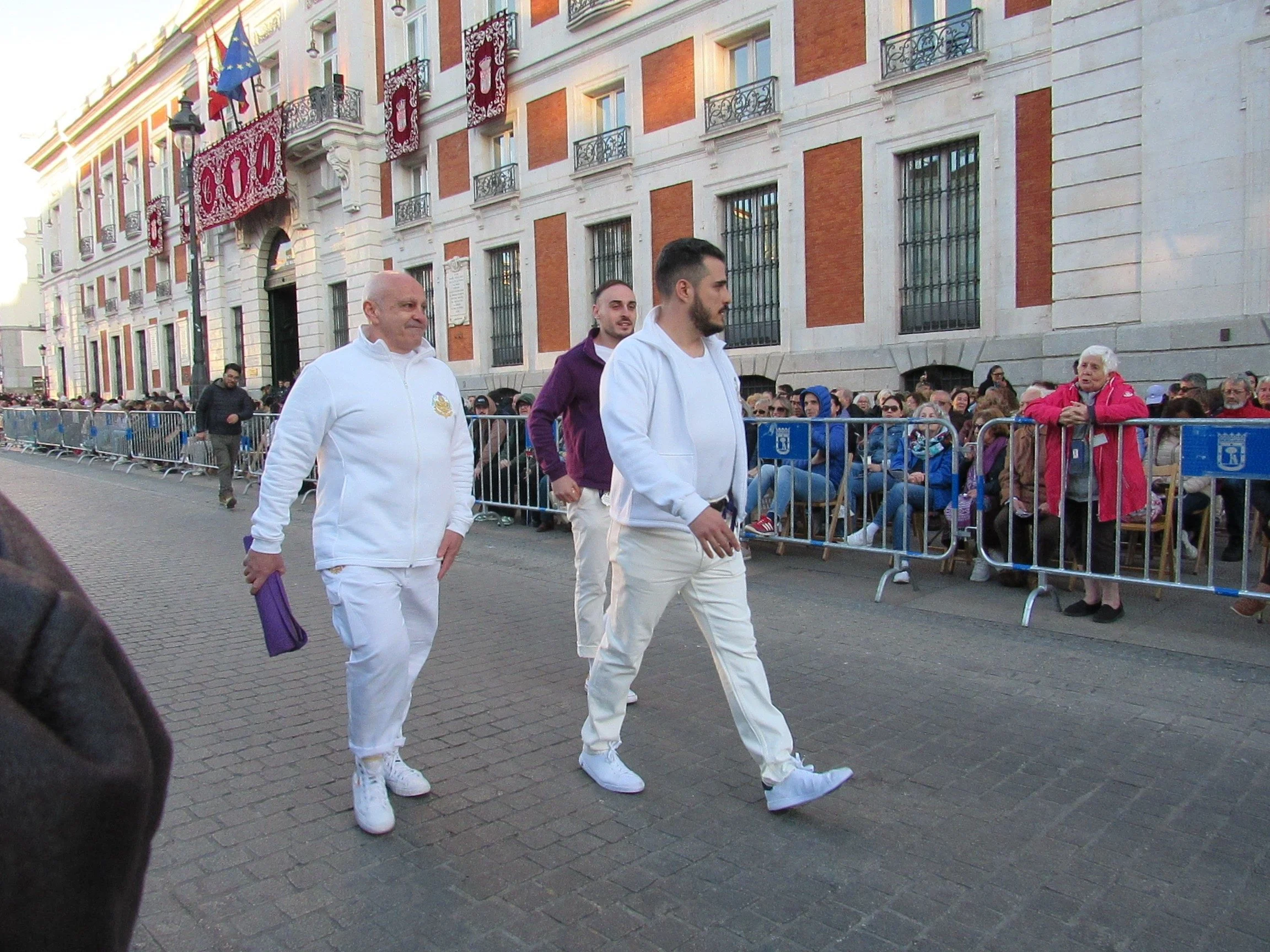
A couple of teens/young adults squeezed their way in to get a view, and I did spend a lot of time trying to get pictures around them. Nothing happened for a long while. On occasion pairs and trios of guys, all in white would walk up to the curve in the route and back, smoking cigarettes and handing out cards with info on their particular brotherhood. I later figured out those were the carriers of the platforms.
It took forever to start, the young folks next to me periodically stopping one of the guys to ask when the procession would be coming through. Older folks across from me in the chairs, bundled up, their hoods tight around their heads and arms crossed trying to keep out the cold while they waited. Eventually the guys in white stopped walking by and it got quiet.
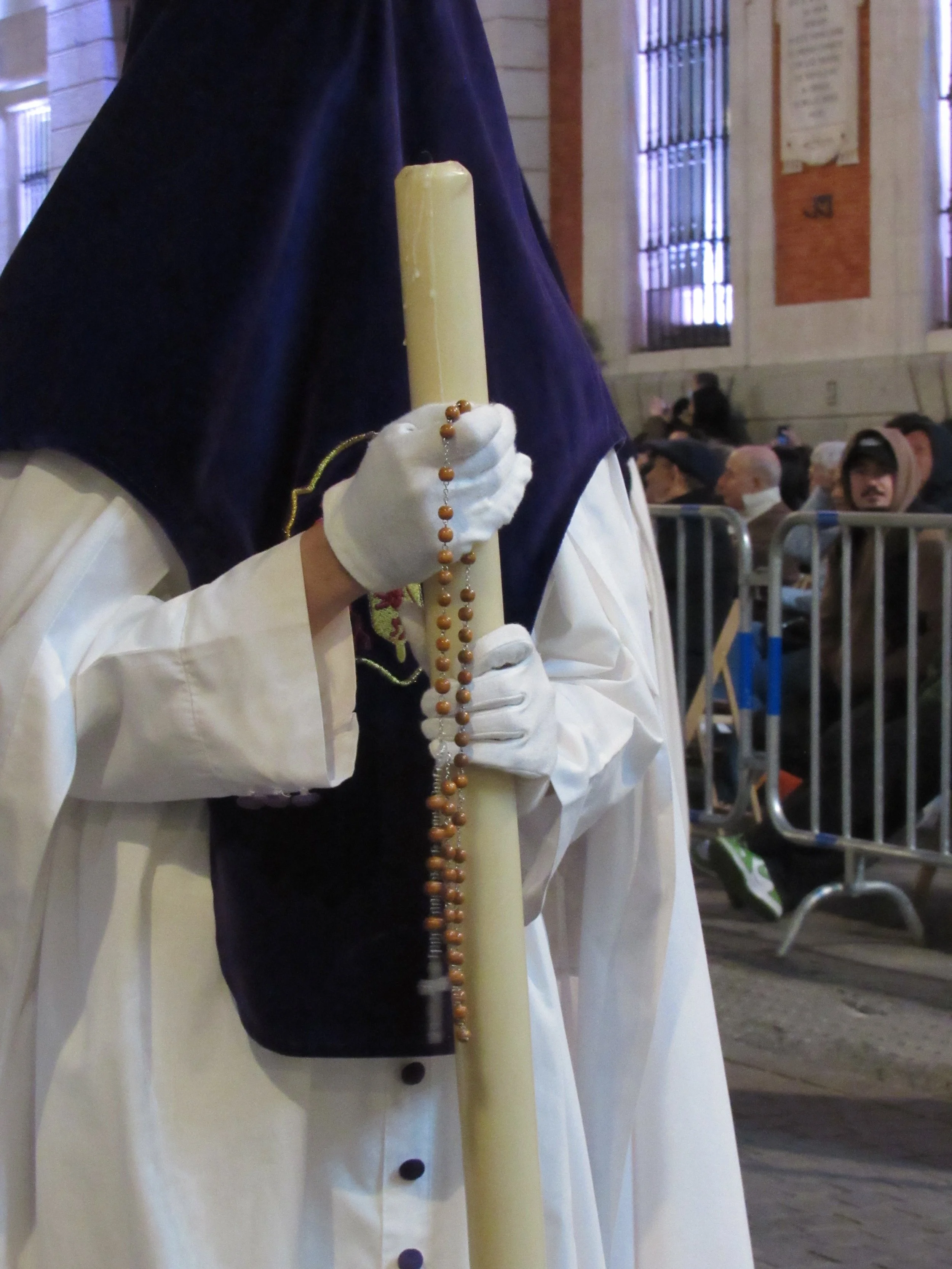
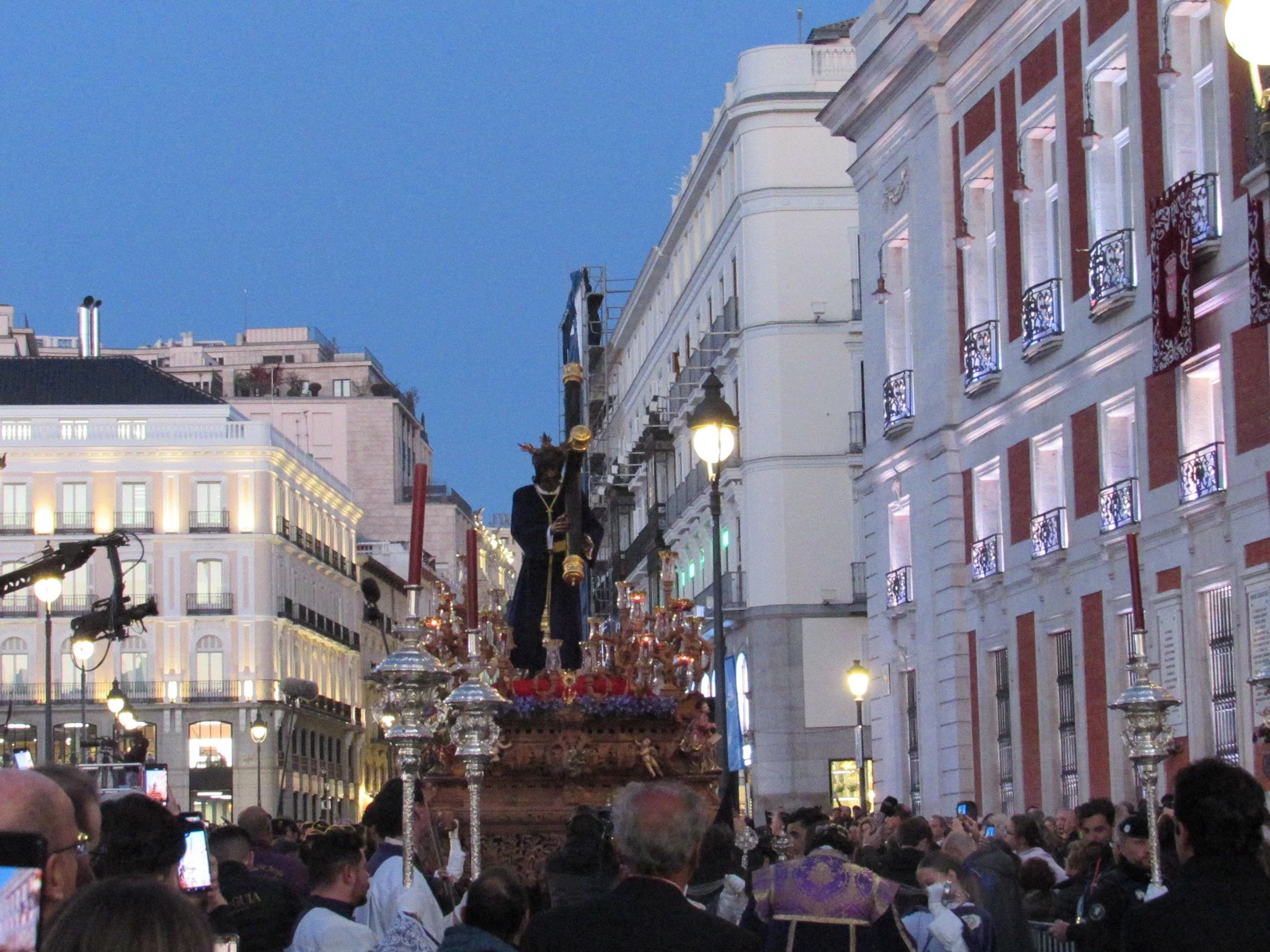
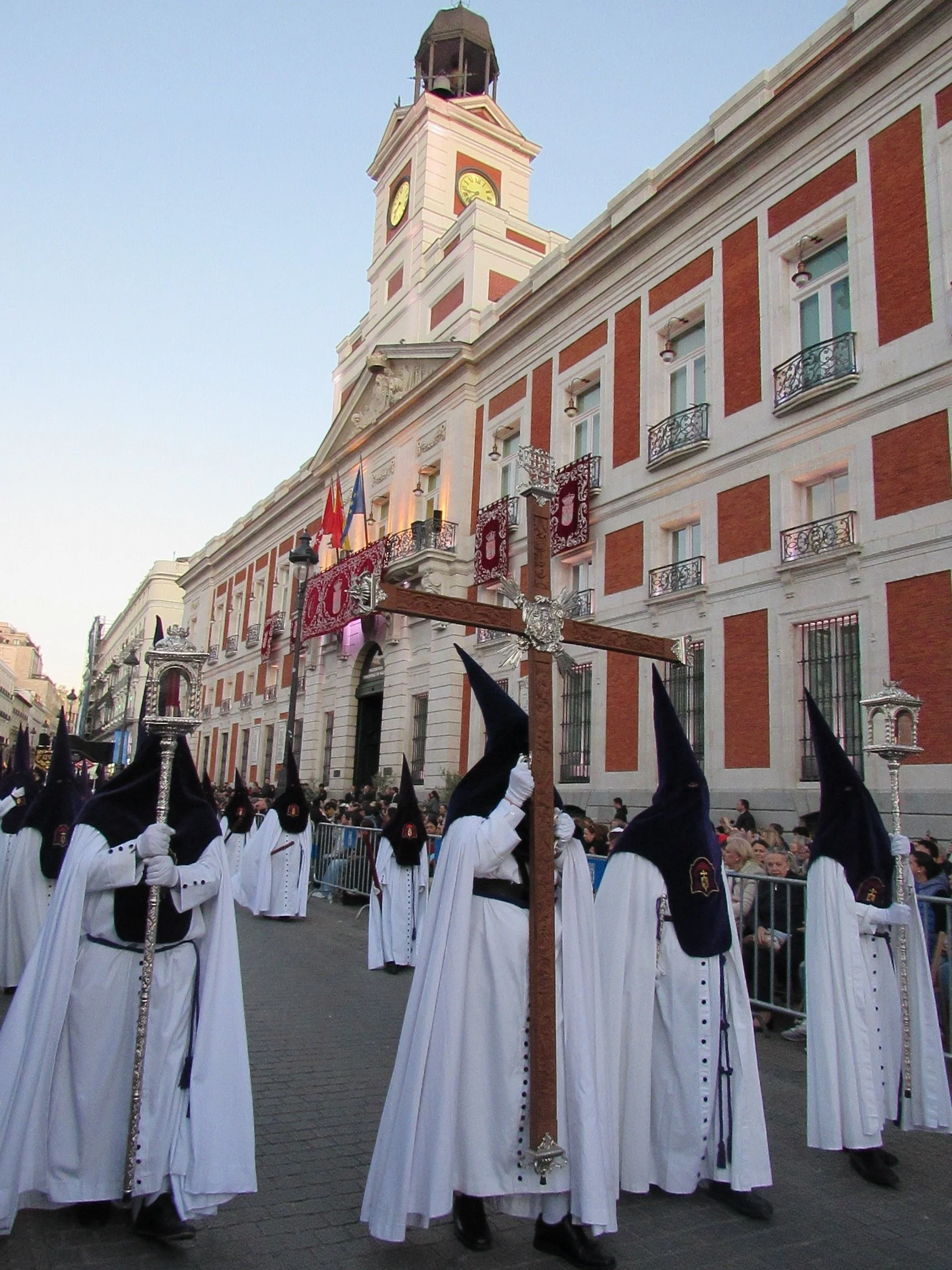
I was in the center of a straight stretch, the route came through the plaza and then turned parallel to the Post Office then turned again down one of the many streets about a block past my position. As I faced the approaching procession, it was blocked by the crowd until the turn. From around the corner hooded and cloaked figures stepping slowly, in pace about 10 feet apart. They moved in and stopped. Before holding and moving again. This continued on, until the first float approached.
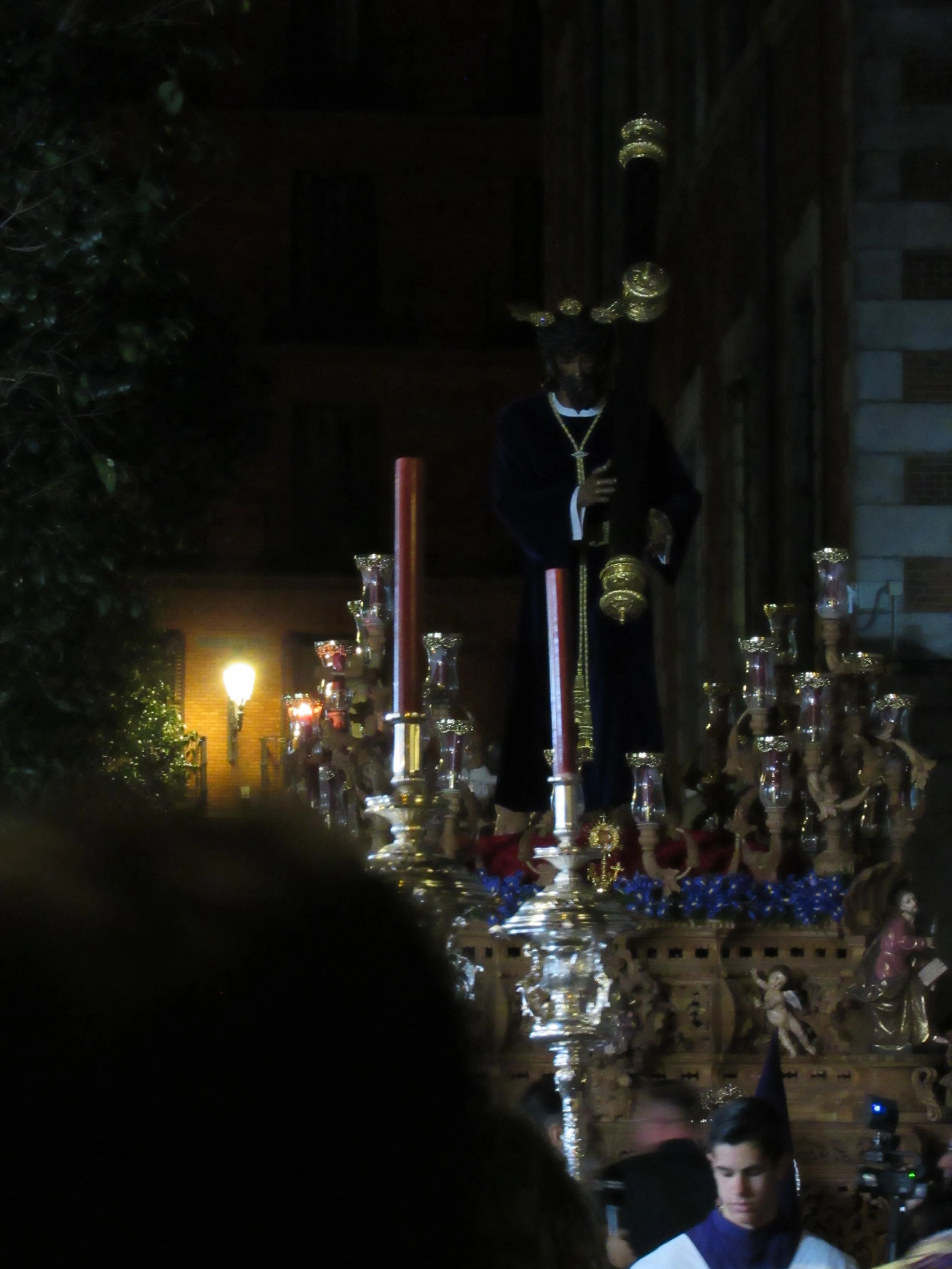
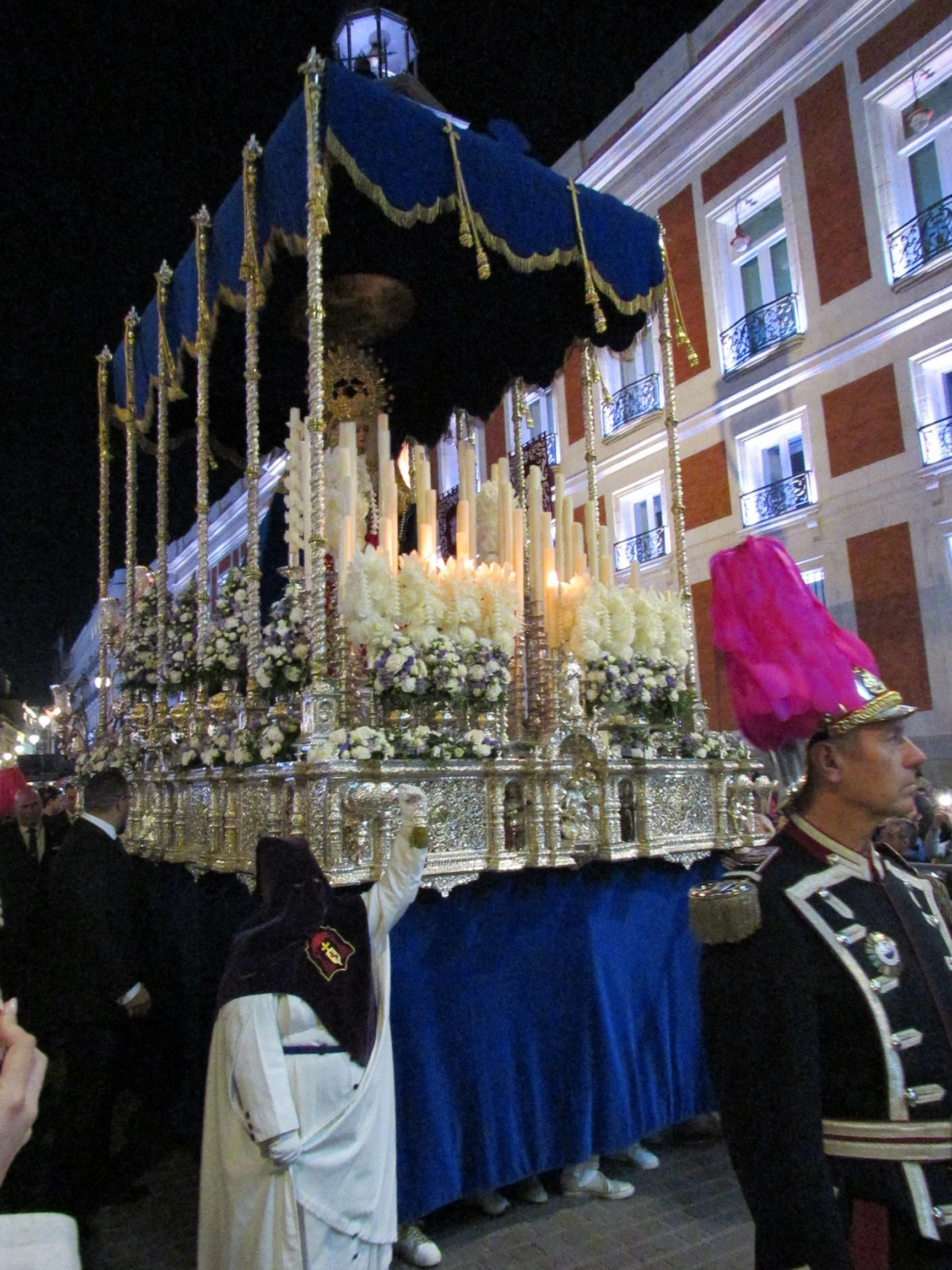
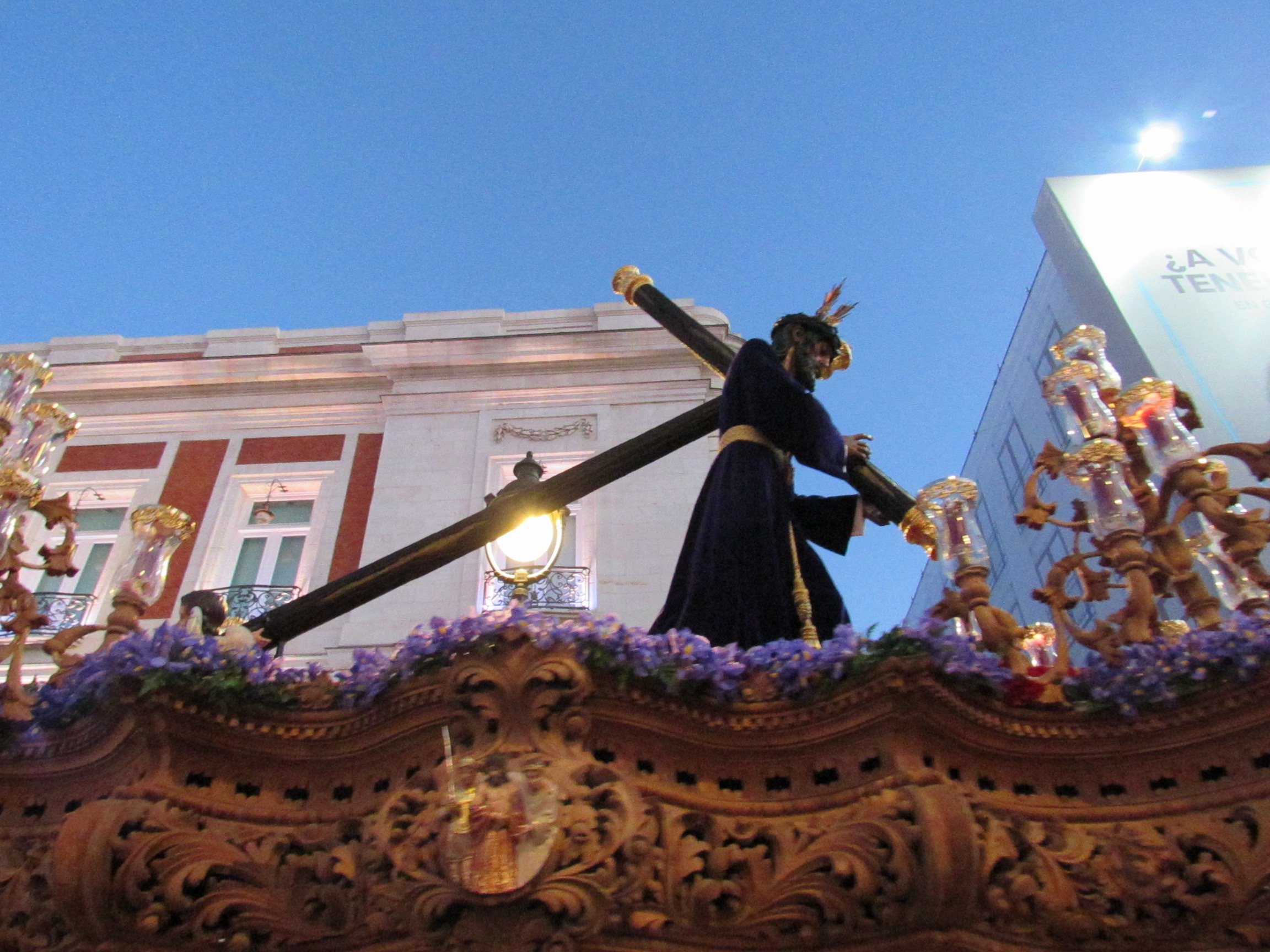
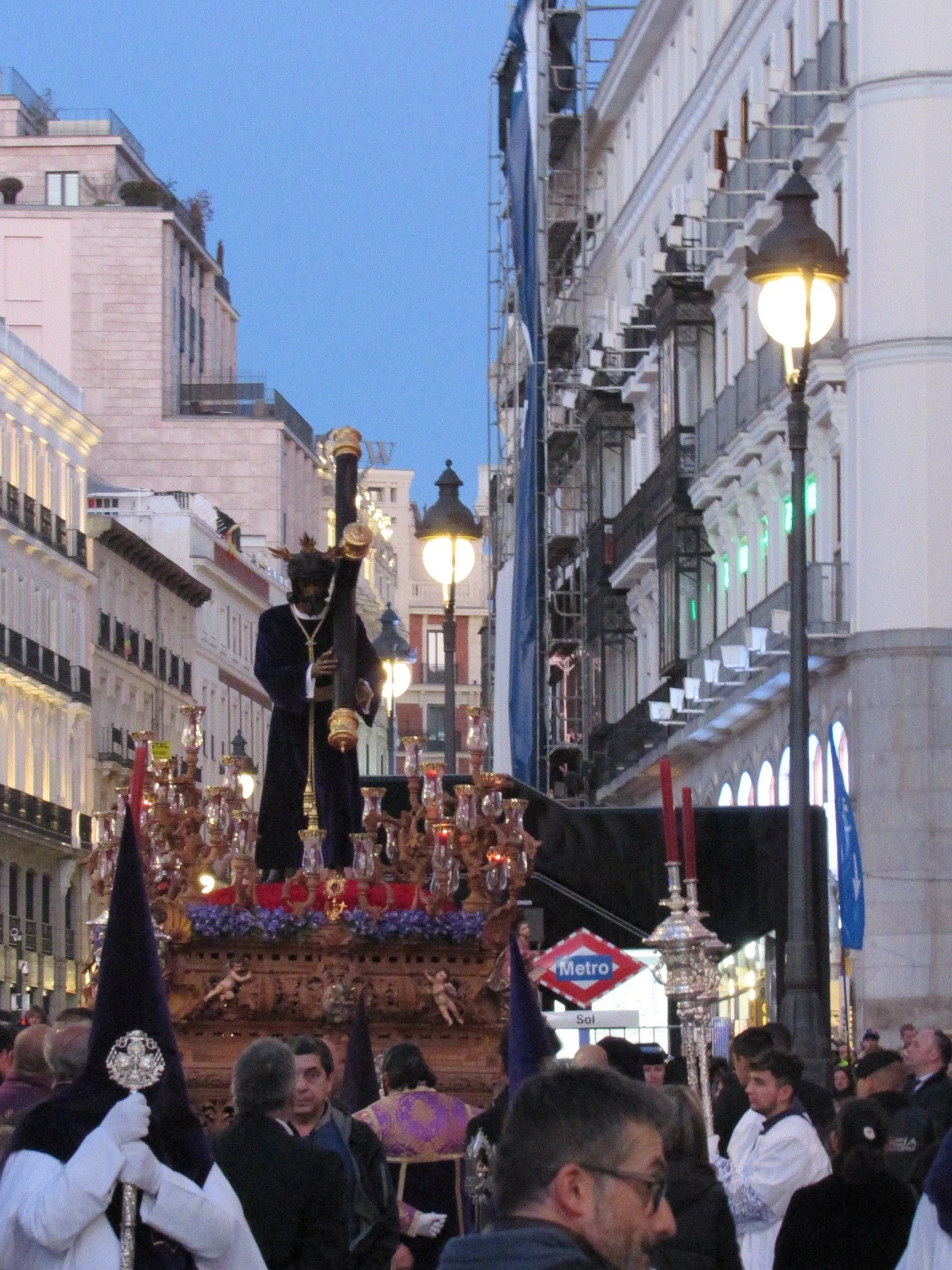
The floats are carried by a couple dozen people, and are all the same general build. A rectangular platform about a foot high made of wood or with (what I think) a silver plating, so that it's not extra heavy. The wood ones are either intricately carved, or with the silver plating inlay around its perimeter.
Attached to the platform, at the bottom of the carved portion hangs cloth on all four sides to hide the dozens of people who carry each one. Somewhere on base is a knocker, which is used by the leaders to inform the carriers when to start, and stop.
Atop the platform, surrounding the figure or figures it depicts, is usually adorned with flowers, and often candles, from hundreds of tapered in neat rows ascending in height to large pillars in glass at the corners. Some of the Mary’s had beautiful canopies while others were open to the sky.
Once the whole procession went through, the following police vehicle went by and the cleanup of the plaza began. Barricades stacked to be picked up and trash collected. The chairs from the viewing area gathered. I decided to make my way farther down the route to find more angles of the floats, and the crowd.
The streets were crowded; single men and women, families, teens, young adults. Many more elderly folks who dominated the chairs across from the plaza. The crowds at the streets packed 4+ people. There were stands for news cameras and places to film from above the crowd. A large section at the plaza and then smaller ones dotted along the route.
Eventually I was tired and needed dinner, and was going to just go to McDonalds because I knew it was open - but on the way I found a local place instead for a focaccia sandwich and chips, fanta from the vending machine downstairs. I ate my dinner, watched some TV before crashing for the night.
—
The next day I was heading to Merida. I had until noon to check out so I again grabbed my Dunkies, ate my breakfast in the hotel room and packed. At noon I was out and then heading to a luggage storage by the train station. I dropped my bag and then, a pit stop in the station to use the bathroom (there are like no public places to go) and I was trying to stay hydrated then back to the Retiro park. There are a bunch of cafes throughout so I found one near the boaters and had (what is actually a breakfast dish) the tortilla - which is egg and onion in like a quiche.
I enjoyed my meal while people watched and then walked back to the luggage storage and headed back to the train station. First I printed my tickets at the kiosk and then went to find where my train came in. It took me a bit to navigate where my train left from. There are multiple sections to the train station, and not all areas show each line and where they are going. I first looked at the screen near the ticket kiosk. My train was not listed, so I walked farther into the train station and found the large timetable. It was listed there, so after finding the small standing sign indicating check in I showed my ticket and was let down a short stair to another waiting area.
Once the track number was announced, everyone en masse headed toward the escalator down to the platform. I went left instead of right after entering the train and ended up in the wrong car. A nice woman who spoke English helped me out, so I hustled over to the right car (number 6) and there was just barely room for my big suitcase. I at first just grabbed a seat, not realizing that “plaza” meant seat and there was a specific one I should be in. But, again the nice family who’s seat I was in, helped me out.
My actual seat was on the aisle, backward facing seat, definitely not ideal and I was across from a very tall and lanky man. I will say, he did his best to not impede on my space, considering there was not a lot of legroom. I was feeling flushed from the confusion, and a bit tired after being in the sun all day, so I settled into my seat with my book as the groups around me got comfortable and settled into a low chatter.
The ride was supposed to be just under 4 hours. We were delayed twice. This was where not knowing the language really hindered my understanding, but here is what I witnessed anyway. First, a few stops into the trip an older man came through with a bag in hand. He said something to the car, the chattering quieted down. He went around and placed flashlights with a small note on the empty seats of people who had gotten up to use the facilities, or get a snack, as well as on some armrests around the car.
Then he left out the opposite door he came in. As the talking resumed there was a lot of looking at the flashlights, while also ignoring their presence. A bit later he returned, picking them up, but then pushing in your face to try and get you to, I assume, buy one. No one did, then he left again. Not long later, the conductor came through and addressed us. I'm not sure if she was asking about the flashlight guy or what, but there was silence from the car and she seemed satisfied and then moved on.
Then a couple of stops later, it was clear we should have moved on, but didn’t. People were getting antsy, confused as to why we were not moving. Suddenly a couple of police officers ran through the car, as well as a small group on the platform. Quick, unexpected, and then silence. The train stayed put, and the conversation started up again. One guy points out the window down the platform. Since my seat was facing backwards I could not see what he was, but I knew something was happening. Then the train lurched, started moving and as we went by I briefly saw a man, surrounded by a few officers. It was a split second, and he was facing away and I don’t think it was the flashlight man, but I’m sure I'll never know.
The city faded away to the countryside, there were fields, and orchards. Modern towns, and even some not so modern ones built around a castle. I made the mistake of not grabbing something for dinner, or any snacks for that matter, before or after getting on the train, feeling too tired to try and communicate, but did have water at least.
By the end of the journey I was hungry and tired, but still had to get to my hostal. This was a low budget option, no amenities like a hotel, but still my own room and bathroom, unlike a hostel.
It was a 20 minute walk away, and not near the main tourist area. Before leaving the train station I (of course) used the bathrooms and got chips and donuts from the vending machine and headed out.
I walked up the hill from the train station, and as I reached the top I could see farther down the street a group of people all crowded at the intersection, glowing with yellow light; the edge of the parade route. It was Semana Santa, the Thursday before Good Friday, and there was a procession that evening.
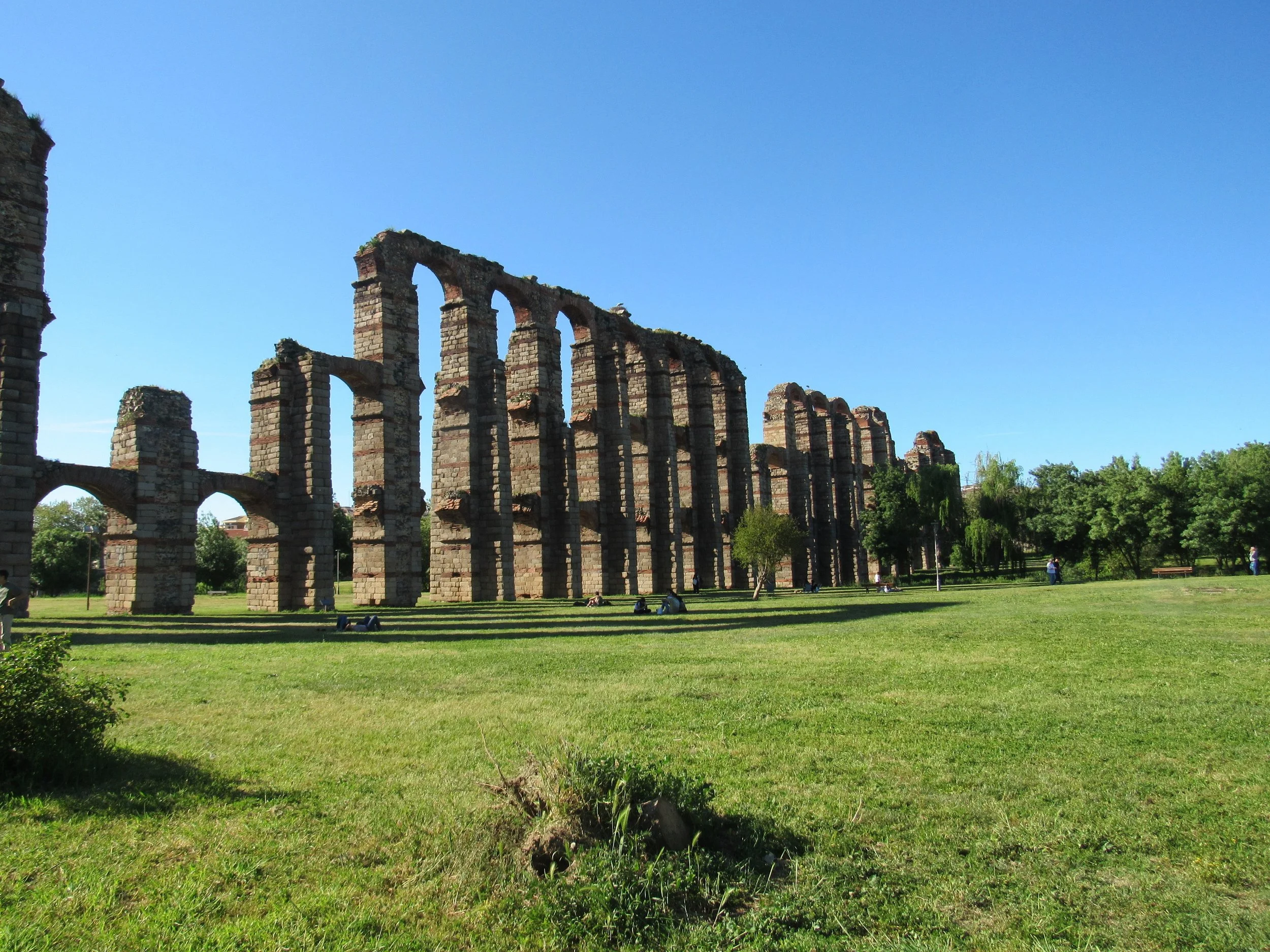
With my 50 lbs roller bag in tow I followed Google to the left, down another street past a Church, The XXX. Its exterior was lit, glowing in the otherwise lit, but still dark streets. I continued around under the train tracks, past some industrial buildings, over a couple of bridges spanning the modern aqueduct, and past the aqueduct park that ran along it. I was not alone, there were families and others walking toward the neighborhood that my hostal was in.
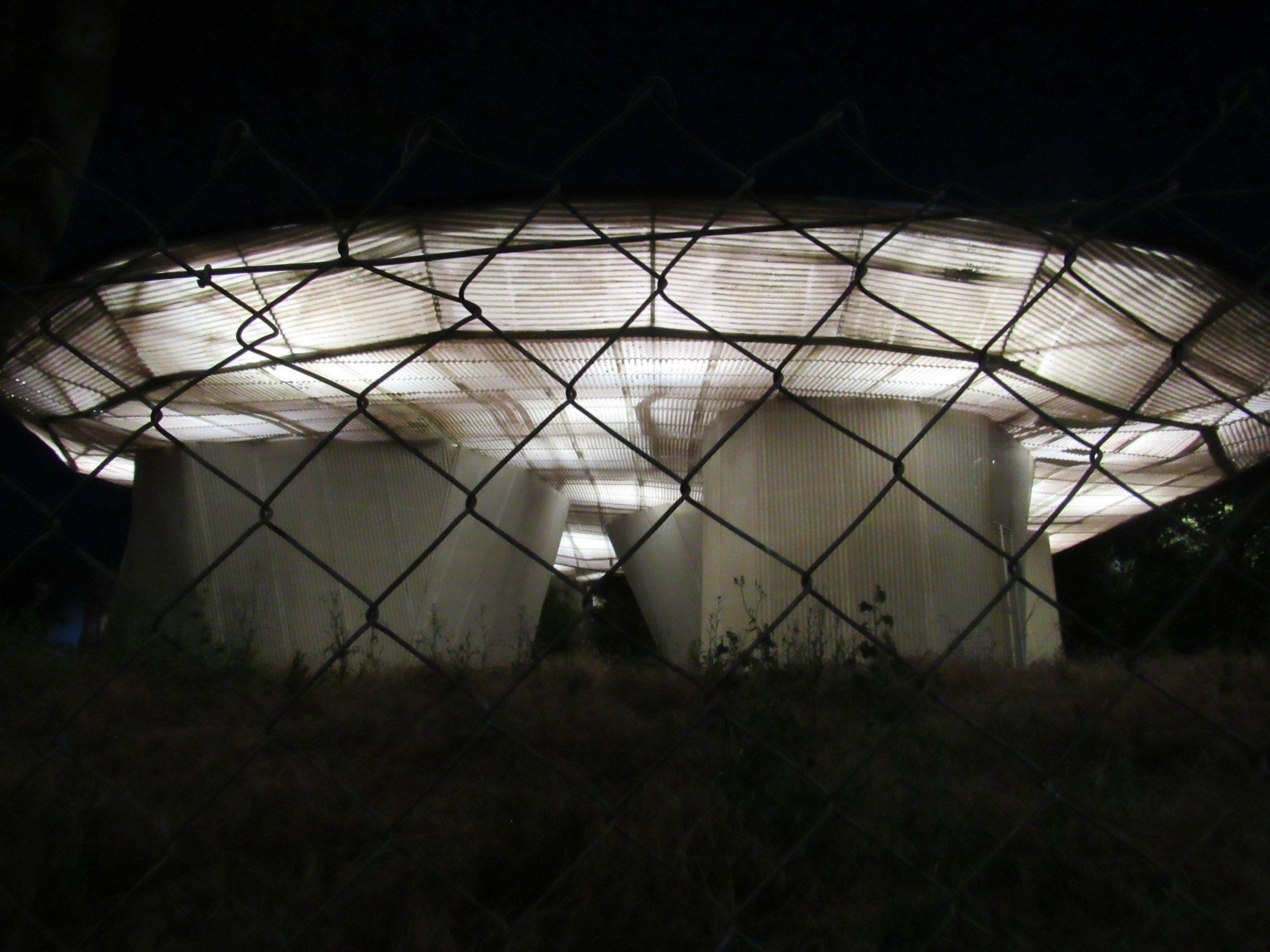
Then to my right, glowing like a mushroom Factoria Joven. It was almost 10 pm, 2 hours behind when I was supposed to arrive and when the desk clerk would be off for the night I continued on toward my lodging, suitcase bumping along behind me. The side of the street was narrow, and barely a sidewalk, but enough that I managed to make it 5 before 10.
The Lobby was square, Immediately to the left are metal double doors with circular windows in them. The reception desk is built in, made of Amber maple, like the wall behind it. To the right of the desk is a hallway leading to the rooms. The right side of the room has a couple of chairs, a microwave and a vending machine that was almost empty but at least had water.
The man at the front desk spoke rapidly in Spanish, and I understood enough to gather the general info and where breakfast was, and that I would need to use the keycard to get in the front door if it was between certain evening hours.
I walked the halls to my room, they were white, with amber maple, doors, and trim including a chairrail. The floor white lightly marbled tile. It is a bit stark and echoes as I make my way through. Motion sensor lights turning on as you approach and Roman skewing art dotted the hallways. I made it to my room following the signage. More of the same. All white walls, the only art is a canvas of a roman woman, red hair, pale skin, draped clothes, holding grain and looking over her shoulder, hung above the bed.
Upon entry the bathroom is to the right with a pedestal sink, small square shower, and toilet, and the usual hairdryer, makeup mirror and soap. Toilet paper was dispensed out of a round, locked holder, which takes the commercial round rolls. It pulled from the center, and it took me a minute to be able to get more than one sheet out at a time.
Beyond the bathroom it opens up to the rest of the room, and the bed fills most of it. Side tables in the same wood as the hallway, on either side with small cubbies. Sconces on the wall above switched for bedside light. On the bed was a welcome letter, and Catalogue of all the celebrations happening in town for Semana Santa and a lollypop.
Across from the bed is a built-in desk connected to a tall cabinet for clothes. All in the same amber maple. Above the desk surface is a mirror, and TV mounted above. A fridge tucked in at the base of the cabinet with a safe stacked above it. The cabinet had two cubbies, the bottom of each cubby had two drawers (which I did not use) and one side had 3 shelves for folded clothes (which I did use).
Each cubby also had 2 hangers that are in separate pieces. The hanger instead of having the regular hook head was a wire with a small sphere that slid onto the metal attachments inside the cubby. The hangers were also too wide for the interior space and when I closed the door the hangar would get pushed around.
There was a small window across from where you entered, by the head of the bed. It looked out to the front of the hotel and street, opened in a V position. I was warm from the walk so I left it open, and figured out how to turn off the heat.
I ate my chips and donuts from the vending machine, and finished up some candy I had in my backpack. I opened my suitcase enough to grab my PJ’s, toiletries to take a shower, and slept well.
—
The next morning, Good Friday, I got dressed, and headed back through the hall's lights turning on as I went to the reception and through the silver double doors with round windows. There were already people seated and getting breakfast. I sat down and was handed a menu, all in Spanish. The same guy who had checked me in the night before was serving breakfast and I asked if they spoke any English, which he did not. This was the make or break it time.
I managed to express I needed a few minutes, and then used Google to help me decipher the menu. One half was all coffee - great, Cafe con Leche I understood and was close to my usual morning cup at home. The other half was basically different ways to have toast, with some sides, like fresh fruit or cottage cheese or pastry.
Not having a lot for dinner I decided on Toast with butter and strawberry jam, or Tostada con Mantequilla et marmelada, and a croissant. The gentleman came back and I did my best to order in Spanish. He then asked a question, which I later deciphered asking what kind of jam I wanted, la fresa. I haltingly requested the first option he gave and hoped for the best.
The coffee came quickly with a packet of sugar. Perfect. Made behind the counter by the same gentleman on the staff who had helped me thus far. I stirred in my sugar and not long afterward came the food. I was pleased to discover I had strawberry jam. Everything was delicious, simple but filling. After getting the check and paying, I headed back to my room, grabbed what I needed - camera, extra batteries, water, then headed out.
Since I had not heard from anyone at Factoria Joven, I was planning to use the cultural events and celebrations surrounding the Semanta Santa holiday in Spain, and the plethora of Roman Ruins and museums as a way to study the Drive in Culture for the Spanish people.
I had read in the guide book the night before as I was falling asleep, that there was something called Via Crucis in the Roman Amphitheatre. It was described as a prayer for the Resurrection of Christ. From what I understood I could get tickets, first come first serve at the Amethere Ticket office. So I headed that direction this time, walking along the aqueduct park, which was pleasant, with trees dotted along the cobbled sidewalk. Then back over the bridges, past the industrial grain and other buildings. Under the train tracks and then through a tunnel toward the back end of the amphitheater. I made my way around to the ticket office and got in line.
After a bit of waiting, I realized this was just to enter and see the ruins, which I did not want to do just yet. I went to the help desk inside and the woman there said the tickets they had available were released at midnight, and were all claimed. BUT if I wanted to wait, I could get a ticket later in the evening. She explained generally where I would wait, and that I should show up around 9:00 - 9:30 at the latest as it was a popular event.
With a plan for seeing the Via Crucis my next step was to observe as many of the processions as I could. The ticket office faces a plaza with benches, museum and ruin entrances, a restaurant and a huge metal Merida sign with a seat for a photo opp in the I of installation.
Across from the ticket office is a main drag, which has restaurants with large outdoor seating, and the Romero museum entrance. Gift shops and other places to purchase clothes, and tours too. Canvas was strung between buildings to provide shade and along the walkwalk were bronze records with musician names in clear bold letters, as part of their Stone and Music Festival, where bands play in the Roman Theater.
I walked through the streets of Merida passing more shops, entrances to homes and hostals, walking through more plazas. I made my way to the Arch of Trojan. The next procession was slated to come through the arch in about 30 minutes. I claimed a spot just south of the arch itself between a family and an older woman leaning against a planter as she waited. Slowly the sidewalks filed up and more people arrived to watch. Everyone showed up. Adults as couples or accompanied by their young children. Groups of teens, and families. Some people sat at the nearby cafe and watched. Some stood on planters and benches to see. Across from me was an old woman in a wheelchair surrounded by her family, children and grandchildren playing and talking as they waited.
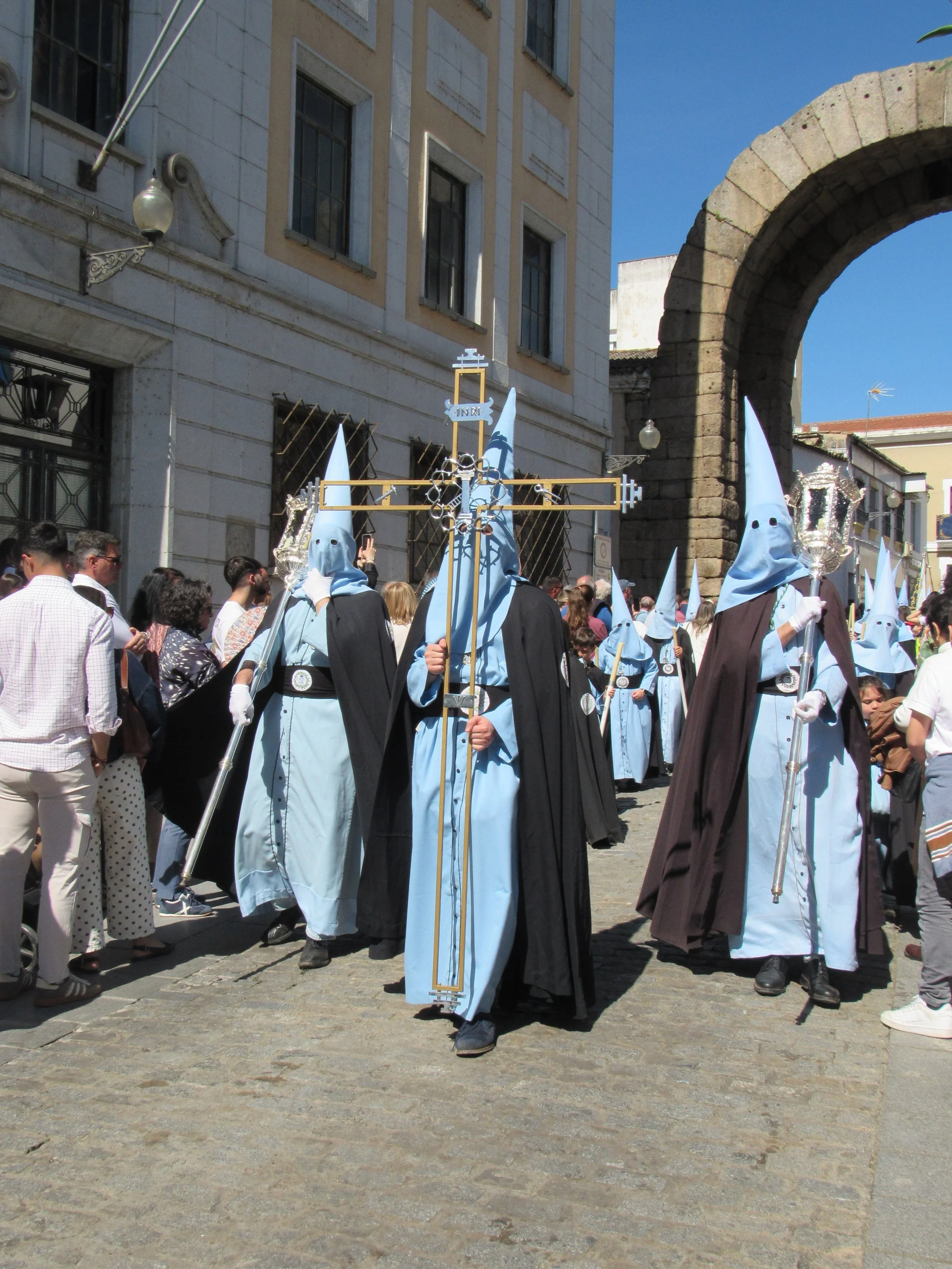
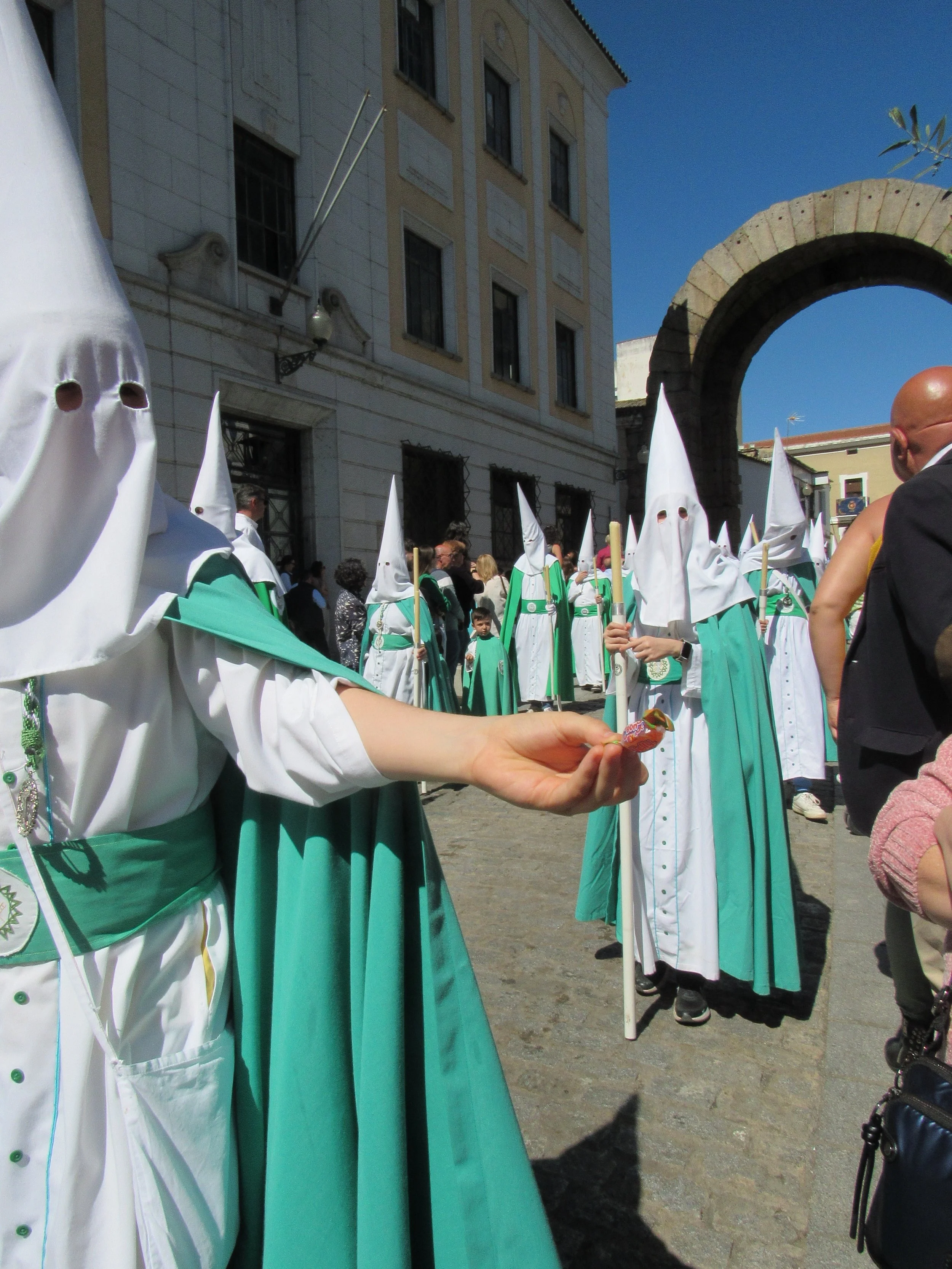
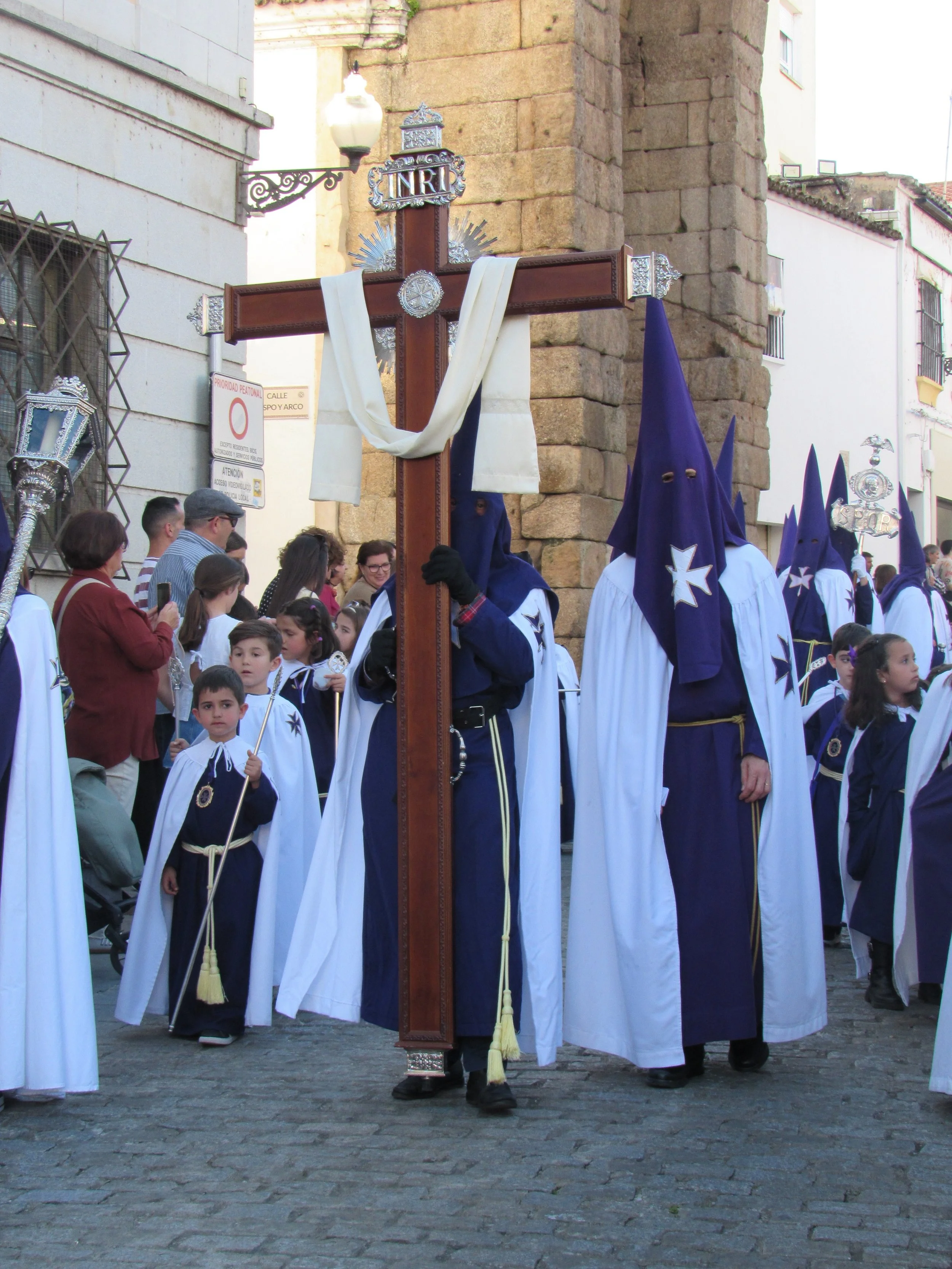
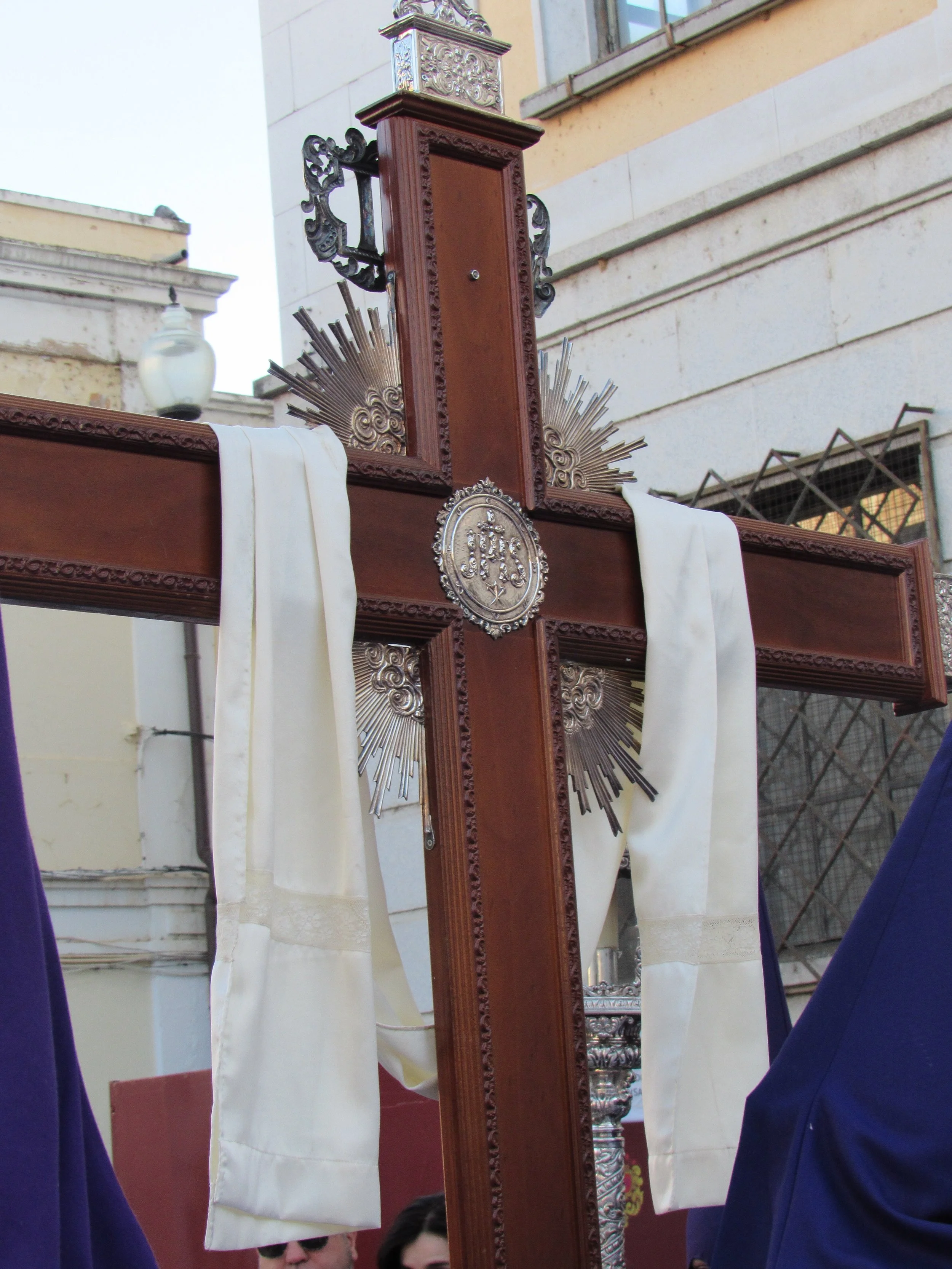
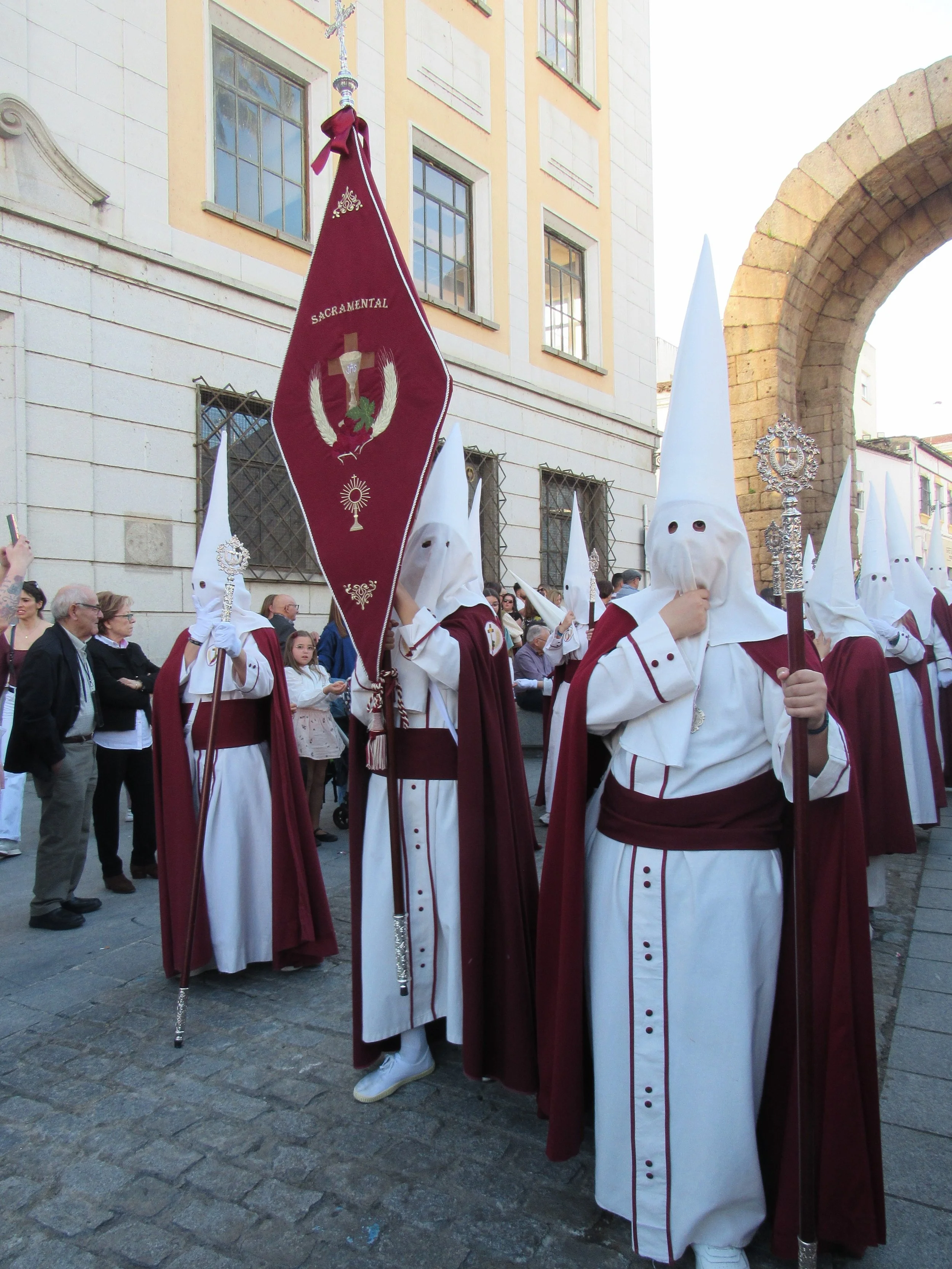
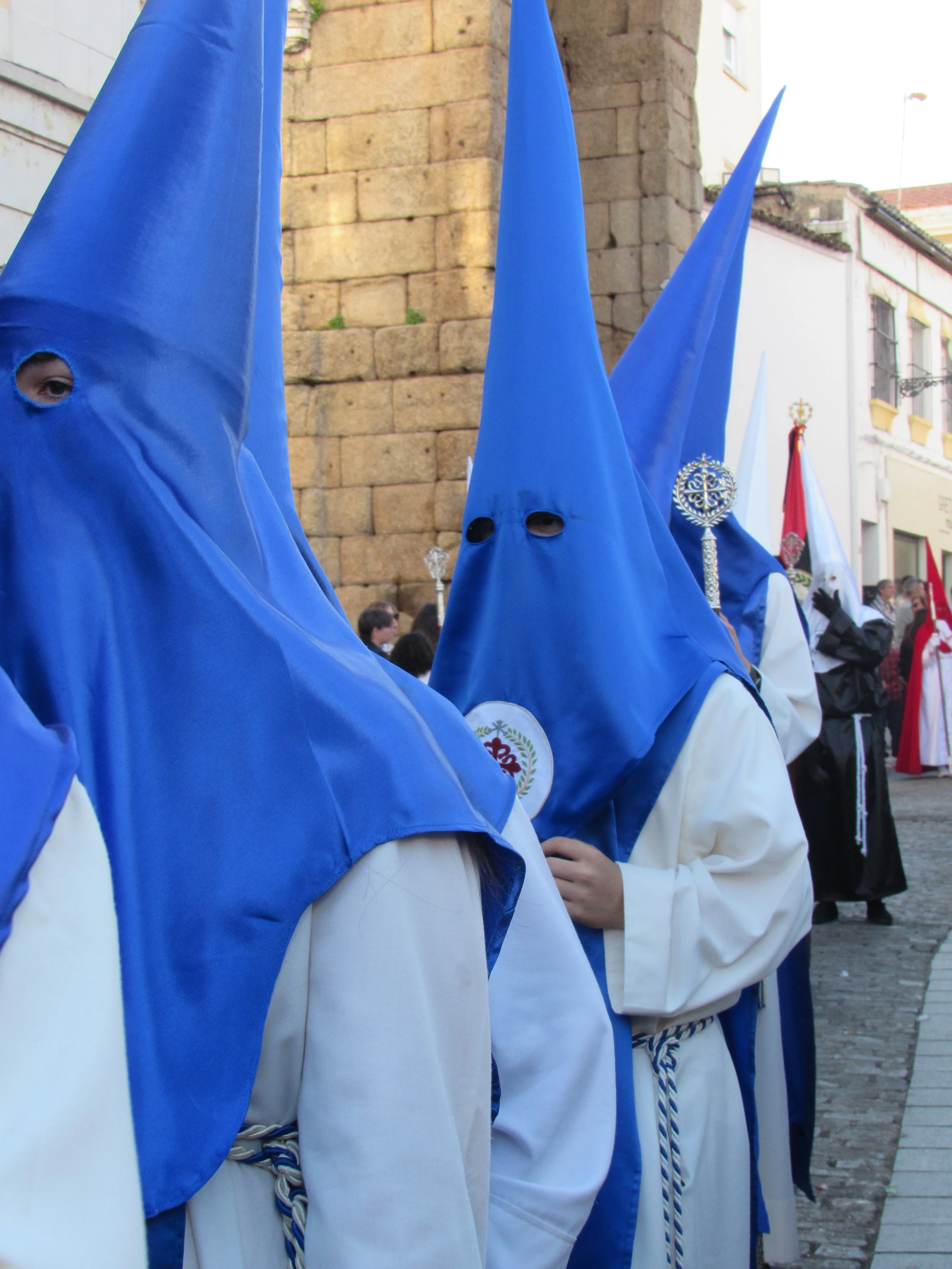
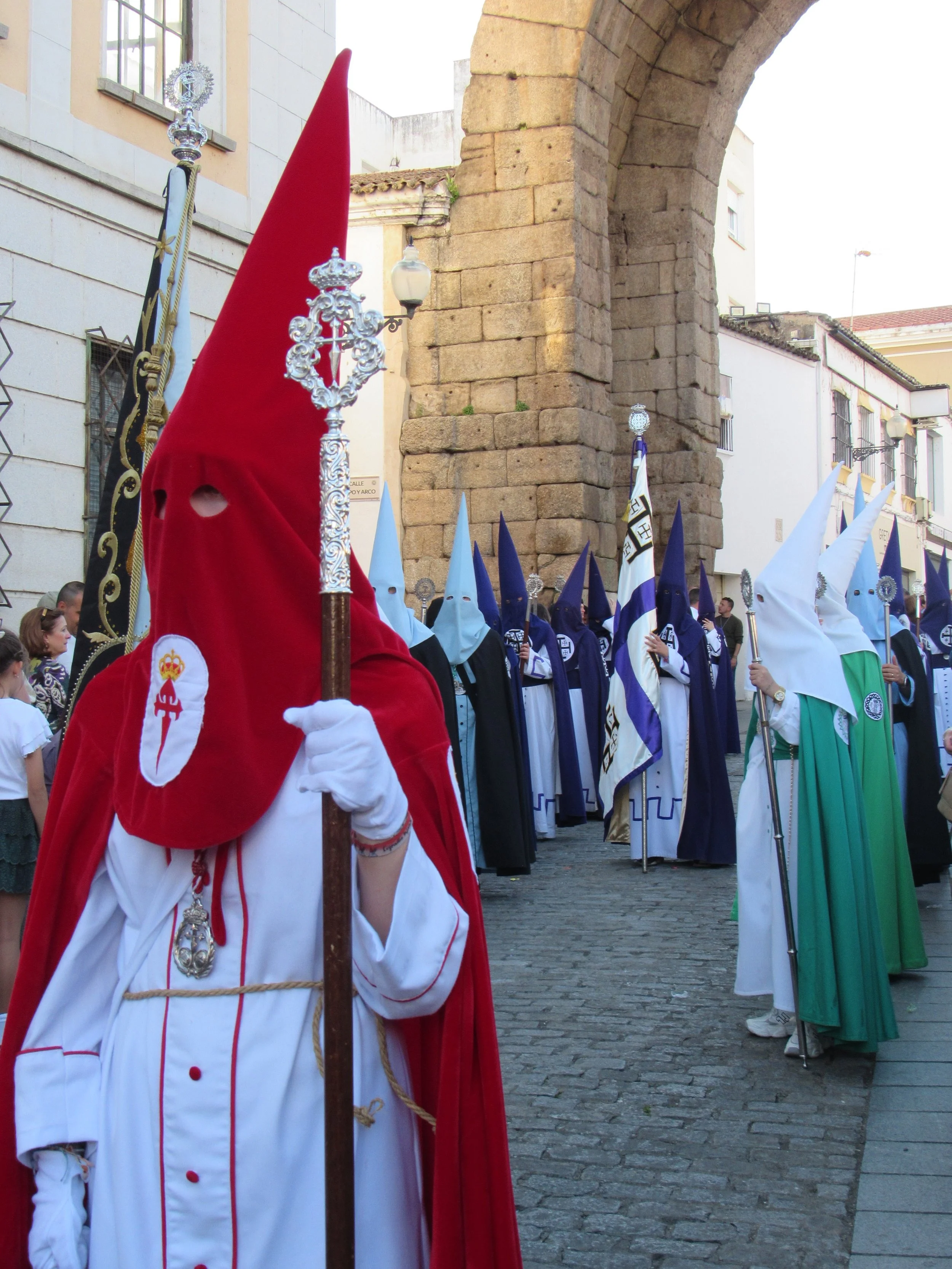
Eventually the procession started. There were two Orders in this procession. The first Brotherhood arrived, the hooded figures which had light blue robes and hoods with a black cape. A large cross being carried with ceremony. Everyone is walking in step. Stopping when signaled them moving again. The adults all hooded often walk with an ornate metal staff, topped with crosses or sometimes carried a candle. The children without hoods, just in the cloaks, hand out candy and cards.
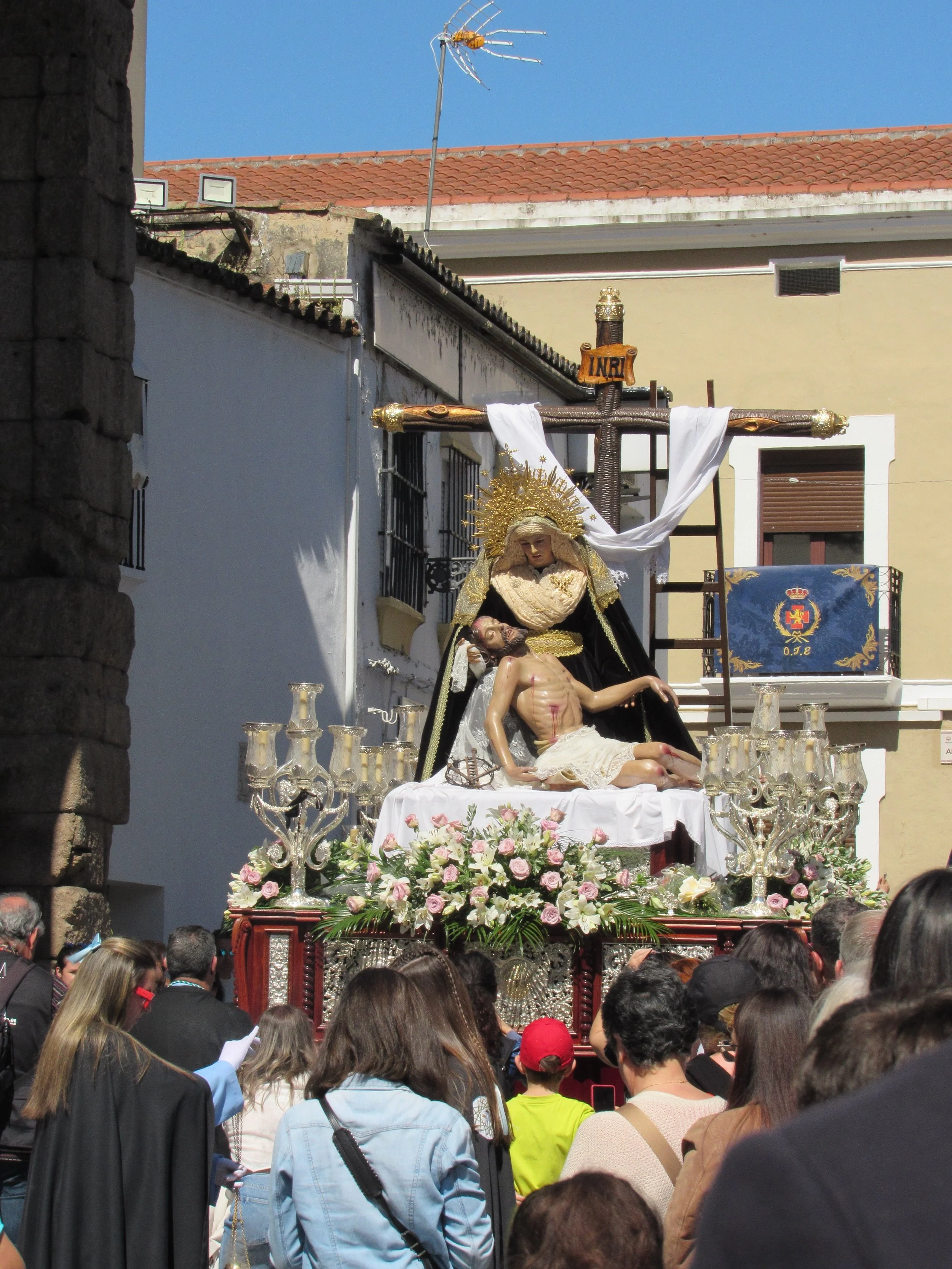
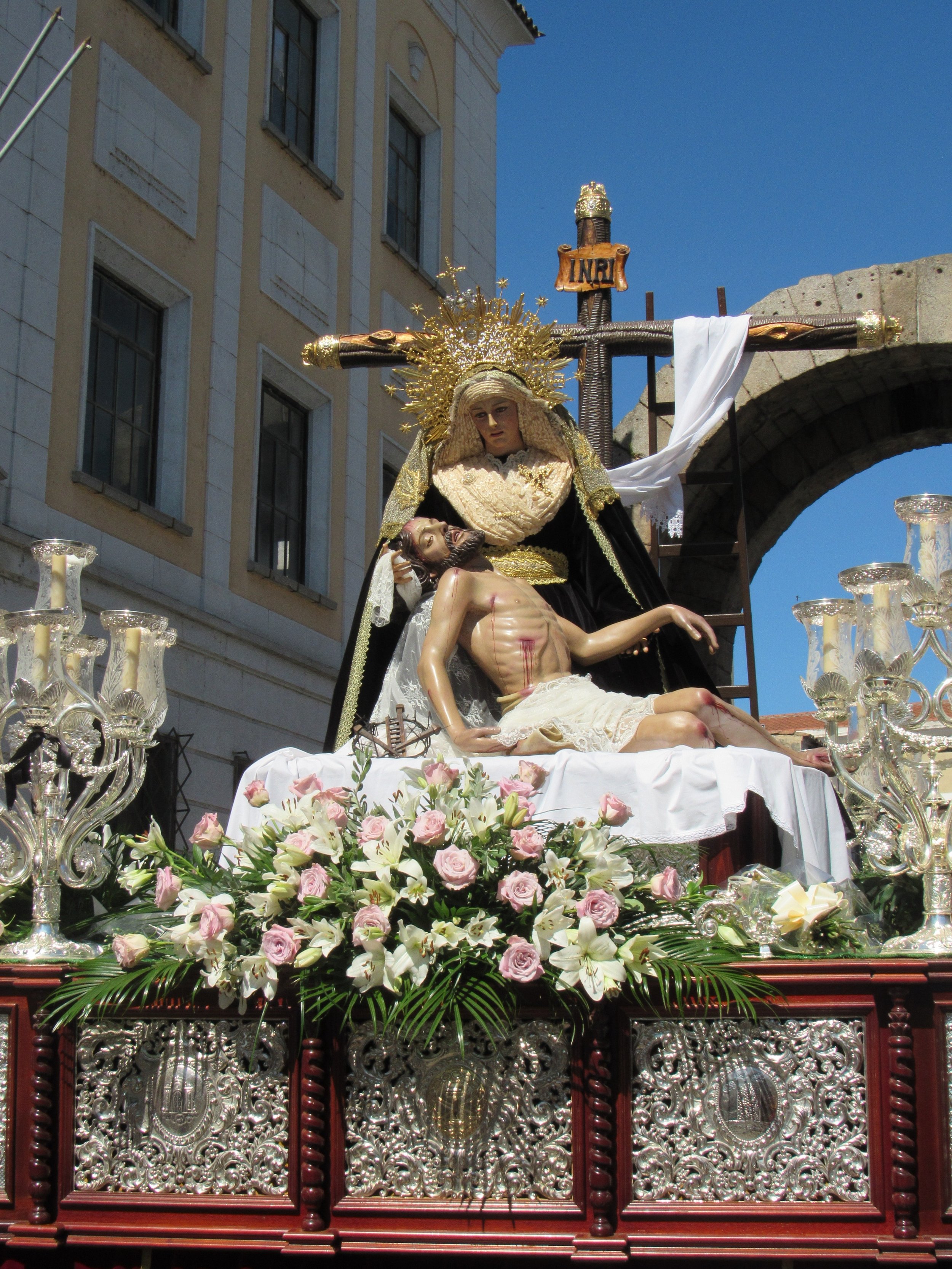
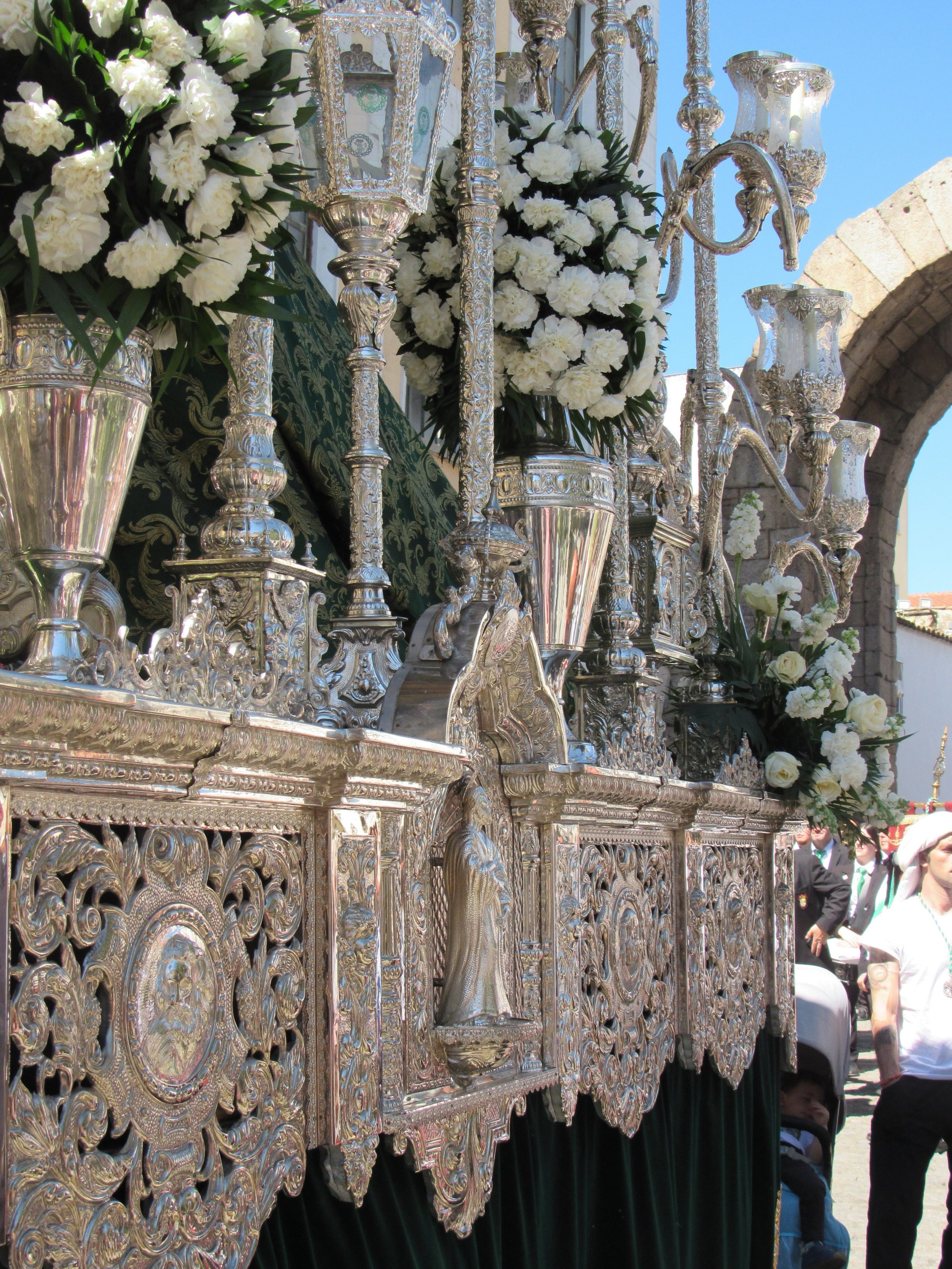
Then came the floats. The first was Mary holding a deceased Jeues bleeding from the wounds suffered on the cross, looming behind. Their base is a red mahogany and red velvet curtain to hide the people who walk the float along the procession. Ornate silver detailing is inlaid in square plaques along the wooden platform which is also adorned with candelabras and flowers.
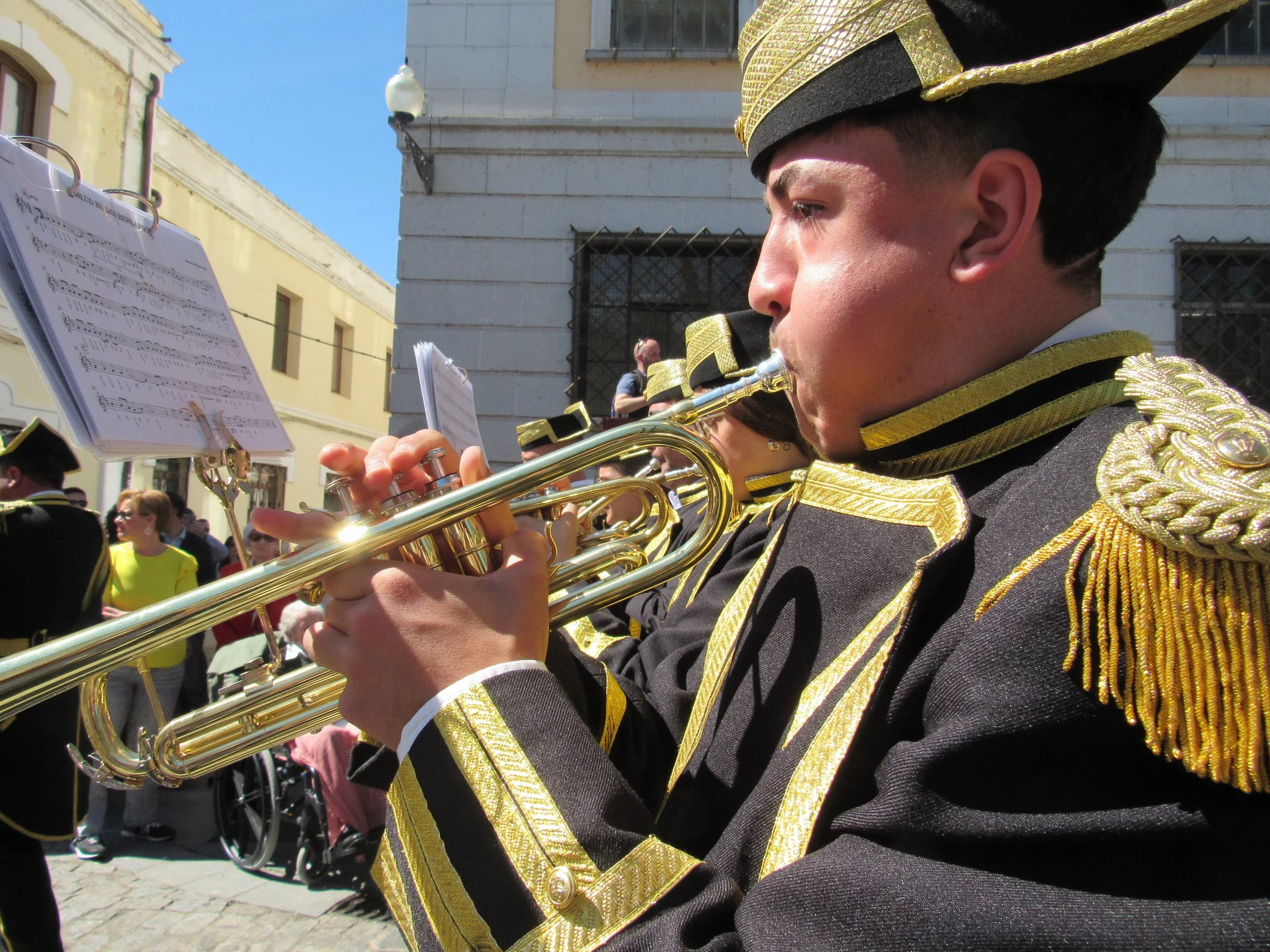
The float stopped just before it would pass me and continue on. They did this periodically to help the carriers rest, but also allow for folks to take pictures, which many did. Not just the news (who I saw frequently) but just parade watchers as well. Once they picked up and moved on, a marching band came though before the next brotherhood followed.
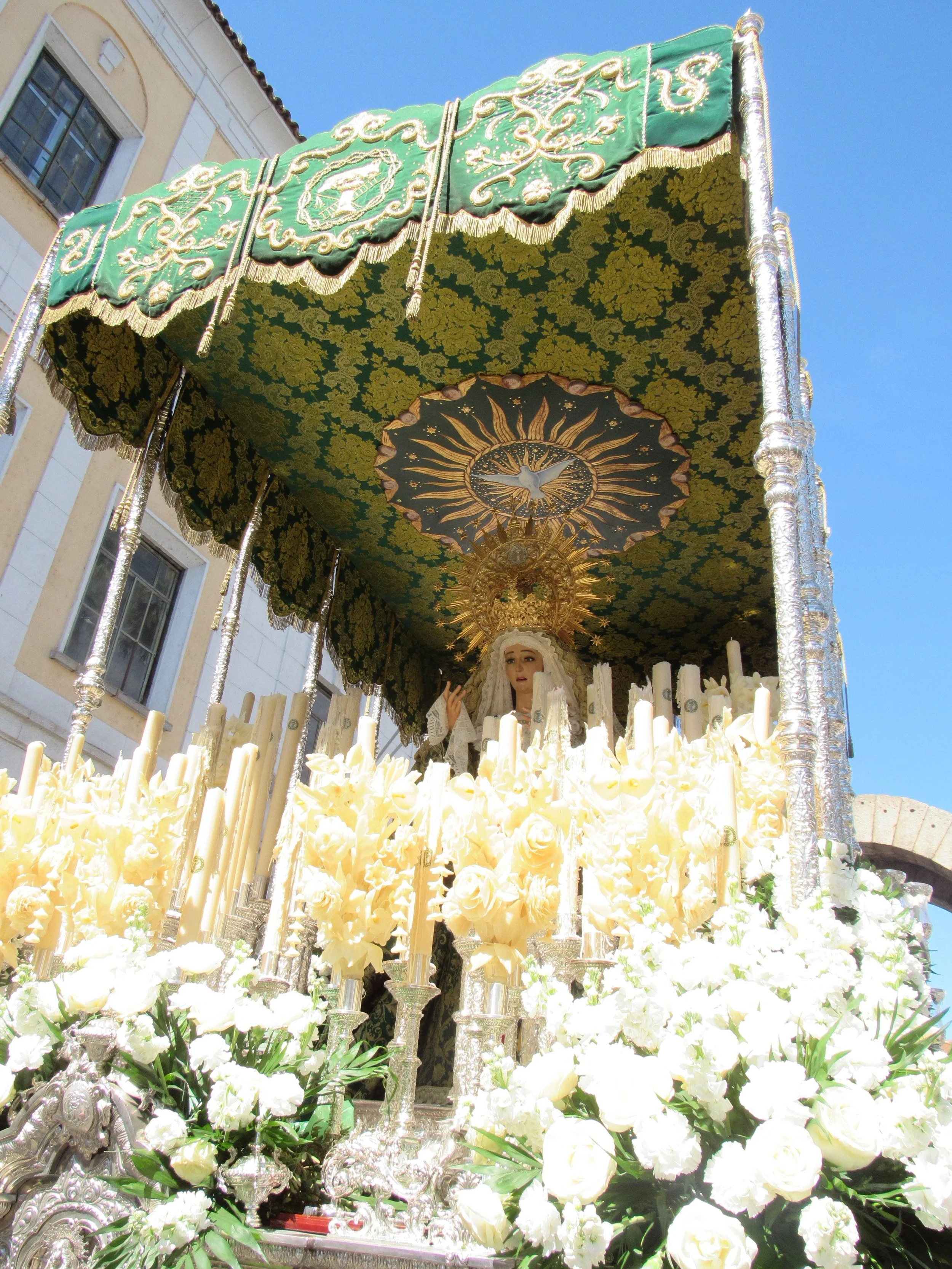
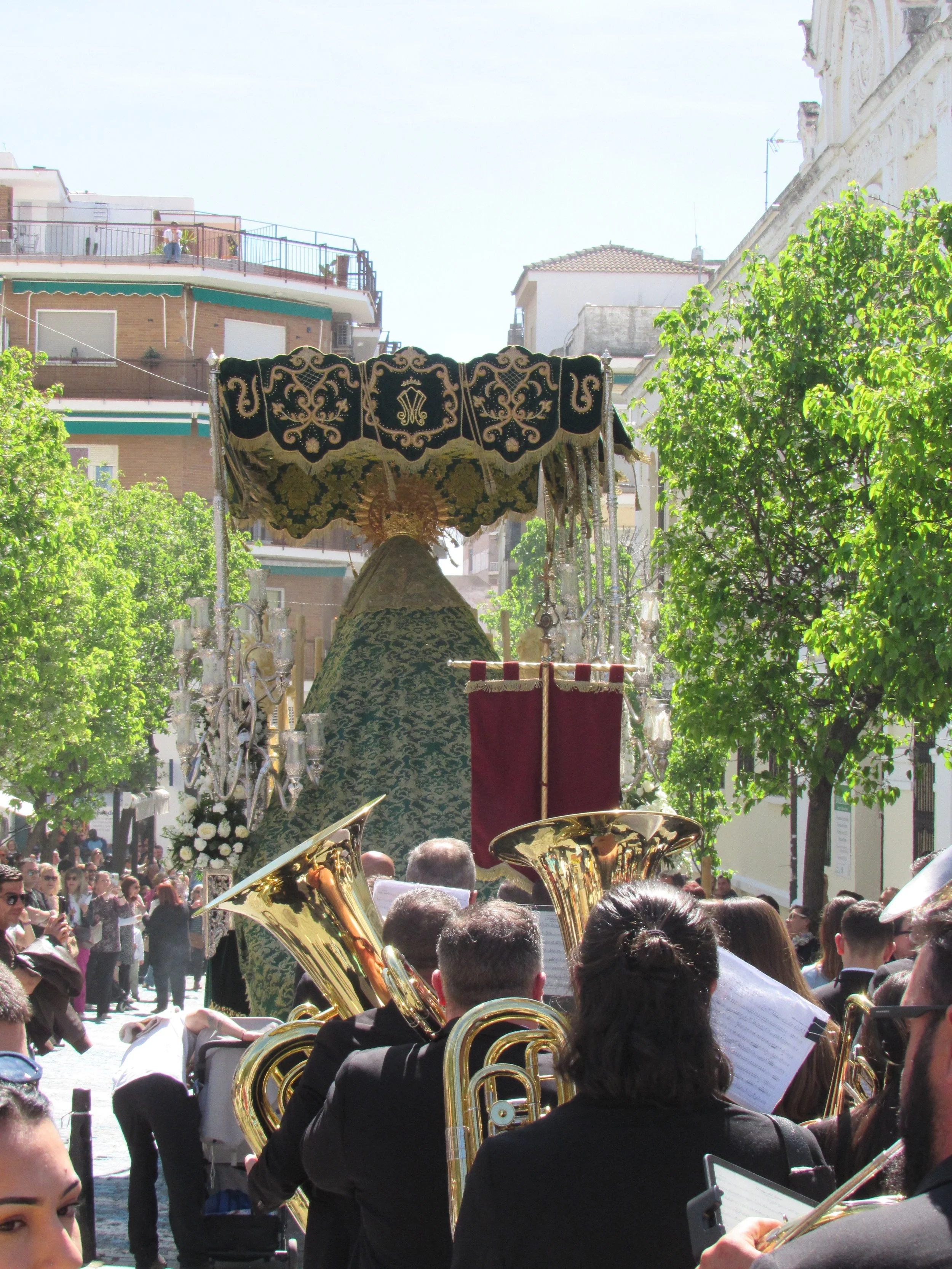
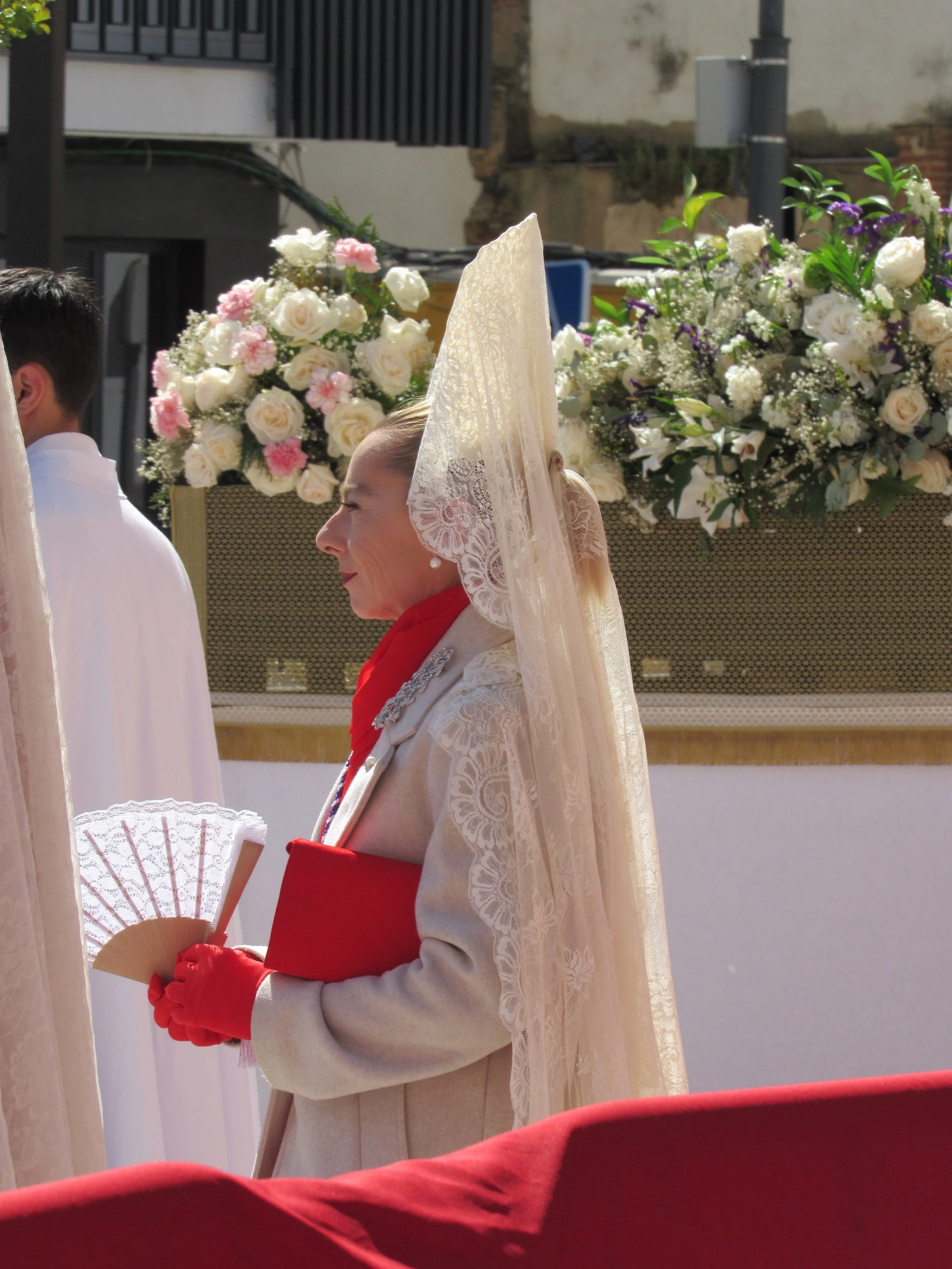
They had all white robes and hoods (a tiny bit of a jump scare) and bright mint capes. Same as before, walking in step and stopping and starting when told. They had women in traditional black dress and headdresses proceeding the float, which was Mary. This one was an ornate silver platform with a kneeling Mary surrounded by flowers and stick candles and under the most spectacular emerald and gold ornate canopy with a dove flying above her head, adorned in the gold starburst .
This one stopped roughly in the same spot as the previous. The usual photography began, but the woman across from me in the wheelchair was approached by an (unhooded) father or priest who seemed to have some authority within the brotherhood. She was wheeled to the front of the float, and I think blessed. She cried, the priest or father kneeled down in front of her and spoke. The family crowded around and the man pulled some flowers from the float and handed it to the woman in the wheel chair. She made the sign of the cross and then was wheeled back to the side of the street.
Not long after that the float picked up and moved on. The many dozens of feet shuffling along underneath its base. Another band followed behind and then people filed in behind them to follow the procession, Others walked away from on to other things for the day.
I was ready to eat again, and knew I would hopefully have a late night after the Via Crucis, so I decided to get some groceries and then rest up before the rest of my day. I found the closest spot, a Corvina. There I grabbed a sandwich and a bag of chips for lunch. For dinner a baguette, prosciutto (jamon), cheese, more water, corn snacks, some candy and chocolate.
I then walked back to my hostal. This time I found another route though the aqueduct park, instead of the previous route. This time I was led under the train tracks through a pedestrian tunnel that opens up to the Roman aqueduct ruins, the main feature where birds nested at every level and the grassy lawn below where people picniced and walked their dogs. There were pedestrian bridges over the aqueduct river. In the shallows, birds swam and played. Then a path through the trees along the river that then led up toward the residential area to my hostal. I unpacked and ate lunch, charged devices and rested. Then I packed my backpack with warm clothes and snacks and make the walk back towards the Trojan Arch through the aqueduct ruins for the second procession of the day.
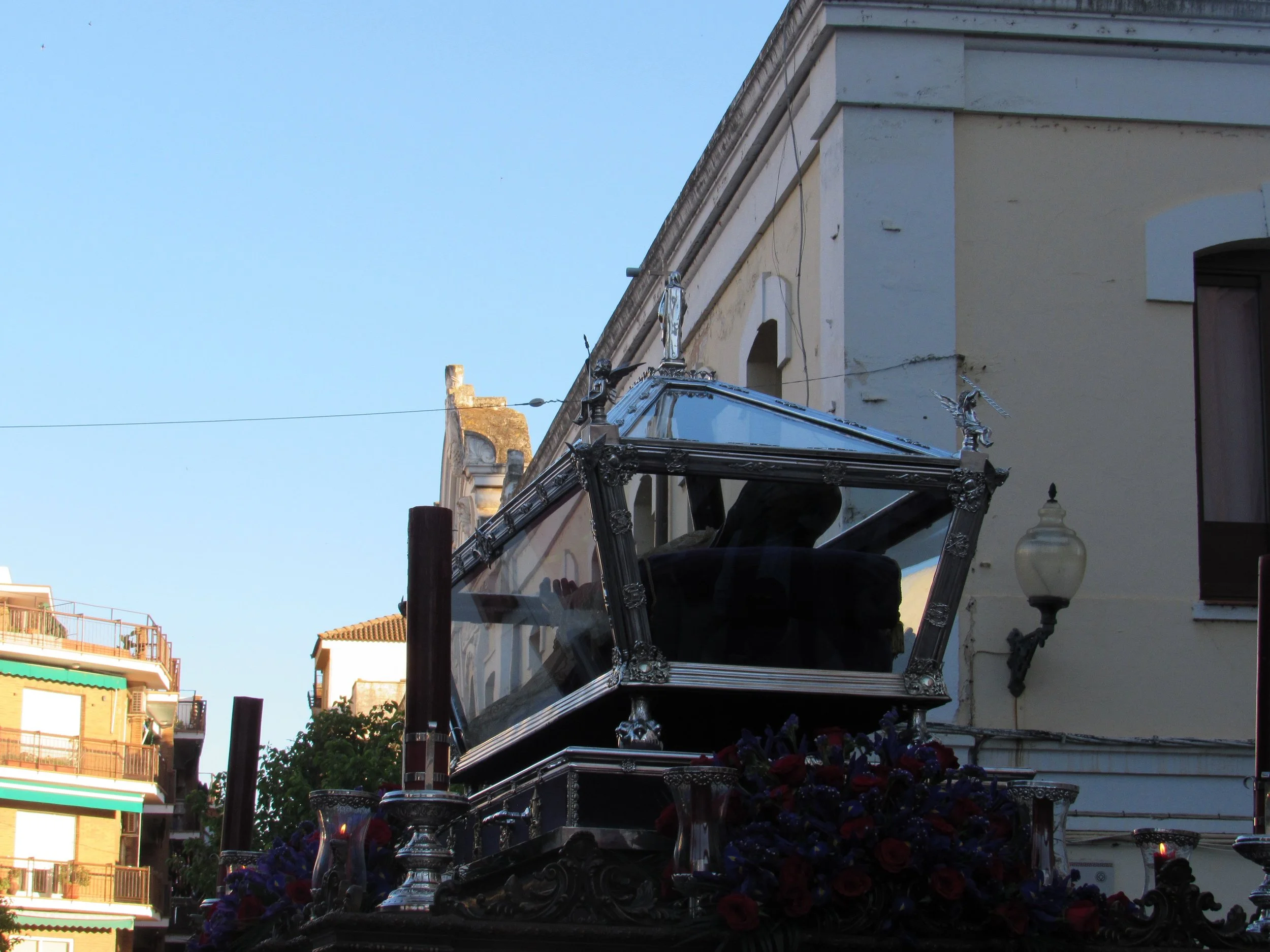
I found a similar spot to where I was earlier in the day. This procession started much the same as the others. Men and women in robes, hoods and capes of varying colors. Walk, stop, walk. Kids handing out candy. This procession had multiple brotherhoods, 3-4 before the first float. This, unlike all the previous, was not accompanied by the band behind them. It was a clear silver coffin, with a replicated corpse inside. This platform was carved dark wood, and adorned with dark flowers and tall thick deep red candles in glass.
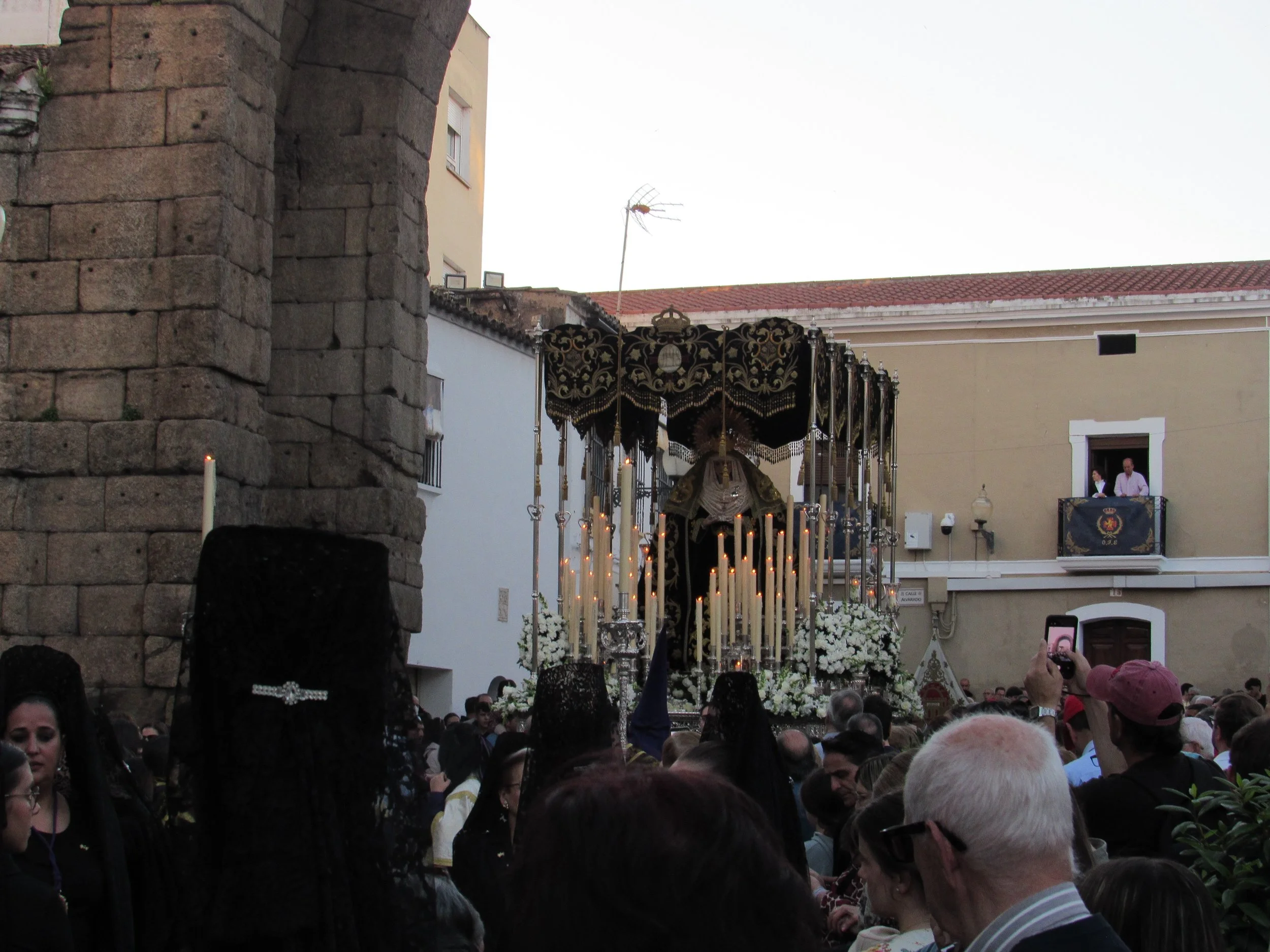
They were followed by more ladies in mourning black dresses and headdresses, before the next float which was another kneeling Mary on an ornate silver platform. Surrounded by tall candlesticks and under a black and gold canopy her head adorned with a sunburst crown of gold and garment draping off the back. She was followed by a band, playing more somber music. As the procession continued onward, people followed in its wake while others headed elsewhere.
It was late in the day when the procession ended. The sun was setting and I walked back over to the amphitheater plaza. There were people milling about but no clear line or spot for Via Crucis tickets. I walked around a bit, and then back to the plaza. Past the restaurant and near the Merida sign a line had formed. There was what looked like a small building that had a ticket window, and about 40-50 people lined up.
This was what I was looking for. So I hopped in line. About 10 minutes later a family came up beside me and in Spanish started to ask about the line. I said I did not understand what they were asking, but the woman in front of me, chimed in and let them, and assured me this was the line for Via Crucis tickets.
I settled in, scrolled on my phone for a bit. Not knowing when I would get to the bathroom, I sipped on water only but did eat a lof of my snacks. As time ticked forward, I looked up to see the line had grown. It snaked far behind me across the plaza, along the barricade to the amphitheater ruins past the entry ticket booth and down the street. There were possibly hundreds of people in line.
I thought we would be getting tickets around 11:30pm, with the prayer starting at midnight. I was an hour ahead of schedule. At around 12:30 they started handing out tickets and a full booklet with information. I got mine and then followed the line to wait for entry into the amphitheater grounds.
While we waited, the line for tickets continued to move, and then about 8 guys dressed in roman regalia, and shields arrived. They stationed themselves outside the ticket booth, next to the entry where we were lined up. People took photos with them while we waited.
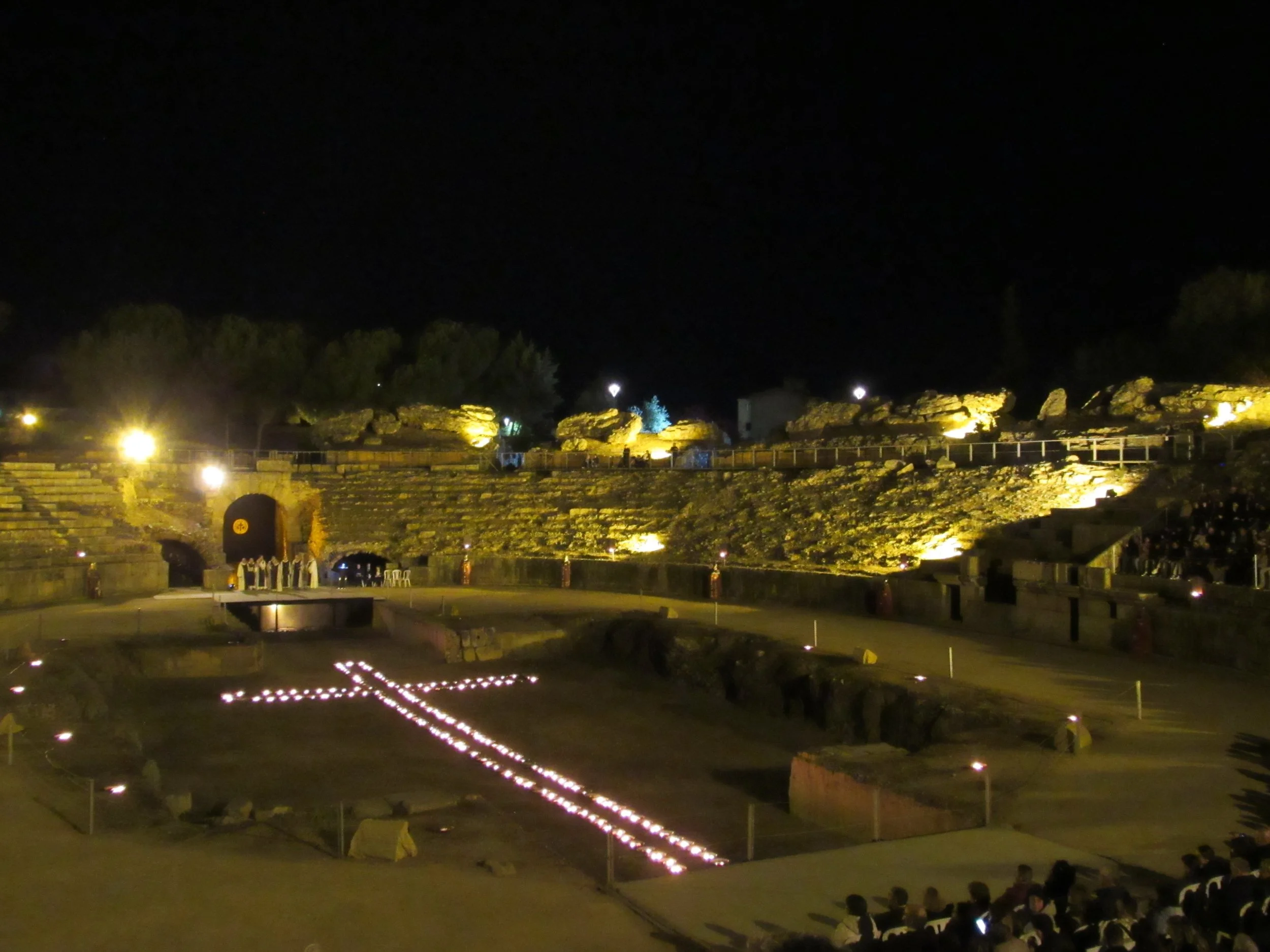
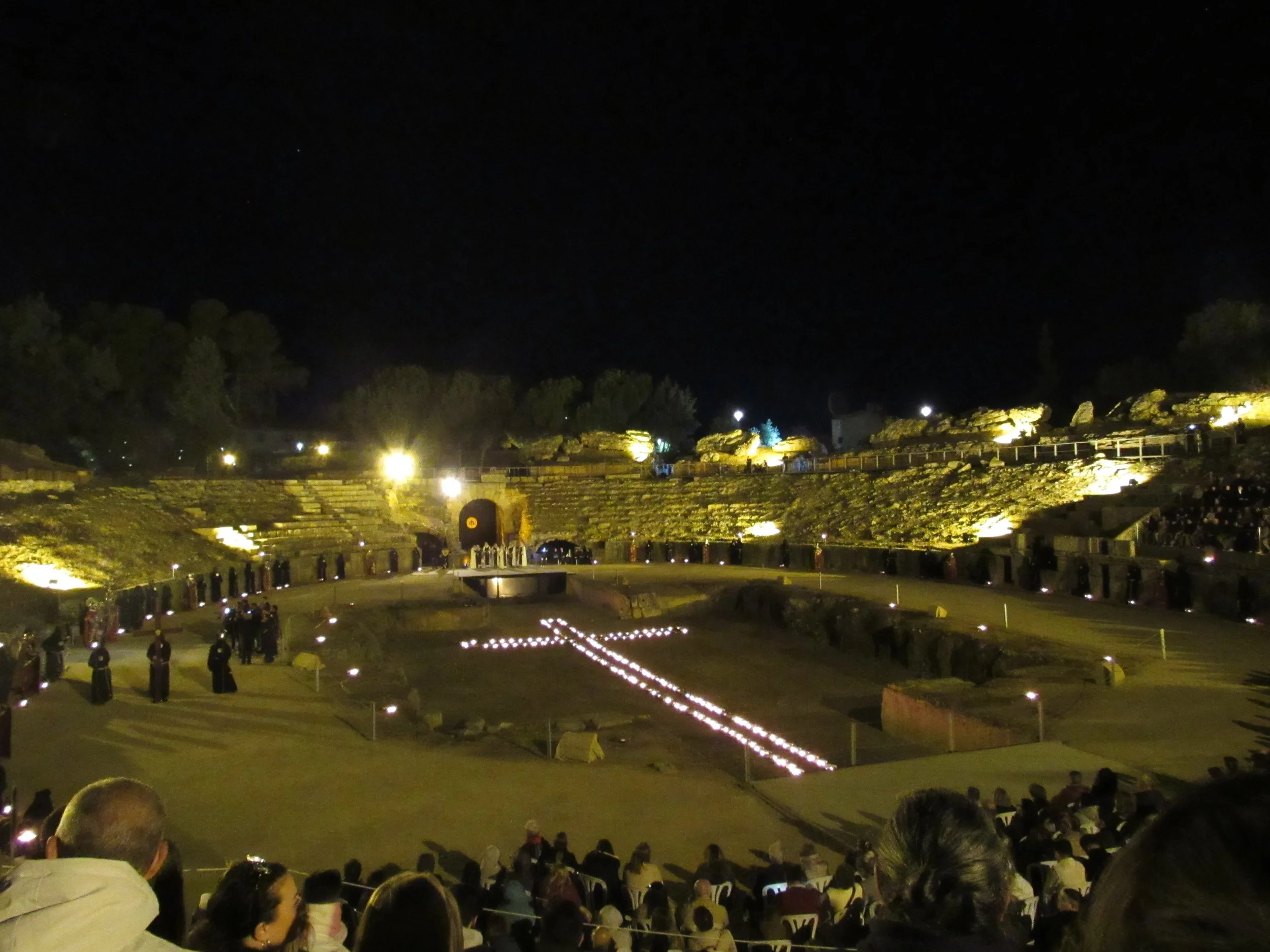
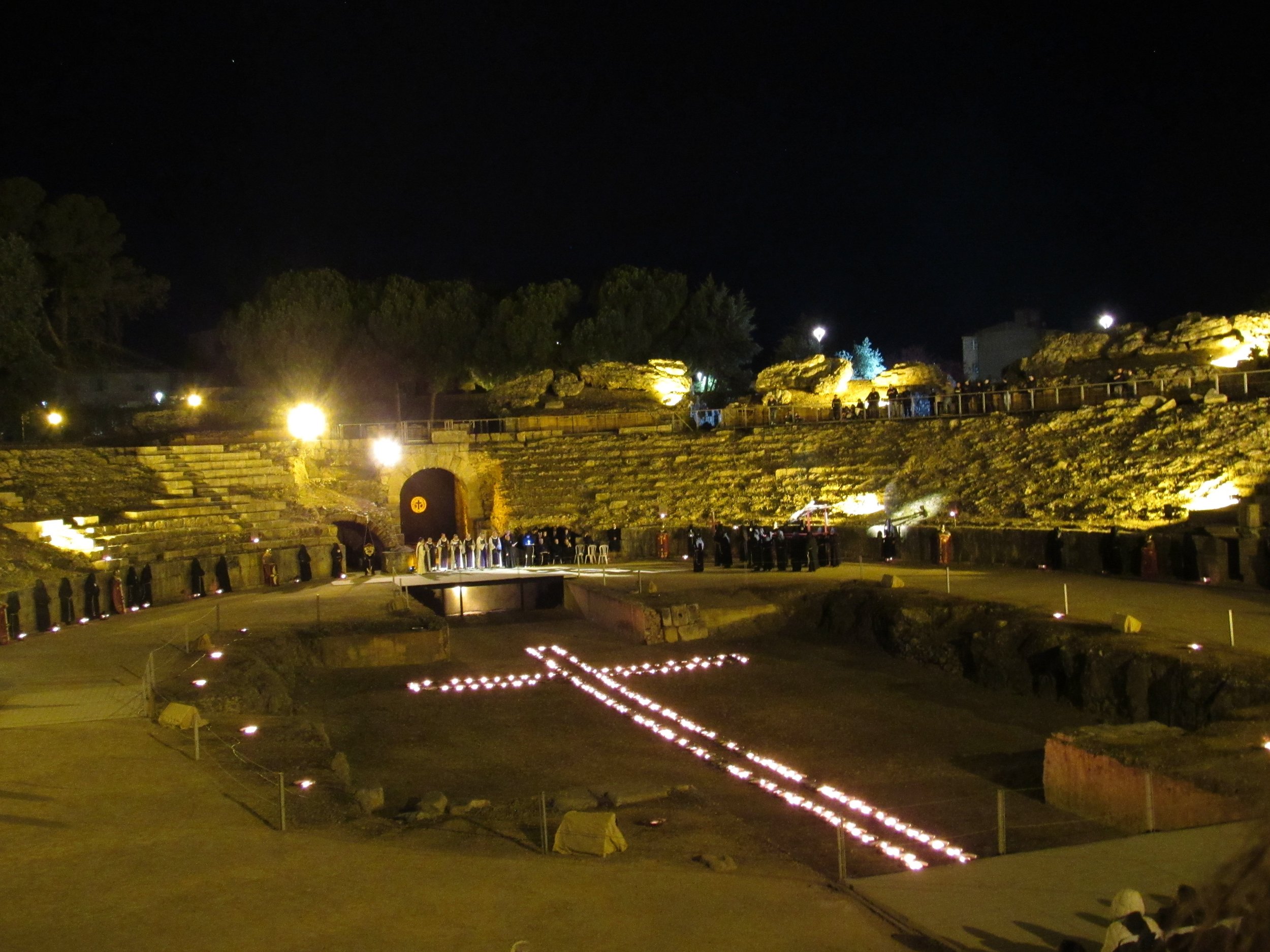
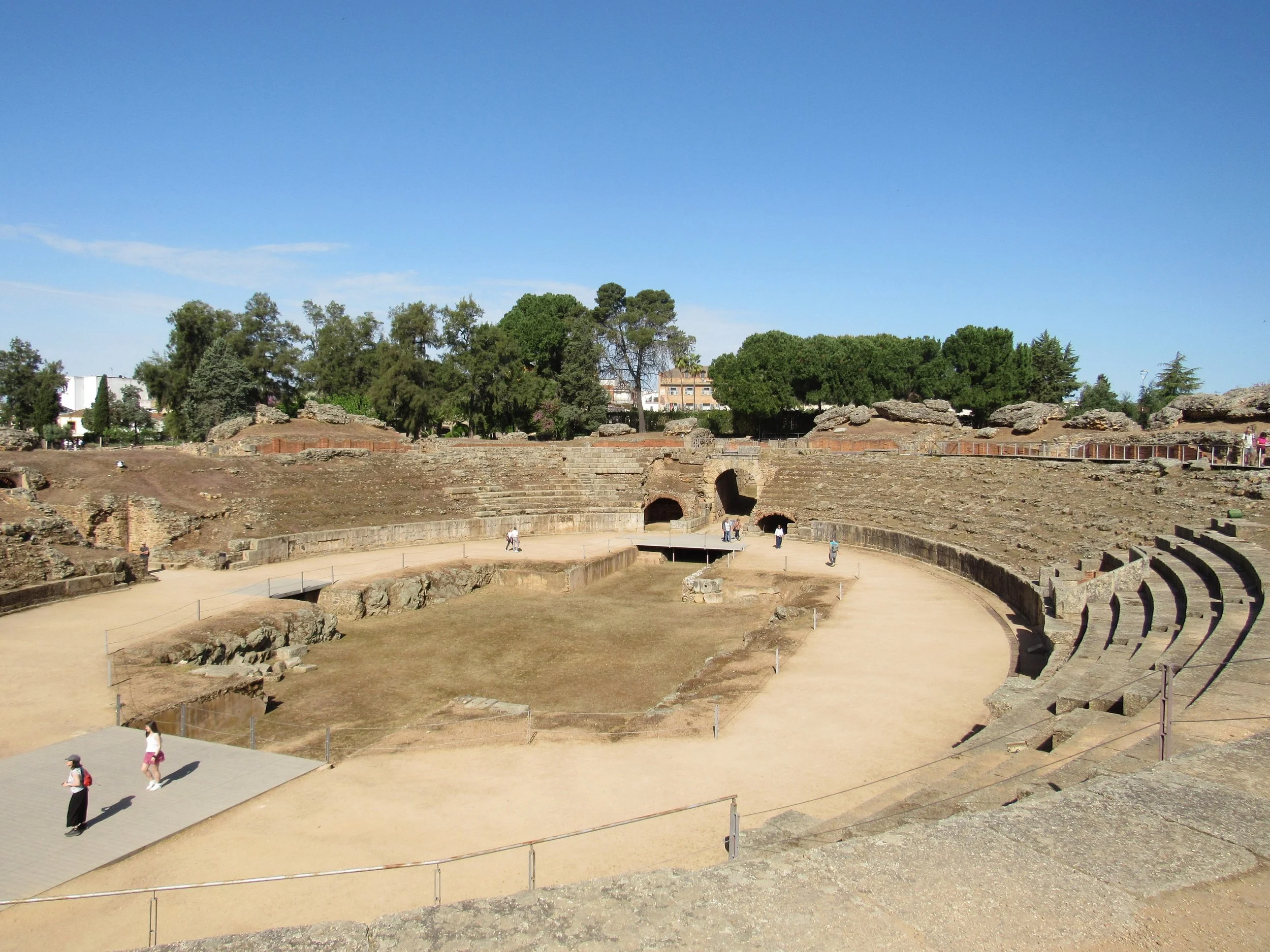
Then they opened the gates and started letting us through. Checking tickets, and marking them used by tearing a corner. I continued to follow the crowd and was led around to a side entrance to the amphitheater stands. Inside was an open arena with a rectangular sunken center. A large cross made up from individual candles spread across the sunken space. Surrounding the sunken cross is a circular path for traversing the arena.
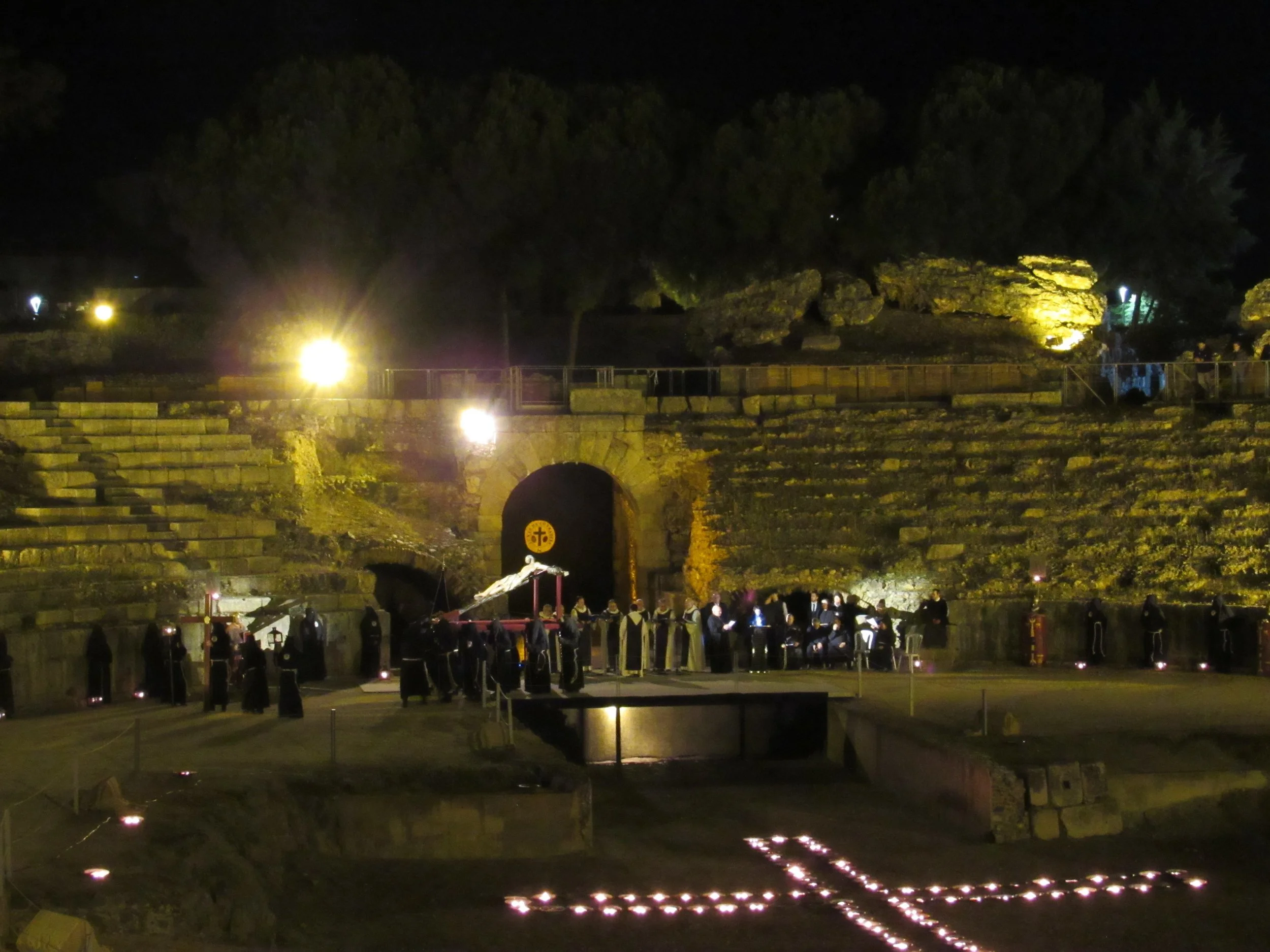
At one end the religious folks in their hooded regalia of white and purple, microphones and speakers ready to go, and us at the other end in the stands. On the arena floor directly below the stands were plastic chairs for people who followed the procession instead of waiting in the line I was in. People streamed in for a good 30 minutes. Finding seats within the stands. As it got full a man started finding empty spaces and asking people how many were in their party and finding them spots together.
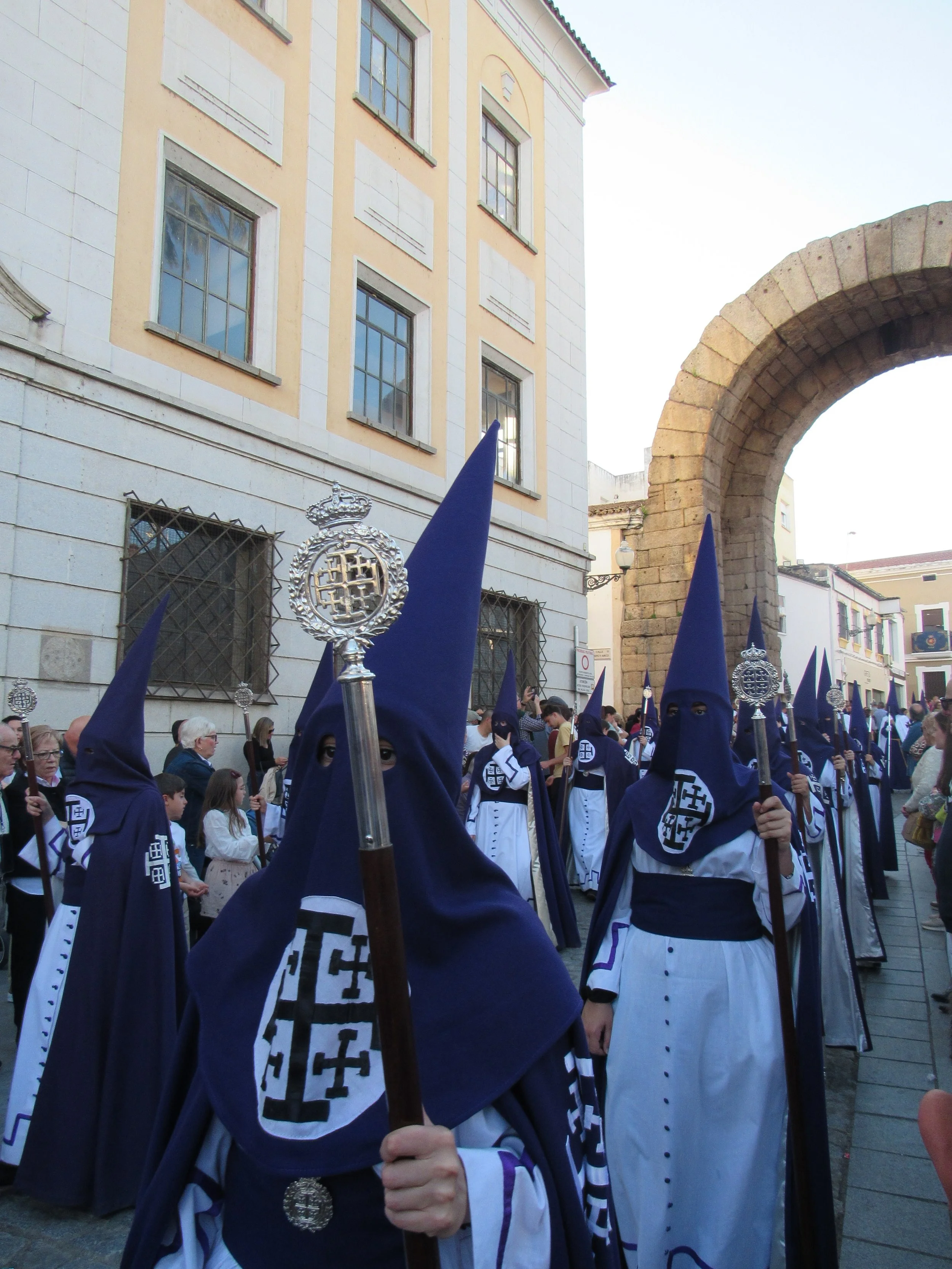
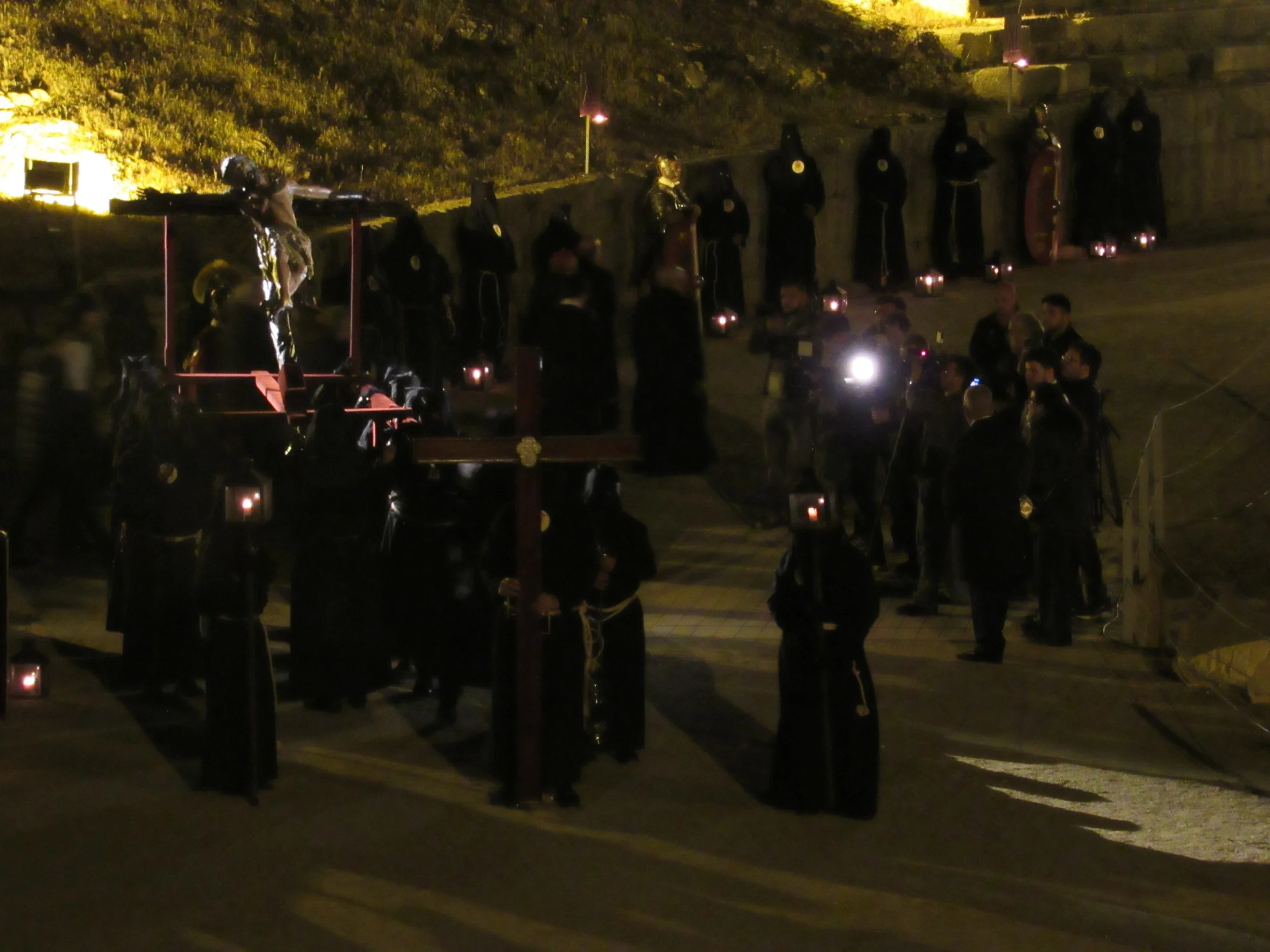
Finally people started entering on the arena level from the entrance, halfway around the area to the left and filling up the seats on the arena floor. When most seats were filled it quitted and the prayer started. First the Romans entered and made an equidistant circle around the arena walls. Then the same number of men in black hoods and robes spread evenly between them. Alternating their way around the arena.
In the guide book it was clear, DO NOT speak. It's not a concert, it's a prayer. Sit and listen. So I did. It started with a chant, by one of the folks at the microphone. Then a replica of Jesus on the cross carried by more hooded men in black entered from the same opening. Then another person stepped up and read their chant/prayer, the last phrase the same as the chant before.
Between each prayer the replica Jesus on the cross would move around the circular path, counterclockwise about 10 steps at a time. This continued on all the way around the arena. I sat on the Ampetheather stands, the moon out, bats occasionally flying overhead while the promenade went on.
About halfway through people started to get up and leave (even though it was expressly told not to unless it was an emergency). It was cold and by the end I needed the rest room and dinner, still stayed through the end. The procession finished, the last prayer was said and we then began the slow exit.
Once out of the stands and back to the grounds I used my quickest New Yorker walk to exit and book it back to my hostal, since it was about 2am. I walked through the quiet streets of the nearby neighborhood. Across a busy roadway back under the train tracks through the industrial district, across the bridges and along the park back to the hostal.
Luckily I knew I had to key card my way into the lobby. I did my best to walk silently in the echo-y hallway and into my room. There were only hard surfaces, so every move I made did echo in the hallway, even closing and locking my door. I am so glad I bought food. I ate my deconstructed sandwich of baguette, prosciutto and cheese, and happily crawled right into bed and fast asleep.
—
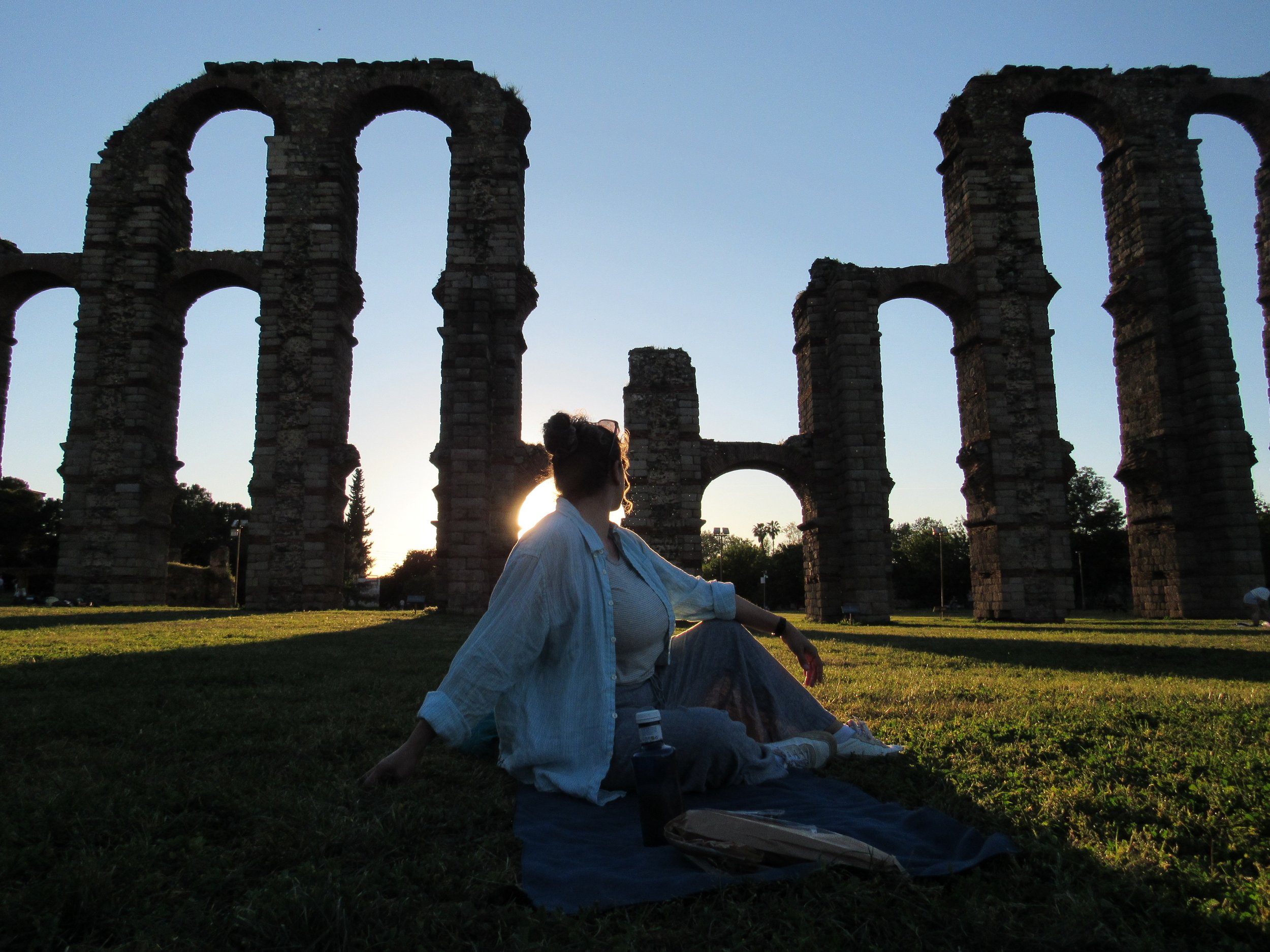
The next day there were no events, a break in the festivities so I slept in, but managed to get up in time to get breakfast and coffee at the hostal’s cafe. After a lazy morning, I walked to Mercadona, a Spanish grocery store and bought more groceries for lunch and dinner. I then worked on podcast stuff in the afternoon before heading to the aqueduct park for a sunset picnic.
There I laid out my travel towel in the shade of the ruins, and had a picnic. I watched the birds and the people. Teenagers and young adults hung out on blankets. Sometimes snacking, but usually just sitting around and talking. Families are on walks, some with littles in strollers or trikes. Dogs run everywhere either followed by their owner or strays looking to snag food (which almost happened to me!). I watched the sun set and then took a twilight walk the long way around on the roman bridge still in use before heading back along the park path to my hostal for the night.
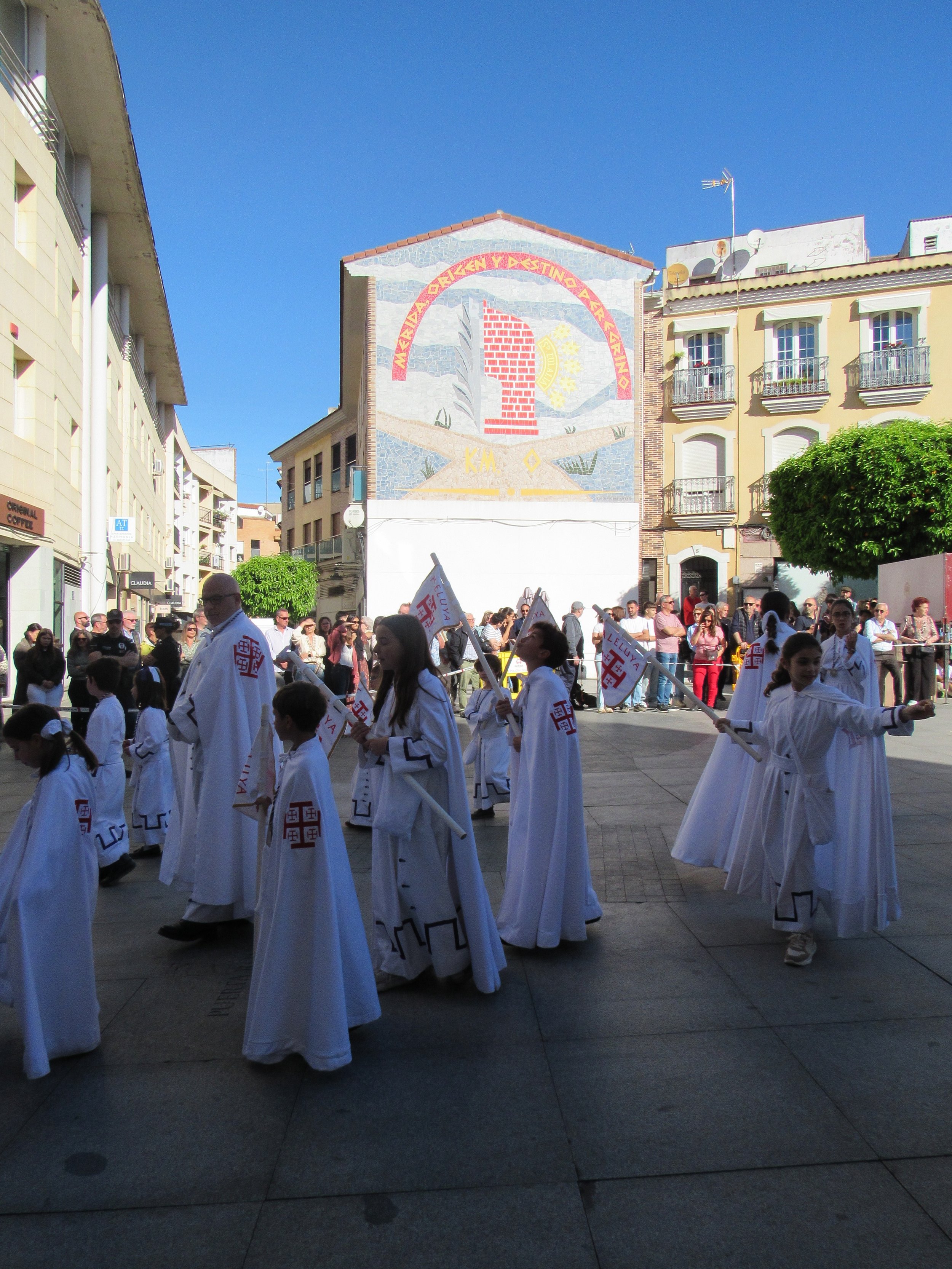
Easter Sunday. The last procession, and the culmination of all the holiday festivities. I got up early, got coffee and breakfast in the hostal and then made my way to the Puerta de la Villa. And the guide book was recommended as a good spot. It has a fountain with a statue of the city’s patron, Saint Eulalia a bit north of center. Streets feed into the plaza from all directions, and it is foot traffic only. A cafe takes up the southern storefront, nestled along one end, a bit of preserved Roman road. A large mural with red and gold on the perpendicular building face is painted, the only color. Below this is the cafe’s outdoor seating. The rest of the plaza is faced by shop fronts with either residential or office space above in white and yellow stucco buildings.
I found an open bit of cobblestone along the route, next to a pharmacy and a children's clothing store, just south of the statue and across from the mural. One of the media platforms at the far corner of the pharmacy. Policemen were the first to arrive and finish barricading/ roping off the center of the plaza from the two streets on the east and west sides.
Soon the procession arrived. There are two northern entrances to the plaza. From the left entrance the first procession started to trickle in. There were no hoods today, but otherwise everyone, which was mostly women and children, were in white robes/capes with purple detailing and a red cross.
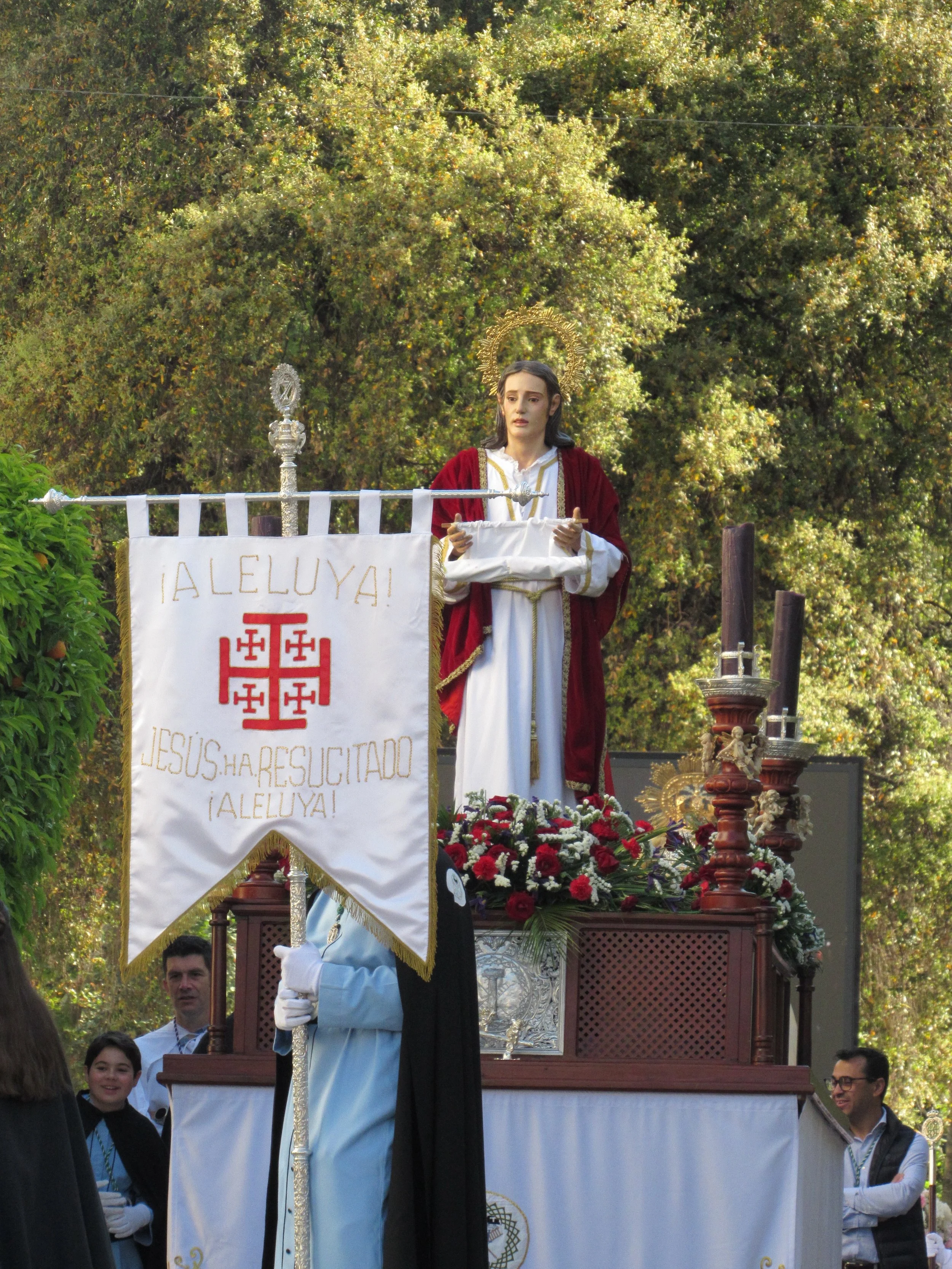
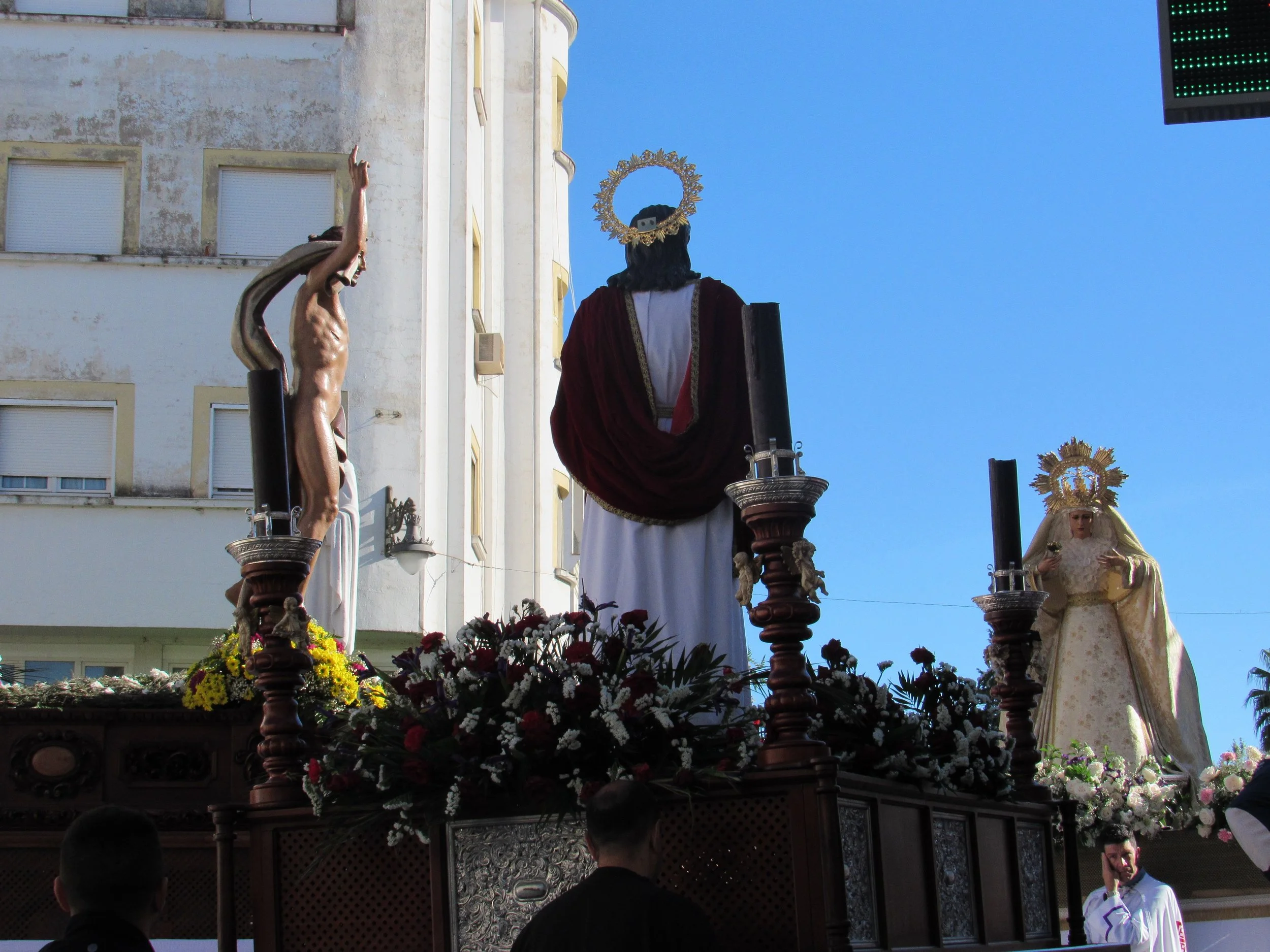
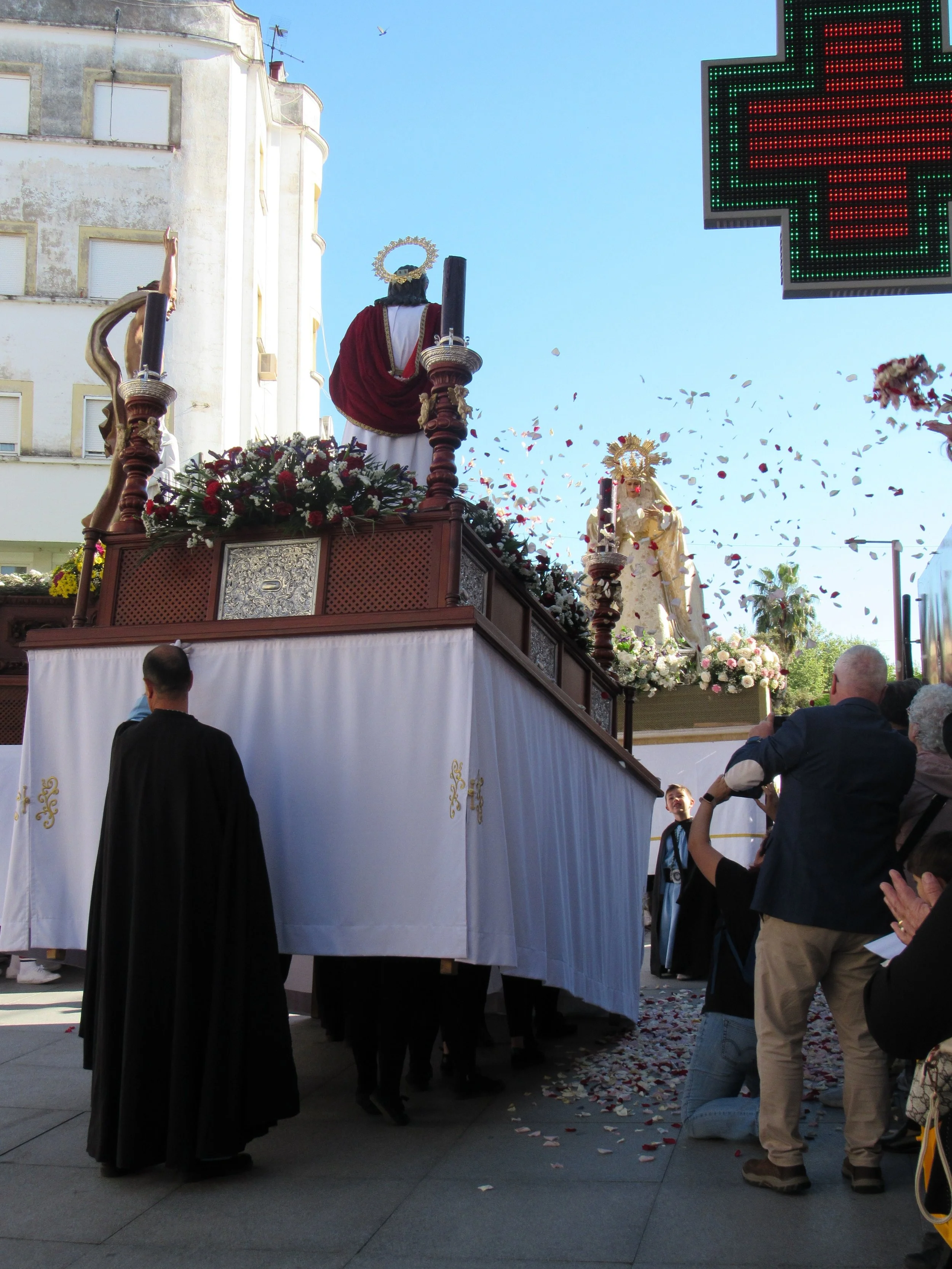
Then from the right entrance came more people in robes, no hoods, this Brotherhood was a mix of mostly young women and girls light blue/black and young men and boys in green/white. Following behind them came the first float. St. John, in a white robe, red cape and a scroll, or rolled white cloth in his hand, gold halo. The float’s platform is made of a dark/reddish wood, standing in a bed of red and white flowers and pillar candles at each corner.
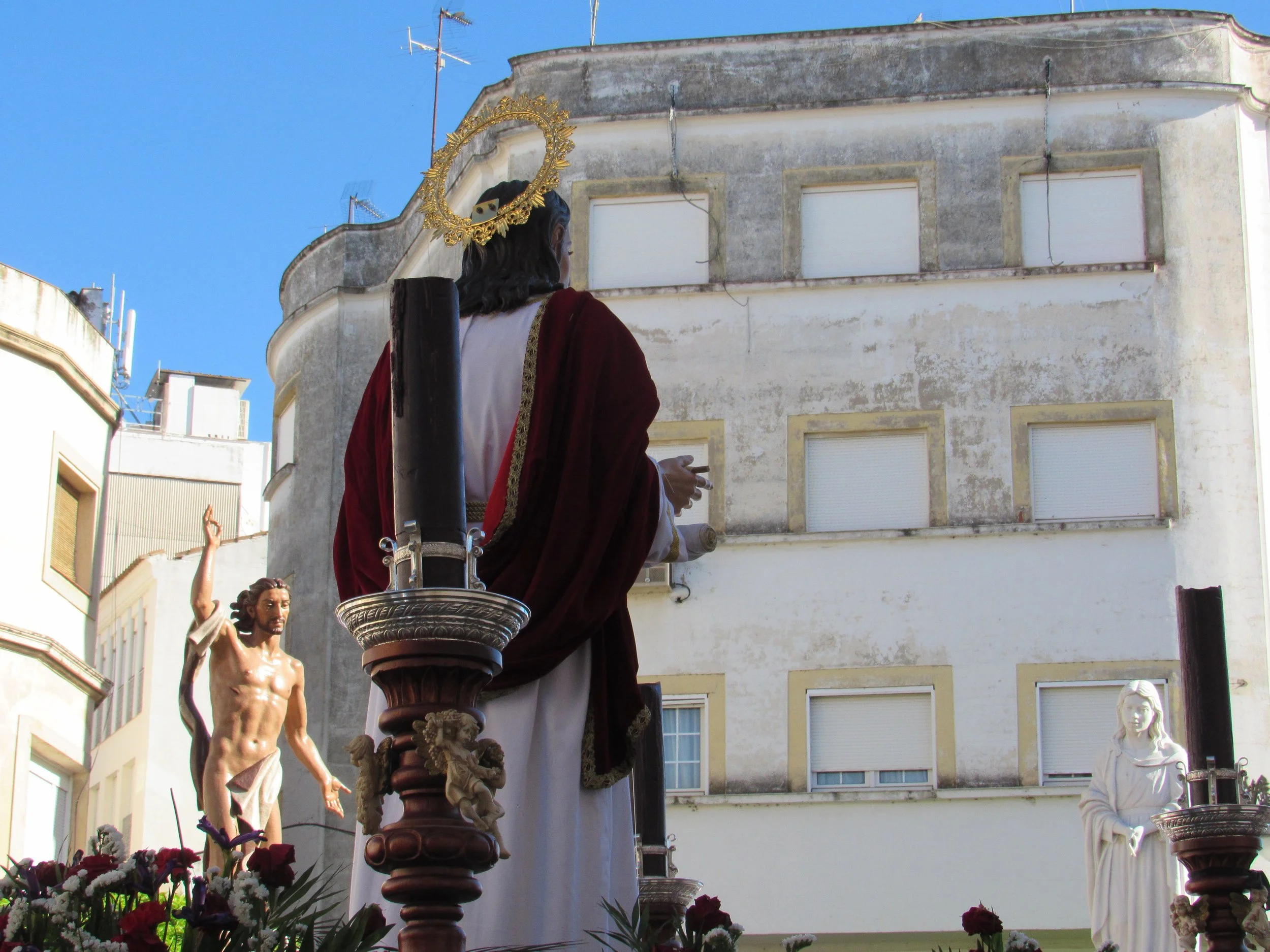
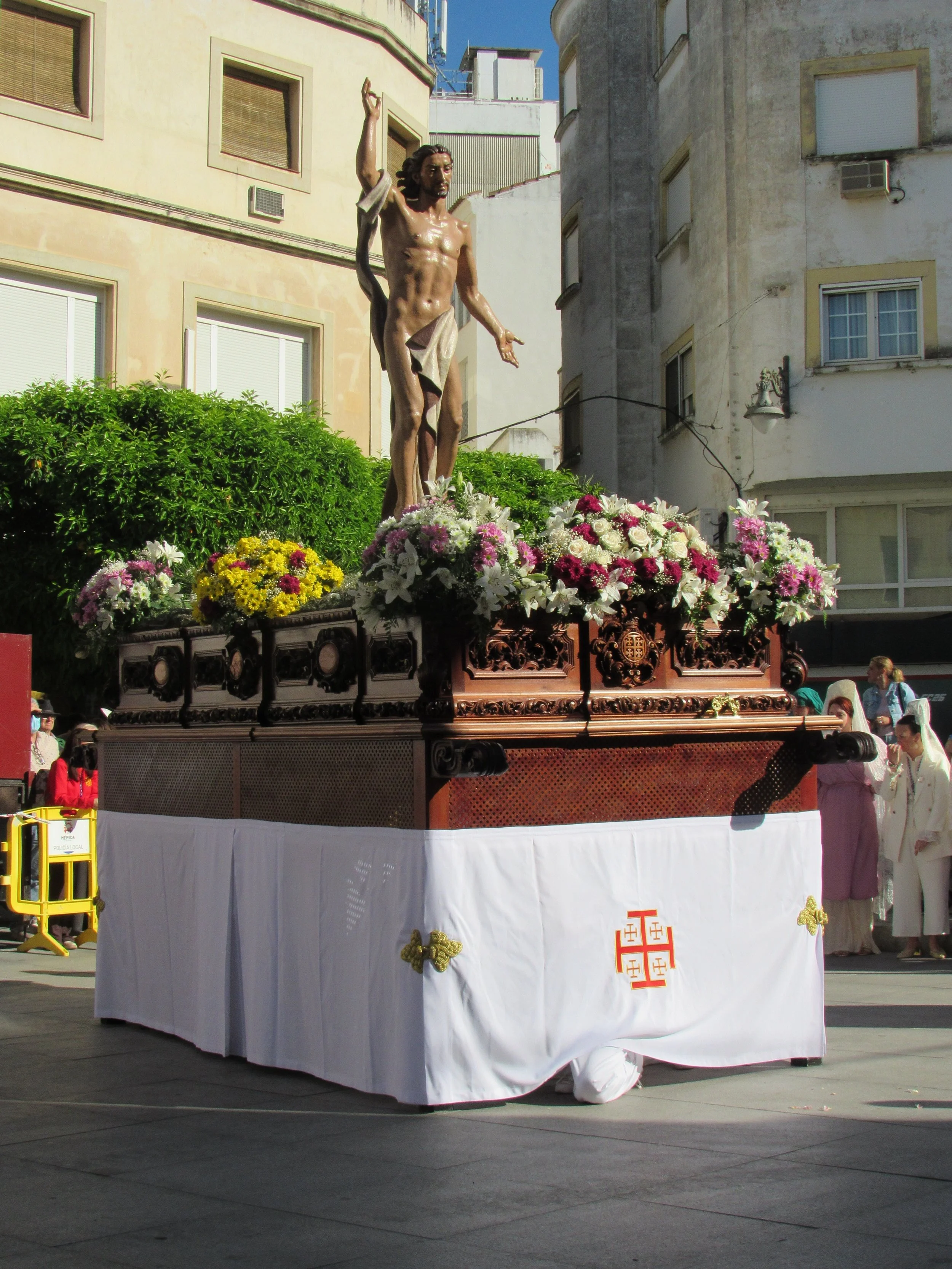
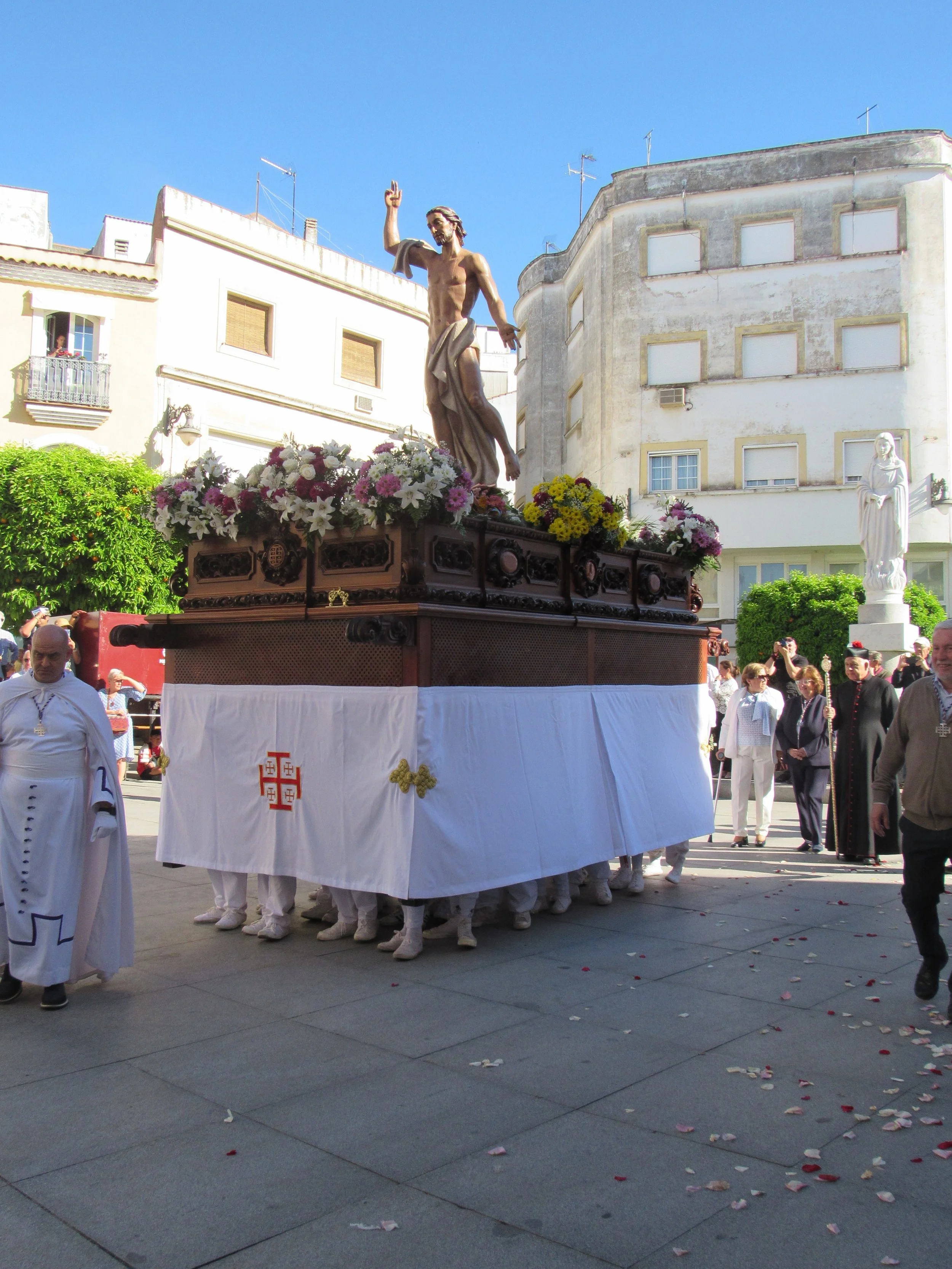
Then from the northern left entrance came the second float. A resurrected Jesus. On another dark wood float pink, yellow, and white flowers around the perimeter. His arm raised,hair flying like a gust of wind had come though, and a cloth over the shoulder falling down the back and around the front, artfully covering his bits.
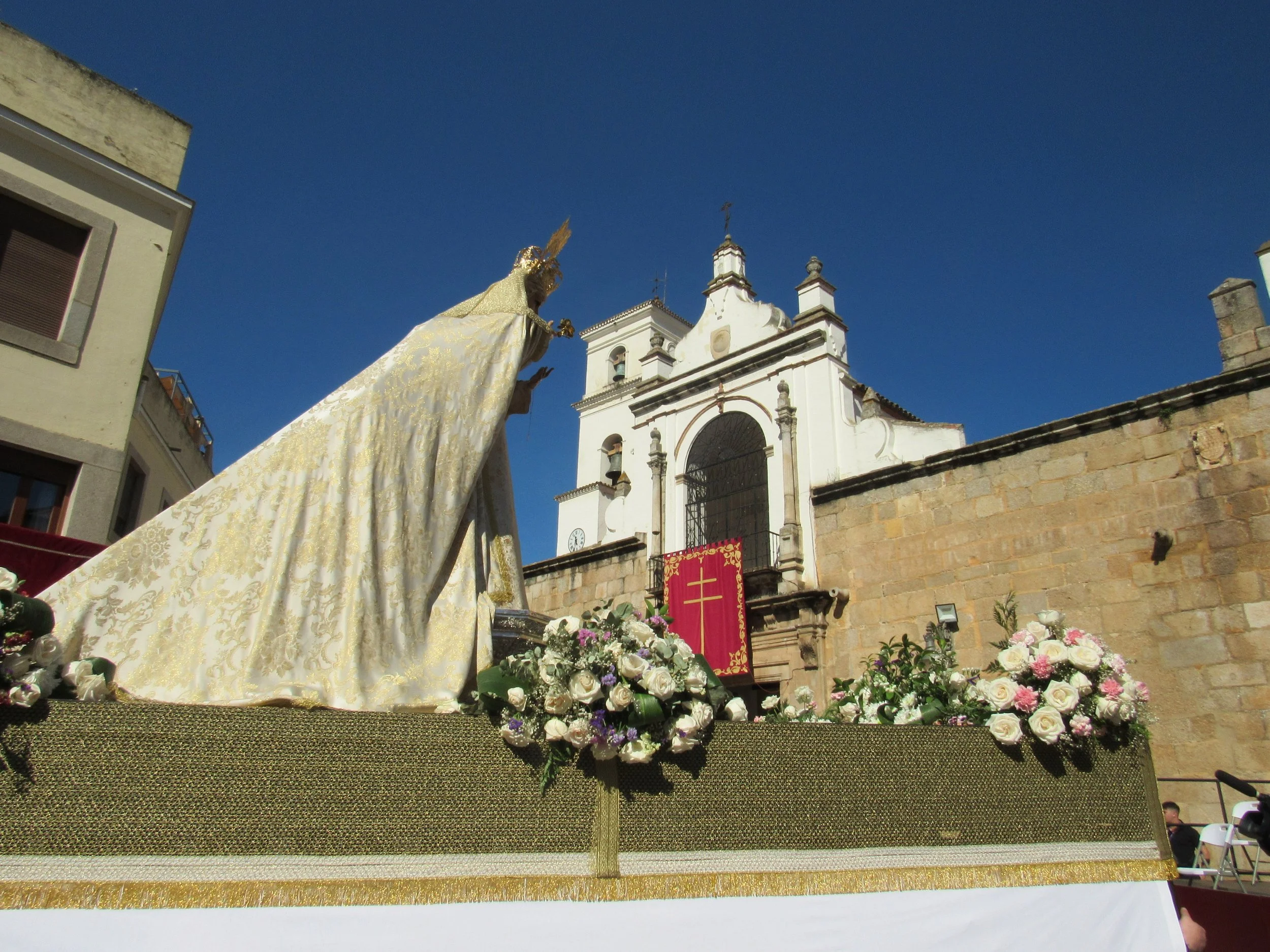
As this float made its way in, the float of St. John, instead of continuing on, stopped and made a 180 degree turn to face back the way it came. Then from the left northern entrance came a float of Mary. In a cream and gold brocade dress that hung down the back of the float, a suncrown, in one hand a gold flower (rose?) and a rosary in the other. The base looked like it was more open, with a latticework to the base with a sheer cloth upholstered over the sides, and white cloth along its perimeter.
As the Mary float approached, Resurrected Jesus continued his way into the plaza and made a 90 degree turn and walked forward so it faced the media platform. Now the three floats and the media platform are facing each other to one side of the plaza in a tight circle. All this time there is a band and music is playing. Then the music gets more intense, and swells. Rose petals are thrown from the media platform and all three floats lift up from the back, tipping inward, and the scroll in St. John's hands unfurls showing the large red letters stitched upon it.
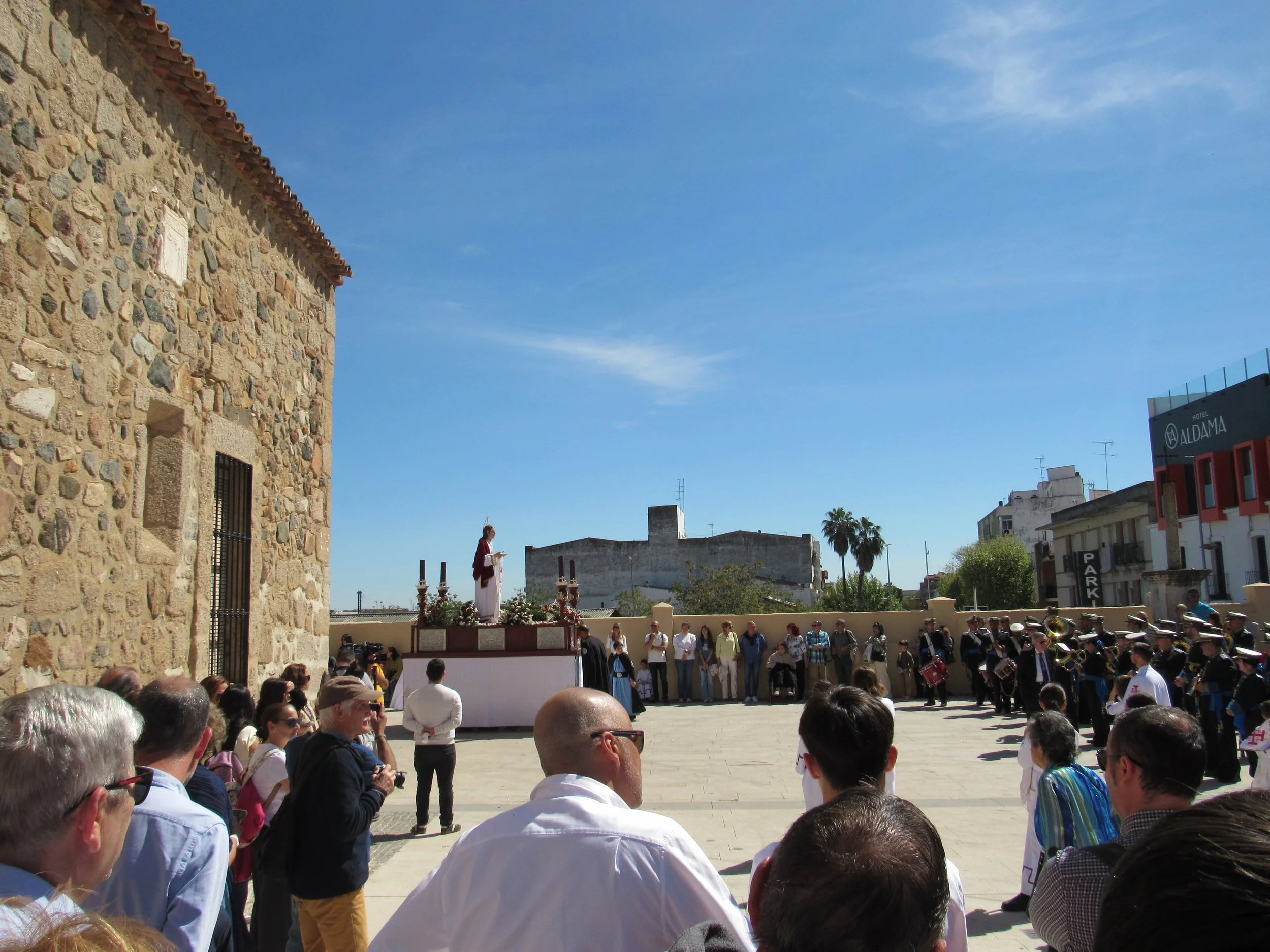
The music stops and from the platform an older gentleman begins to sing. The tenor's voice cutting through the silent square. As he continues, the floats sit back to their neutral state. A person whoops as the singer hits a portion of the song, and someone else claps along. As the finishes the crowd gives a hearty applause.
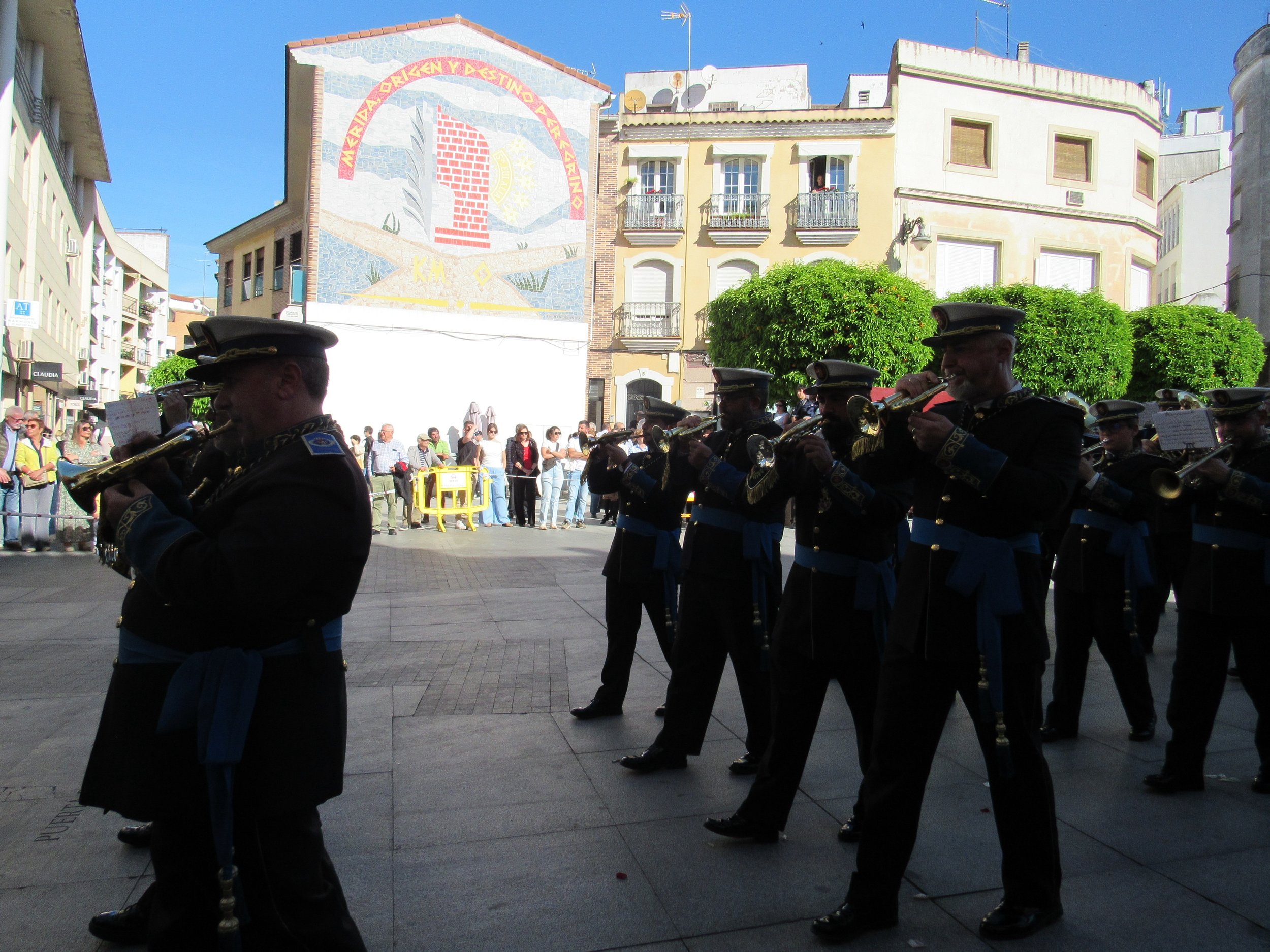
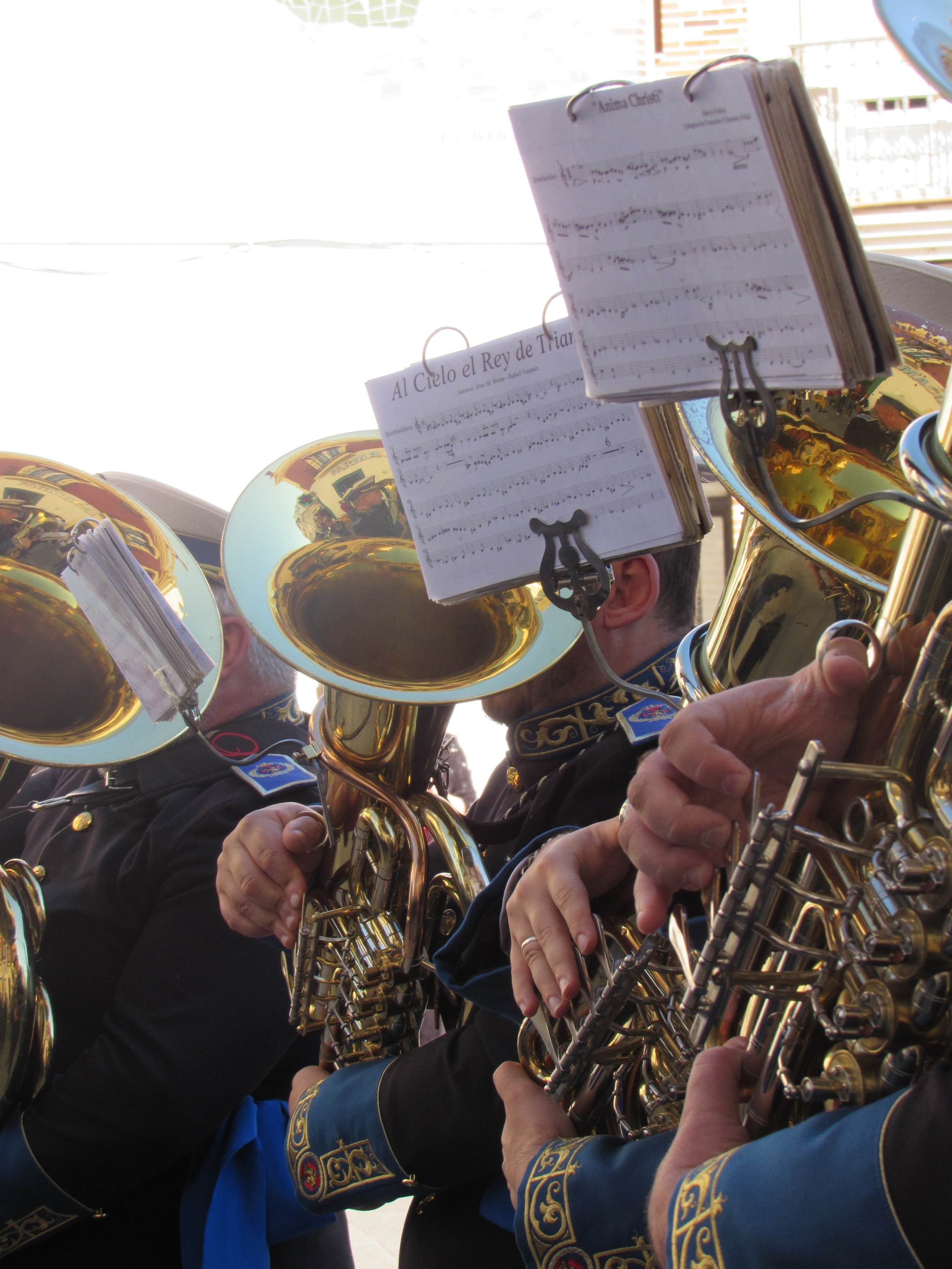
The band starts back up and the float of St. John rises as its carriers pick it up, and it begins to turn back in its original direction. Then it begins the slow processional forward, past the preserved roman road, and heading left when the road forks at the Merida Visitors center in an old clocktower. Then Mary continued across the plaza, following St. John, ladies in headdresses, and in white this time following her, and Resurrected Jesus taking up the rear. The band, which had been playing regularly, continued their upbeat tune, horns blasting as they followed the floats down the street.
I wanted to catch more of the procession, so I went to the next major plaza they would walk through, the Plaza de Espania. The route took the procession by the Santa Iglesia Catedral Metropolitana de Santa Maria la Mayor on the edge of this plaza. When I arrived there was almost nobody there, so I took a spot across from the front doors church itself, right as the road curved. Across the street to the left of me were folks just watching from the restaurant tables, under a row of orange trees.
Across the street to the right of me was seating against the side of the church and then more standing space as the road continued on. As the procession got closer the sidewalk filled with people. Soon the people in cloaks and their banners appeared, then St. John, then Mary, her ladies, Resurrected Jesus and the band behind. Contingencies of the cloaked folks between each float.
They made their way up the street from the left, made the oblique turn at the church and continued up the street to the right. There was lots of cheering, as the floats went by. The procession moved haltingly. Starting and stopping, I suppose some for the rest of the people carrying the floats, as well as to be sure they can safely navigate the route.
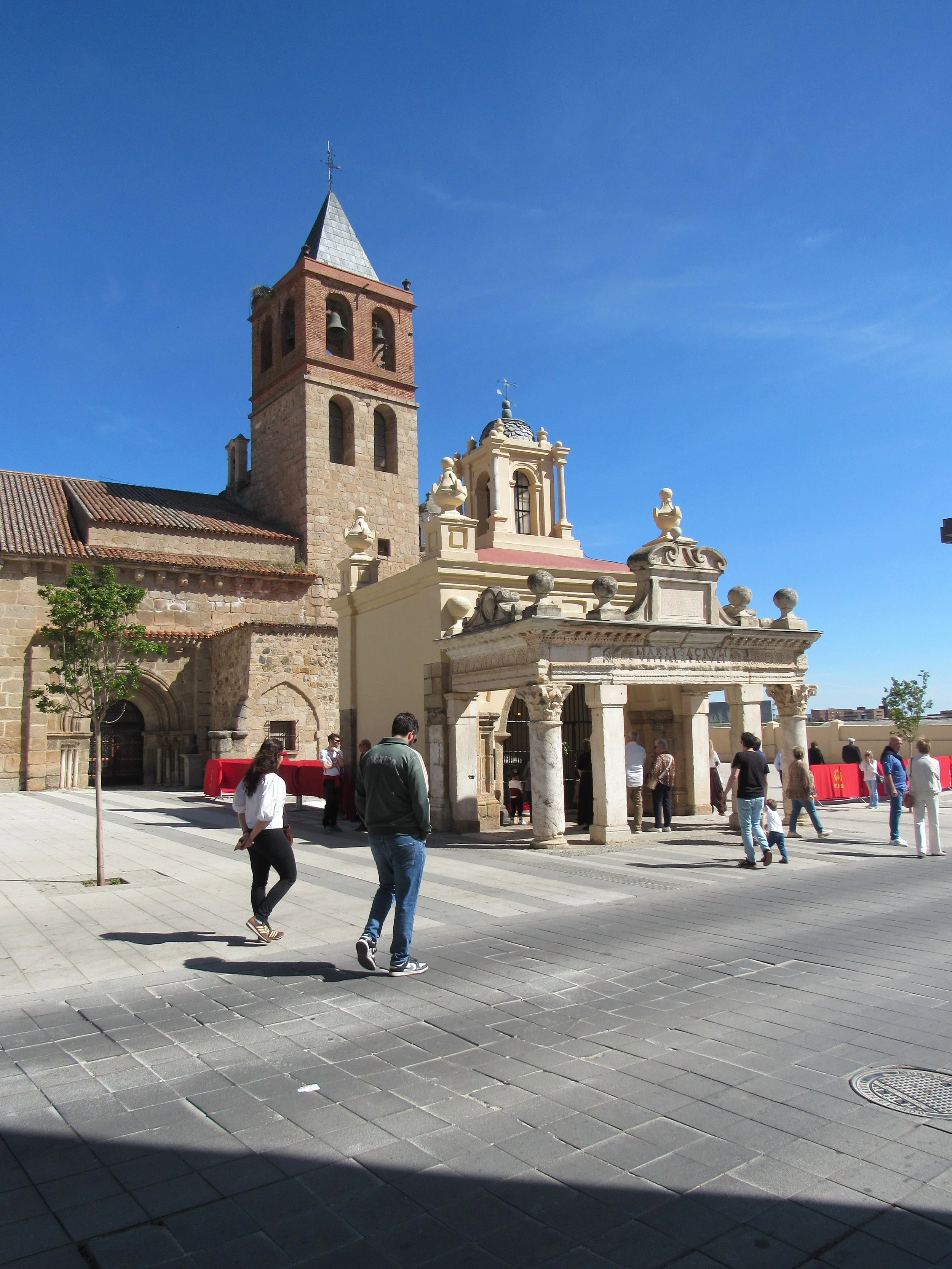
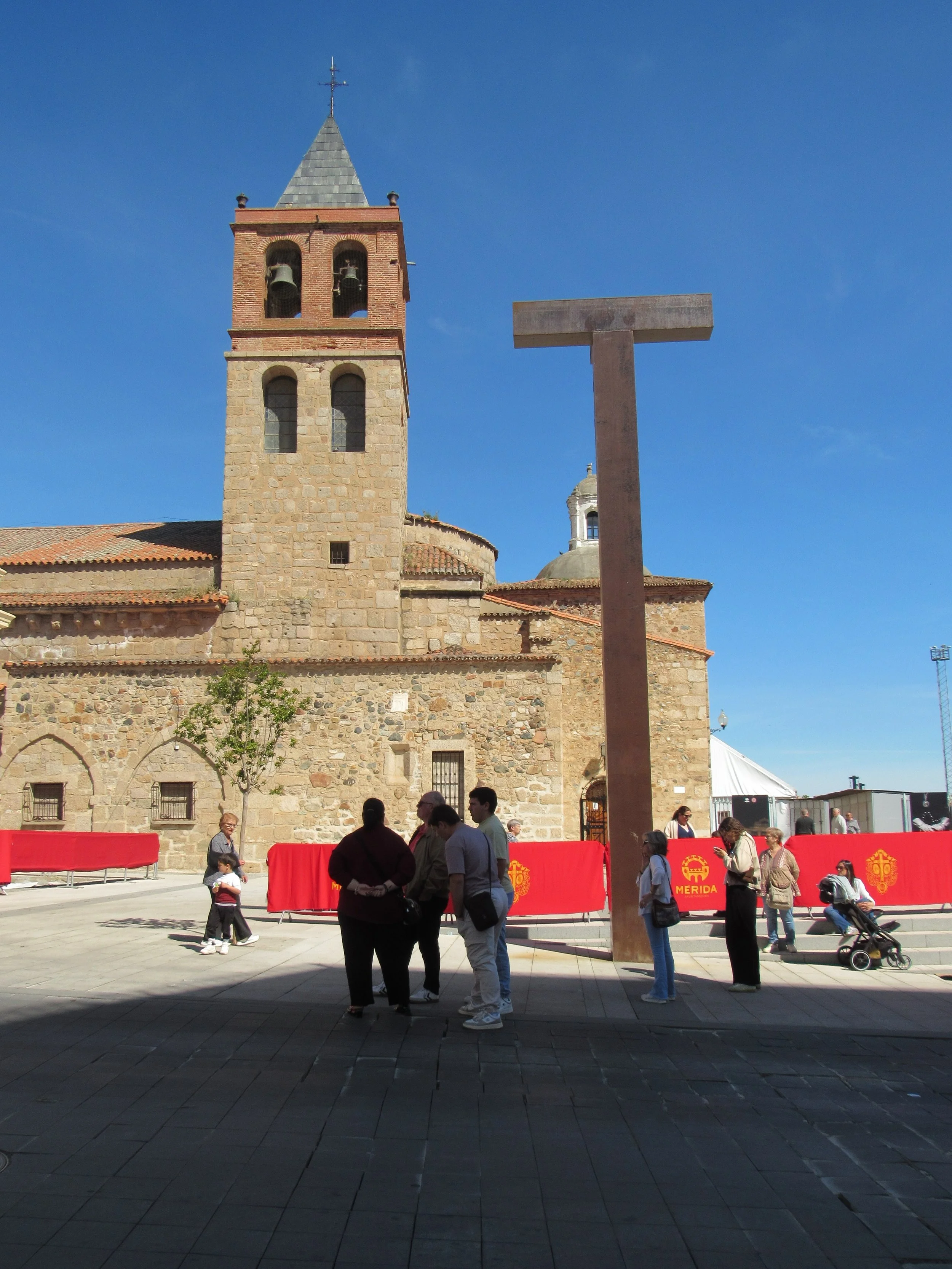
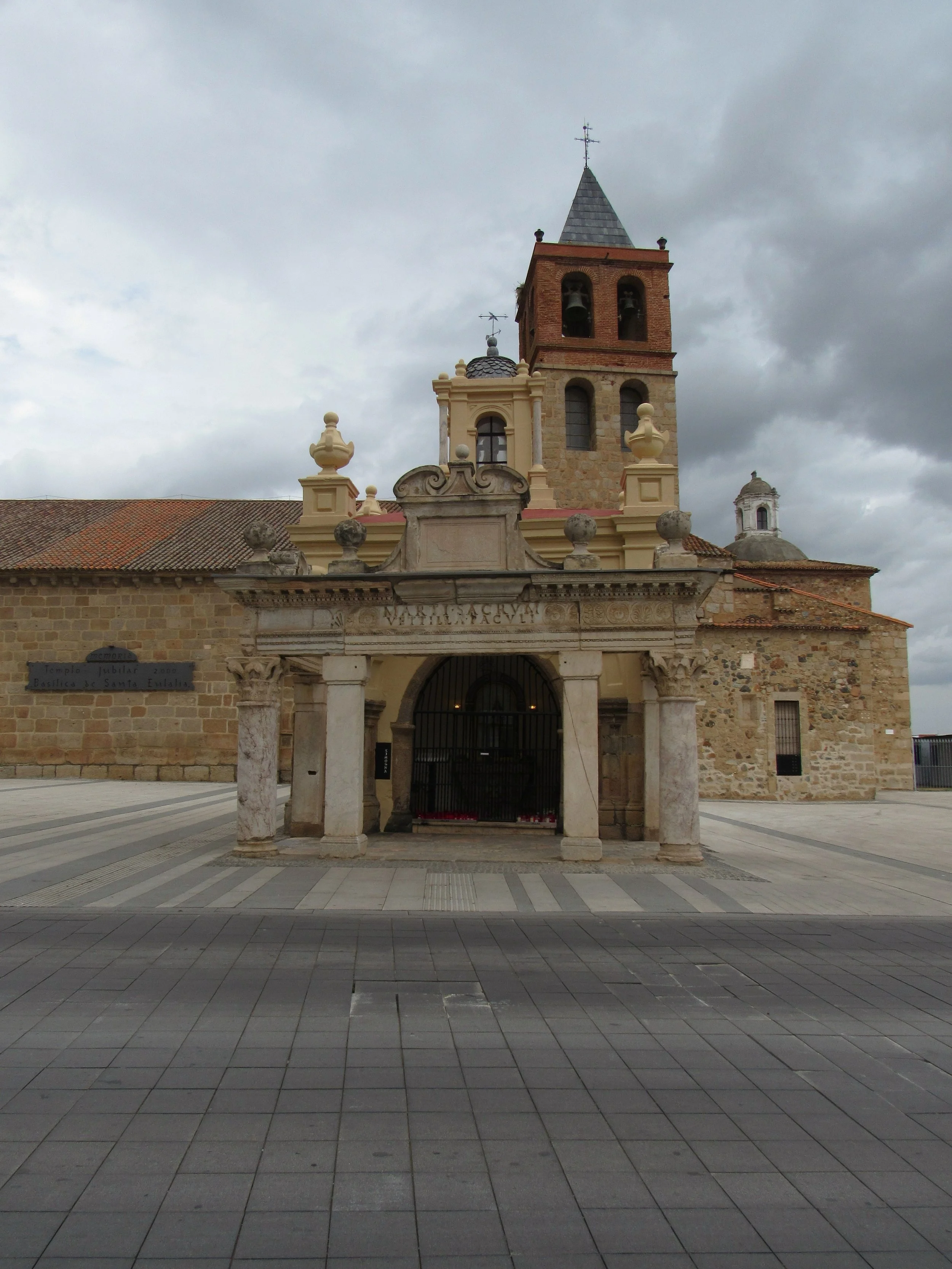
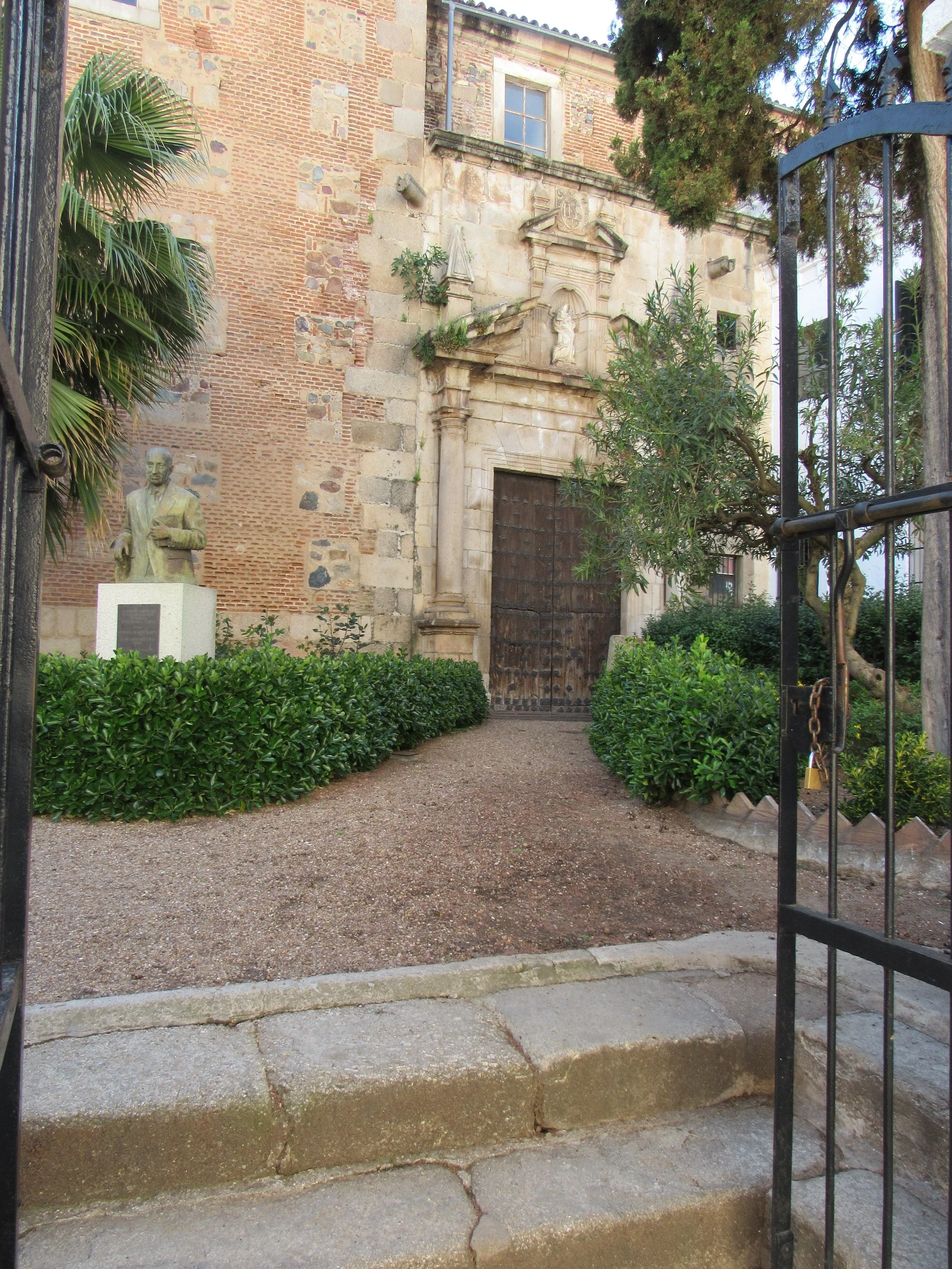
Once the procession had passed through and the crowds thinned, I walked toward the end of the route, the church I had passed on my first night, hoping to get one more opportunity to observe. I approached from a perpendicular street, facing the Wayside Shrine of Saint Eulalia, standing out front. A small carved stone pergola was a figure inside, behind bars littered with prayer candles. Baz Lurman’s Romeo + Juliet would have fit right in in the iconography.
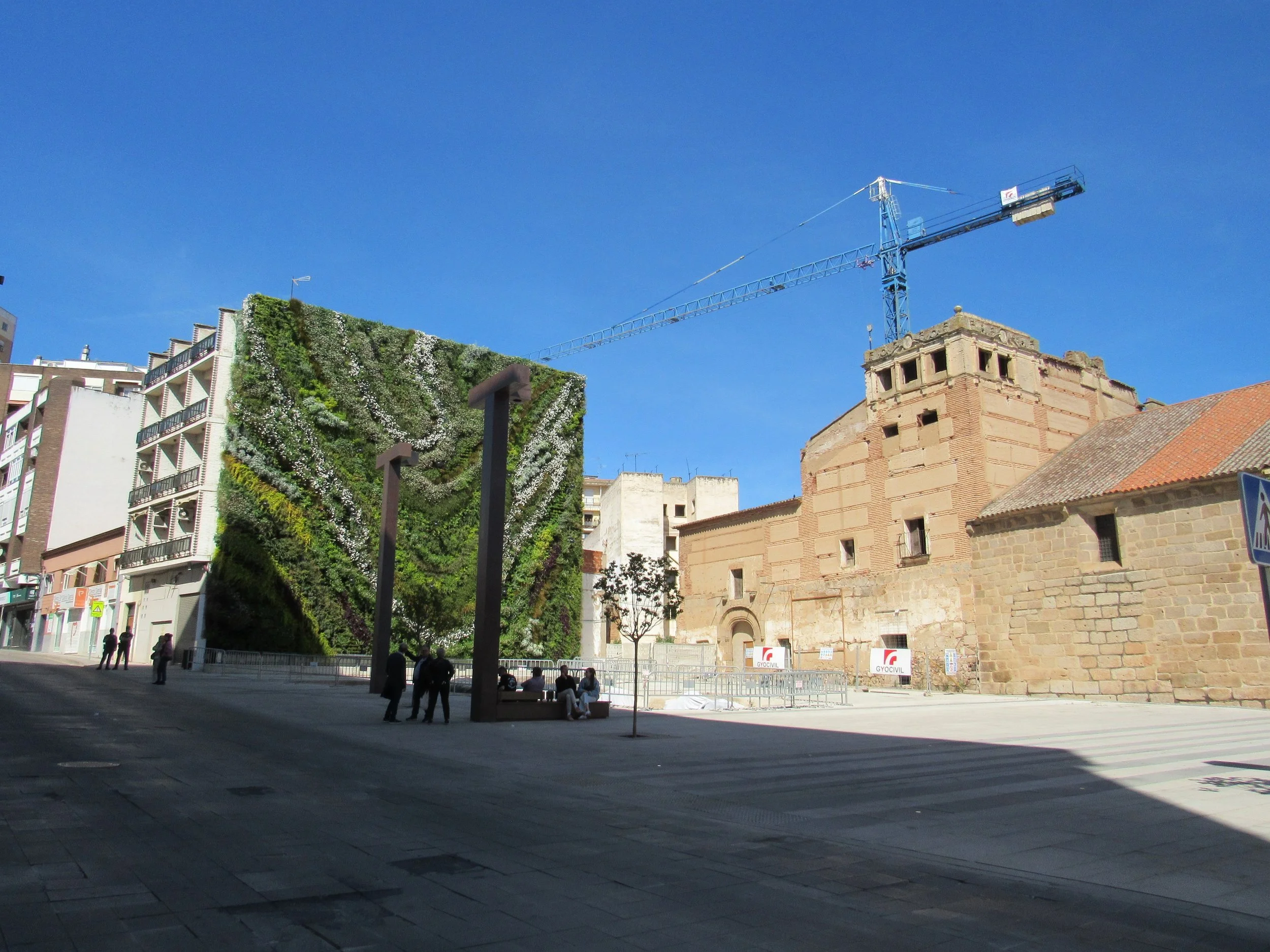
The stone Church of Saint Eulalia sits behind this, a large expanse of a building. Towers at either end. The left edge of the plaza in front is a tall plant wall, and organic design, almost like topography with vegetation, it stuck out as modern in the ancient feeling city. The other elements that feel modern are the four metal light fixtures. They stand across the front of the plaza; tall and square. Large T’s. The middle two have built in benches that jut into the open plaza.
Most of the left third of the plaza is blocked off below this wall with dug up sections of the stone and covered in plastic. A large crane looms behind the church. Construction in progress.The middle third of the church's plaza is open to the entry doors. The name of the church on a large metal plaque on the wall.
The pergola sits in front of the tower on the right and behind it is another dug up section that has been blocked, and covered in red covers to hide the plain metal barriers. There is about 3 feet of space for walking between the church and the portion cordoned off.
At the right edge of the church's plaza from the pergola on has more barriers with fabric covers and a wide opening. Cordoned off into its own section. Beside the church is a barrier, more like a temporary wall, and a large white tent. Backstage for the processioners.
From the right the procession eventually came. Same order as before. They walked around the pergola with the vigil virgin and then into the area with the red barricades. From there the people walking would go behind the wall. The Float would turn 180 so they were facing outward and then would back through an opening in the wall and disappear.
First St. John, then Mary, and finally Resurrected Jesus. The band followed, played their last fanfare and then marched behind the wall as well. Soon kids came running back out robes half torn off looking for their parents. Families who were all in the procession, arm and arm chattering among themselves.
It was clear it was time to find lunch, being around 2 pm. I figured I’d treat myself to a restaurant. I walked back to the Plaza de Espana and found an outdoor cafe for a long lunch. I stood around awkwardly until a server let me know I could find a seat. I got a glass of wine and the lamb special with fries. I sat for a while and enjoyed watching people and the gorgeous afternoon.
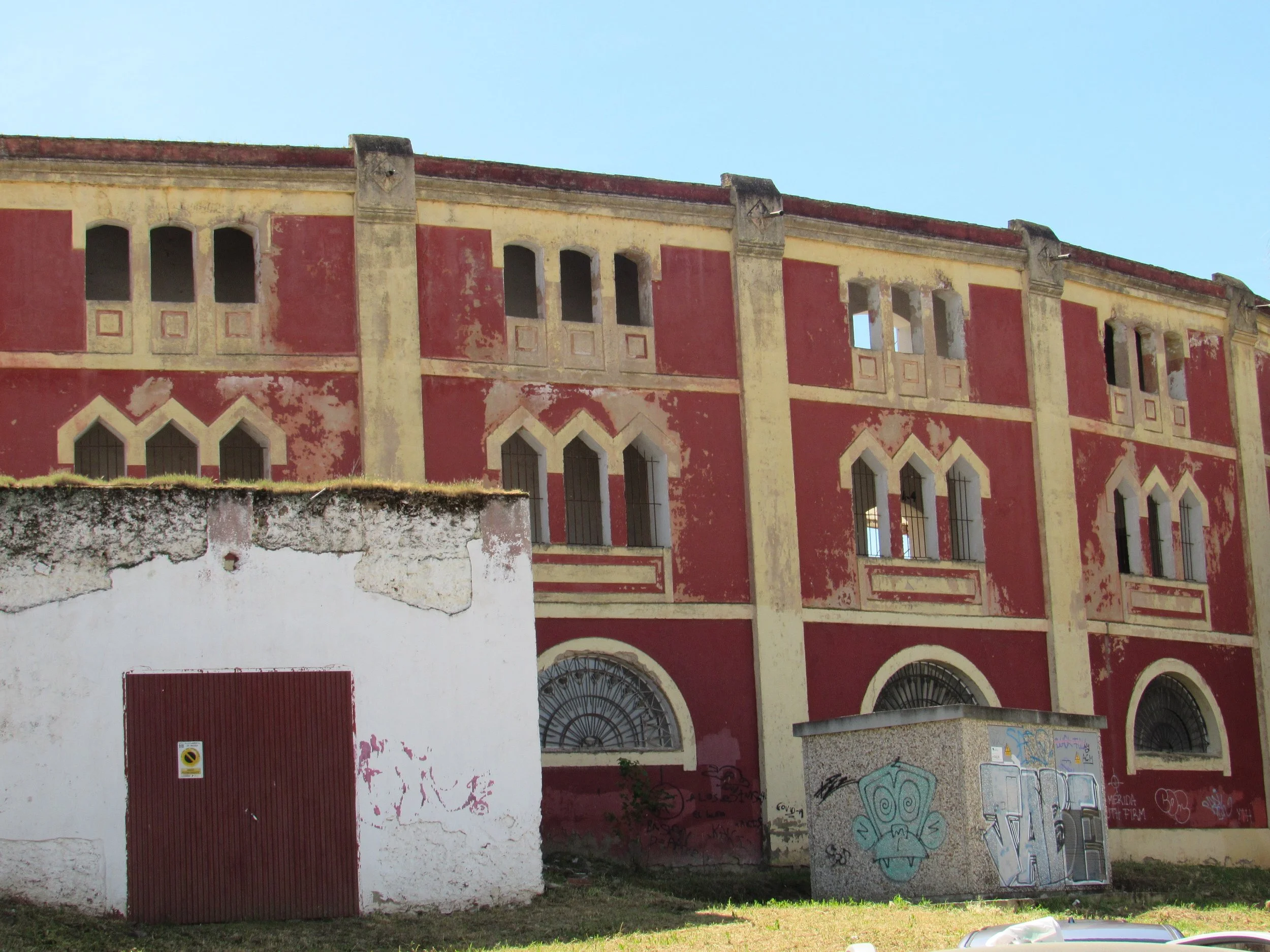
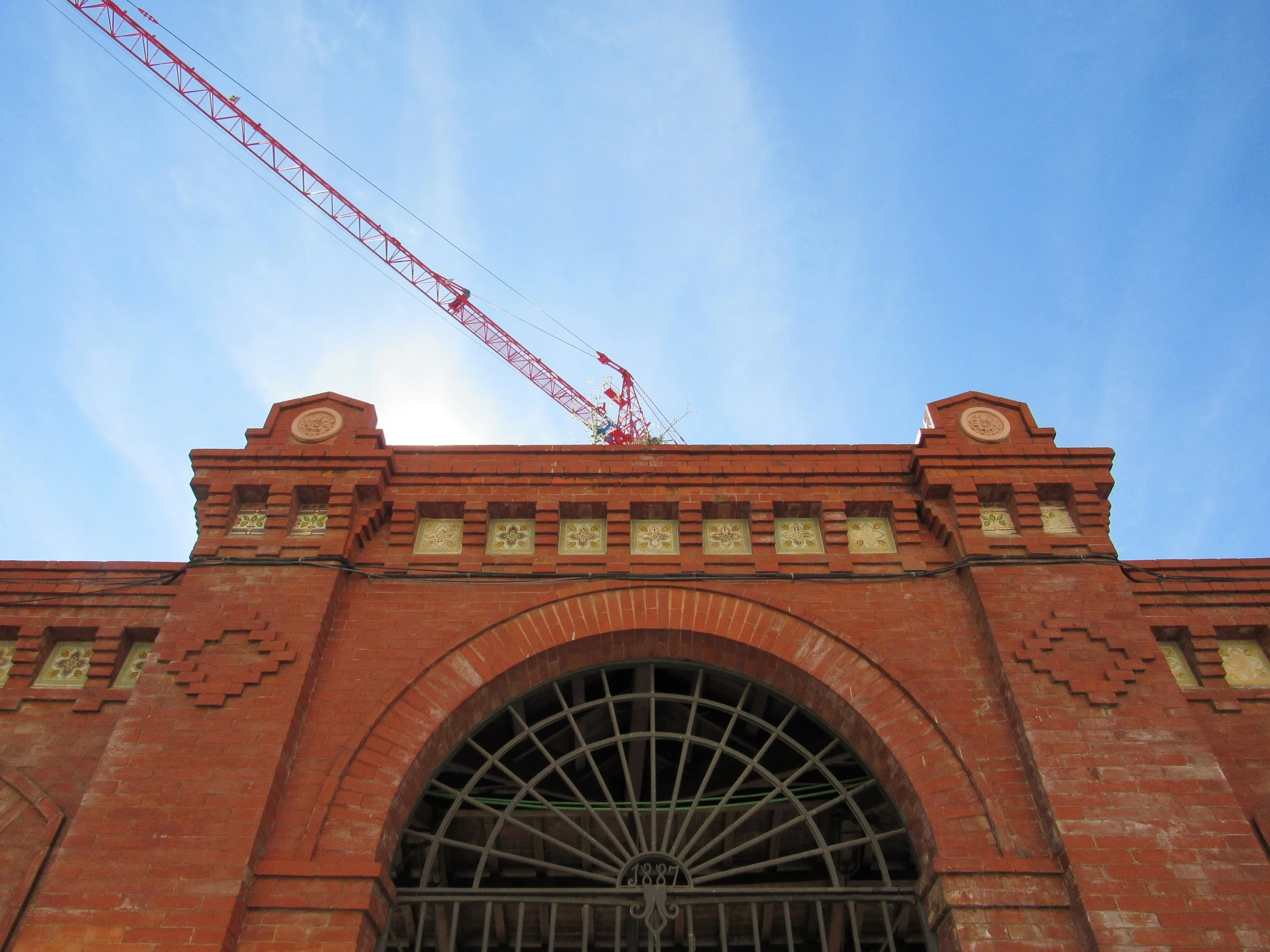
Knowing I would need dinner, I found another grocery store to try, grabbed dinner items (more bread, jamon, and cheese and snacks) and checked out some new streets as I walked back toward my hostal, coming across the bullring jutting out of the town in bright red and yellow.
Back at the hostal I charged devices, and uploaded media, before watching Easter Parade on my ipad, per my own easter tradition, eating my delicious basic dinner, and getting sleep so I was ready to explore more the next day.
—
Monday morning the first stop was to see some Ruins. I had seen the Amphitheater a few nights earlier at the Via Crucis, but there was the Theatre and other ruins to see within the complex.
After my usual breakfast of toast, butter, jam and cafe con leche I headed over to the Ampetheather plaza. Since the holiday week was over there was no line, so I walked right in and got my ticket. In reading the sign I realized for two more euros I could get access to all the paid ruin roman sights, not just the one. So with that ticket in hand I started down the main walkway toward the entrances.
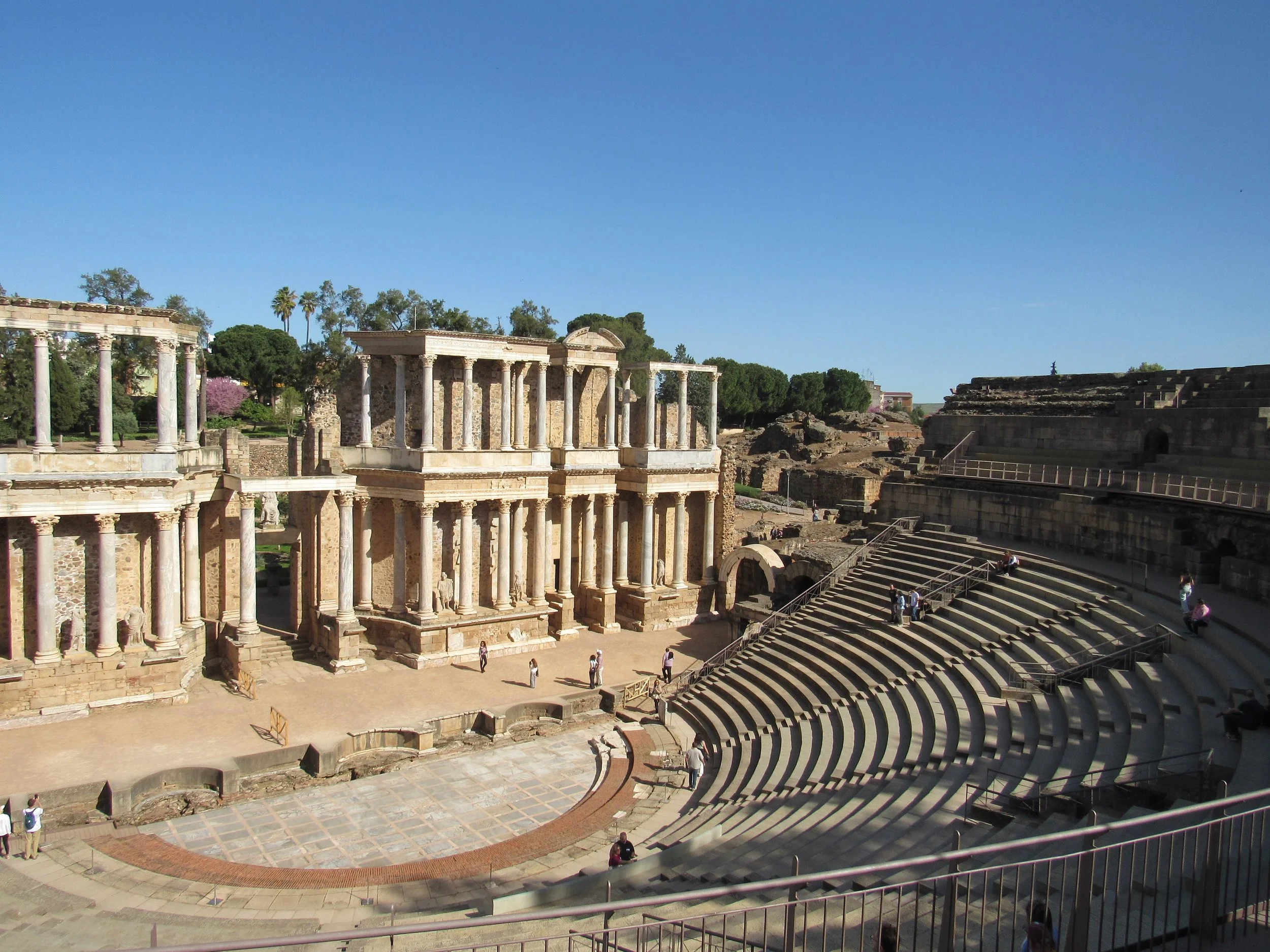
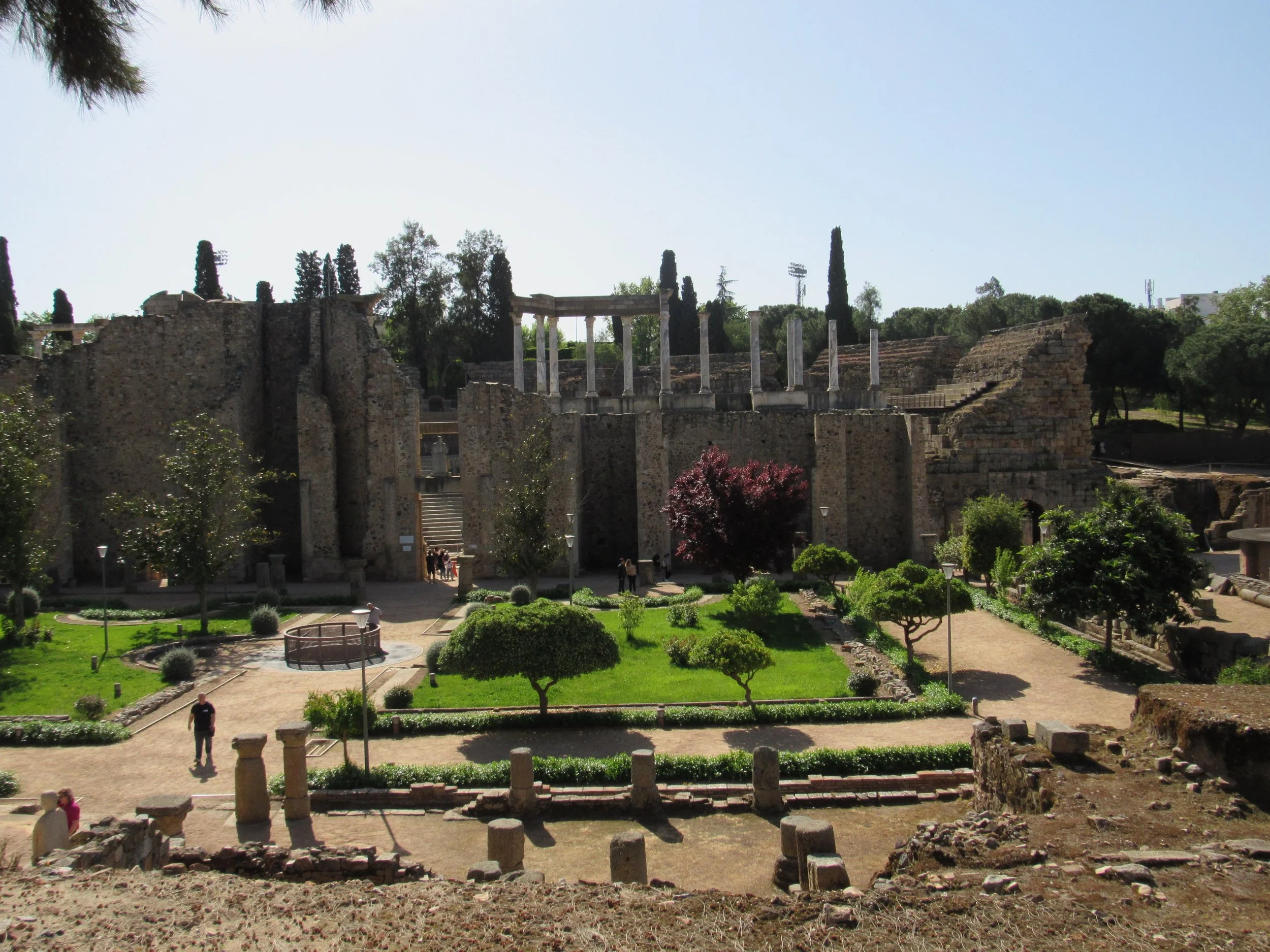
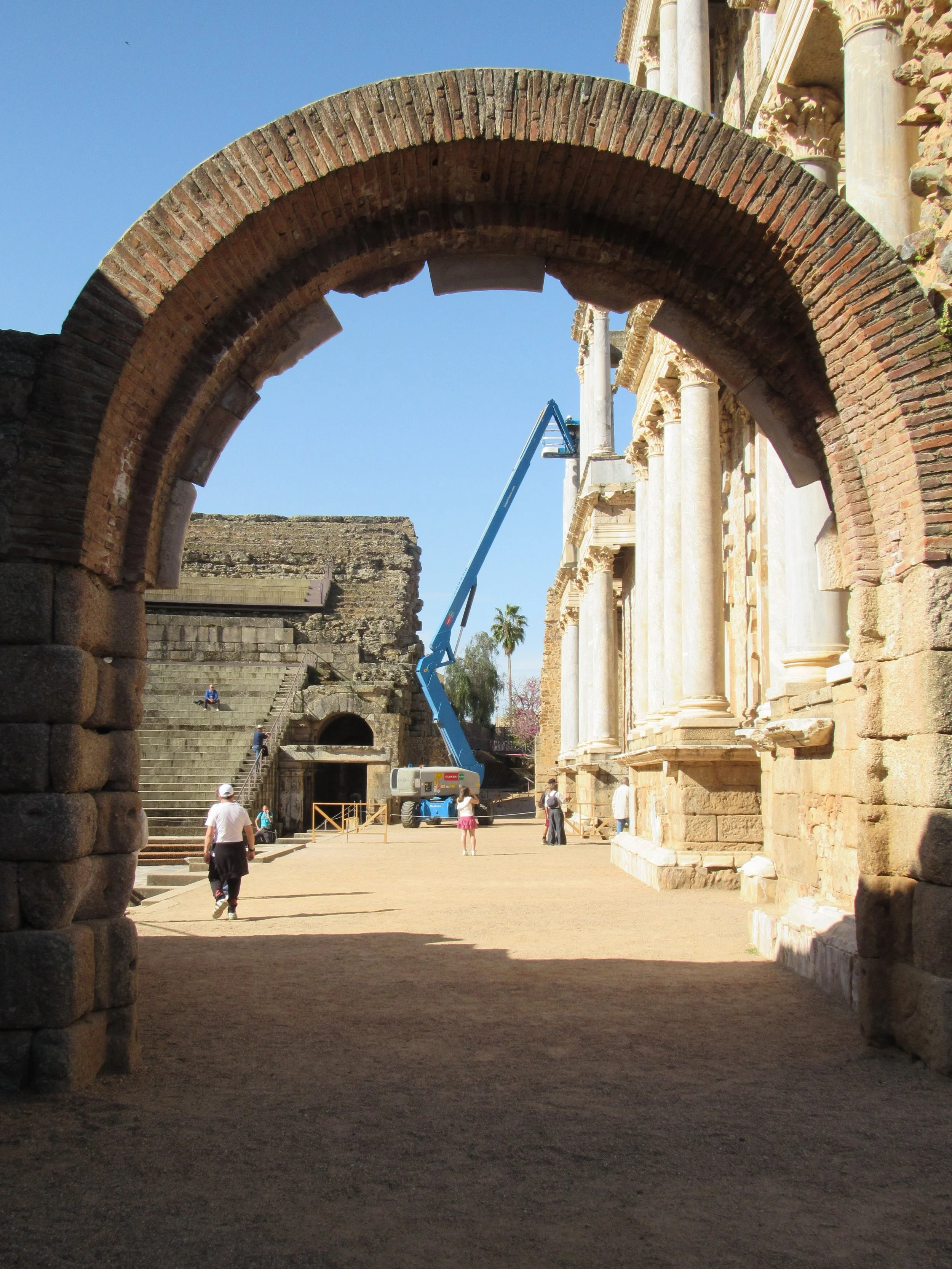
I started with the theatre itself, working around the outside first and then took a small dark tunnel which opened up into the upper stands.There were more stands farther up, but they were preserved as is. The stands are steep. A large half circle of stone facing the stage, information stations equidistant around them. A few spots have stairs for getting lower in the stands.
Along the far end sits a docent, who blasts a whistle and yells at you if you try to cross one of their rope barriers. Which two guys did while I was in the area, one American and one Brit. The brit even tried to defend himself before just doing what was asked. I was pretty early, so there were only a few tourists in before me.
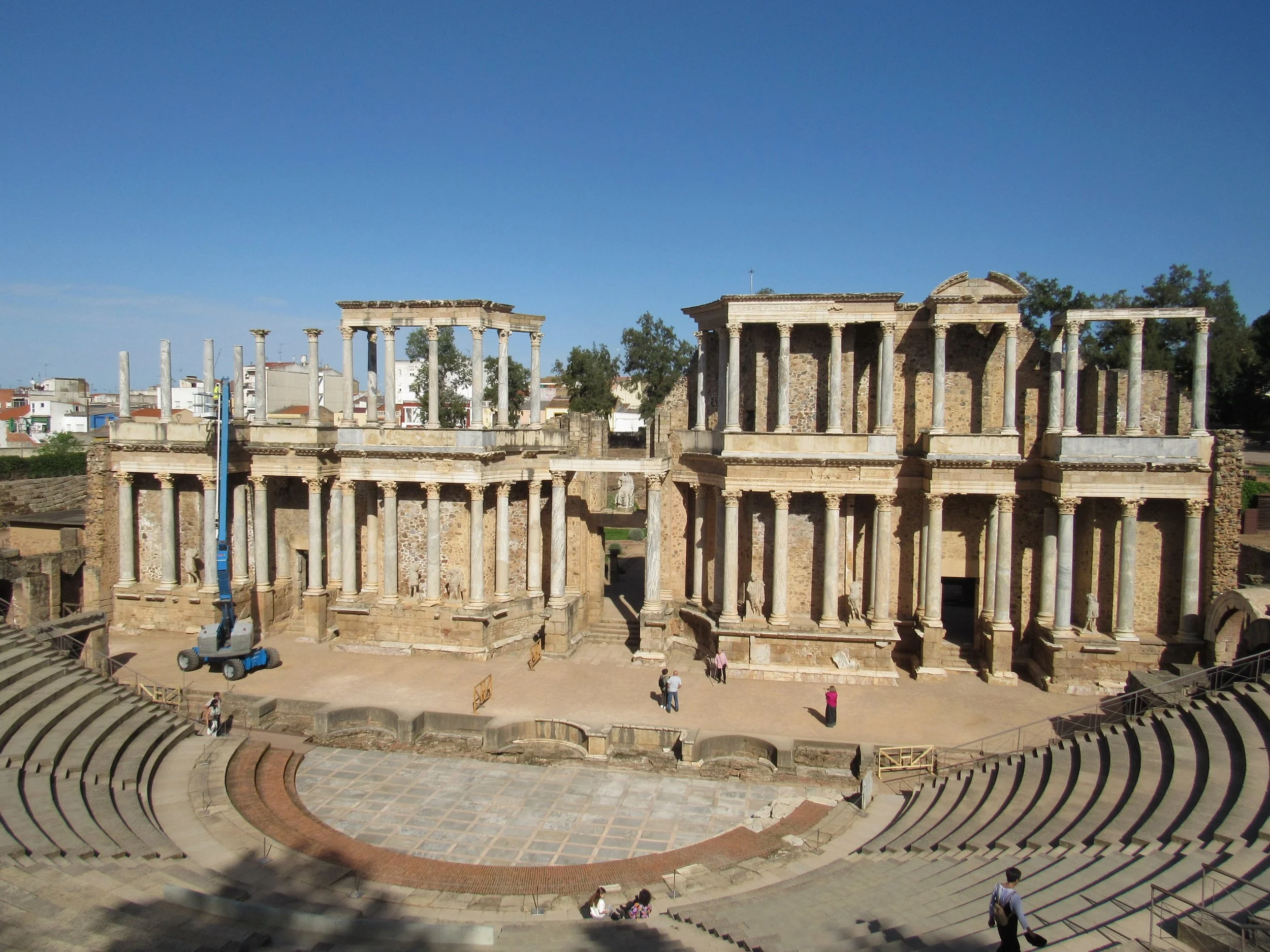
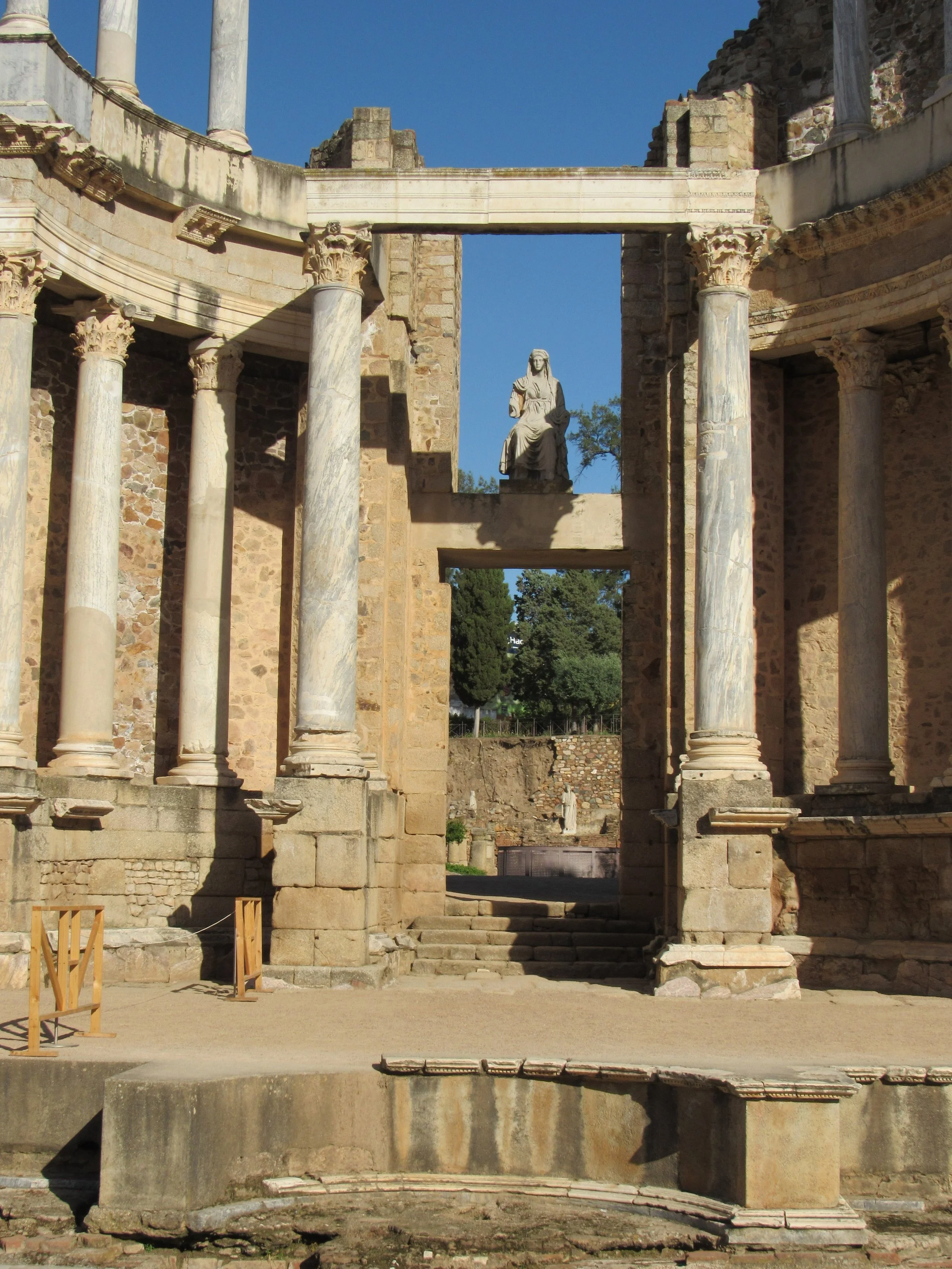
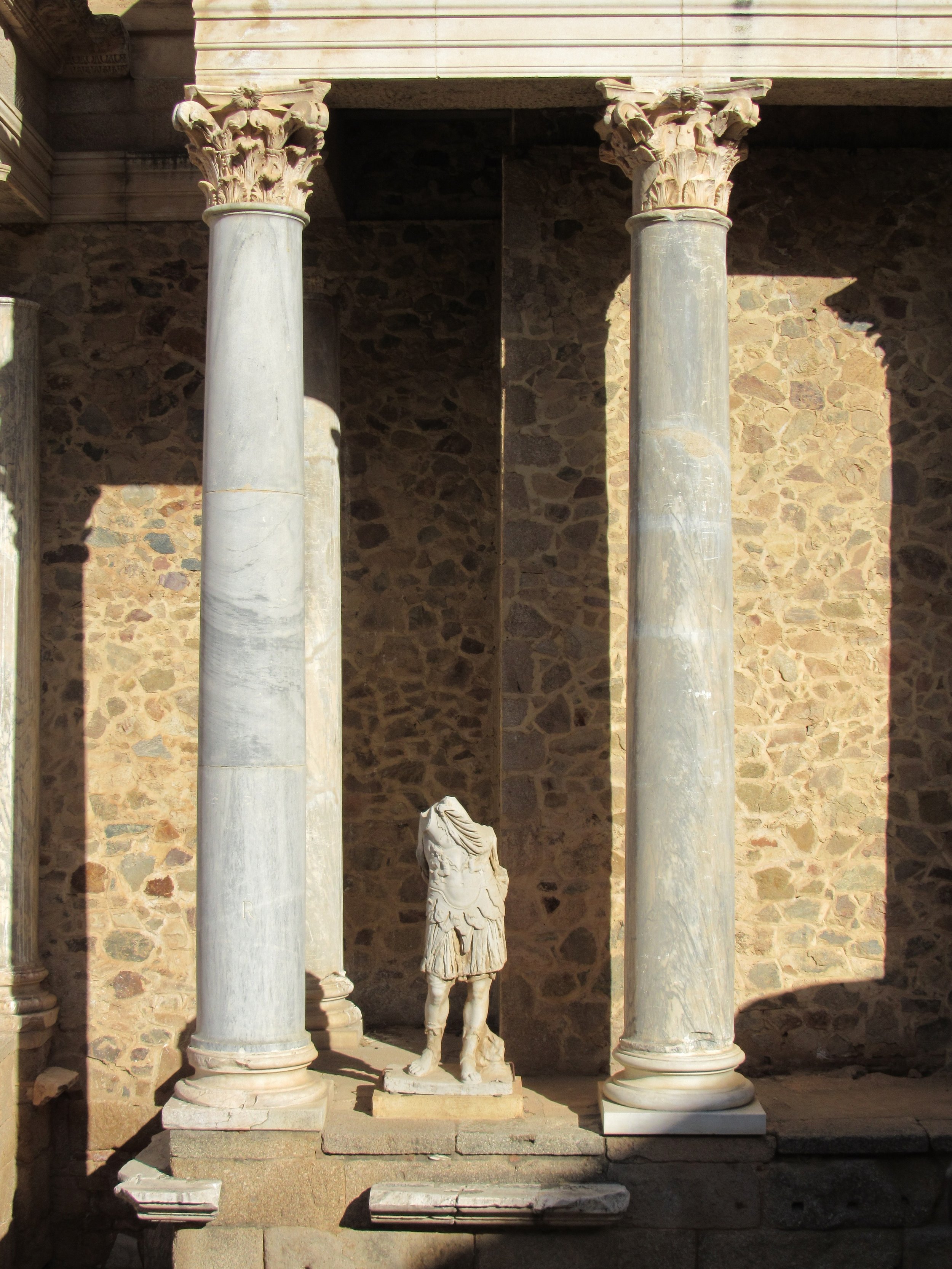
As the stage base, where the orchestra would normally be, were a series of short scalloped walls. The stage itself was not far off the ground, but the backdrop was a dramatic series of columns, double stacked between which marble statues were erected, of which only a few remain along the bottom tier.
Center is a sitting figure of the goddess Ceres over the opening to the “backstage”. Standing on the stage to the right the “wings” lead out to a side garden. The back and stage left exits both lead to a large garden with a well, more ruins, including the Aula Sacra, a once roofed structure, with statues within, that could have been used for worship and propaganda for the Emperor Augustus and his time in this area.
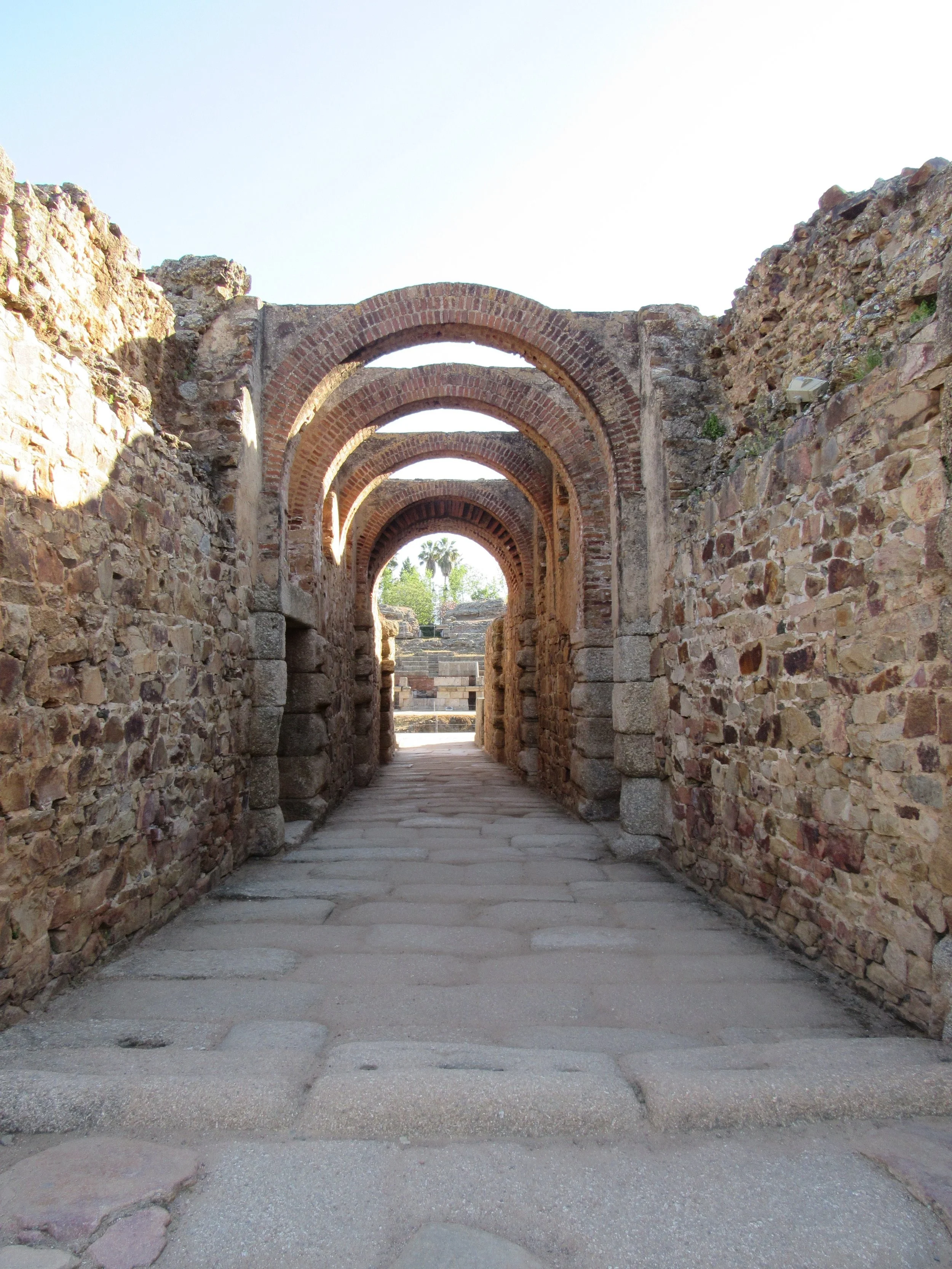
I exited the backstage garden onto the main thoroughfare, and continued along it around the backside of the Ampetheatre. Information stations along the way until you approach a large, but dark arched tunnel of brick and stone. It's long, and from each are alcoves that showcase some of the way Romans built their structures.
Once out of the tunnel, I was in the upper stand of the Ampetheather. Although the seats would have originally run the full 360 of the arena, only a small portion have been cleaned and replaced for tourists. I had hoped to go back to my seat from Via Crucis but that portion was closed off.
I walked around the top, reading the information panels, before heading back out and around the outside. About halfway there is another large arched tunnel, also a mix of brick and stone, the gladiator entrance. This steep staircase downward talked about each of the types of gladiators you would see (my favorite being the guy with the triton and net) and where they would wait, and where they would enter depending on how good/ popular they were.
Once out into the arena, I walked around, learning more about the gladiator battles, what they looked like and how they would have gone down. Then I exited the Amphitheater, from the same place that Jesus on the cross and followers entered during the Via Crusis. What I could not see from the stands were the series of stone arches that overhang the walkway.
I walked through it and back to the main path. Back towards the entry of the complex. I found a shady spot, drank some water and mapped out how I wanted to go about visiting the rest of the roman sites. Then I stopped at their bathrooms, three raised boxes, Men, Women, Families, with glass floor walkways between each box so you could see the ruins it was built over below. Then I headed back out through the gift shop and headed toward my next stop, the Circus.
The Circus is actually where the Chariot Races were held. This was on the edge of the city proper, so I walked that direction. I was not prepared for the lack of shade, and how hot it would be in the open area. Before going outside, I walked around the small interior display. One room with a brief history of the chariot races. It was all in Spanish, so I used my translator app to read the text.
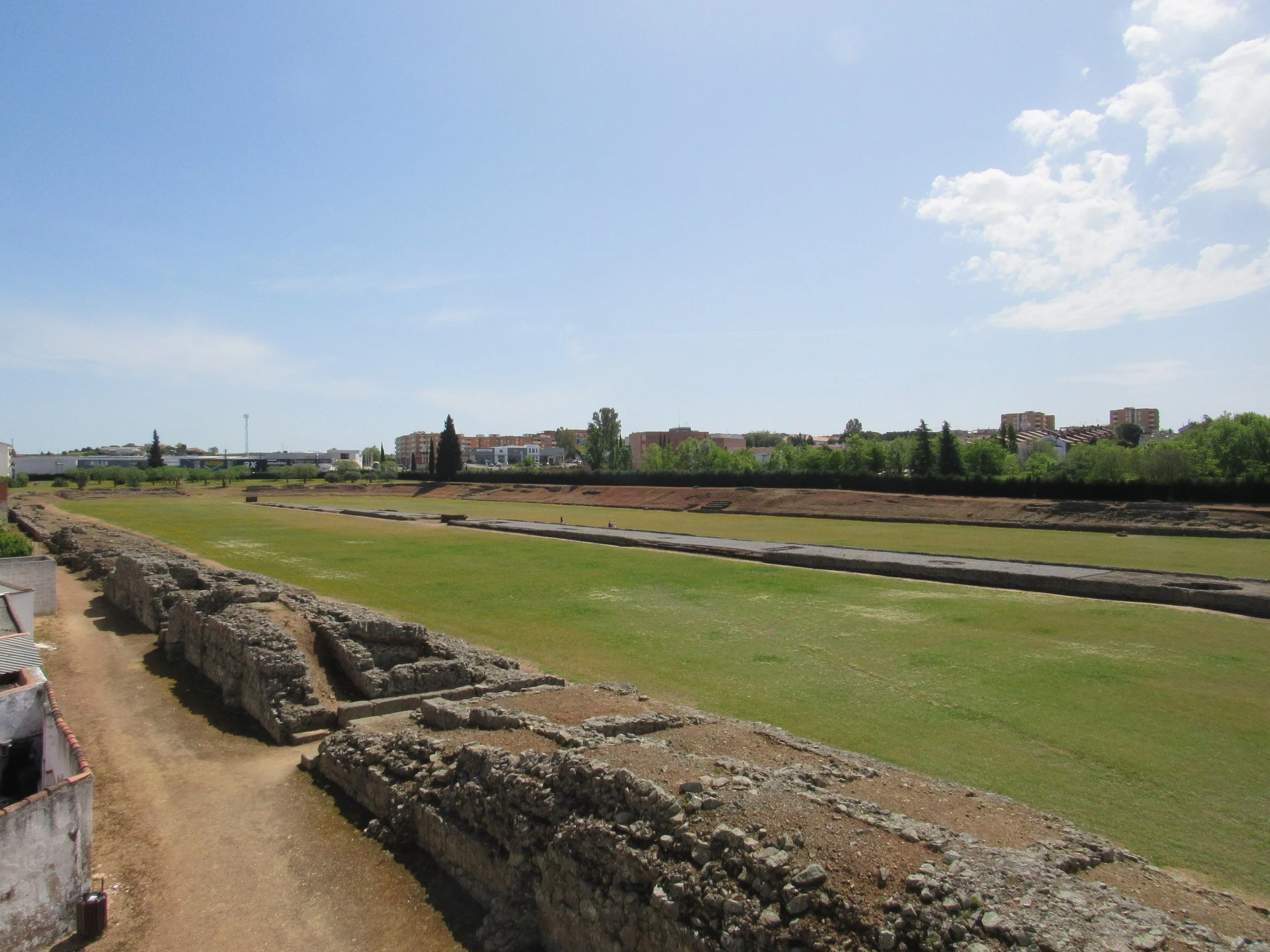
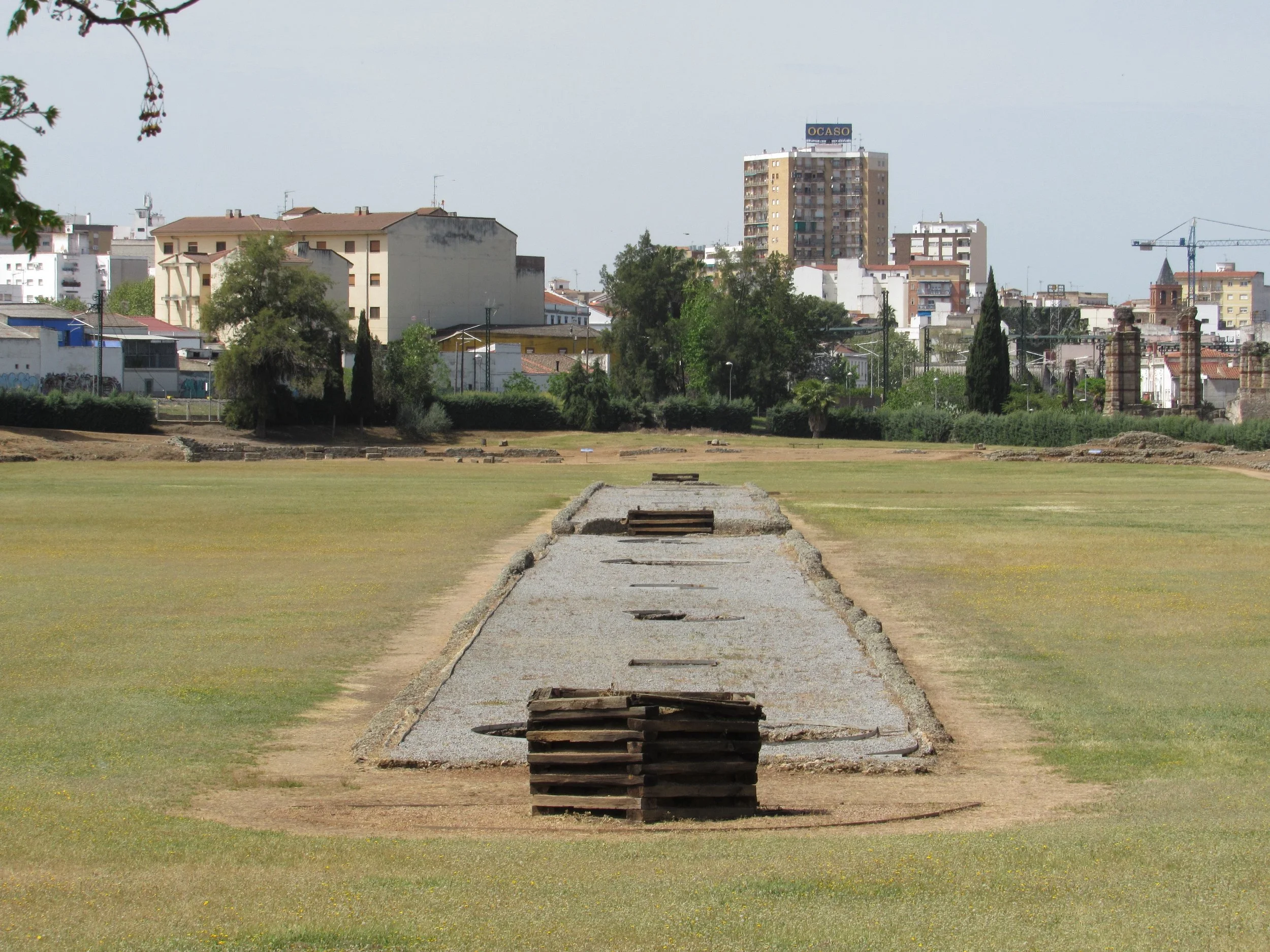
Off the room with the displays, is a small theater where they project a short movie. The stairs up the side of the seating, lead outside to the roof of the building where you get a full view of the scale of the Circus. It is a large expanse of grass. A long rectangle with half circles at either end. Down the center are low ruins, the central barrier, which is what the track goes around, in its heyday it held an obelisk that represented the sun at dusk, and pools which represented the ocean. Now where they are standing are just open holes ringed in metal.
Around the outside is seating, now overgrown, in different states of crumbling, mostly a playground for rabbits. At one end of the half circle, the Chariot Gates, is where they would start the race from, now is dotted with low ruins, and a bench. This was the ‘dawnstarting point” and the gates each represented a month of the year. The other end now holds a grove of olive trees and was called the “secondary goal point" and after the 7 laps (to represent the days of the week) would be where the race ended. There is even more symbolism baked into the Circus that I could probably talk all day about.
Modern buildings can be seen no matter where you look around the Circus Romano. What struck me were the apartments that butt up the back half of the Circus. All white, with just a hedge between the site and them. Since it was sunny the residents' clothes were all hanging out lines off the balconies. Their view was a UNESCO site. Were they amused by us tourists coming through everyday? Did they find us annoying and disruptful?
I made my way back down the outside stairs, into the theater, back through the display and out to the grounds themselves. I walked counter clockwise around the track, outside the walls for the stands following the information stations. This led me to the race start, then I walked down the center taking pictures, and getting a feel for the scale (and probably where I got my sunburn,I really should have worn my hat). I walked all the way over to the tree grove and then back to the entrance.
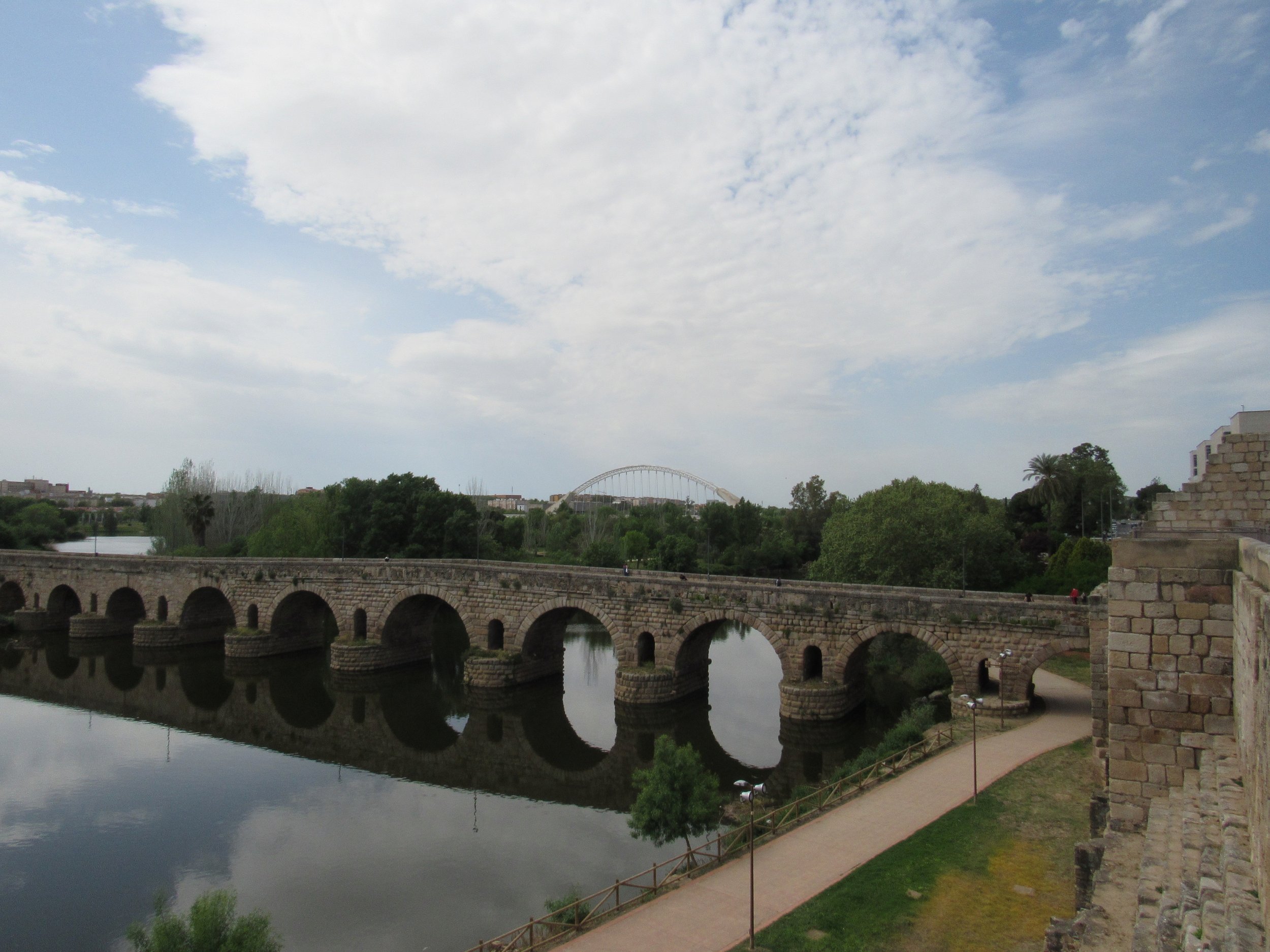
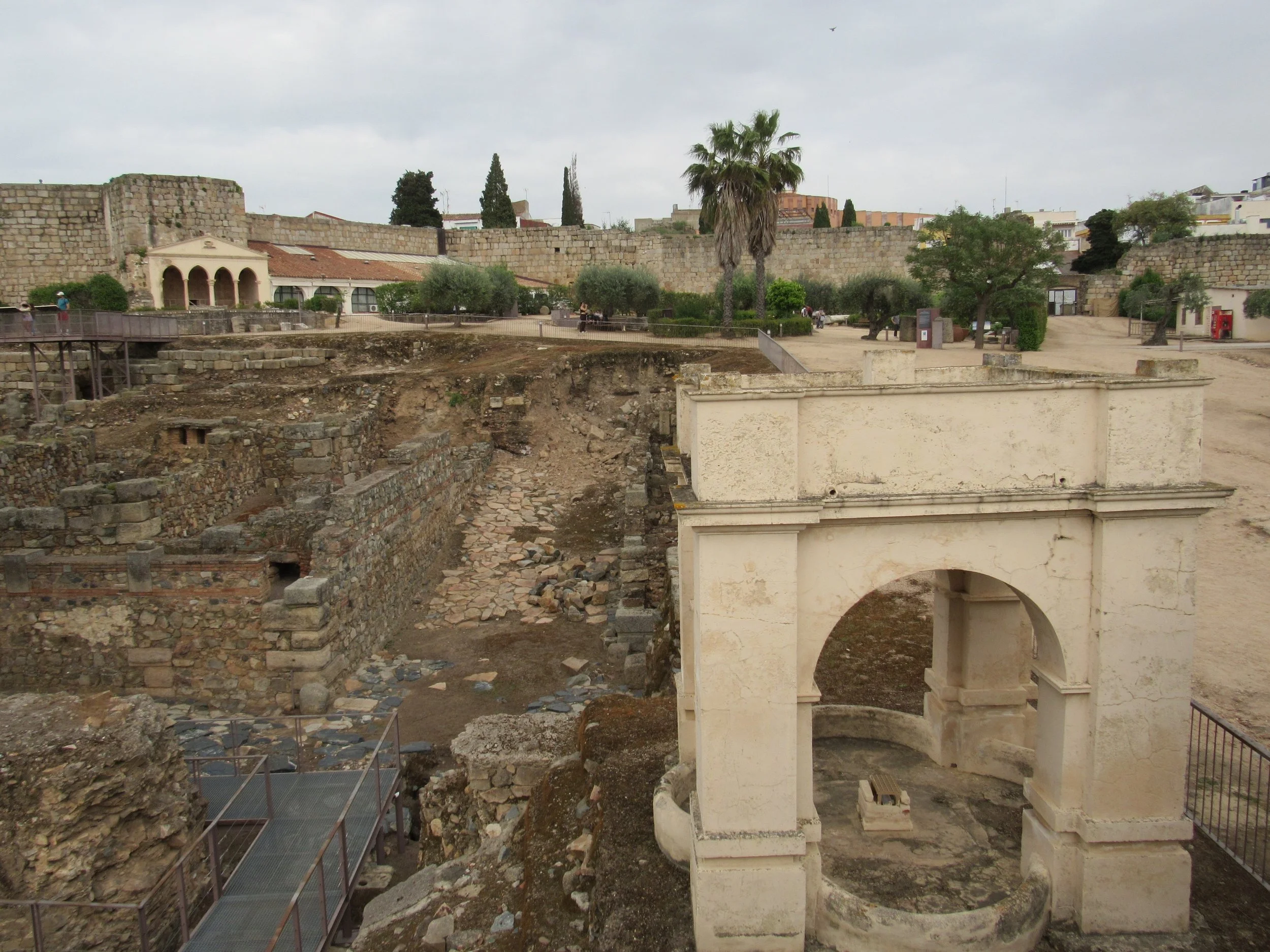
I had one more place I wanted to check out, so after a long stop for lunch at a restaurant in the main drag for tourists (I got a salad and white wine), I walked across the downtown of Merida to the Alcazaba, or The Citadel near the Bridge Over the Guadiana River. Built by Abd ar-Rahman II he had a fortress over Roman ruins and main roadway after the city had rebelled against his rule. Excavation in the 70’s found there were ruins of a Roman dwelling and other artifacts that the Citadel was built upon.
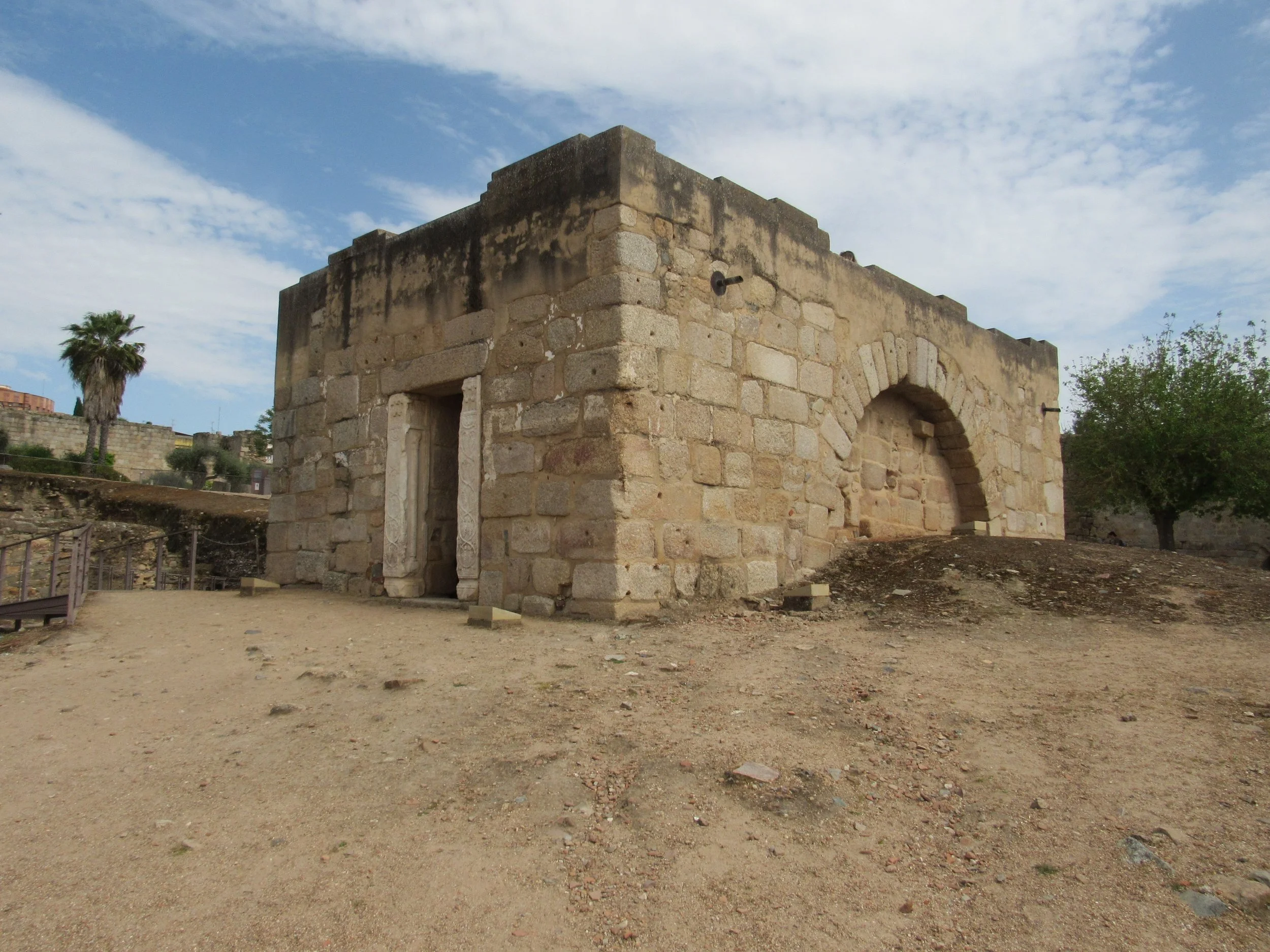
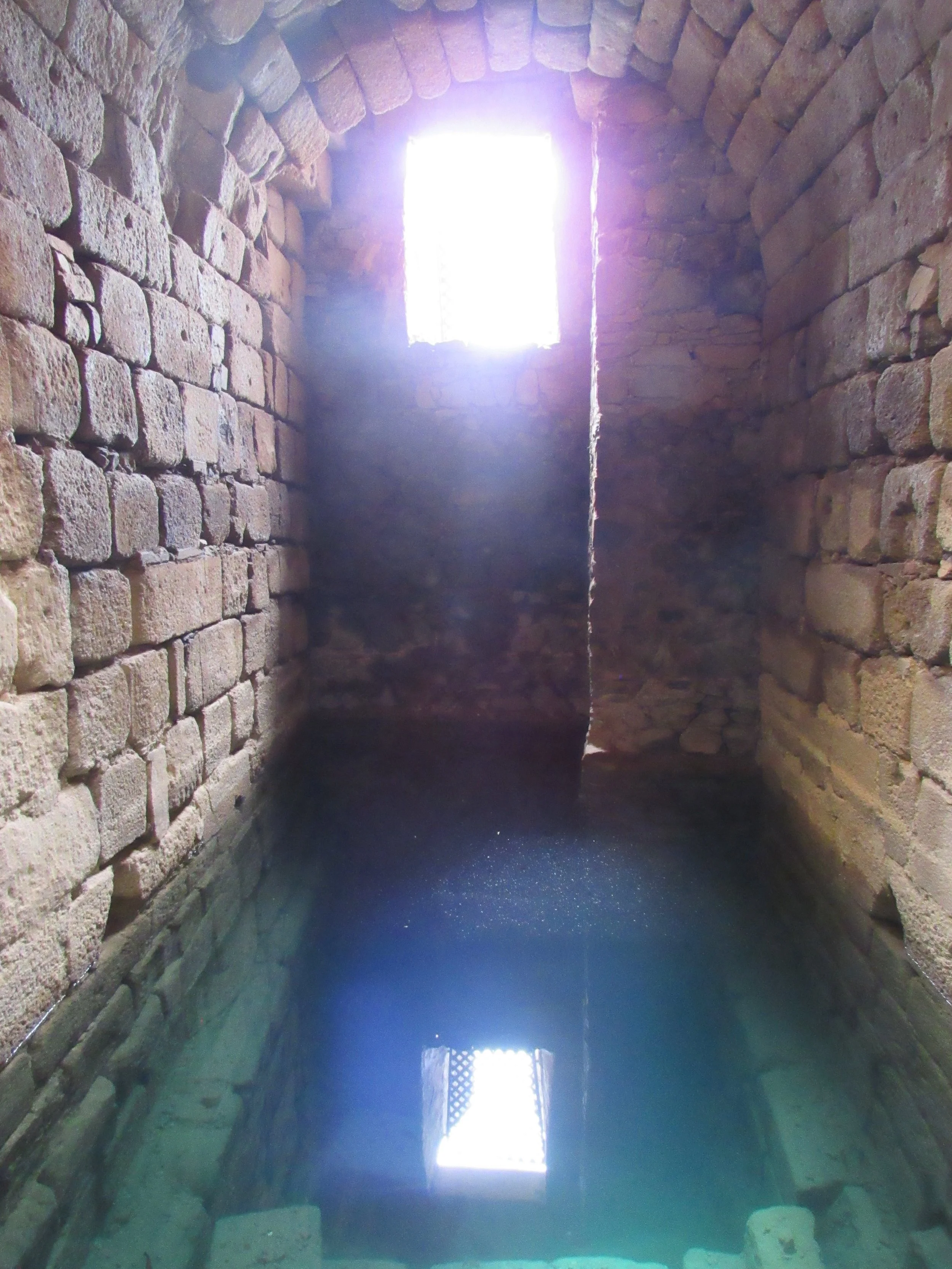
Because it was a fortress there were ramparts that looked over the waterway, toward the bridge and the breakwater. So I started there enjoying the clouds, finally giving a filter to the intense sun and then made my way down to the cistern building. Square, made of stone with carved lintels. It was originally 3 stories, the cistern base, with a mosque, which was then converted to a church in the middle, and a communications tower at the top that is no longer standing at the top.
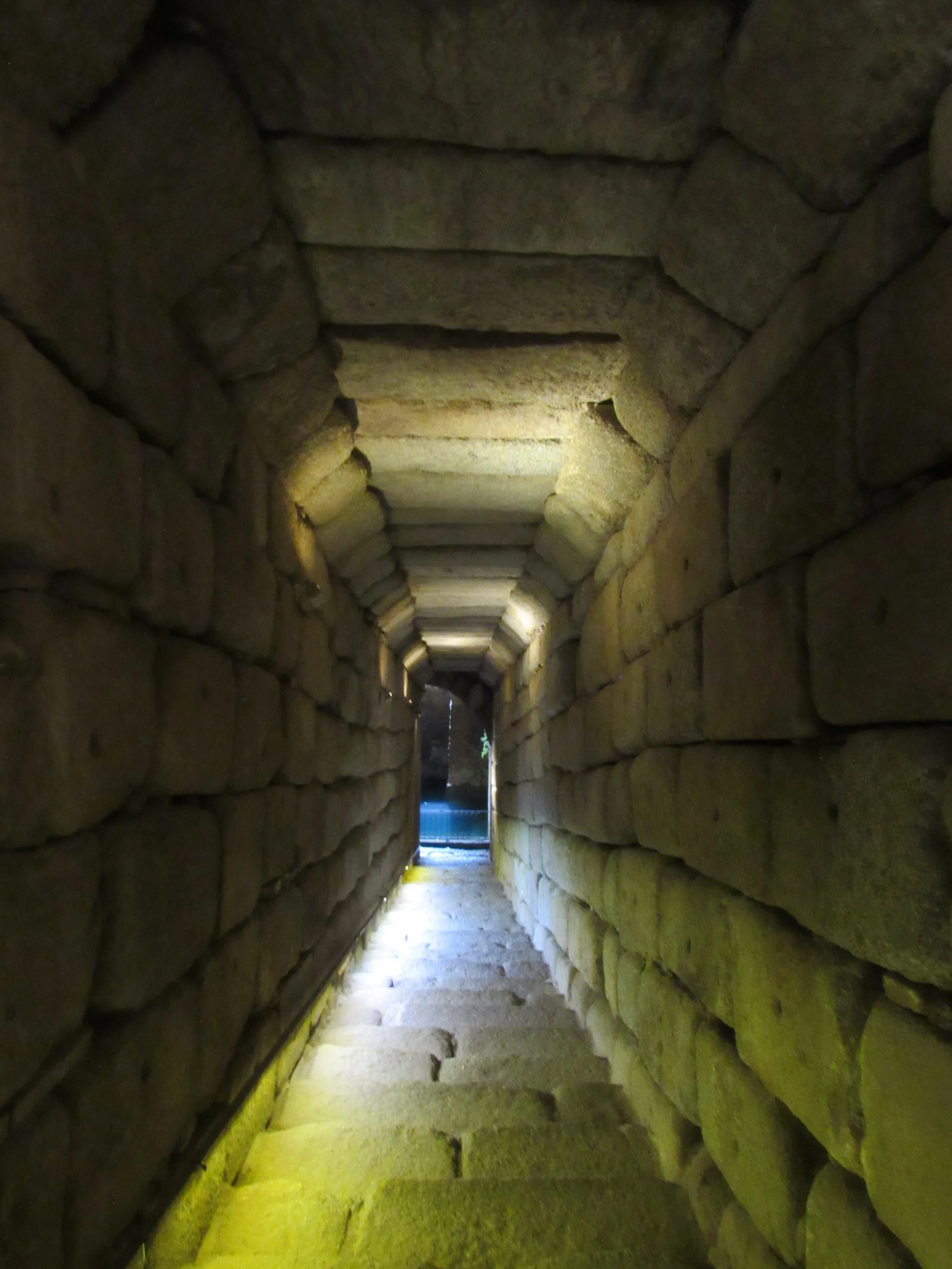
There were two entrances across from each other, with a short downward staircase, about 5 steps, to a small hallway with a barrel roof. At the centerpoint to one side is another opening with a carved lintel. This double stair case with a wall between leads down to the cistern pool.
The cool air felt so good as I made my way down to the spring. A relief from the heat. At the bottom the aqua pool had fish in it and lit from the window above. After the respite of cool, I headed back up the opposite stair from the one I entered down and continued to explore the citadel.
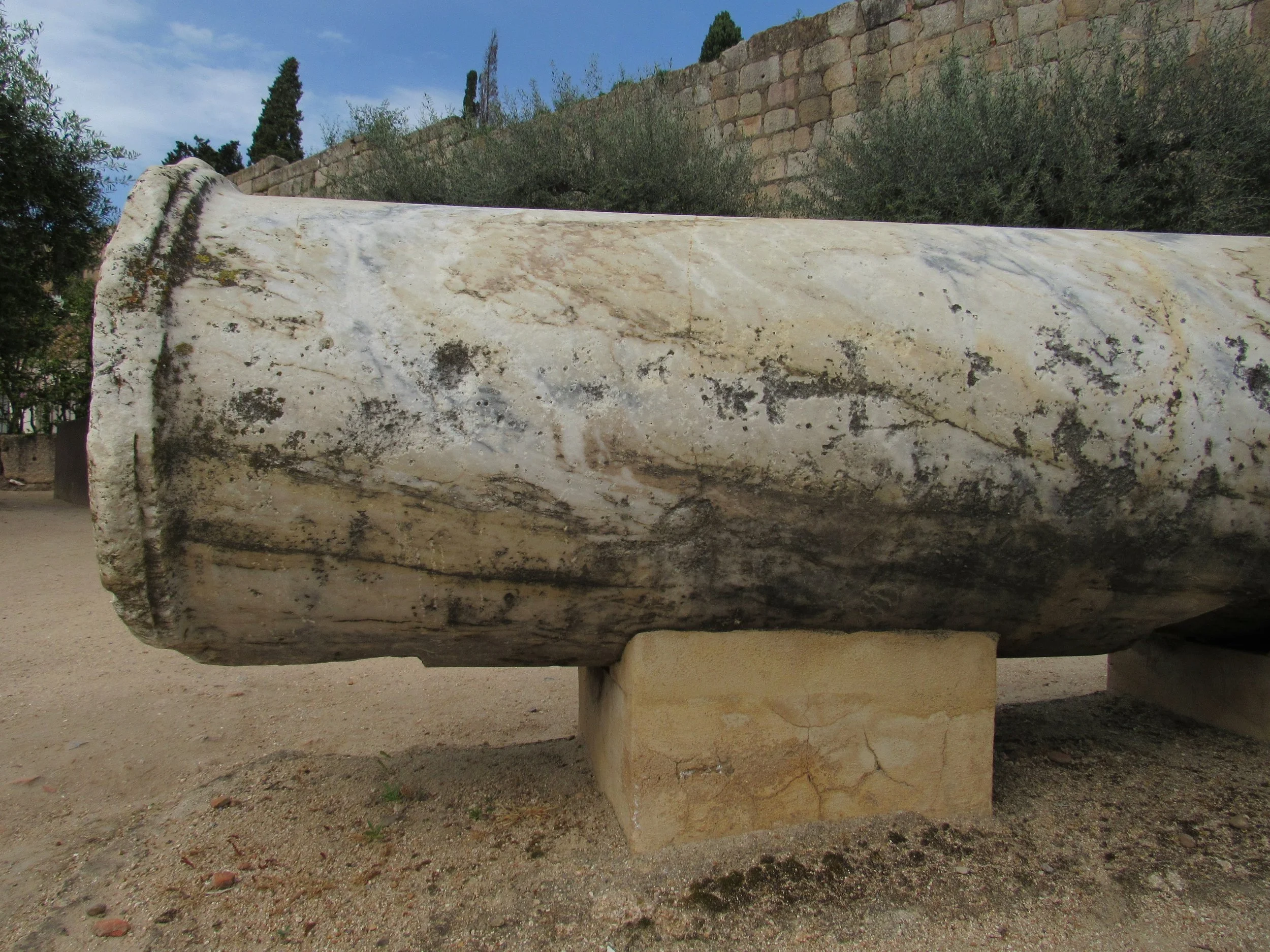
There were columns galore; both fallen and standing (even one with a penis carved into it), parts of grinding stones and their set up, cannonballs and reliefs and lots of olive trees. You zig zagged up a low incline as you walked through the artifacts along one side of the roman dwelling complex. At the top was a classic building, with some modern upgrades with bathrooms and offices for the religious order that had their headquarters.
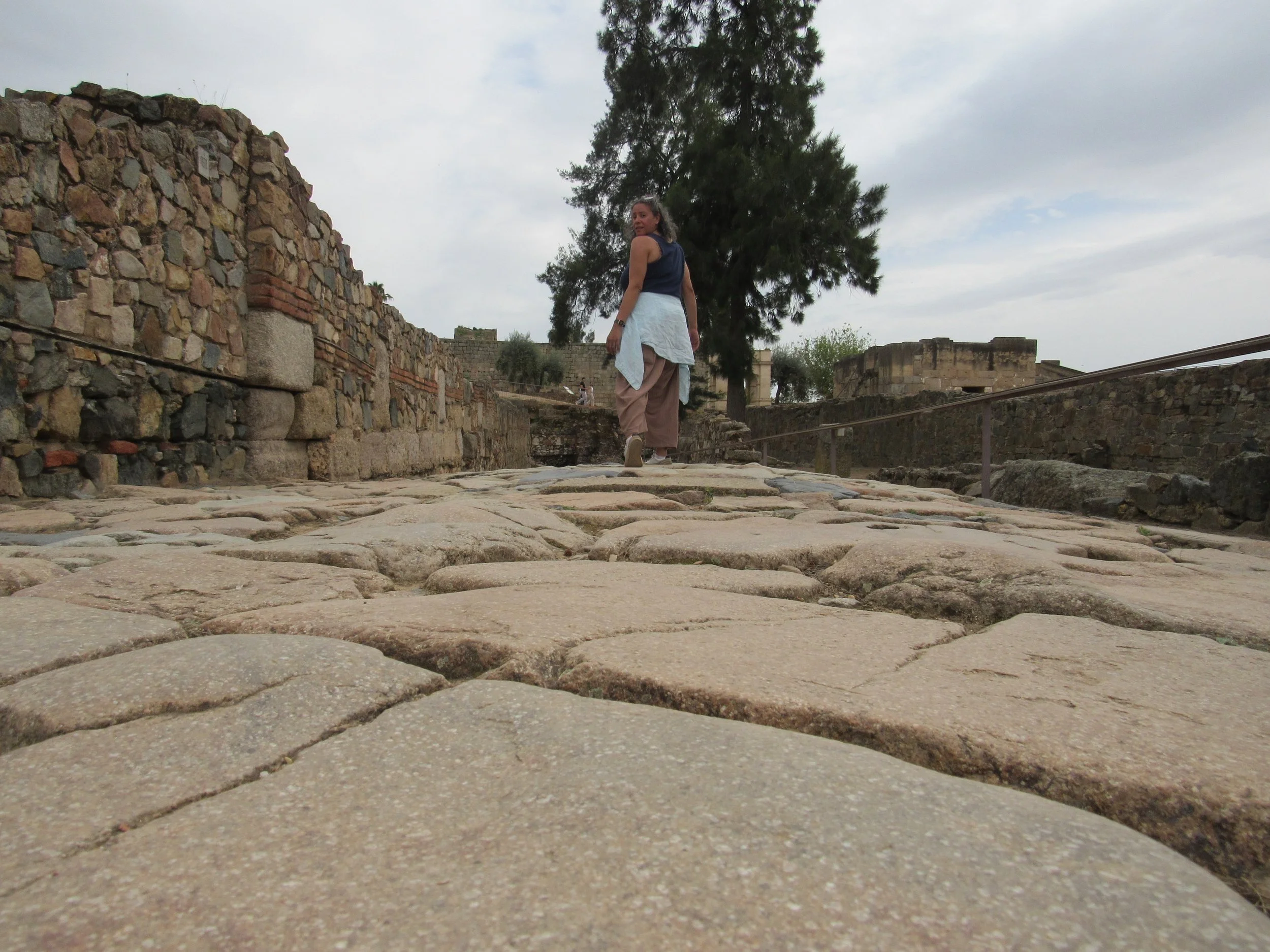
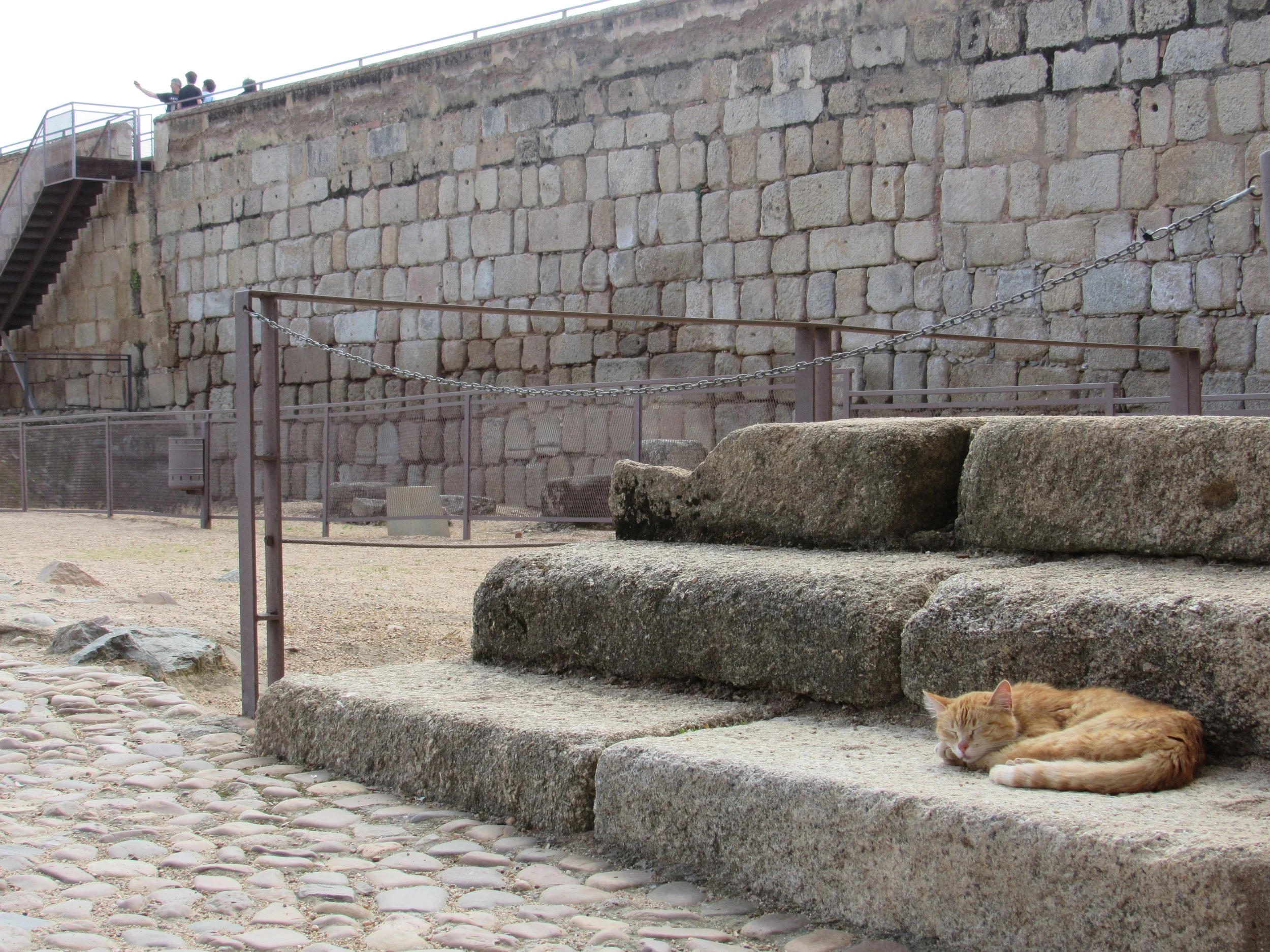
There was an overlook, below which were ruins of a Roman home and the incredibly preserved Roman Road. I walked down the smaller walkwalk around the other side of the Roman Dwellings, and walked along the Roman Road. I went up to the top of the cistern tower, and then on my way out waved hello to the citadel cat. I already had dinner groceries at my hostal, so I headed back and watched some TV before crashing for the night.
—
The next day I had another list of ruins to check out, plus see what was up with the Factoria Joven, but I would head back there during the hours they said they were open online. I had seen a lot of youth around, on bikes, hanging on the grass, on the playfields and playgrounds but nobody seemed to be heading that direction.
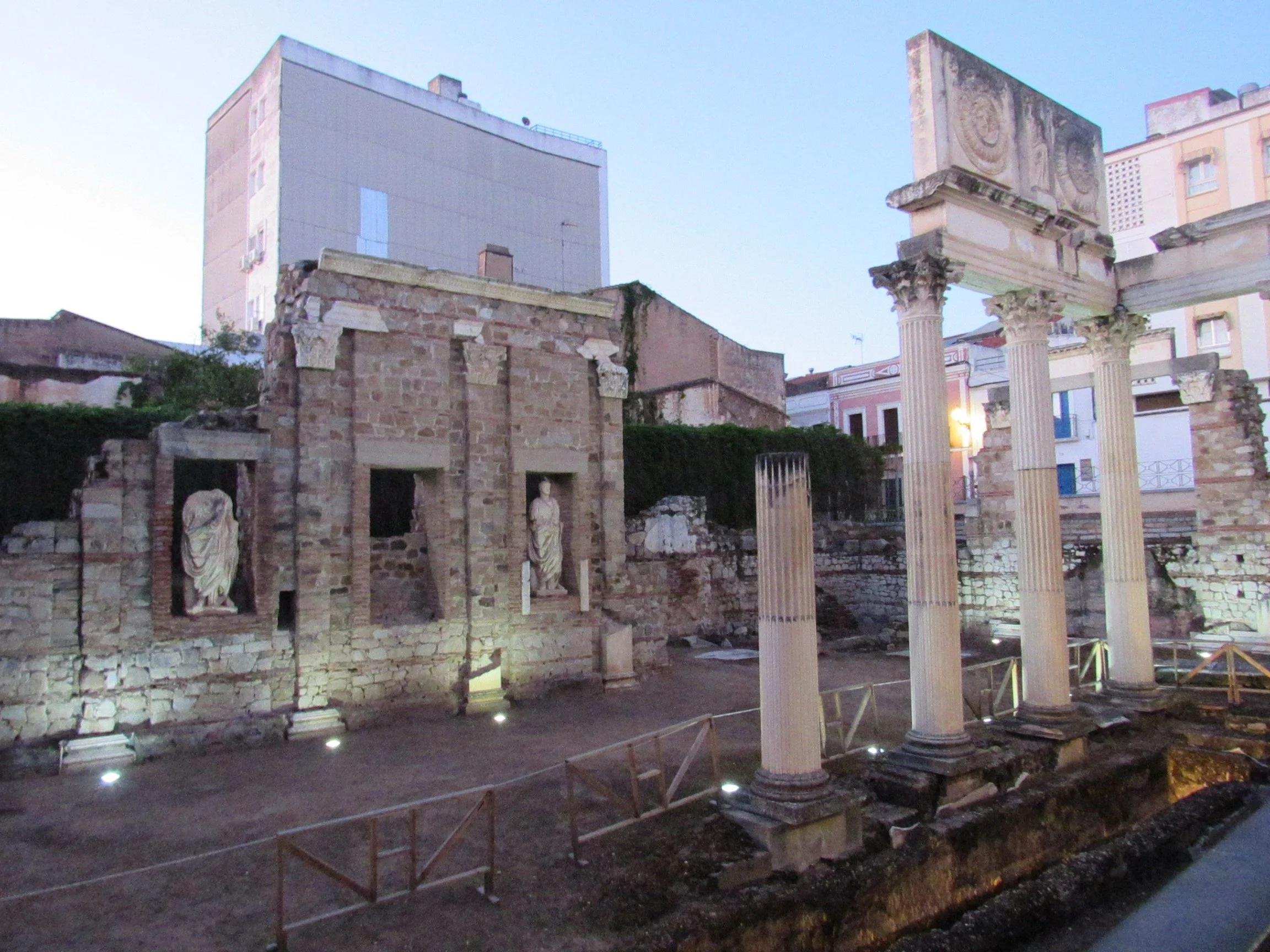
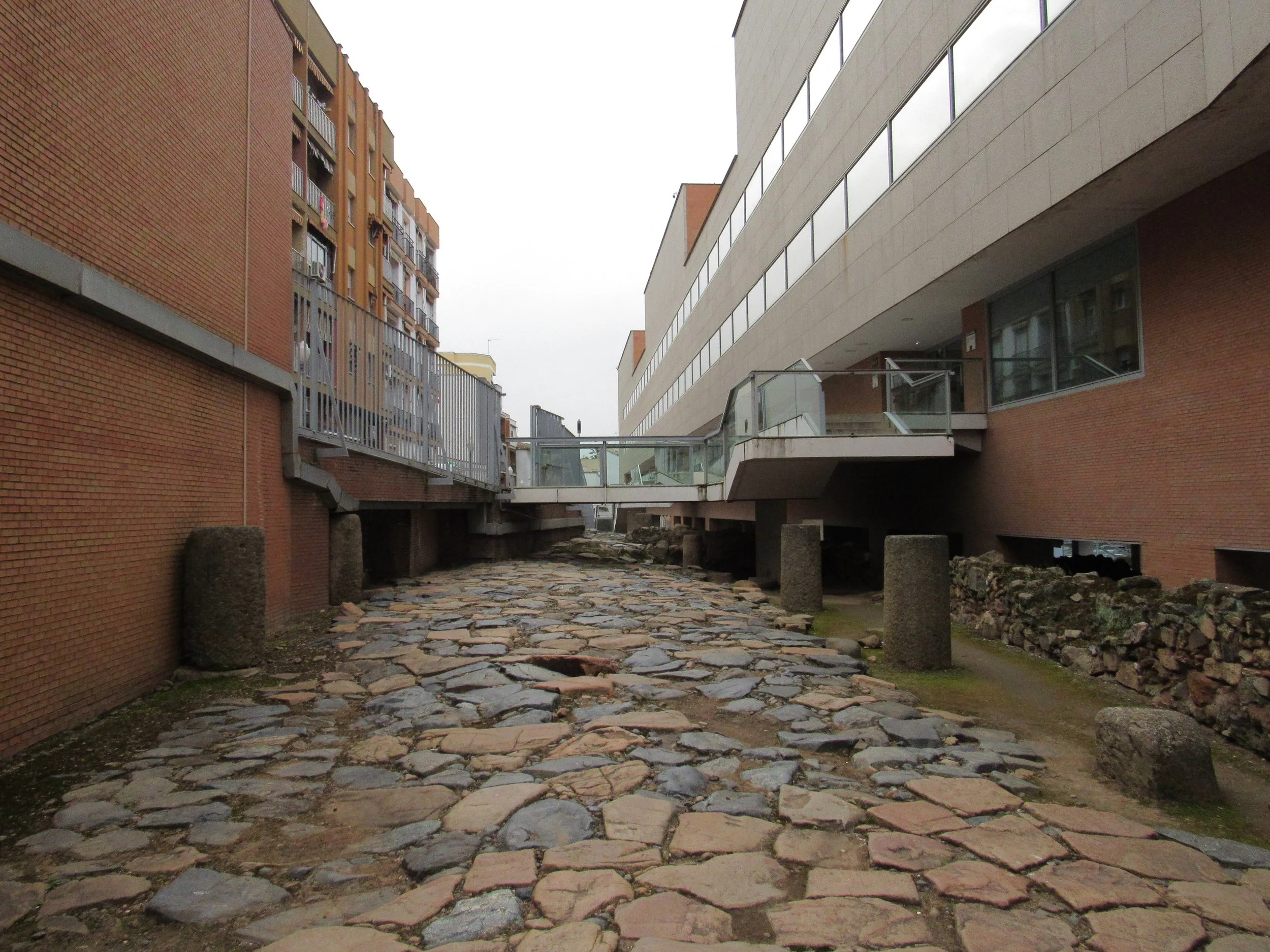
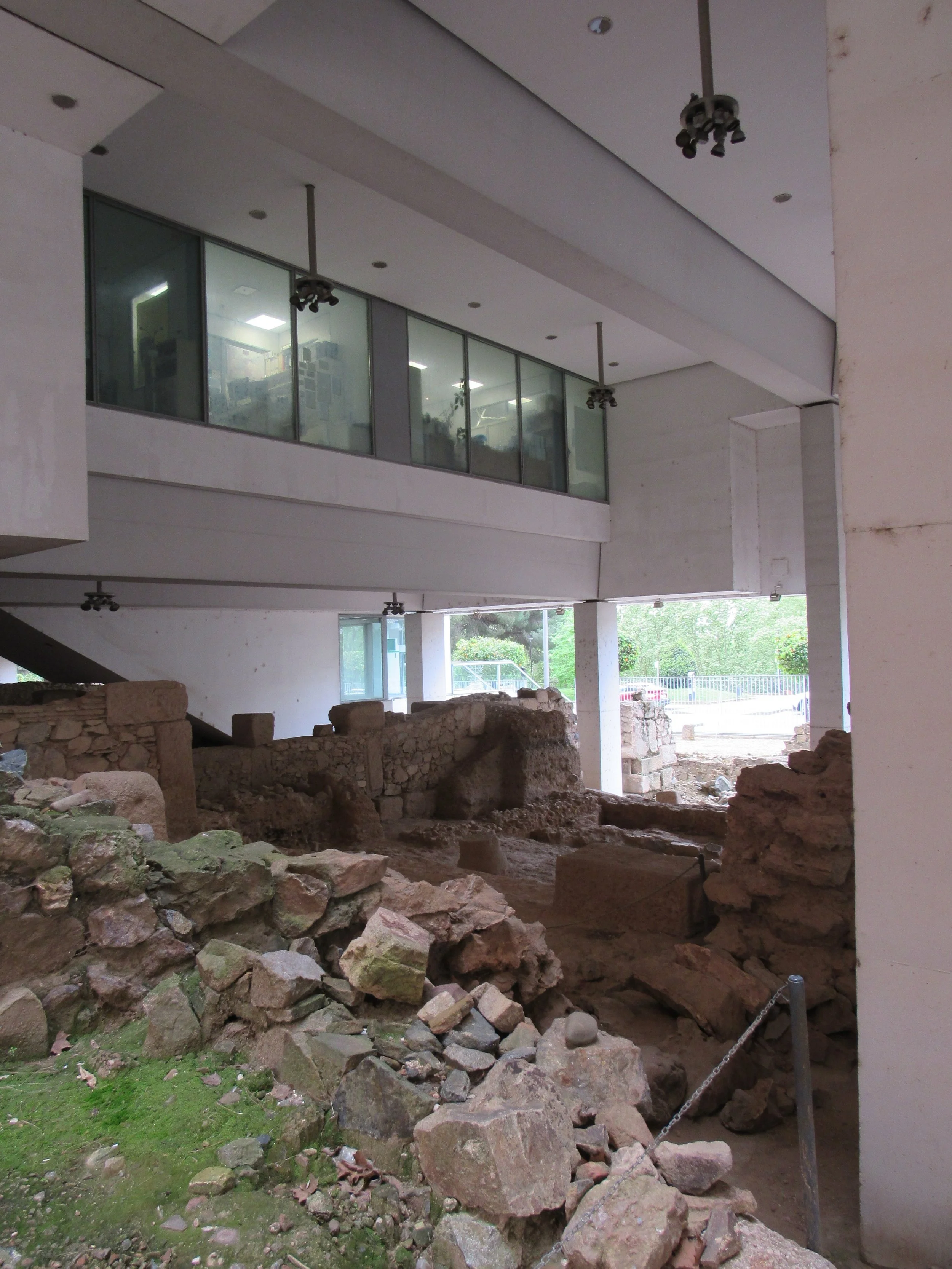
First though, I walked through town, and started at the Archaeological Area of Morerías These were old roman homes, probably lower-middle class folks. What was interesting is that these ruins were under a modern office building. A low modern bridge spans a section of old road, high enough so as not to disturb it, but not high enough for people to walk under either.
The site was relatively large, but there was not a lot I was allowed to walk through, mostly just the two streets that were the main thoroughfares. A large boulder, typical of Roman times marking the intersection. Clearly still being evacuated and studied in areas. Not a very busy site visitor wise, I was the only person during my visit, and only saw two others (one on the way in and one on the way out) there unlike the other ruins I visited that were busy pretty early in the day.
It was a wild juxtaposition walking through this set of ruins. The ruins themselves spill out from under the cover of the buildings. Large white stone office buildings on modern, square columns, acting as cover for a maze of crumbling walls. Large windows into people’s offices filled with modern day objects; desks with computers and lamps, shelves stuffed with paper, and office chairs just casually looking over the ruins that were once someone's home.
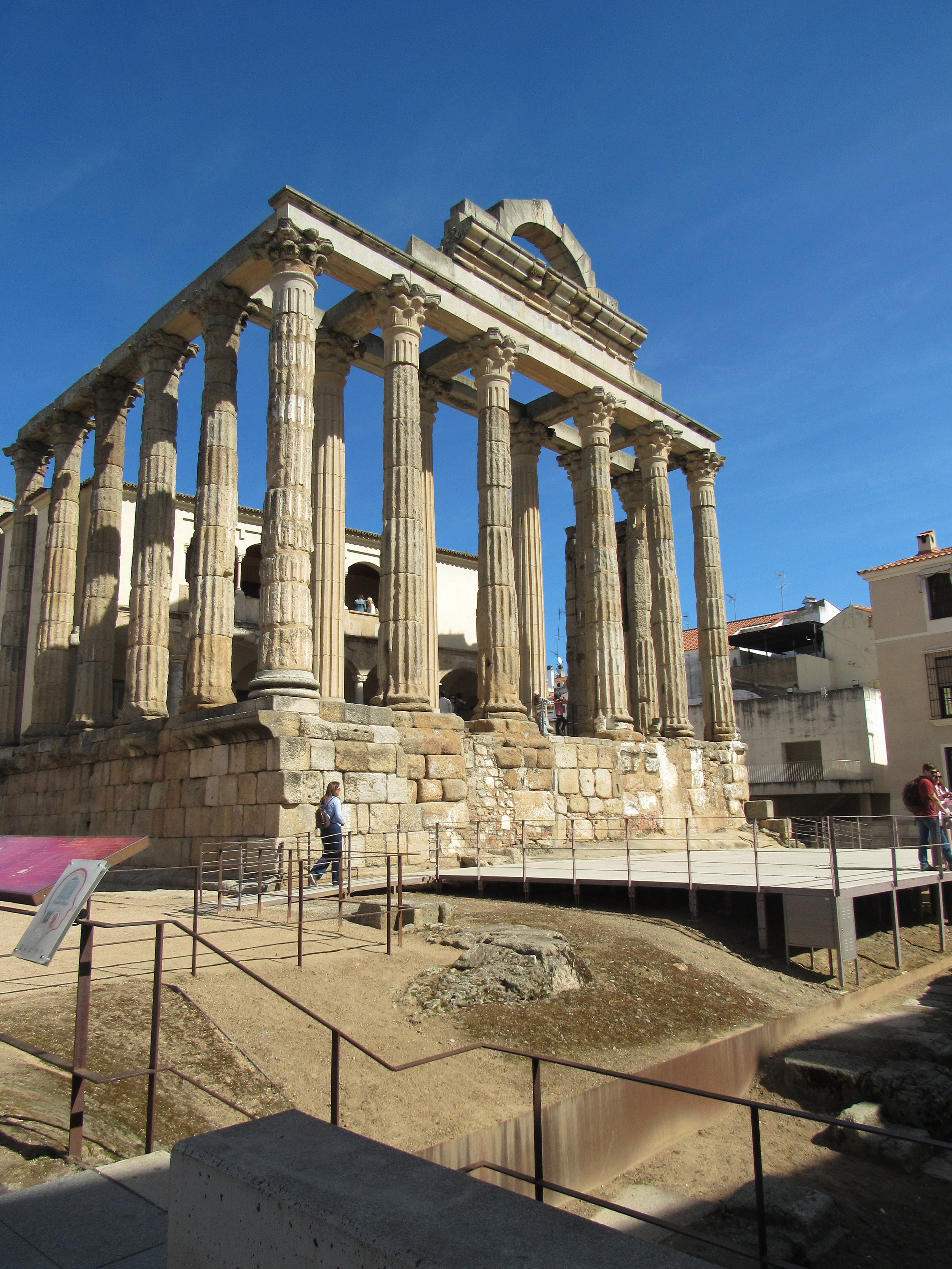
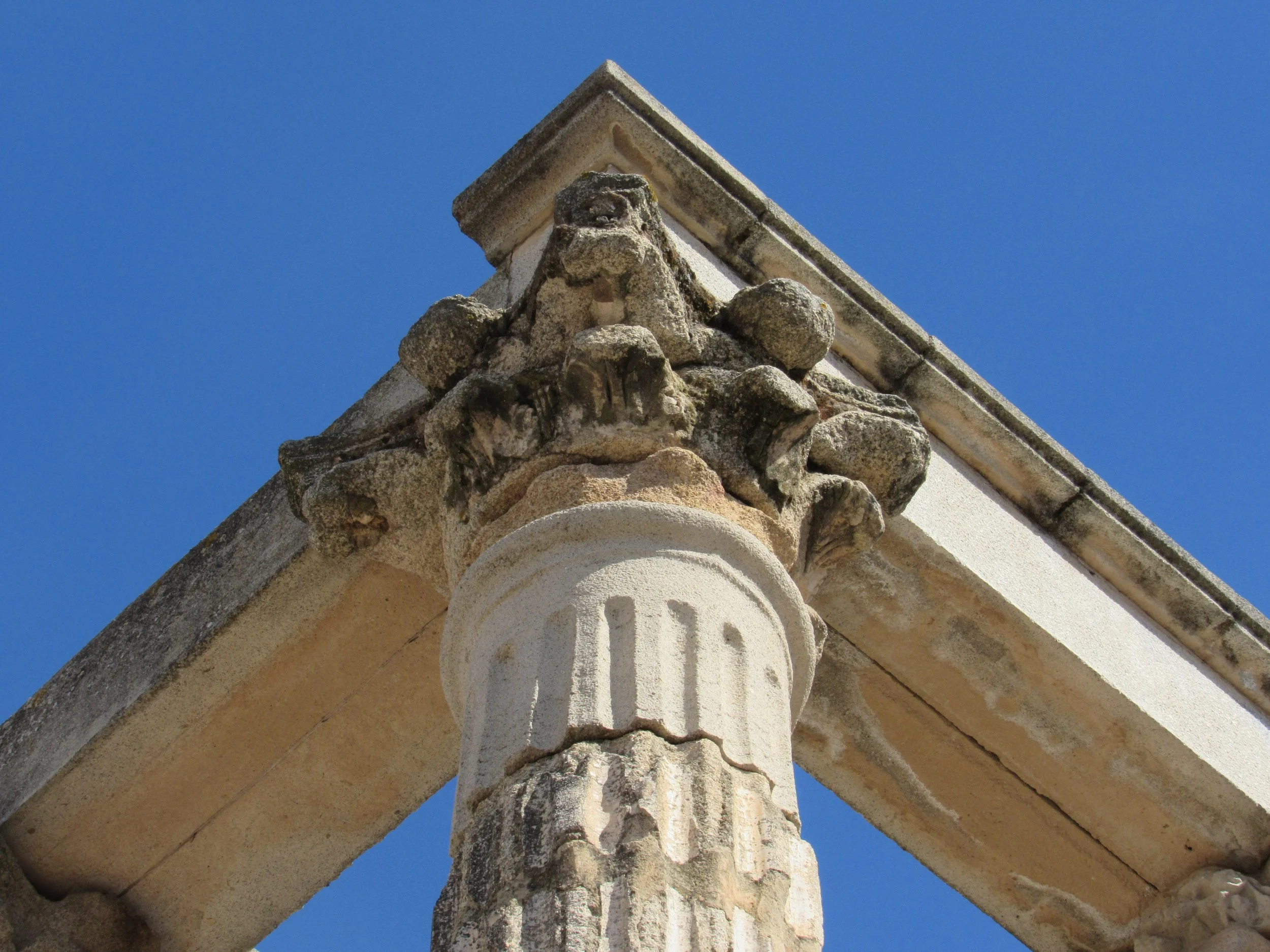
From there I went back to the center of town to the Temple Diana. This temple, usually busy with tourists, luckily only had a few people milling around. The outside is free, but I had to use my ticket to get inside.
The temple itself was cool, but information/art wise was a bit disappointing. A lot of stuff was obviously missing and there was nothing in English so I did have to go through and translate everything. The architecture was spectacular though. The balcony looking down on the plaza was worth the visit inside.
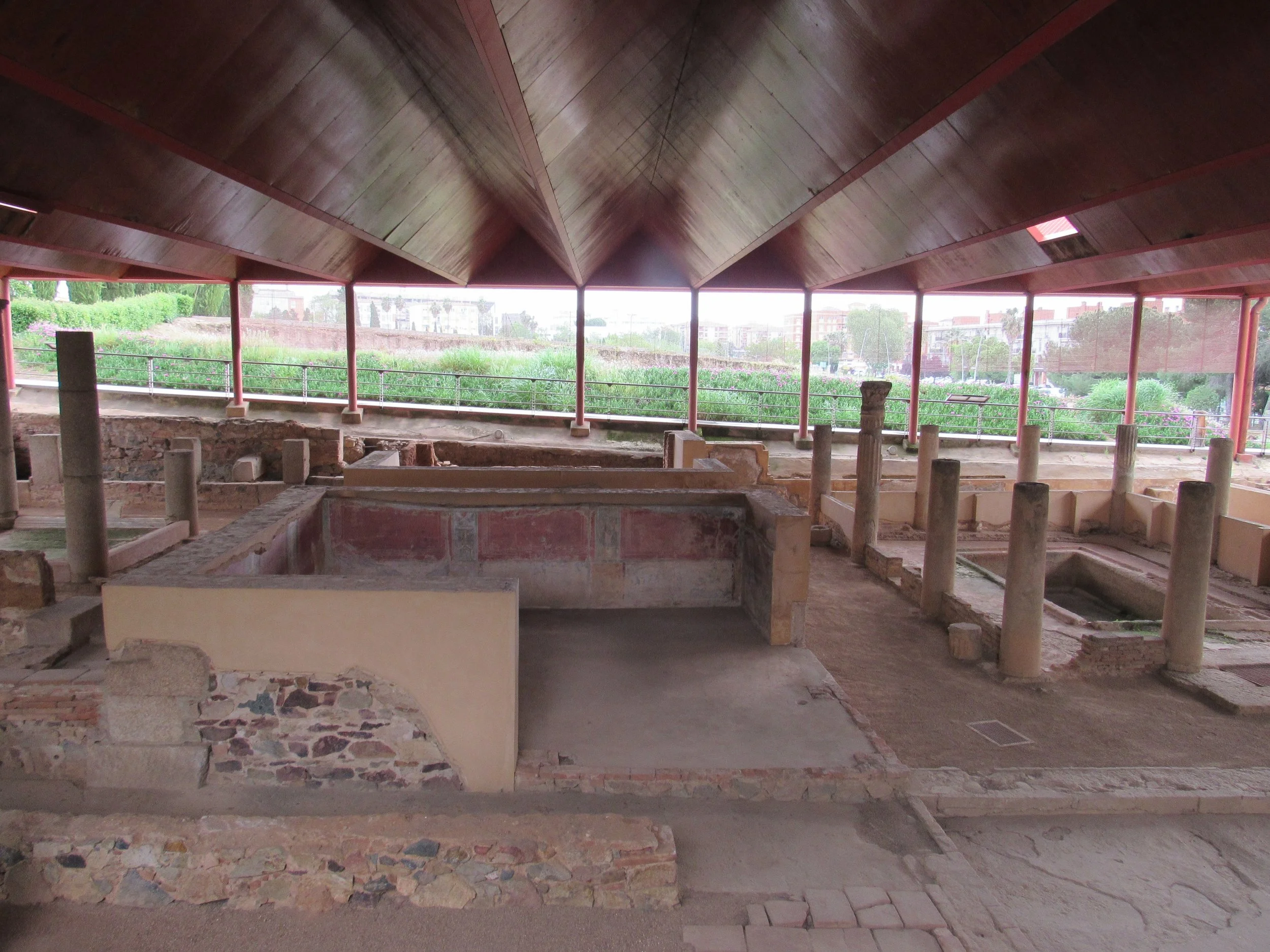
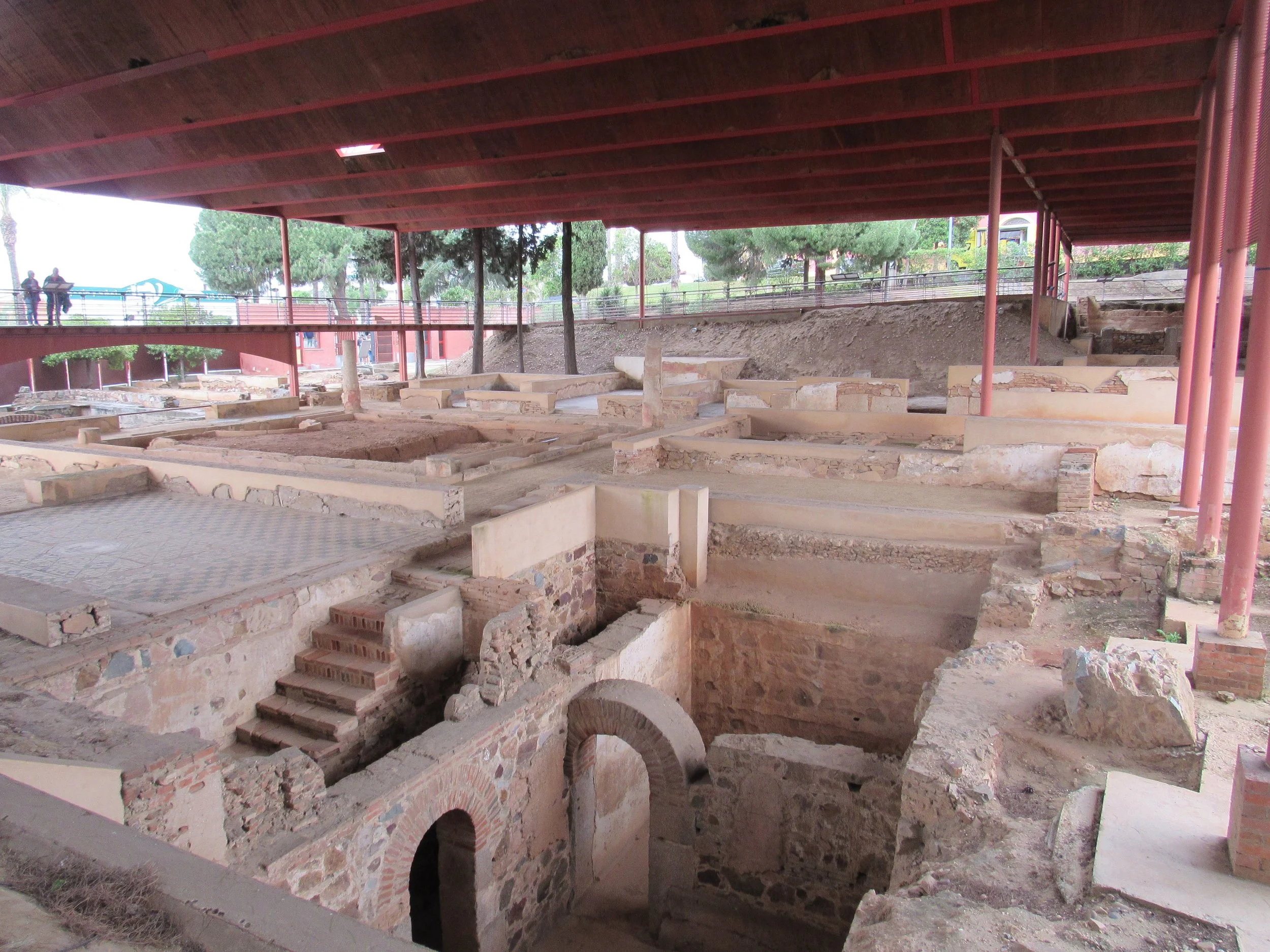
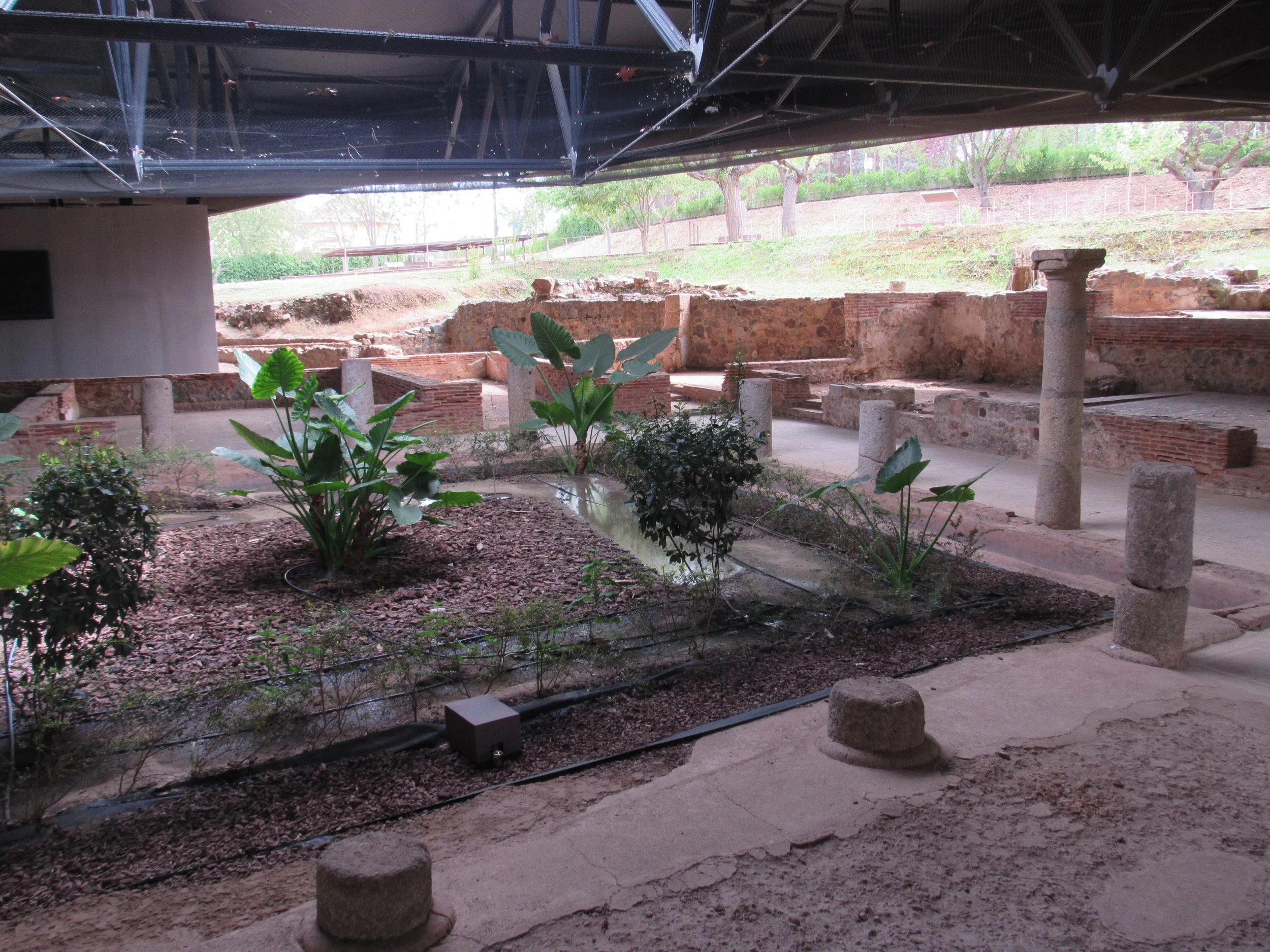
After another grocery store stop for lunch nearby and a sandwich under the ruins, I bird and people watched before going to my I headed to my next set of ruins for the day. This was the Mithraeum House and Columbaria, located near the bullfighting ring, and were probably upper middle class homes. These ruins, like the ones I saw in the morning, were covered for protection, but instead of being a building it was by a large red metal structure that spanned the entire site.
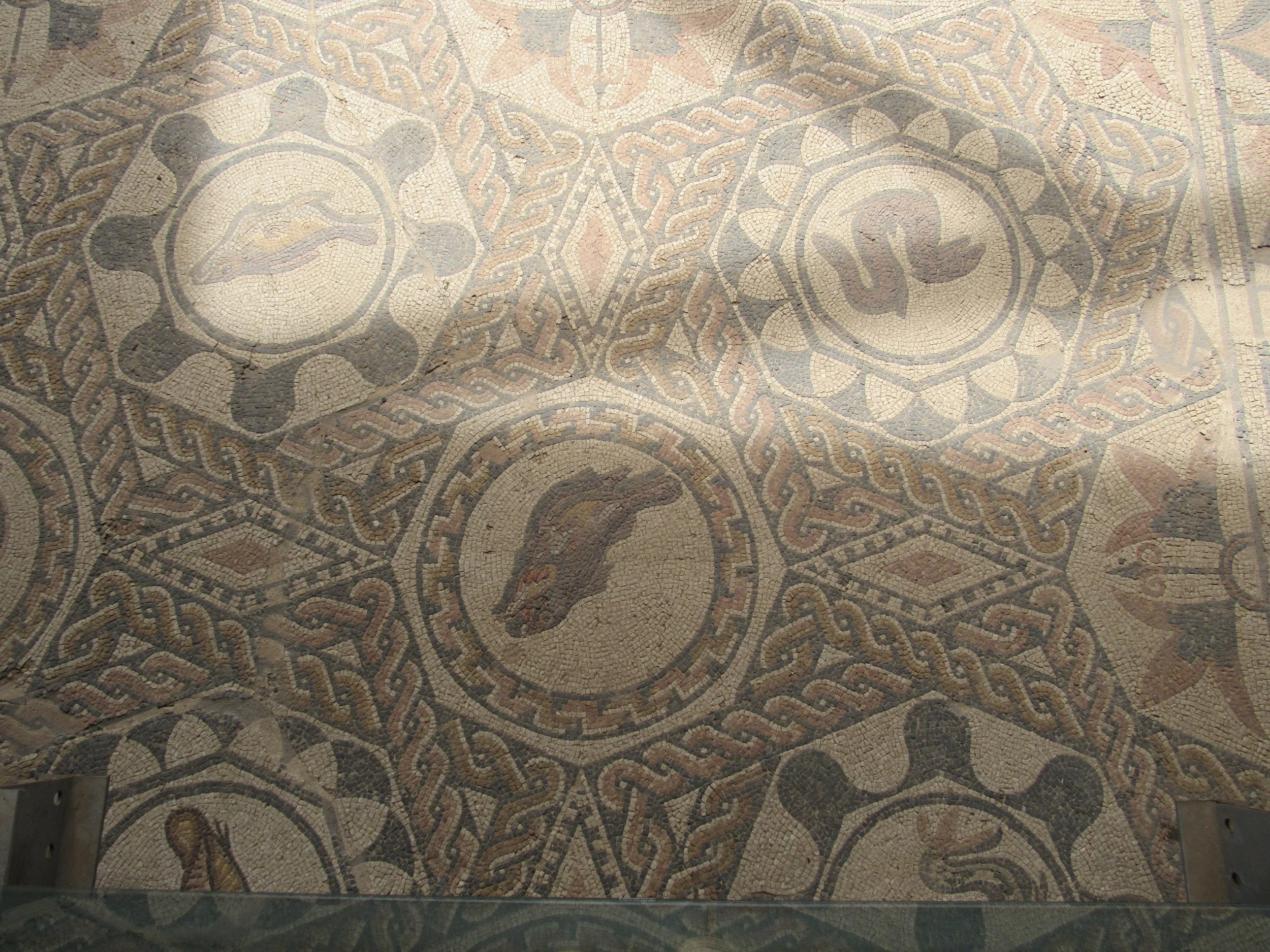
This spot was cool because it had a bunch of preserved mosaics, and the rooms were clearly shown, plus delineation between public and private space, and you could even see some of the paint still on the walls. An elementary school class was there on a field trip, so I circled around the site opposite of them.
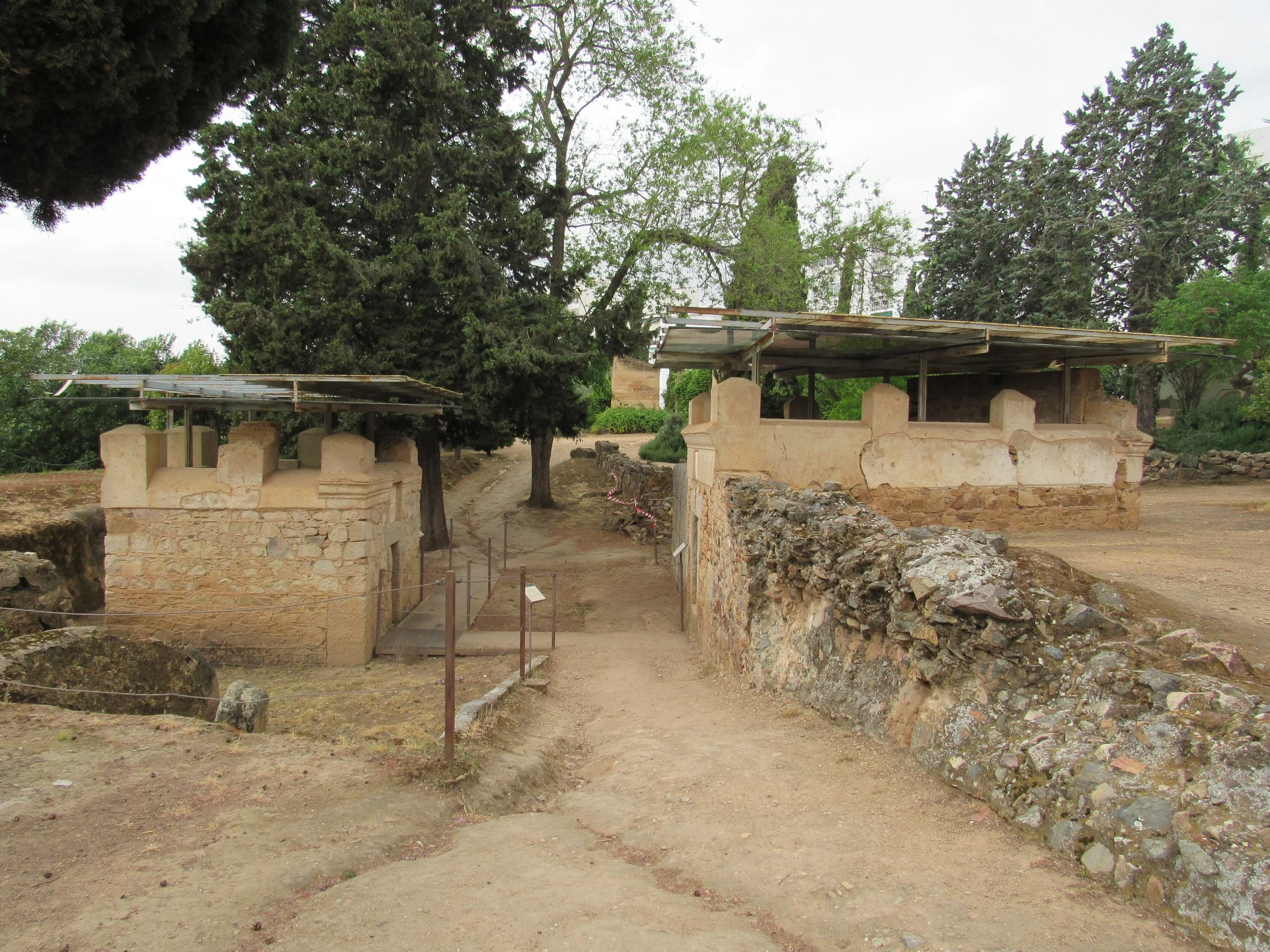
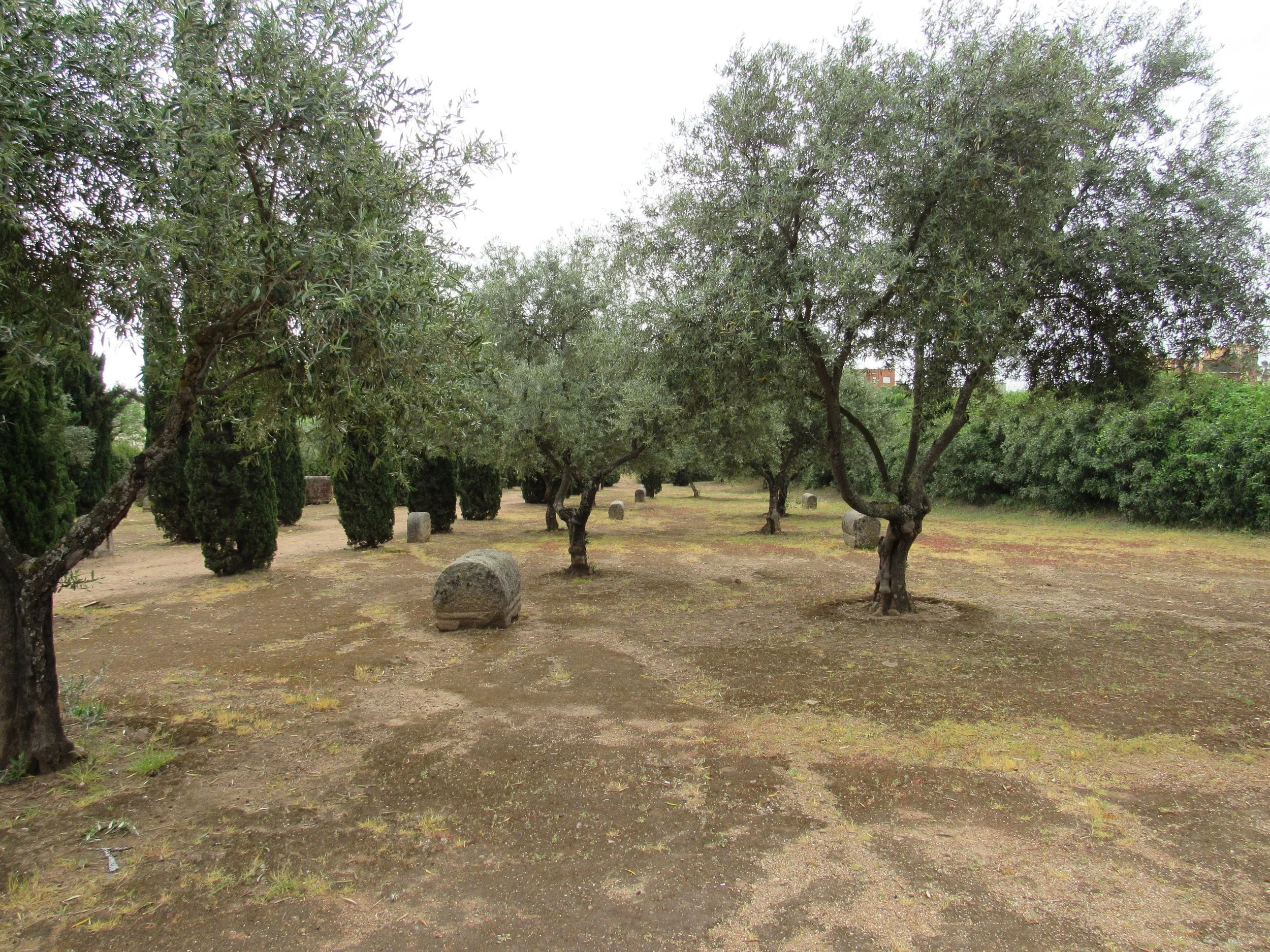
This site also had a graveyard you could visit, which I never pass up an opportunity to go where the ghosts could be. After a short walk through a tunnel of cypress trees there was a garden of sorts. The front half was an olive grove with ruins and gravestones encased in glass for protection. There were also a couple of crypts between a small walkway and more encased pieces of pottery and other items found on the site. At the very back was another path lined with cypress trees. On either side of the path were old gravestones and more ruins. beyond.
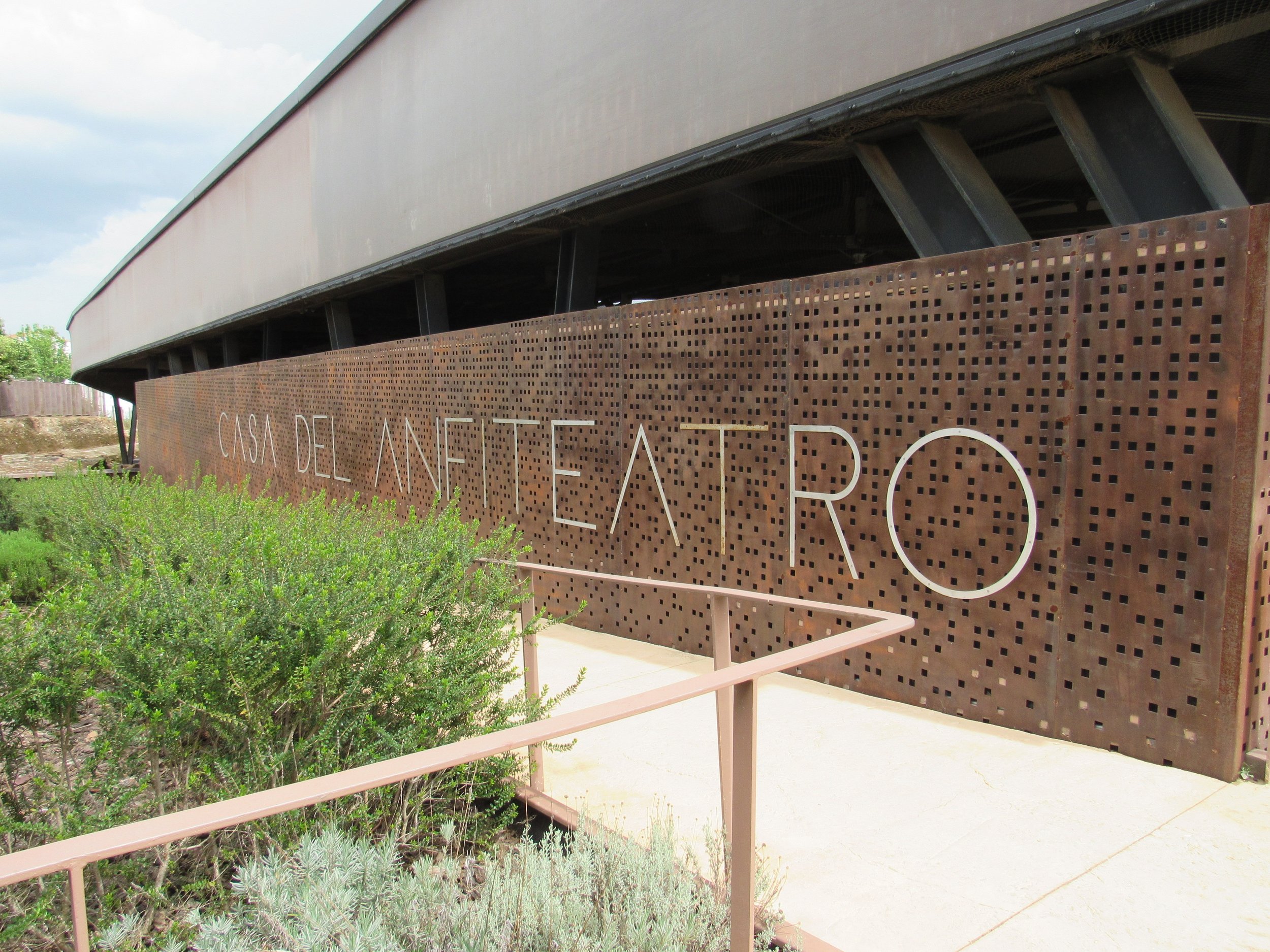
From there I had time to check out one more, via my free ticket. I headed toward the Casa de Anfiteatro. I probably should have done this the same day as the Amphitheater because the entrance is across the plaza from the ticket office. In general the order in which I chose sites added to my step count.
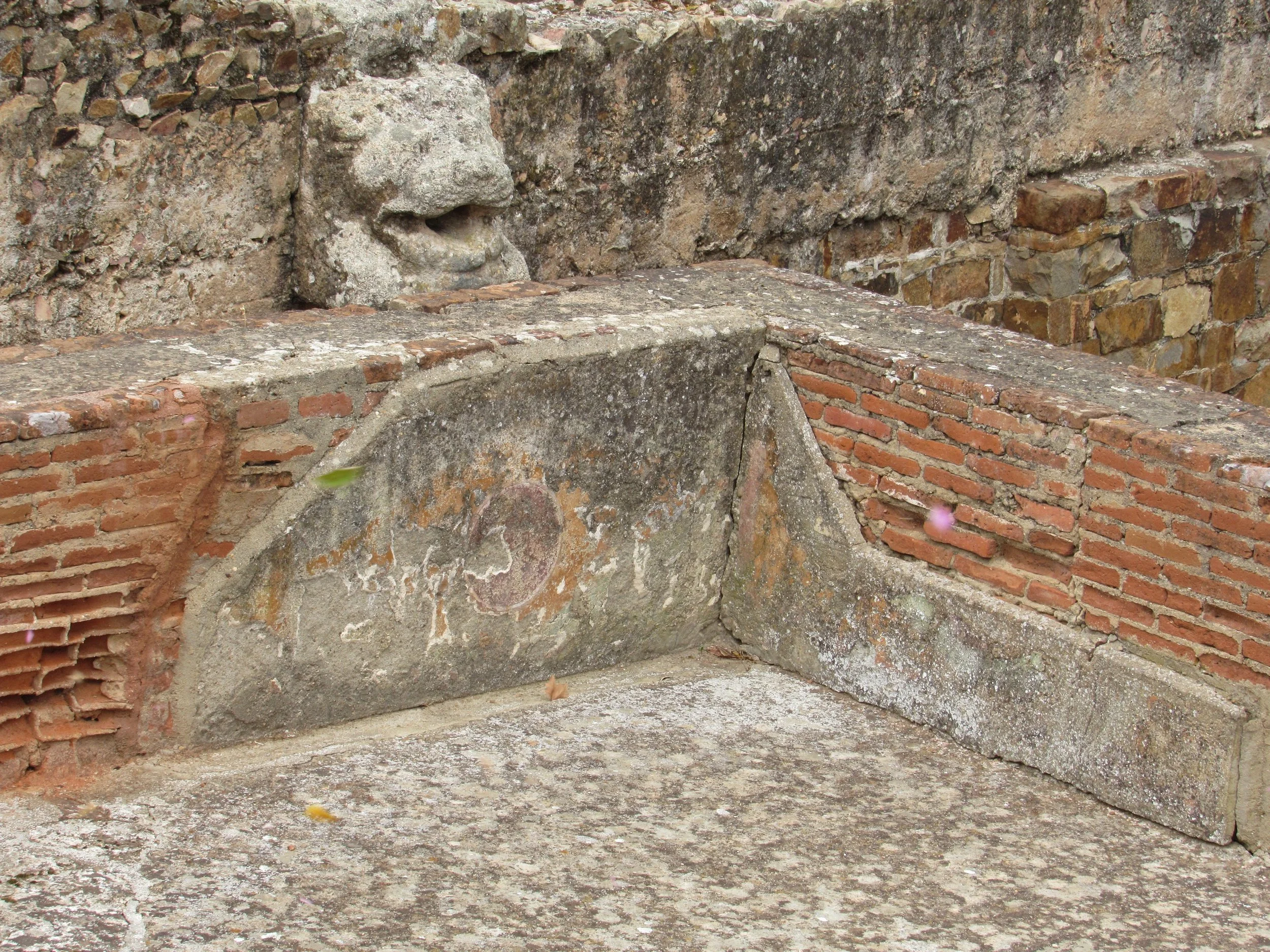
Upon entering the Casa de Anfiteatro you walk down paved ramps with information as you go. There is a long channel along your left that once carried water to town and a spigot that still resembles the lion head it is supposed to be.
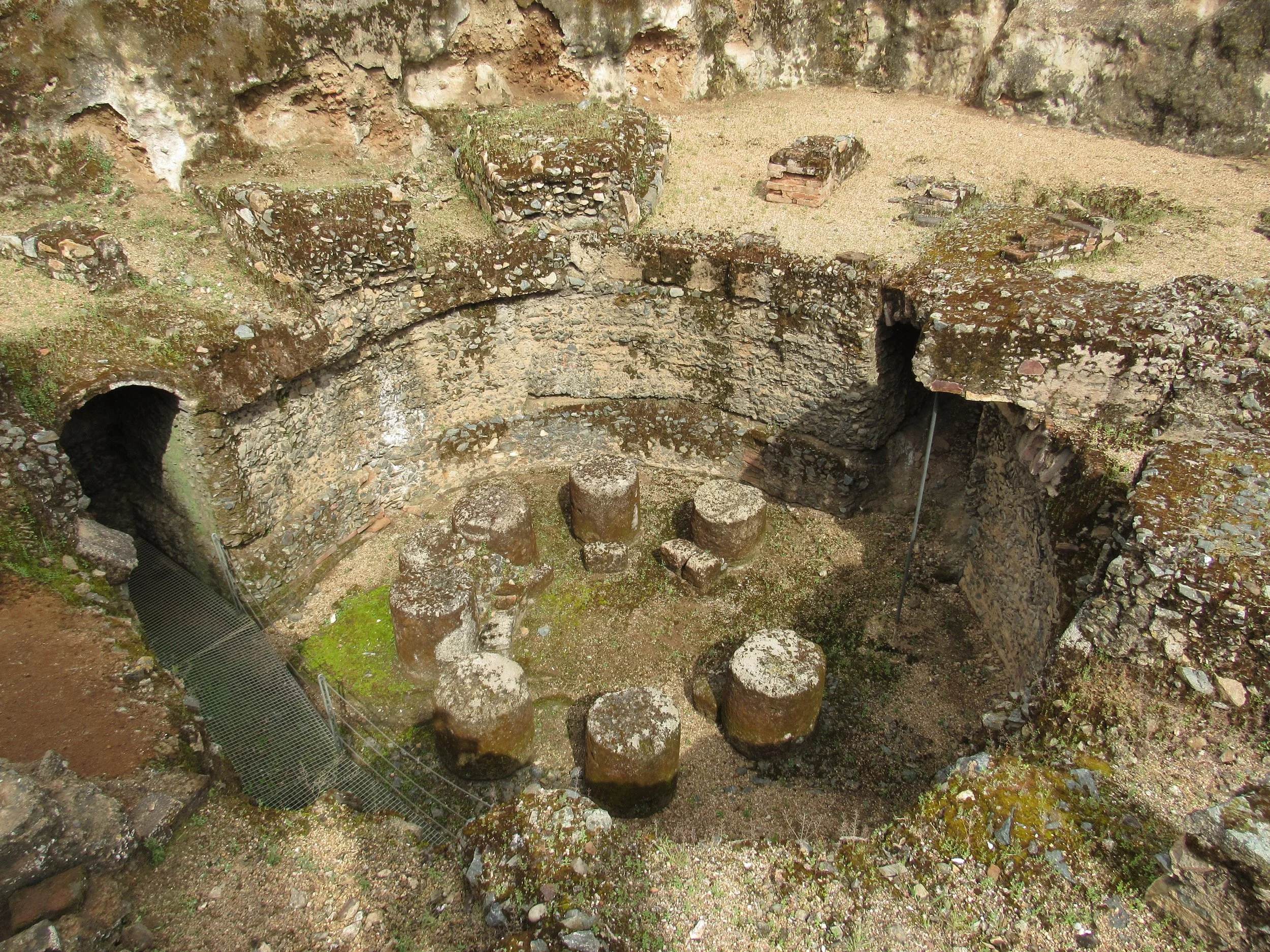
As you approach the casa itself there is a collection of low arches contained in a square bit of ruin. These are part of how they warmed the water for the residents at the communal bath nearby. From there you enter into the casa itself. You step onto a metal walkway suspended over the floor. There is also a metal roof, matching the walkways, in a dark maroon, and skylights punched throughout for natural light.
This would have likely been a home of two wealthy families, and had some of the best preserved mosaics in the world. I was absolutely gobsmacked by the condition. There were also still designs on the walls, and clear delineation between rooms, and even the hallway being individual units. These ruins also showcased how the home was built around the open courtyard, with plants that would have been planted there in Roman time, and one of the skylights above.
You exit out the opposite side of the casa, and then there is a small ruin under another cover. This is a crypt and shows what the inside was constructed like. From there I walked back toward the entrance, and retraced my steps back up the paved ramps. I walked back toward my hostal using the route that takes me by the Church of Saint Eulalia, quiet after being the beginning and end points of the Semanta Santa processions during the celebrations.
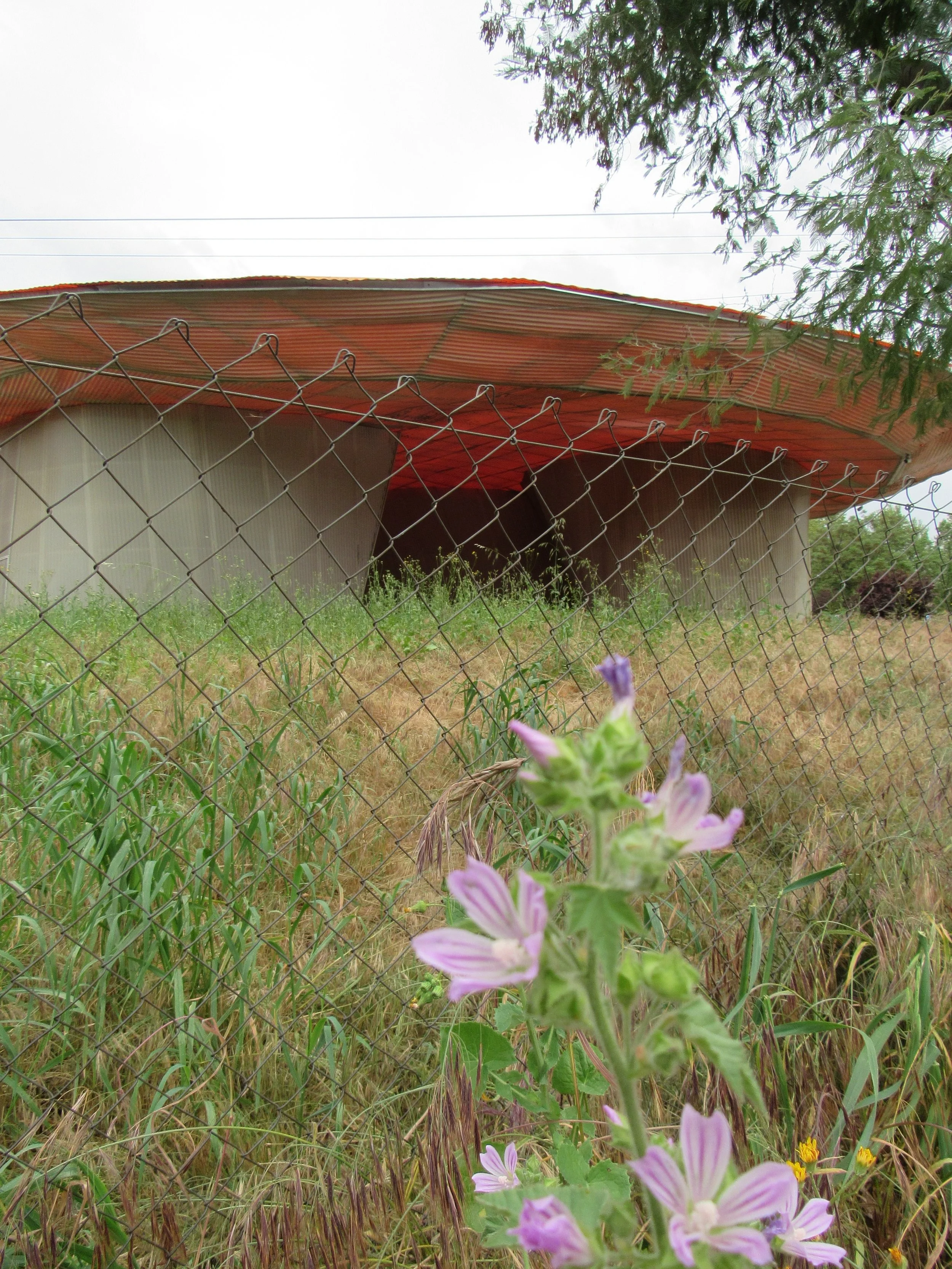
I continued on toward Factoria Joven. Per its website, it was supposed to be open in the afternoon. As I walked up I was surprised to find it was empty. As I approached the chainlink fence surrounding it I noticed it was actually in pretty bad disrepair. Behind the chainlink fence I saw the sign, "Temporarily Closed For Repairs”. Welp, this explained why I did not get an answer from anyone about touring the facility. I decided to still walk around the building and see what I could.
It was clear it had not held up particularly well. The climbing wall had huge panels missing. The corrugated plastic of the main building had come off and was banging in the wind. Orange pieces of plastic from the structures scattered everywhere. Moss and grime all over the concrete. I kept walking past Factoria Joven. The right side of the property butts up against what looked like another youth center.
I was trying to get to the backside of Factoria Joven but instead I ended up at another set of aqueduct ruins. These ran perpendicular to the road and to my delight cars could drive under! I followed them up a large hill winding my way up the path. It was an open park with new small trees and benches in the crook of the path’s curve. At the top was a playground and a parking lot. From the lot I could see in the distance Factoria Joven and a racetrack behind. I continued down the other side of the large hill down the street lined with orange trees, continuing down past the racetrack and the large swatches of unmowed grass and eventually came back close to the Factoria Joven Building.
Between Factoria Joven and the racetrack is a small driveway that leads towards a block of industrial buildings and a row of cars outside. There is a double fence, one hugging the main Factoria Joven structures and then a secondary one further out along the driveway, enclosing what I assume was once parking. The lot is full of patches, low scrub, a bench and an overflowing trashcan. Shards of orange corrugated plastic litter the ground. There are a row of shipping containers along a portion of the main structure.
I photographed what I could of Factoria Joven, and then headed back to my hostal along the aqueduct park. After another day of walking around I was tired, so I had more baguettes, prosciutto and cheese for dinner in my room and crashed.
—
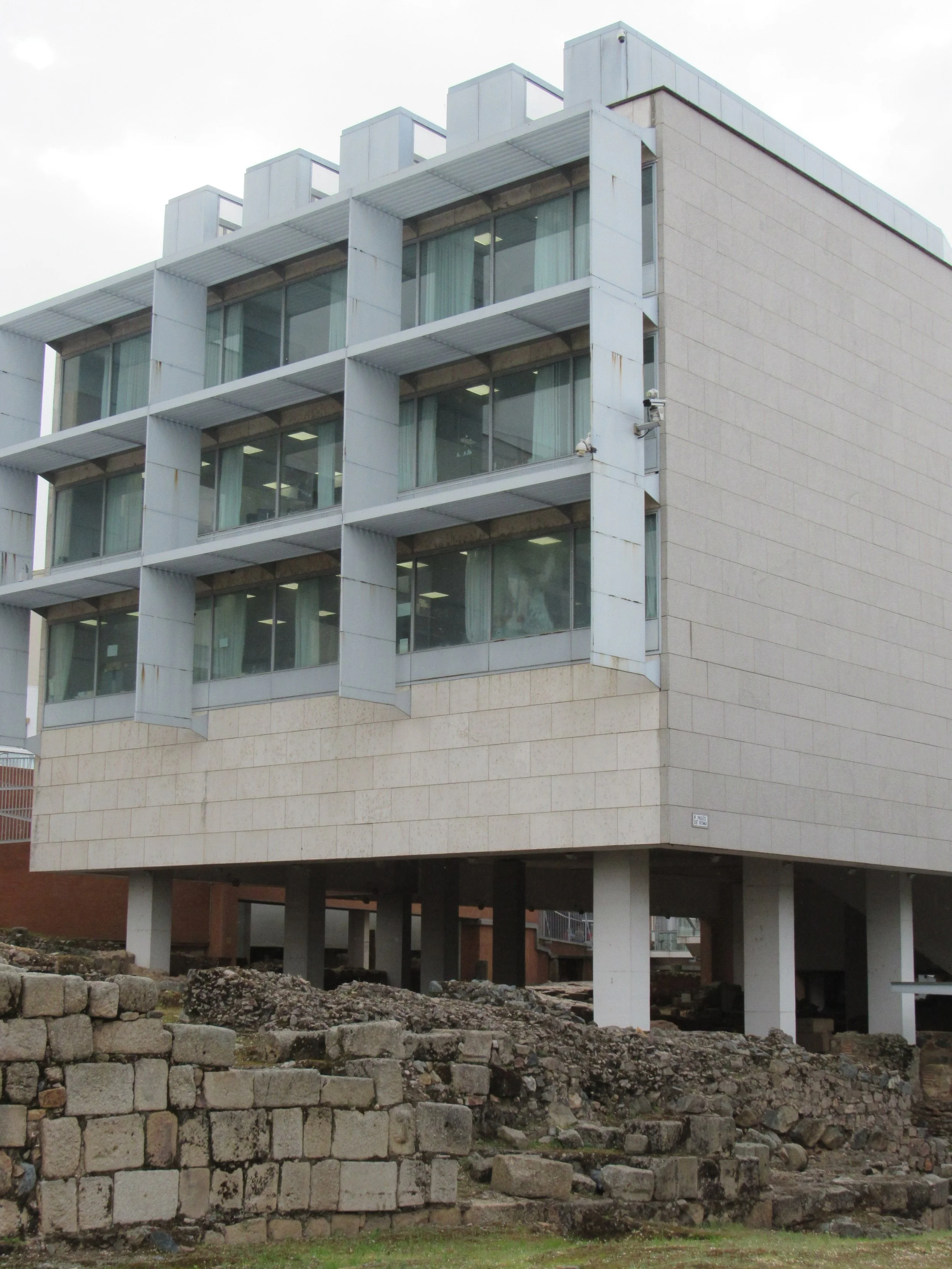
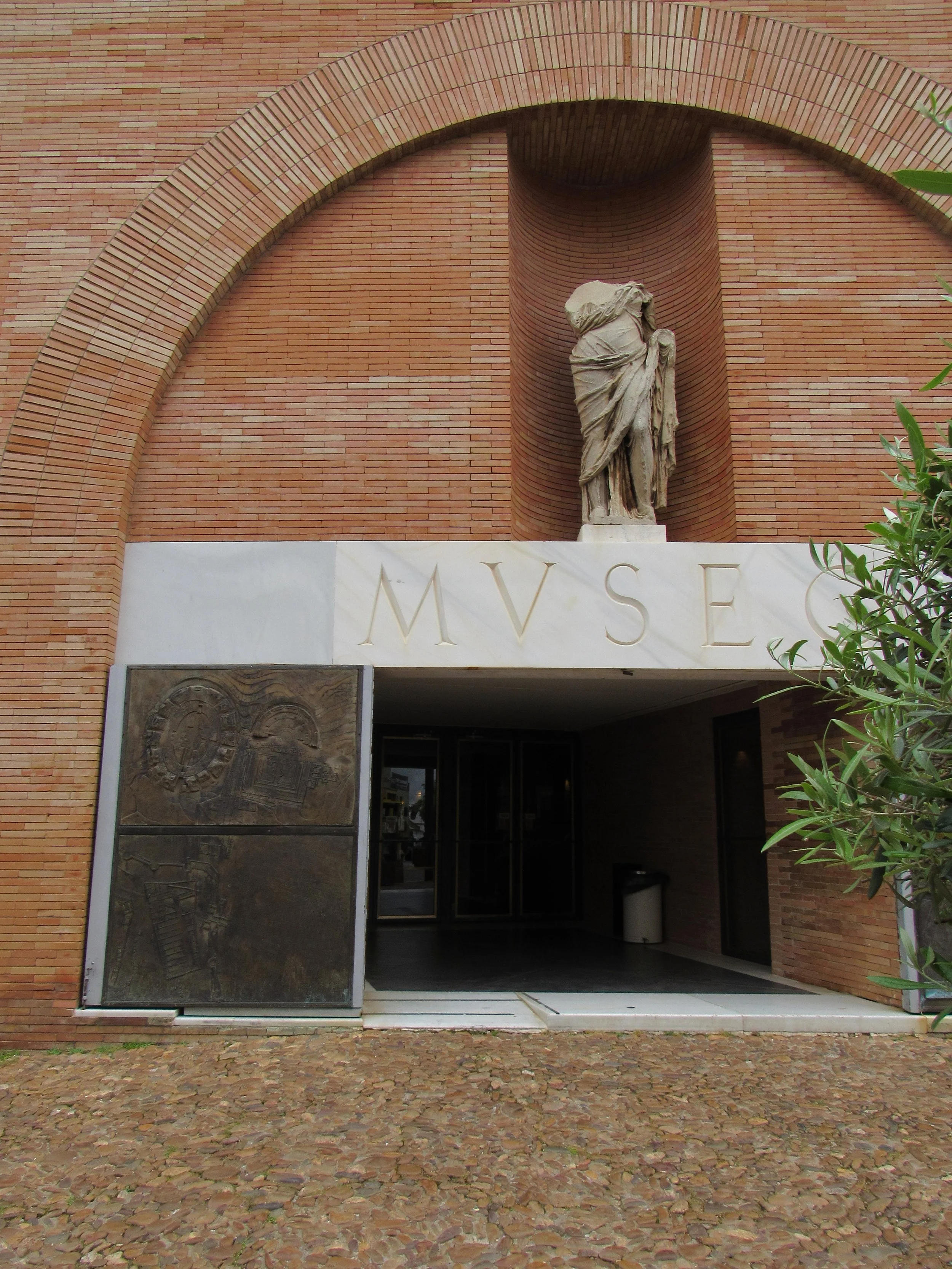
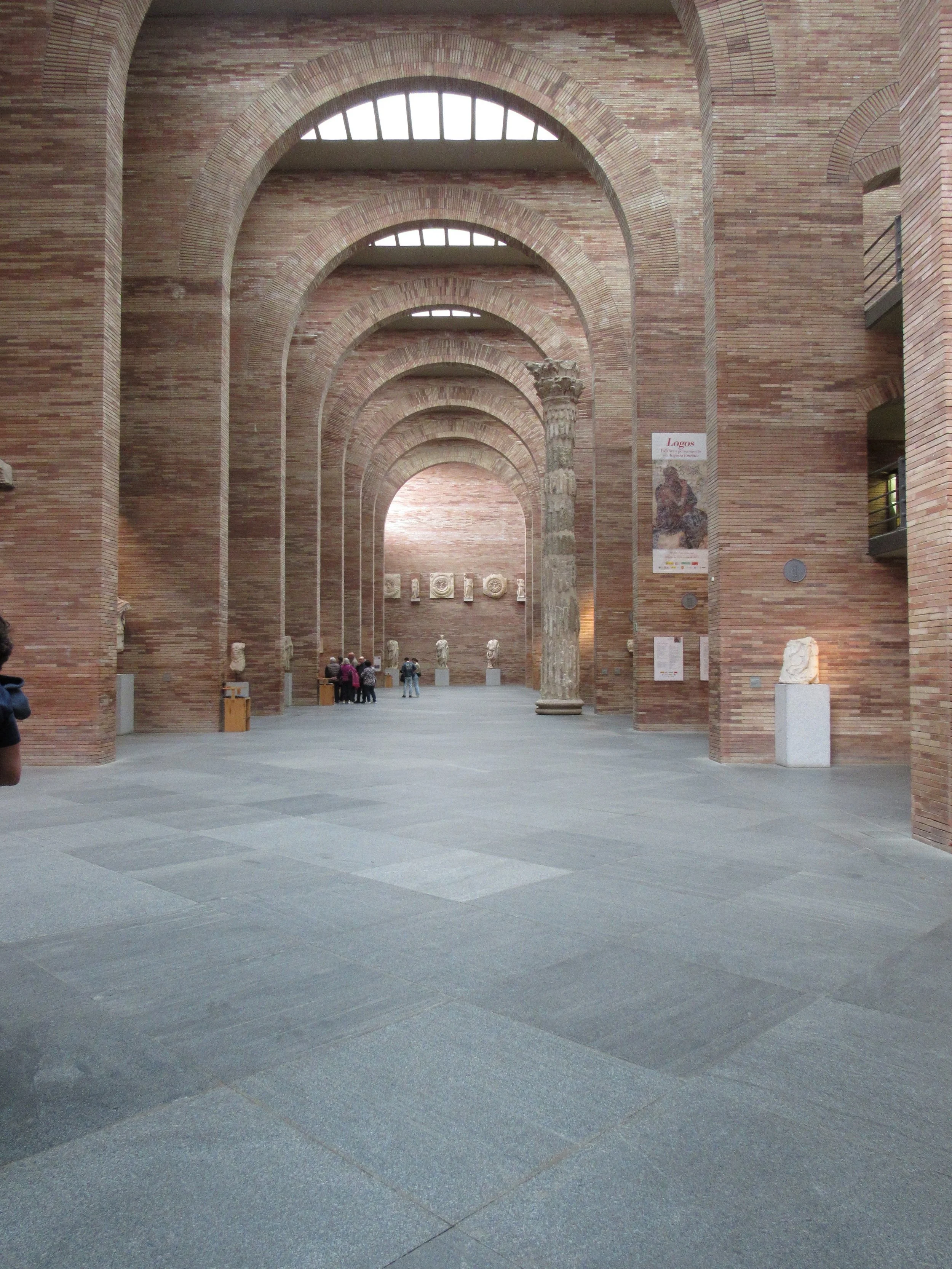
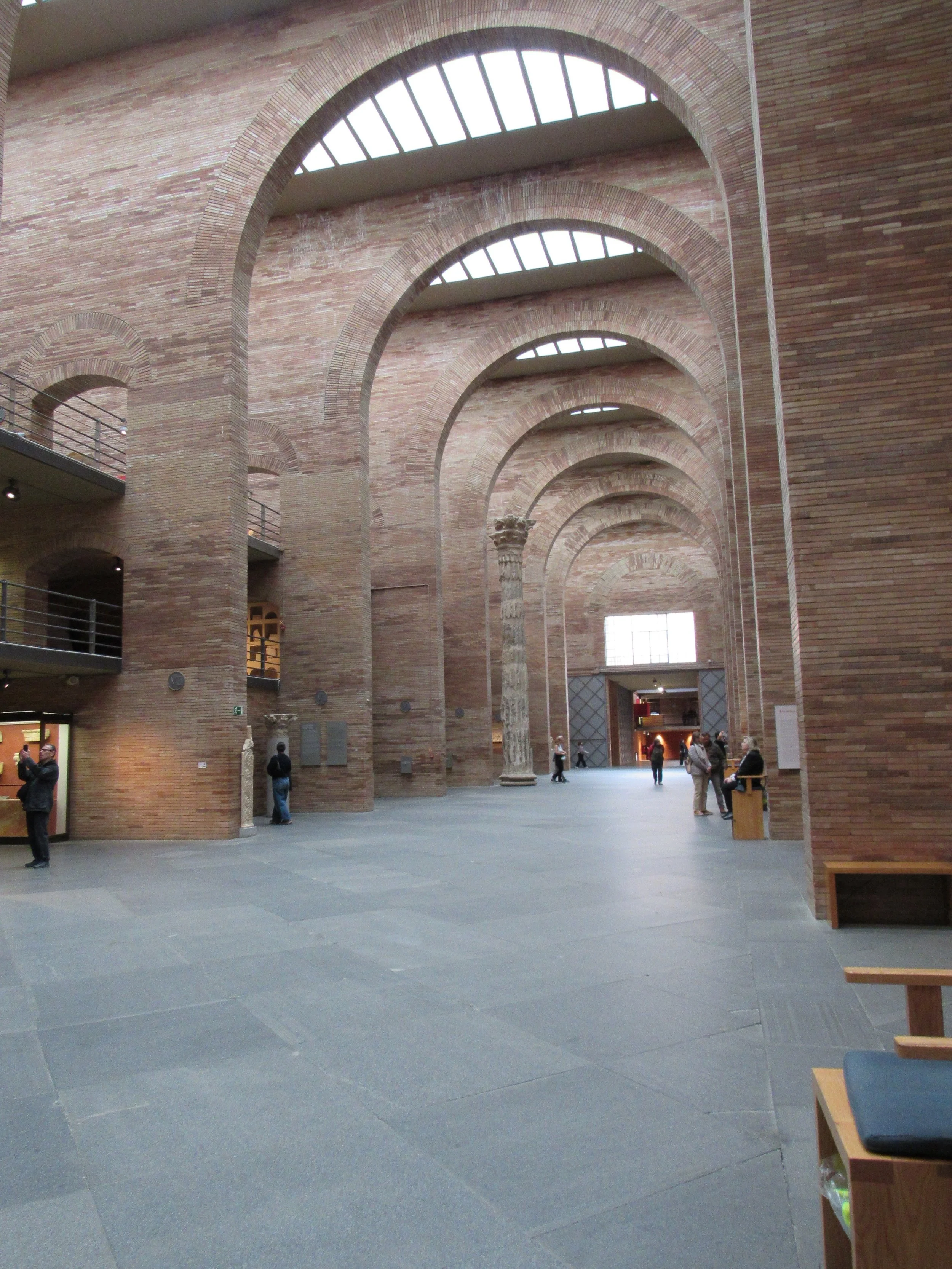
I had two more days, and I wanted to check out the museums, since the Youth Center was a bust. On this morning I walked though the aqueduct park stopping to photograph some birds, and back through the Amphitheater plaza where the National Museum of Roman Art was located. It was a modern, brick building, 3 stories high. A roman statue without a head in robes wrapped in rope above the double metal doors in a brick arch and tucked in an alcove. Walking into the entryway, which is the second floor of the building with dark and low ceilings, there is a coatroom and an entry desk.
As I approached the desk, ready to pay, the attendant asked me something in rapid Spanish. I did not understand and communicate as much. She then in English replied that the museum is free, and asked where I was from. I sheepishly said, “America, so sorry” before she gave me a pained smile and told me how to get to the exhibit.
I walked down a ramp that zig zagged down to another low room, along one wall a low window looking into a small exterior courtyard along floor level with metal making large X’s across the rectangular pane.
This then opened up to the ground floor of the main display space. Long and skinny you enter a bright open space with a series of arches creating alcoves on either side and skylights between providing natural light. The floor is a grey 24x24 stone. Along the back wall is a series of four marble statues and above statues alternating with round sculptures with faces in the center…somehow a less creepy version of the Telle Tubby baby in the sun.
The left side alcoves are floor to ceiling with busts and statues. To the right are long and skinny hallways two more levels of display above the ground floor with a staircase up in the last alcove at the back. As you walk down the right side the natural light dissipates and the displays are highlighted with electric lights. At the end of each is an arch with a statue and another small walkway-like space that leads you to be able to walk between alcove sections.
I spent a good 3+ hours there looking at the art. There were so many statues and busts, and more mosaics, and reliefs, plus new items like oil lamps, coins, jewelry and more.
Afterward I grabbed a salad from the grocery store and had a picnic along the waterfront, right by the wall of the Citadel I was in a few days previous, overlooking the Breakwater. Then I headed to another museum in an old church, the Visagoth Art Collection.
The entrance was through a nice garden, with just a docent and security guard at the front. As I approached they said something in Spanish, I let them know I did not understand, they switched to English to let me know there was no entrance fee.
It was small, just a single room, the walls an off white and the ceiling a brighter white with an oculus dome in the middle and high windows in a pointed arch that let in large beams of sun. The floors are a terracotta tile; the columns, reliefs and other artifacts stand on pink pedestals and ledges along the edge that seem to grow up from the floor.
I was in here by myself for most of my visit, the docent came in once to check on me, and only twice did other small groups come in, and left pretty quickly. I enjoyed the sun streaming into the building and not being surrounded by a ton of people for the first time in a while and the beauty of carved stone.
From there I walked around more of town, checking off more ruins - including the Trajan Arch without a bunch of people, and a section of a temple that was closed for the day. Taking the long way back to my hostal, I trekked to the major outlet of water for the Romans, the Monumental Fountain before heading back for an easy dinner from the food stash in my room before bed.
—
My last full day in Merida. I started at the last museum, the MAM. The Open (or Abierto) Museum of Merida and its exhibit Luxuria: The Pleasures of Augusta Emerita" This one was very modern. The entry way was open space with a Merida timeline (in Spanish that I could not read).
Directly in front was a large open room that was being set up with sound equipment for some sort of event. To the left was a room with the information ce. Another exchange like the previous two and I headed across the entry hall to the exhibits.
This was an incredibly interactive museum. The first room was a replica of a bedchamber, and behind a replica kitchen area. Along the back wall of this room were also three large screens. The middle was a “cook” who you could interact with, and he would talk to you about the different flavors, and meals that a typical roman would make. Visuals shown on the screens of either side.
Below was a series of white tubes sticking out of a low, long rectangular box, the top sloped toward the visitor, and buttons beside each tube. When you pressed the button each was a different scent that could have been used in the kitchen, and described by the virtual cook.
The next room was dedicated to the gladiators and the roman amphitheater. There was a mural of it on the wall, and they had a spot to take a selfie and look like you were actually there. A video played on a loop about the gladiators and a display with all the different types of weapons and armor used, plus mannequins in roman garb. Behind the TV was another smell station but this time for the perfumes and scents that were prevalent and worn by the Romans of the time.
The following room had a music wall right as you entered. Each instrument was mounted to a red panel, shaped like a rectangle sitting a few inches off the wall. There was a drawing in a Roman style of a person using the instrument at the top, with information between the figure and the instrument itself. Next to each panel is a button and through speakers you get about 16 bars of what the instrument sounded like.
There was a Citharta, kinda like a lap harp. A Tibia, similar to a flute or a clarinet but it forks into two tubes with finger holes. A Cornu, a long trumpet-like instrument that makes a big loop and has a bar across the middle for the player to hold. A Tympanon which is a hand drum, and a Sisrro, a metal rattle.
After finding great delight in listening to these I took a quick look around the rest of the room. There was a VR station where you could simulate a chariot race at the Circus. It was not set up for use, and because the big holiday had just ended I assumed they did not anticipate enough visitors to have someone on staff to run it.
That half of the room, the walls were wrapped in a wallcovering that looked like the full stands of the Circus. The middle held a desk for the employee to run the VR program from, and then two mock chairiots, red and blue, for the user to sit in. Behind each chariot on the back wall were screens that I assume showed people not using the VR what the user was seeing.
Since I could not use the VR, I headed back the way I came and into the main entry hall again and into the room where they were setting up equipment and into the restroom, since there are not a lot of places to use a public toilet.
The main room did showcase how modern this particular museum was. The stark white walls, printed graphics in many of the windows, and concrete floors. The ceiling was a partial barrel, in wood, and kinda felt out of place compared to the rest. There were also large walls with rows of hearts (in a metal maybe) with the names of the donors on them.
From there I went to check out the rest of the Roman ruins I had not seen yet. There were two sites that were more of the Roman Baths. One even had guys actively working on the sites to excavate and general maintenance. I popped over to a temple I could not get into earlier in the week and then decided to walk through plaza with the Temple of Diana.
I am so glad I did, as there was a band on the platform in front of the temple doing their sound check. Not sure what was going on I did a little internet searching to find out there was a live recording happening that evening with a local band/art collective? With no other plans that evening I decided I’d come back for the show.
After listening a bit, I moved on to check out a couple more ruins before heading back to my hostal to start packing and siesta before the evening. A few hours later I headed back out. There was already a crowd when I arrived. Big professional cameras at the center and then folks with drinks, and snacks hanging out in the stone stands.
Folks grabbed drinks at the nearby cafes and caught up, found friends in the stands and made their way through to give hugs and hello. Kids ran around playing with each other, and on the steps. I had a group of 20 somethings next to me who chain smoked, drank grocery store beer, and chatted among the friend group.
Eventually it quieted and the show started. Two guys in bright patterned shirts came out and started talking. Then they introduced the band members (which I figured out because I saw them doing the sound check earlier). Then after some more talking (not knowing the language really hindered me understanding WTF was going on) the music started.
It was slow to build, the violins and choral singers creating a beautiful but eerie sound. As it grew dancers all in white dresses all tattered and ripped, came crawling onto the stage. As the music grew, so did the dance. They moved together limbs and hair being thrown around. Behind the sun had started its descent, its rays directly on the dancers and the temple.
After this, there was more talking. Actually a lot of talking with bouts of the DJ playing tunes in the back. I did not know what was being said. And learned later it was a Live episode of a Spanish podcast. Lots of people came on and talked to the two guys in the loud shirts, (who logically are the hosts). Not sure who all of them were, but definitely the band members, the choreographer and conductor, who all perform together as part of the collective (which is what I am calling it I guess).
Finally the sun went behind the buildings and the temple became lit up in purple light. The next performance started. This was closer to the sound check I had heard earlier, with guitar, and drums in a heavy beat. Eventually a dancer, in black pants, top and thick soled shoes this time came out and began to move around the front of the stage in jerky sharp movements.
About halfway through she was joined by the rest of the group, who came in fast, creating a knot of people in the center who thrashed around each other in fast movement before all heaping on the ground in a large pile as the music ended. This was the finale and afterward everyone came on stage, stood in a line and bowed to the vivacious applause of the crowd.
Some folks stayed and clearly planned to hang out afterward, while others quickly got up and left. I was ready for dinner by then, so I gathered my stuff and walked back toward my hostal to try and finish up more of the groceries I had in my room. On the way I walked by the Factoria Joven again, to get some pictures of it at night. Although not in use it was still lit from within, and kinda reminded me of a mushroom from certain angles.
—
On my final morning in Merida I packed my bags after breakfast (cafe con leche, Tostada con Mantequilla et marmelada la fresa), and checked out right around noon. I then walked over to a luggage storage spot to stash my bags since my train back to Madrid did not leave until later. I had a few more ruins I wanted to check out. First I made my way over the bridge into the Breakwater park. It was a lovely swath of land full of trees, picnic tables, walking/running/biking paths and even dedicated cat houses.
I had a picnic of the last of my perishable food and then I started to think about some of what I had learned and observed in my time in Spain. I loved the way people just live modern lives with ruins and UNESCO sites are just part of everyday life and environment. History and tradition is a part of their current culture and beliefs, shown in abundance during Easter week.
It is a social culture, I felt the lack of travel companions the most here. Everyone was super nice, but not knowing the language made it hard to make friends and interact with the people (which is totally on me for not trying harder to learn).
Even when it was no longer a holiday week, it felt like nobody rushed to get things done the way we do in the states. Errands have a time built into the day, not something you squeeze in after work and before the chaos of home.
Siesta was taken seriously, not just for rest but for walking the dog when the weather allowed, and spending the hottest part of the day inside. Small mom and pop stores would close during this time and reopen later in the day.
I saw kids playing tag and pretend, throughout my time in both Madrid and Merida. In the plazas waiting for a procession, at the abundant parks and playgrounds during Siesta and later in the day when it cooled off. Football (soccer) was the most played sport, often groups of kids, from middle to high school would hang out around a soccer ball, just kicking it around practicing skills more often than not. All things I had witnessed at home, kids will be kids not matter where they are from.
Art, architecture and pieces from the past inform the future. I loved the way modern music and theater were held in the ruins of Roman society. How Roman art is housed in a modern building. A constant juxtaposition between the old and new, that nods to what was but is not afraid to be forward thinking.
—
I spent the rest of the afternoon enjoying the town of Merida, checking off the last of the ruins and people watching. I picked up my luggage and then made my way back to the train station. I boarded with no issue, now that I understood how it worked. As we made our way back to Madrid, I realized it was going to be quite late when we got in and I needed somewhere to crash for a few hours.
I had originally planned to stay in the airport for a few hours, but I did not have it in me to watch my luggage all night and the landside hotel was insanely expensive (which was not the case the last time I had looked) . They would not let you book by the hour, only allowing 8+ hour overnight bookings which was WAY longer than I needed..
So I found a hotel nearby the airport that was way cheaper so I could shower after a sweaty day in the Spanish sun, and get a few hours of sleep before my flight the next morning to London. Which will begin our next episode.
Design Over Drinks is Hosted by Kendra Shea
Produced and Edited by Kendra Shea and Simon Shea
Season 3 Graphics and Cover Art by Tano Design
Season 3 Music is by Qreepz
Email: DesignOverDrinksPod@gmail.com
Socials/ Patreon: @DesignOverDrinksPod
BlueSky: @DesignOverDrinks