
Travel Log Episode 5: Fulfilling my Second Grade Dream of Seeing Lake Victoria, aka Bukoba, Bushaha Village, and the Twegashe School
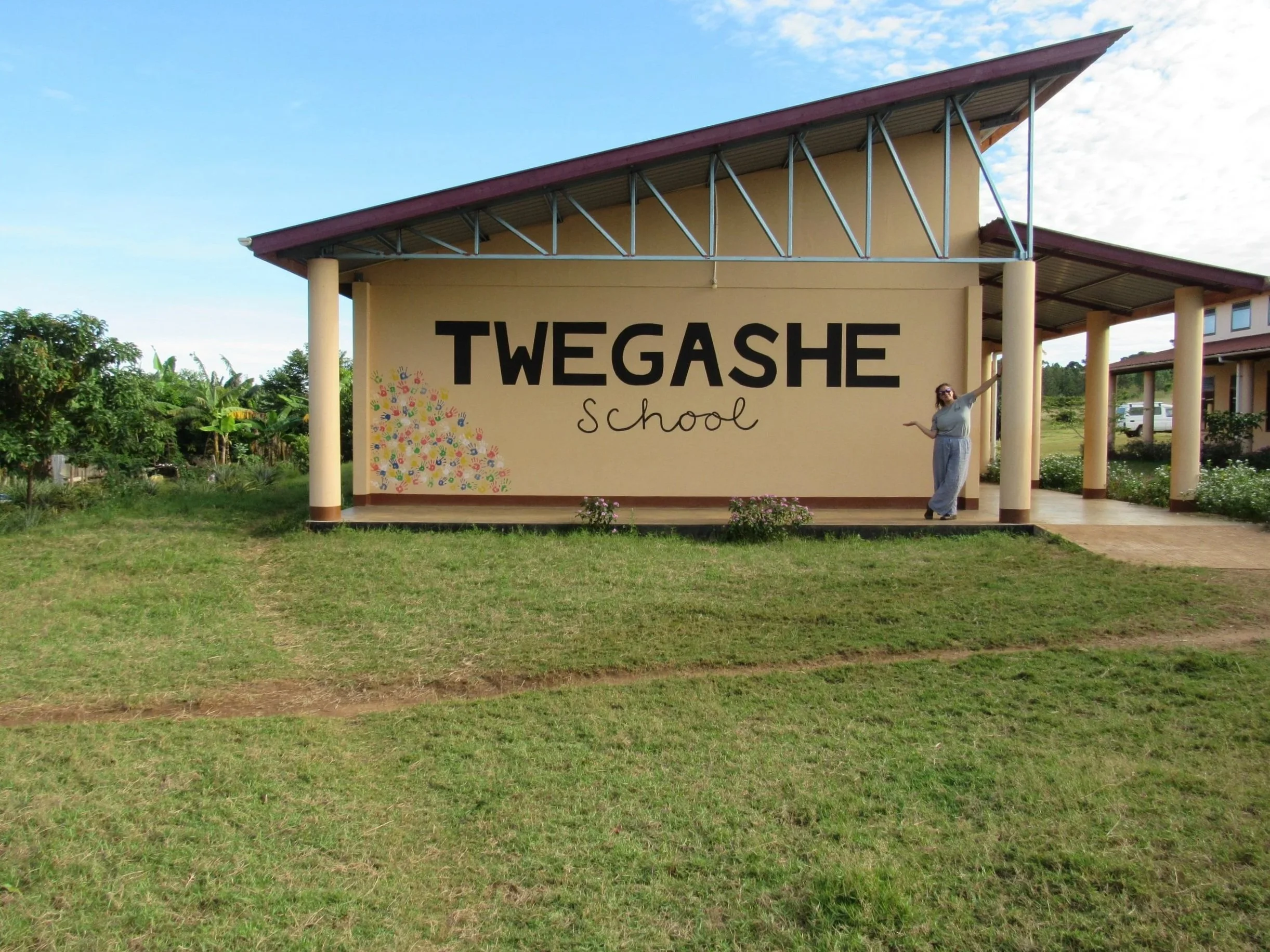
If you want to learn more, or support the Twegashe School you can find there website here.
Timestamps:
Intro: 0:00
Next Leg of the Journey: 0:34
The Twegashe School Project: 1:55
From Bakoba to Bushaha Village: 8:45
Describing the Place: 16:04
School is in Session: 31:35
Visiting Lake Victoria: 46:19
Documentation Days: 54:08
Parachute Day!: 1:03:01
Back the way I came: 1:10:14
Let me sum up: 1:12:55
Last night in Africa: 1:15:51
Outro: 1:18:32
The next leg of the journey was making my way to Bushaha Village, where the Twegashe School is, via Bukoba. I was nervous about being on time so I skipped breakfast at the hotel, and went straight to the airport. Truly the most helpful folks. The taxi driver made sure I got in okay. The guy who checked my reservation helped me understand that I had to go through security and wait to check in, and even came by to tell me what time I could go up to the counter.
I got through all of that and then headed to my terminal. After another run through security, there was a cafe where I grabbed breakfast (omelet and toast) and a much needed Americano. Then I waited for boarding. I had a bit of scare when the digital board noted the flight had left, but in the end it was just a technology error.
With the jet lag and exhaustion I did not quite catch that the flight had a stop in Makoba before heading on the Bukoba. When we stopped at first I was confused but the nice lady next to me assured me that Bukoba was the next stop. Now, my e-sim was also not working so if my hosts did not show up for some reason I was kinda screwed, and that was giving me some minor anxiety.
Luckily I arrived, grabbed my checked bags and walked out to Jeannette and Michael Banobi, my hosts. I had not actually seen them since 2017ish when the firm I was with got (rightly imo) removed from the project.
—
Why do you ask? We were not moving fast enough for one thing. The team at the firm could not make a decision on how to move forward, and we needed to be done with design in just a few months. We did not have time to dawdle but yet nothing was ever decided during our time on the project.
There were also a lot of lofty ideas that frankly were not feasible. I remember being very frustrated as a brand new employee (I had been there maybe a month or two) and not feeling like I had the power to say “hey we need to figure this out”, or “is that something the locals will be able to build?”. I’ll also note, none of the employees on this project were getting paid. It was free labor that the firm would get credit for, which looking back now, is definitely not okay. I agreed to be on the project because that is why I had gone into design, to make a difference in communities. But in the end it was good that it moved under the direction of Marc and his team, who completed the design in 6 weeks.
Before I left I reached out to Marc about the rest of the design process. We met at a coffee shop downtown and had a great conversation about the way the project went. When I left the project they were still trying to figure out the brick, which I then learned got changed to concrete blocks. They then had to find someone to manufacture them and be sure they would be good quality.
Marc made three trips over during the build process and helped Michael procure some of the materials. Getting glazing, which is an important part of the building for cross breeze and ventilation. Sourcing is not an easy prospect, you have to know someone. They had to meet with the building minister to get plans approved, but had to bring the already printed drawings. I asked if he did anything different with the set, considering it was not what we would call “skilled labor” but he said that it was done the way he would have done any other set.
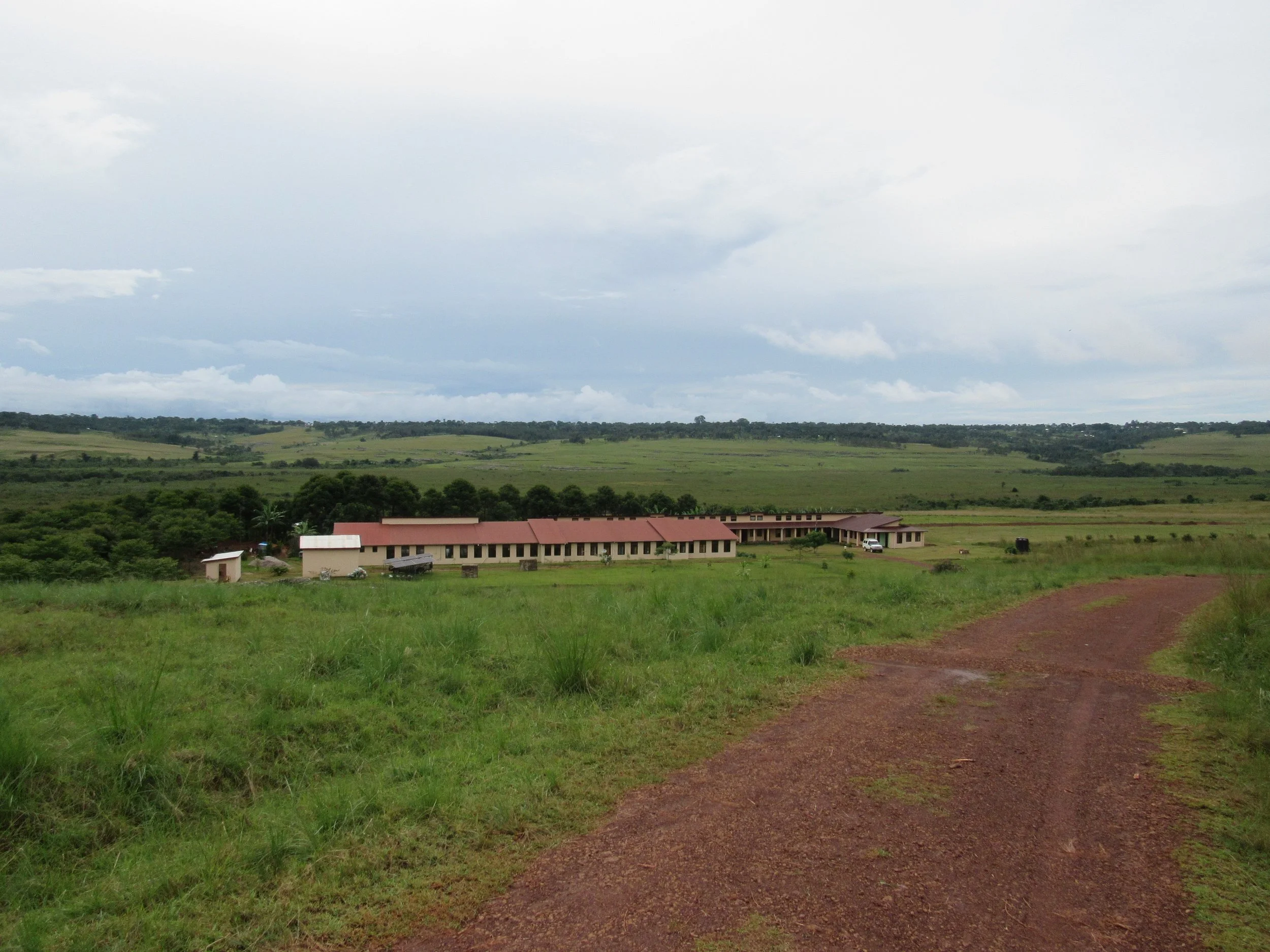
The site (and I remember this) also led to some challenges. First it is incredibly sloped, so the teacher housing is at the top of the hill and the school at the bottom. The buildings had to be laid out North to South, and the sun shines directly into the windows of the classrooms. Building 2 as the sun rises and Building 1 as the sun sets.
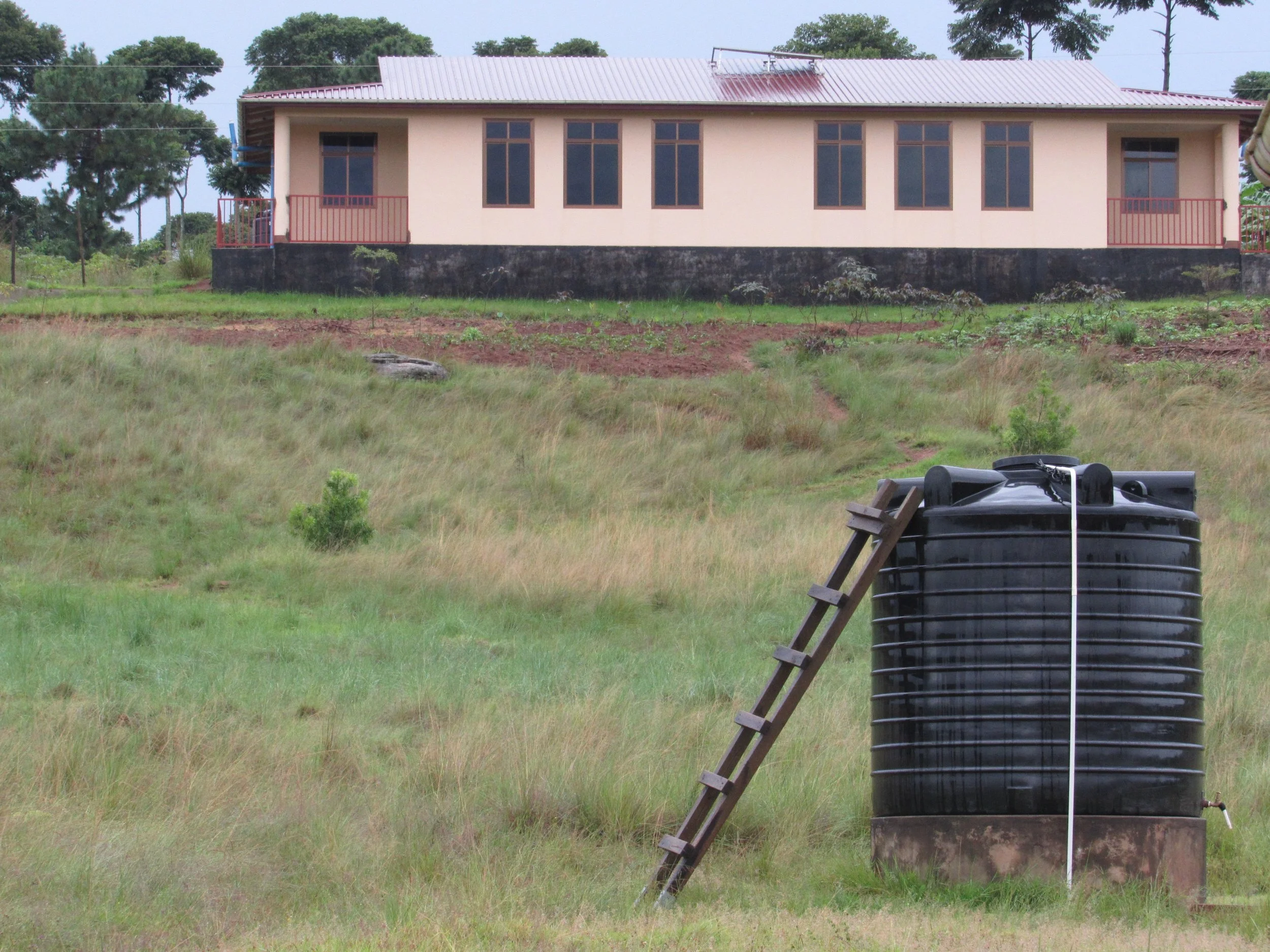
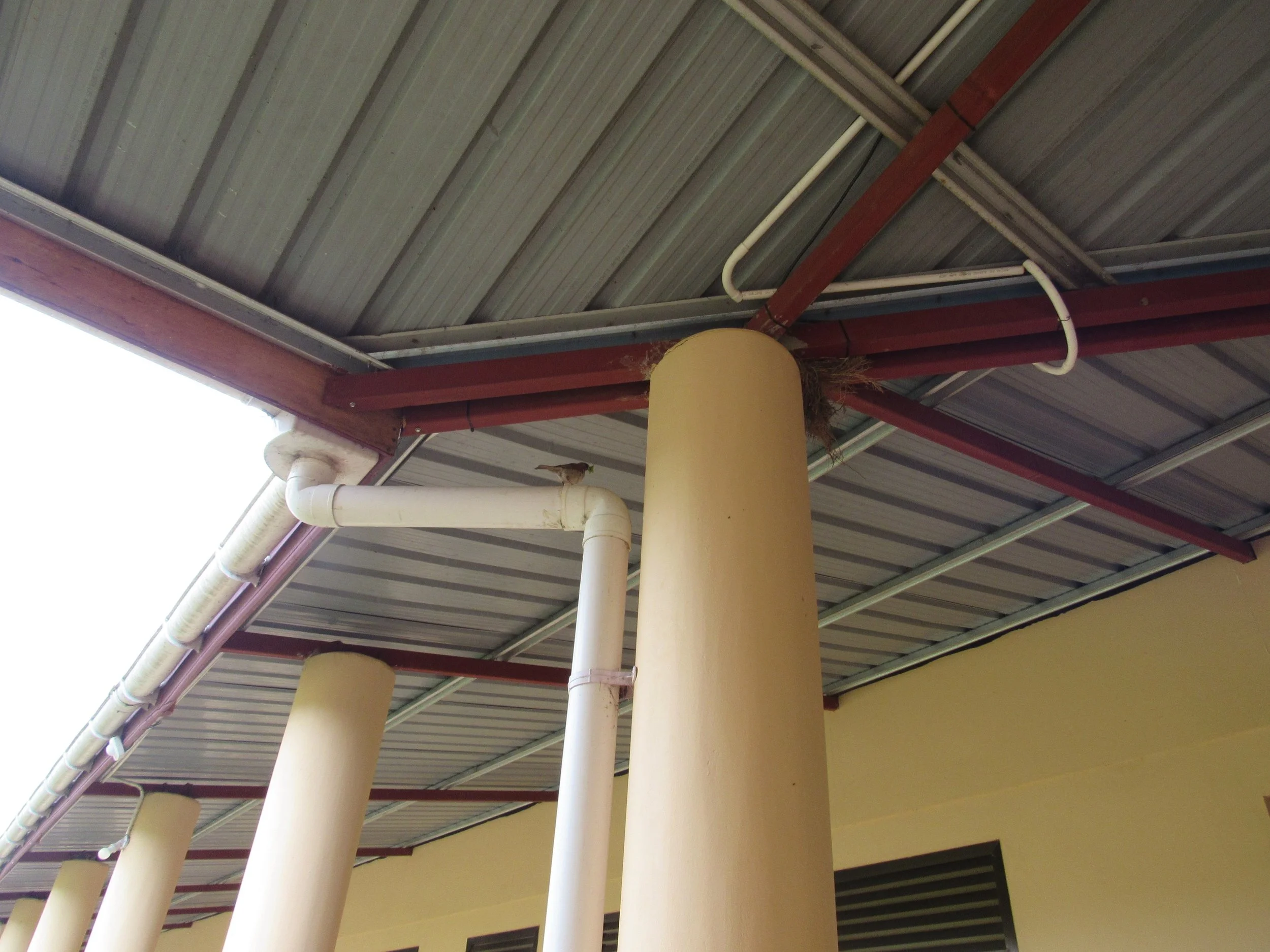
And then, there were still issues as they moved through the process. Roofs of each building were done by different contractors. The first according to Bill was over engineered. It has angled unpainted steel trusses, and pacing them out are about 6 feet apart throughout the building. I also noticed from the outside, the main roof structure does not have insulation, whereas building 2 does. The second building’s roof was supposed to be done by a better company, but they contracted out locally instead of their own work force. This roof has steel rafters, painted the maroon of the roof and those are about 10 ½ - 11 feet apart. They (mostly) align with the columns.
Multiple times rebuilding sections of the building that were not done correctly. The bricks were not manufactured by machine, so the holes for the rebar were small and had little room for error when placing the rebar. And sometimes just getting the material on site was an issue.
The well that was already on the property would not produce enough for the volume of people, how then would they get water to the staff housing? The original roof for the admin building (which I am in now as I write this) was too tall, and they had to find a way to make it work with the rest of the architecture. There was lots of tearing down work and redoing it because it would not hold up over time.
Overall, despite the challenges, Marc felt it was still successful. Created community space, with negative space between buildings and the Cafeteria. Considering unskilled labor, the cost, no electrical power (just solar eventually), and no running water, successful design.
I also reached out to Bill who would be the one to teach the local folks how to build the school. He came out the year before construction on the school began to help survey and lay out the road for the trucks to have access to the site. Was farming land before being given to the Banobis, then tall grass they had to work through. He then spent 6 months here educating the folks who would be building. He and I met via zoom, and had a great conversation about his experience.
Bill took a Dwell Earth one week course about making earth bricks with the machine before the project started. I had mentioned before there was a test earth brick but could not be replicated. It was able to be made, but then could not get it sticky enough to hold to move the brick. They wanted to use sand locally, from the shores of Lake Victoria, but it was not coarse enough. The next plan was to have it brought in from Bukoba, mined coarse. They also needed clay, and the amount that had to be trucked in was so much that it didn’t make sense.
So then they had to pivot to concrete. The biggest challenge for him was making sure it would all work. Because the brick was not machine manufactured, the rebar holes were never exactly the same size, or exactly the same place. The standard block for Tanzania is solid small brick with no holes for rebar. There was no western type of brick, so they bought a press, and had it manufactured in the country. In Tanzania they do a double pour for concrete, instead of a single pour that we do in the states so it is hard to keep the quality control. It also depends on who makes the brick.
Because they ended up with the concrete brick, not the original dirt brick, the drawings were not quite right. They were also hard for the 6-8 local people who were doing the building to understand. Bill had to draw simple diagrams as they got started so the workers would understand what to do. They did not care about the big picture or grand ideas, just wanted to know how to do the labor. Bill had to teach them how to read a tape measure, and then figure out who could do what task, and then made teams of workers for each step of the process. He taught them how to use lazer, set bricks, and lay a plumb line. He did learn though that the local folks working with a hoe did a great job and there was no need for a shovel.
There were never ANY inspections so QC was left to Bill. The Education ministry would come out to be sure you're meeting their guidelines for teaching, nothing about the QC for the construction. In the end he knew he would not be able to do it all, but knew he wanted to set up a plan, and make it work for the rest of the construction and the local guy who was leading it after Bill left.
—
Bukoba is about 90 minutes from Bushaha Village where the school and the Banobi’s live. So while in town they had to run some errands. This is really the best way to experience a new place. Driving through the city of Bukoba is chaotic. Barely paved roads, no sidewalks so pedestrians are just along the side of the street, most of the trees were recently cut down so shade is few and far between for being practically on the equator. Motorcycles drive with no care, weaving in and out of cars, ignoring stoplights or being on the correct side of the road. Often they are piled with lumber or steel tubes being transported somewhere.
First stop was lunch, at a spot run by nuns. Beautiful spot that also holds weddings. Because of malaria and other diseases out here, you always wash your hands before you eat. So we started there and then at the buffet they served you. This was my first Tanzanian meal. I had rice, a banna (kinda like a squash), some cabbage and tilapia. Some of the best fish (hello lake victoria, or “the lake” to the locals).
From there we went on to errands and I learned first hand how complicated shopping is in Tanzania. There is not just a grocery store, or a single place to get things, you have to shop around. We stopped to get gas, well propane for the kitchen, but there is no parking, and we had to shoo away some guys using the small bit of shade to hang out. Then we went to a different area to get rice and some other small items like toothpaste.
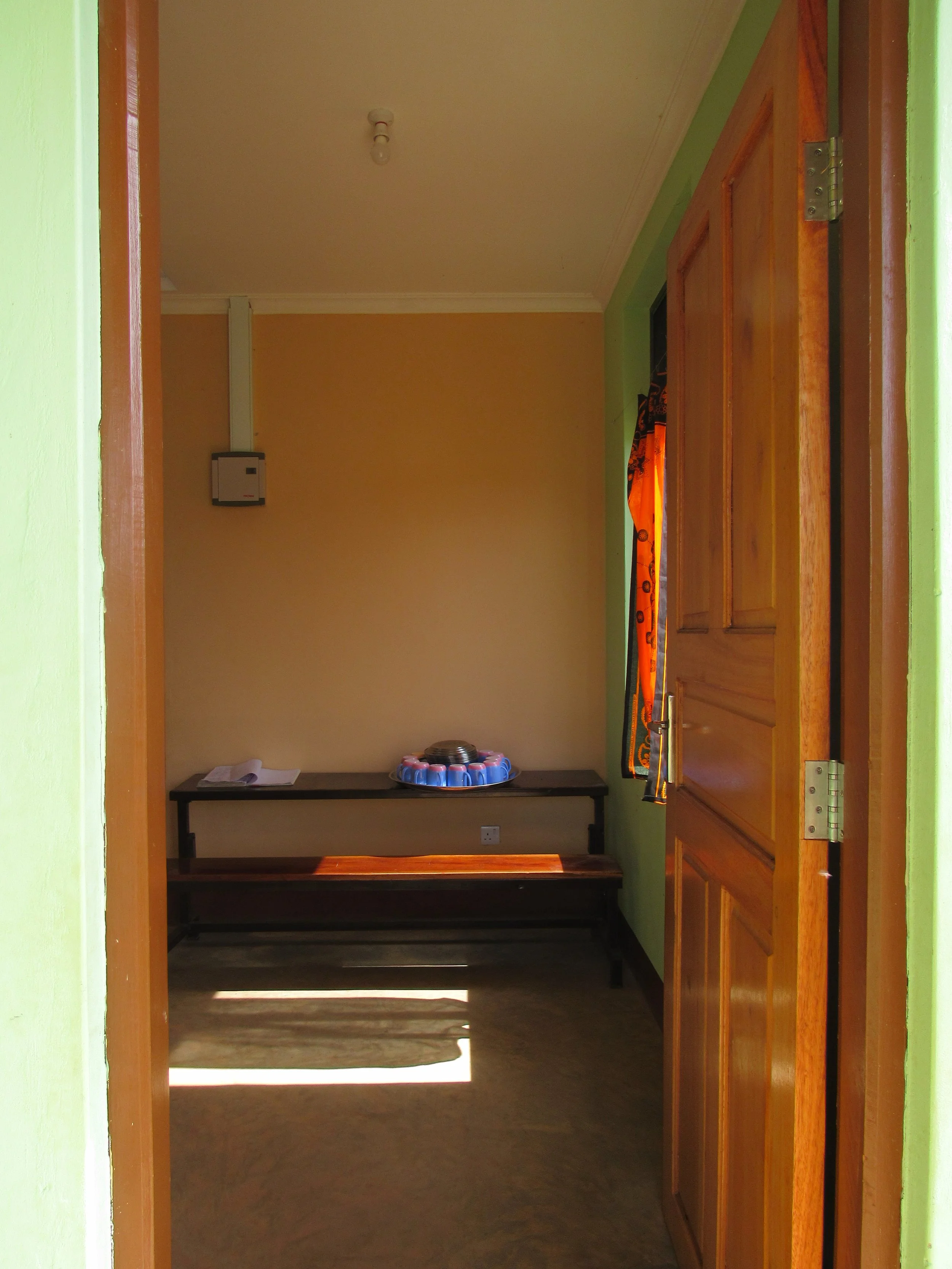
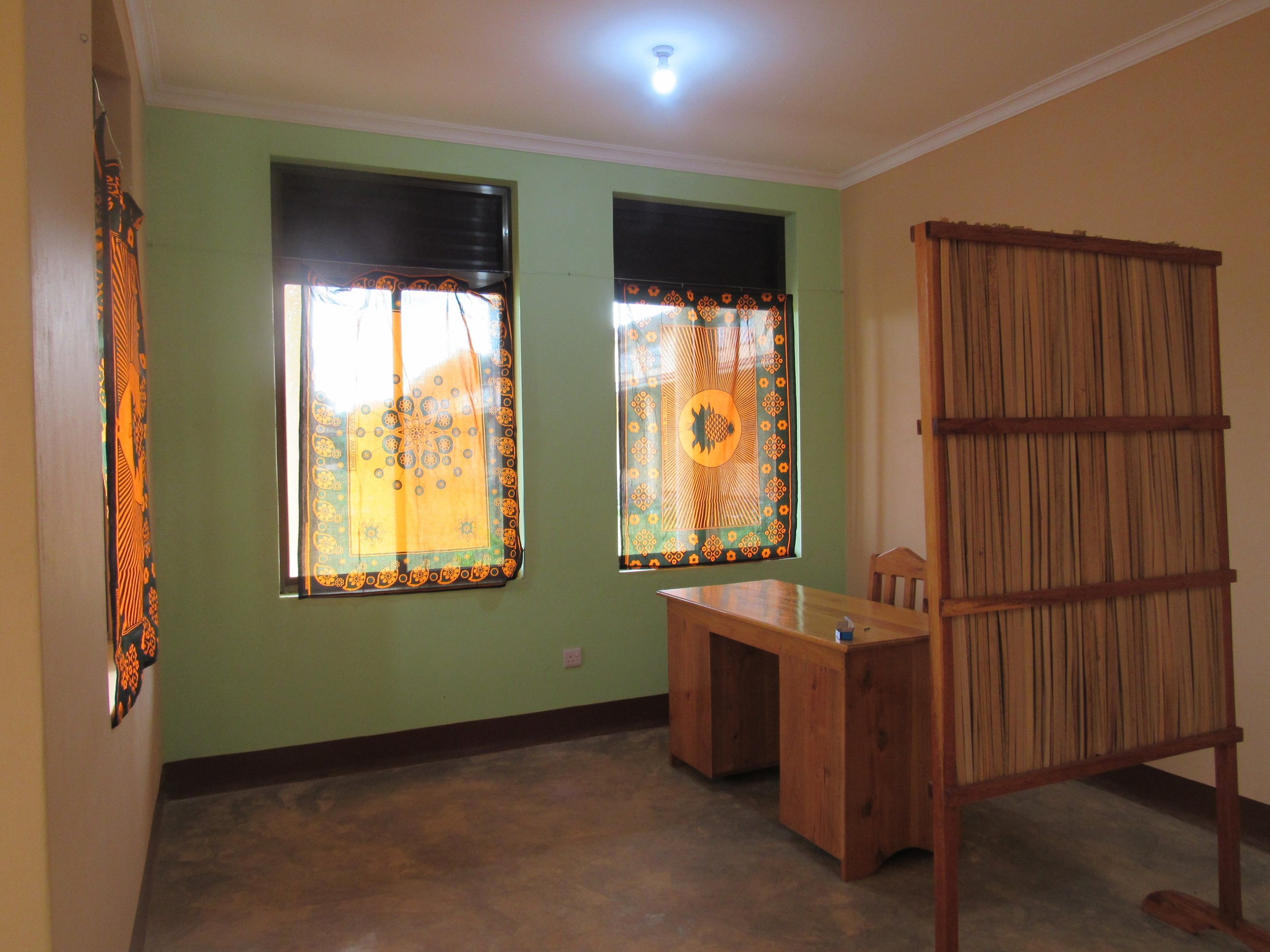
That wasn’t ready so we went to a tailor, the one they use for the students uniform, to get cheap kangas, large swatches of fabric they use for curtains (see previous sections about the site and the sun). Usually they would just go to the large market, but they have shut that down to rebuild it and needed a contact to get kangas to look at. They chose ones that were black and orange, but needed to be hemmed.
So then we went walking looking for a mango vendor. After some walking around they noticed a cart. Once we negotiated for those, we went back to the tailor and waited for the kangas to be finished, then went back to pick up the rice.
We had one final stop for vegetables, at a market. They have a regular vendor that provides tomatoes and some other items, and then also bought bananas. People and children everywhere. Any fruit and vegetable you could imagine. I had a couple of kids come up to me to say hello (I am VERY american, a fish out of water for sure). I was taught to say “asanti” which means thank you in Swahili when someone greets me.
Then we headed back to the Land Rover, and headed to Bushaha. The road was paved for maybe 20 minutes of the drive and then it was just dirt. Bumpy roads that change as the rainy season takes hold. Kids walking along the side of the road from school, Adults with bags of all sizes going between home and work. Some were carried by hand, others folded in cloth on their heads.
Along the way we drove by homes of all types, and the Banobis showed me some of the typical primary schools along the way. As we went on the road went rougher and down to one lane. Almost no cars, plenty of motorcycles and lots of folks walking. Eventually we made it to Bushasha Village. We drove down the main roadway with mostly open fields, or clumps of trees, on either side. We passed the Twegshe School, and I got my first glimpse from the top of the hill. A 10 minute bumpy ride later we arrived at the Banobi’s home, which is probably the most modern in the village.
The house has two wings, with a courtyard between. There are large metal gates on either side, the ground is a diagonal pattern of alternating red and tan hook shaped bricks. There are also two rainwater tanks nestled against the wall, and beyond the back gate is a garden. I can hear the chickens and the rooster making noise quite often. ON the right side are doors leading to the dining room and the attached kitchen, as well as a bedroom for Michael's grandniece who lives with them and helps with the cooking and cleaning. On the opposite side is a door that leads to the rest of the living quarters. THere is a small living room, a couple of bedrooms, and a small bathroom.
The walls are tiled three quarters of the way up, and a small window in the back. This room included a toilet, but also was the shower so it had a drain in the floor, hooks for towels and a soapdish.. There was a utilitarian spigot to turn the water on and off, and a simple knob to turn the water to and from the showerhead. The pedestal sink with a mirror is right outside in the hallway.
My bedroom is small and lightly furnished, but it works just great. The double bed has a pink bug net on a frame and is pretty comfortable all things considered. There is a small shelf next to the bed for my things, and then a camping chair to sit in if needed. Hooks on the back of the door only. If they were on the wall you would risk geckos and frogs making a home in your clothes, as they are often on the walls. There is a window looking out to the front, and I like to leave it open when I can for a cross breeze and to just enjoy the lack of light pollution.
Dinner was ready not long after I got myself settled, around 8:30pm. Rice, red beans, pumpkin greens, and catfish. Being on Lake Victoria, fish is a staple of the diet here. The fish and beans are cooked in a tomato “soup”. It's watery and thin, more like tomato water than soup. At the end of the meal they cut up a mango to share. Best mango of my life. Honestly fruit in the states is going to be ruined for a bit after this trip. There is only water, which they run through a filter, and you fill via a bucket.
After a long (and sweaty) day I took a shower (cold water only, which for the perri-metapause person is actually great) and crashed. I woke up about midnight to the BOOM of thunder and then the rain started, the white noise sound of it bouncing off the roof lulling me back to sleep pretty quickly.
—
The next morning, I was late to breakfast (I forgot to set an alarm) so I dressed quickly in my most waterproof clothes since the rain was still going, and headed over. Breakfast is rice and scrambled eggs (fresh from their chickens) and chopped small green peppers, a piece of bread and then a slice of orange to finish it off. Coffee is instant, but I have come to love the way they drink it here. I mix mine with two scoops of sugar, and then squeeze in a slice of lemon. They claim to do this to help prevent colds, either way I'm not getting scurvy on this trip. I should also note the water is never just boiled, it's hot ginger water. At first I was puzzled, but now I look forward to my morning cup.
Okay if you know me, you're probably like, you're eating these things? Picky Kendra?! You hate beans, peppers, and plain tomato soup. I do, but my mum always instilled in me that you do your best to eat what is put in front of you when someone else is hosting you. I don’t know if it is because I am in a new place, or my taste has changed over the last few days, but I am starting to really enjoy these simple meals.
After breakfast we headed to the school. I was excited to finally see in person this thing that I had briefly been on, and continued to follow their journey even after I was no longer on the project.
When you approach the entrance to the left is the school sign, which says “Twegshe Pre & Primary School”, its address and at the bottom “Be Kind, Be Safe, Work Hard.” A short way down the winding path is what was supposed to be the well house. Since it is not actually usable for its original purpose it may eventually become the guard hut that they will put thatching on to mimic the traditional grass buildings of the Tanzanian people.
To the right, opposite the future guard house is a lane, which along it the bulk teachers housing is. There are two sets of three duplexes, and each duplex has their own rainwater tank. As you ascend down the road to the left a large garden sits on the slope. Once you make your way down to the bottom is the “parking lot” which is just a grassy section, near a bucket on a small wooden pedestal for hand washing near a small tree. To the right is the main rainwater tank for the school itself, and beyond that the soccer and play field.
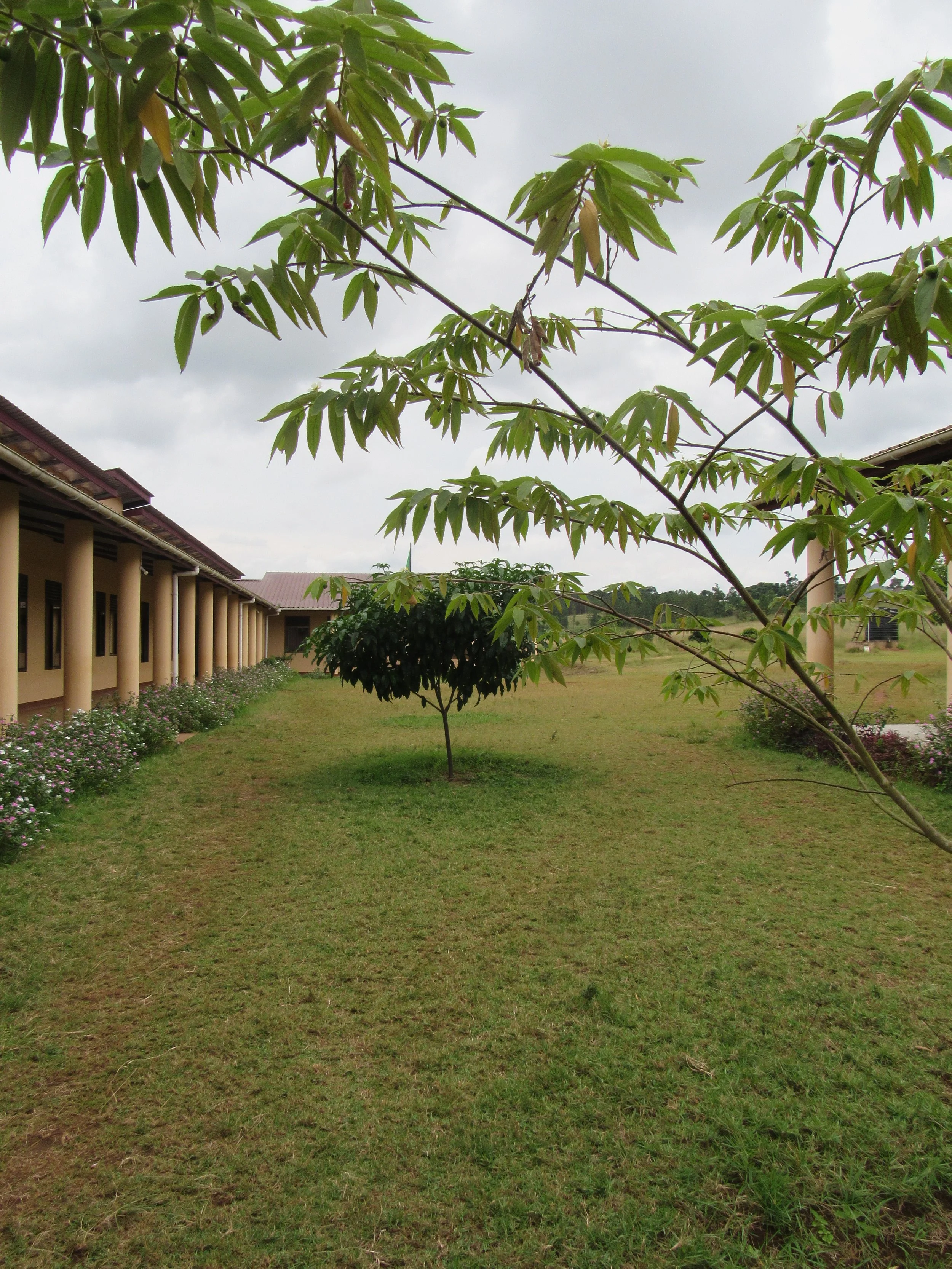
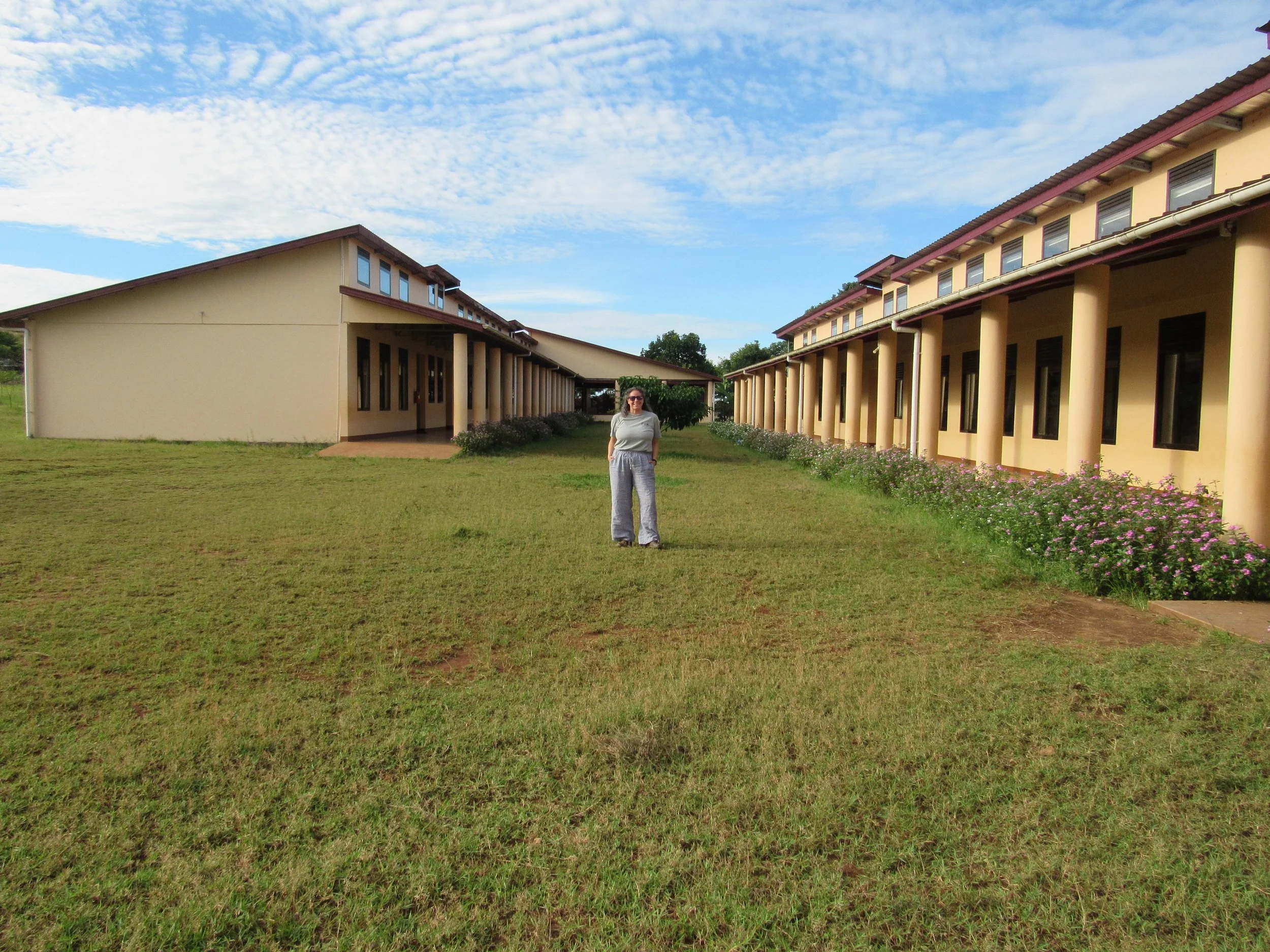
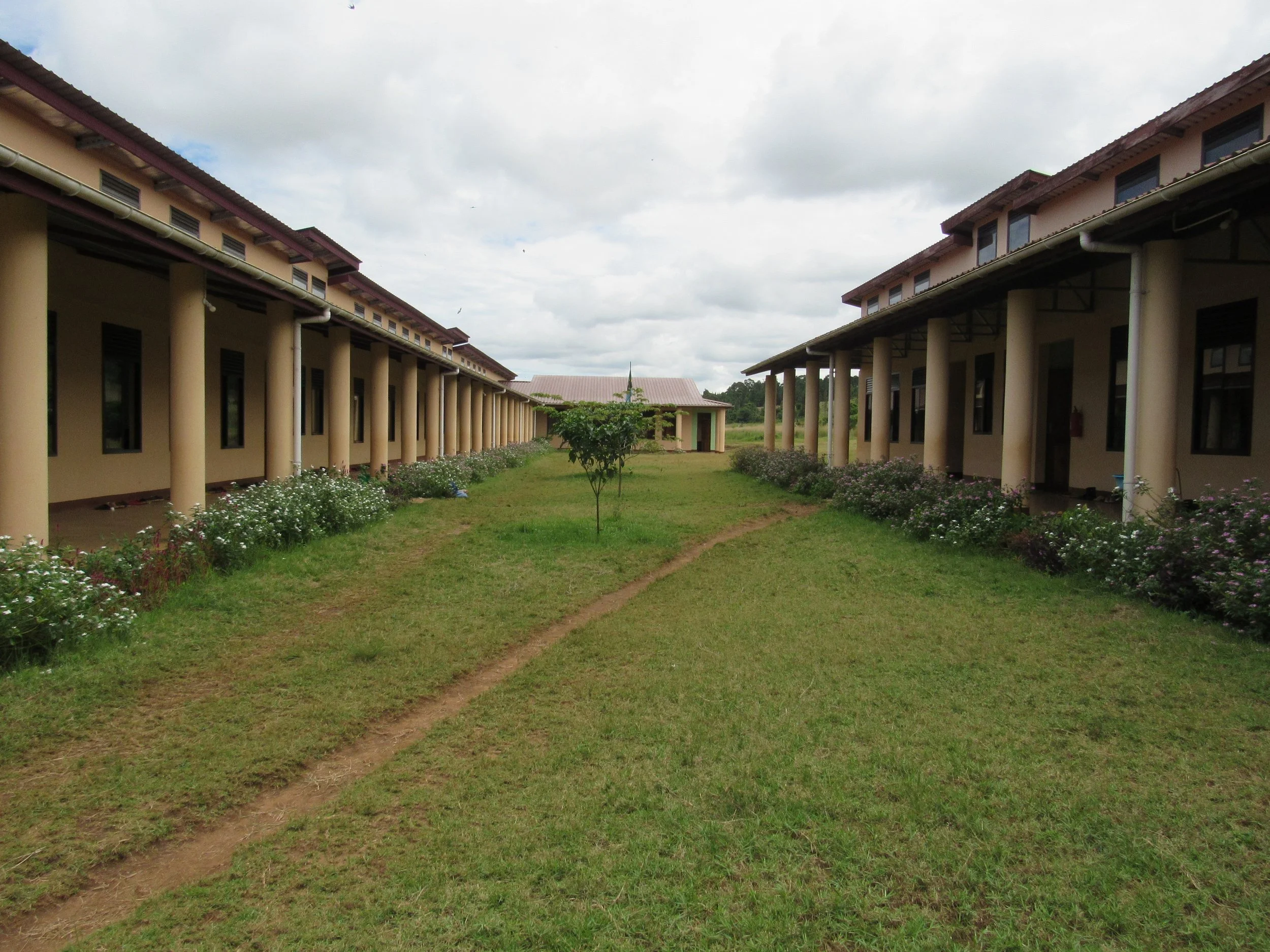
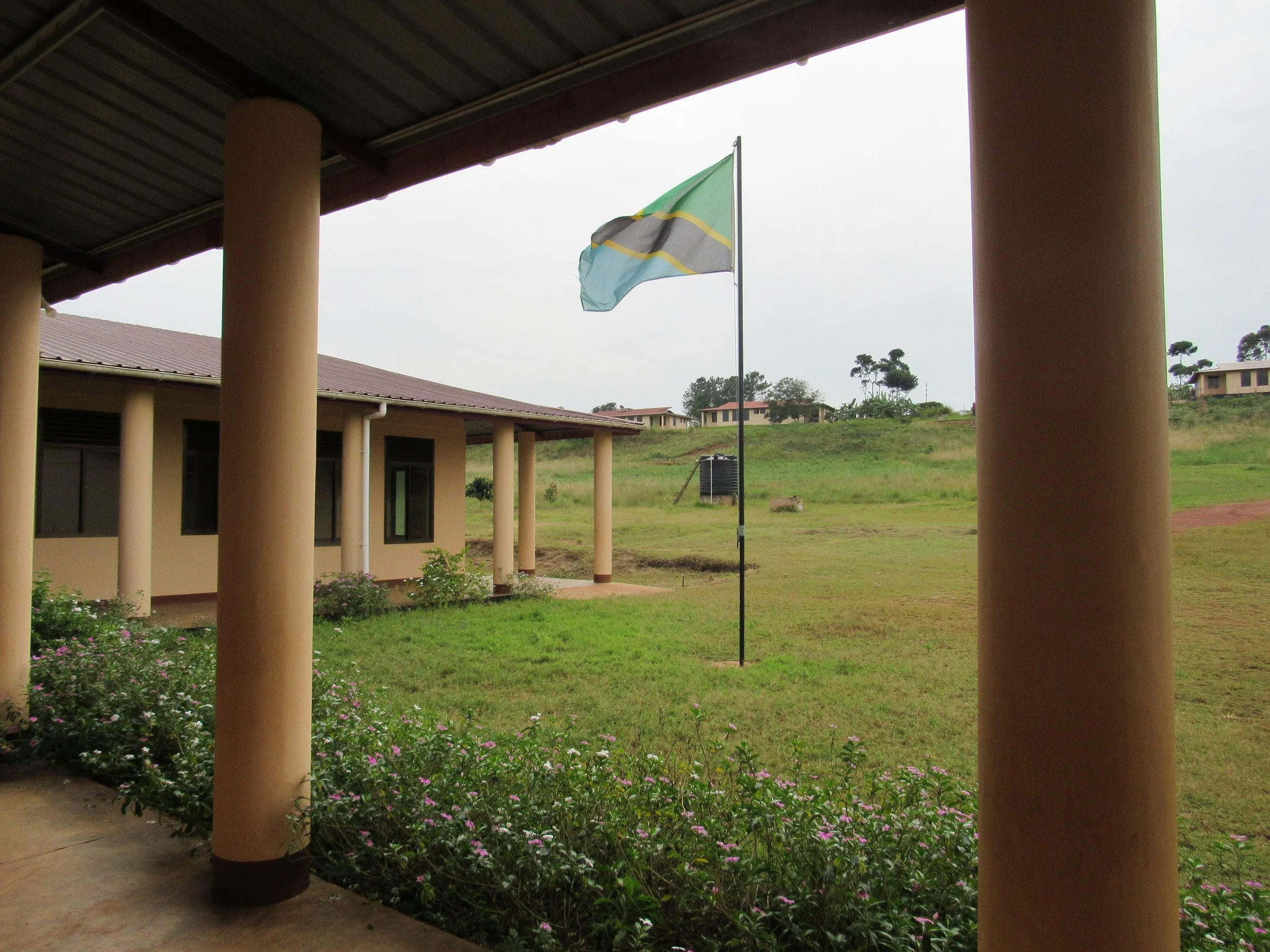
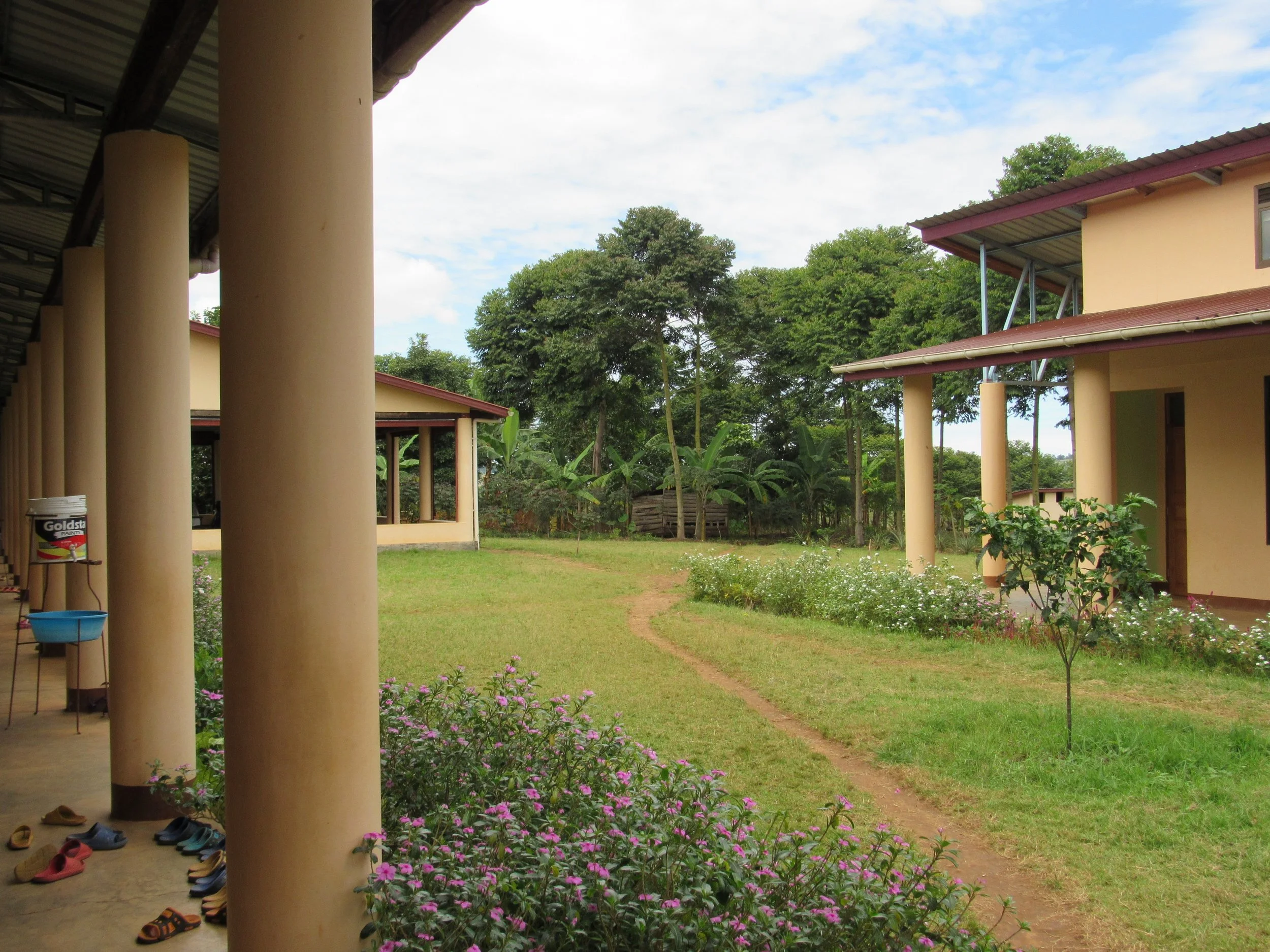
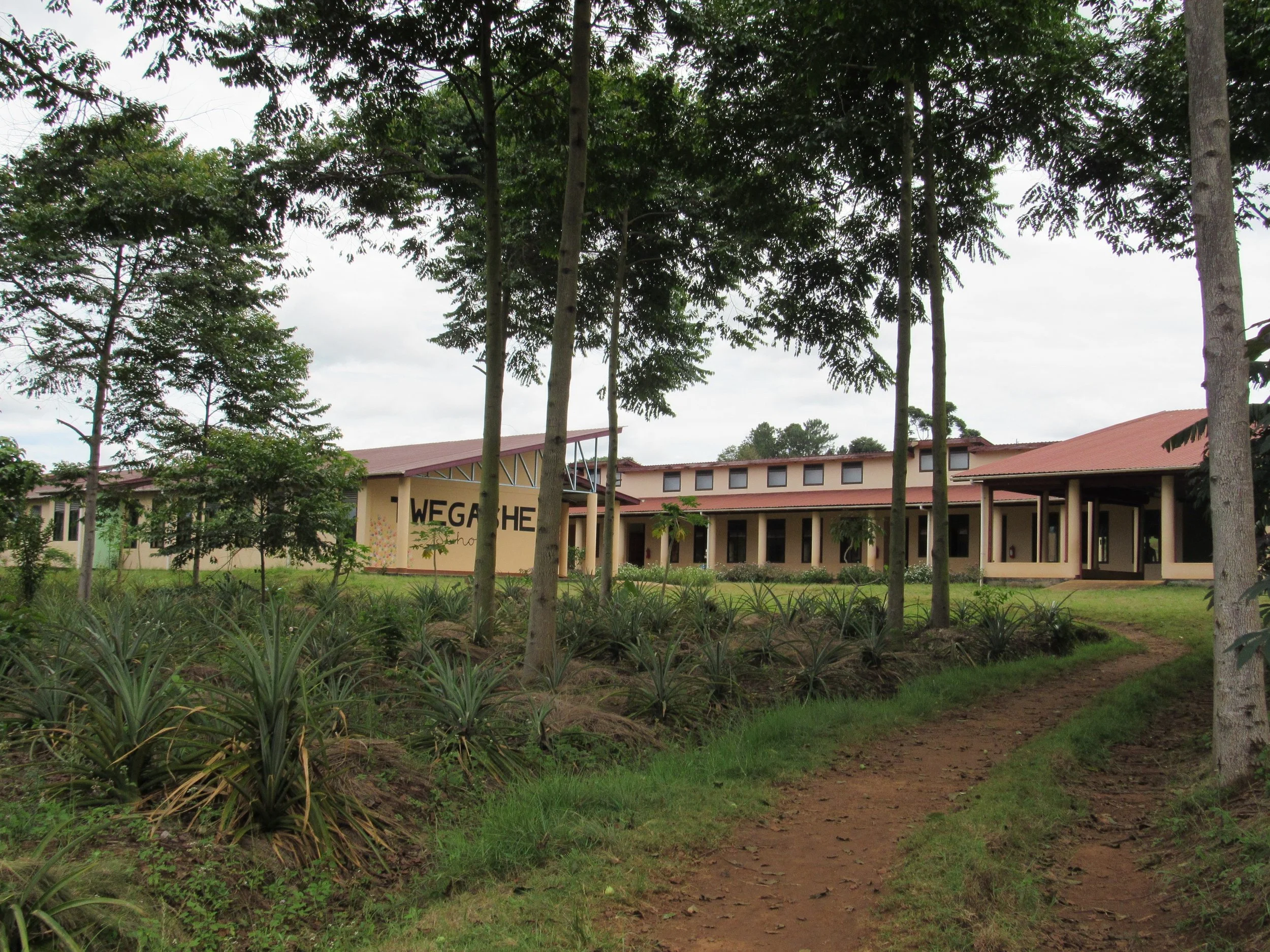
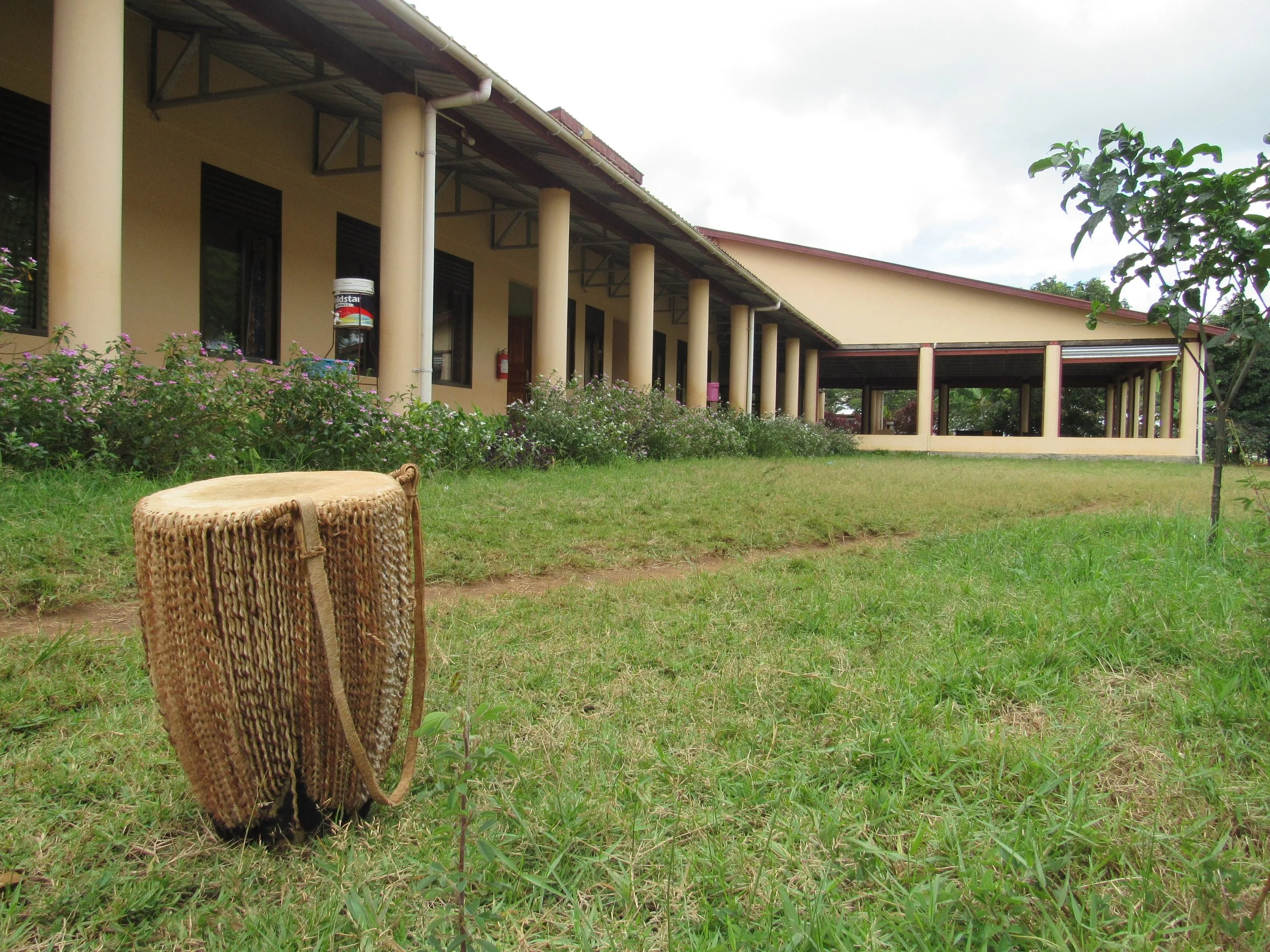
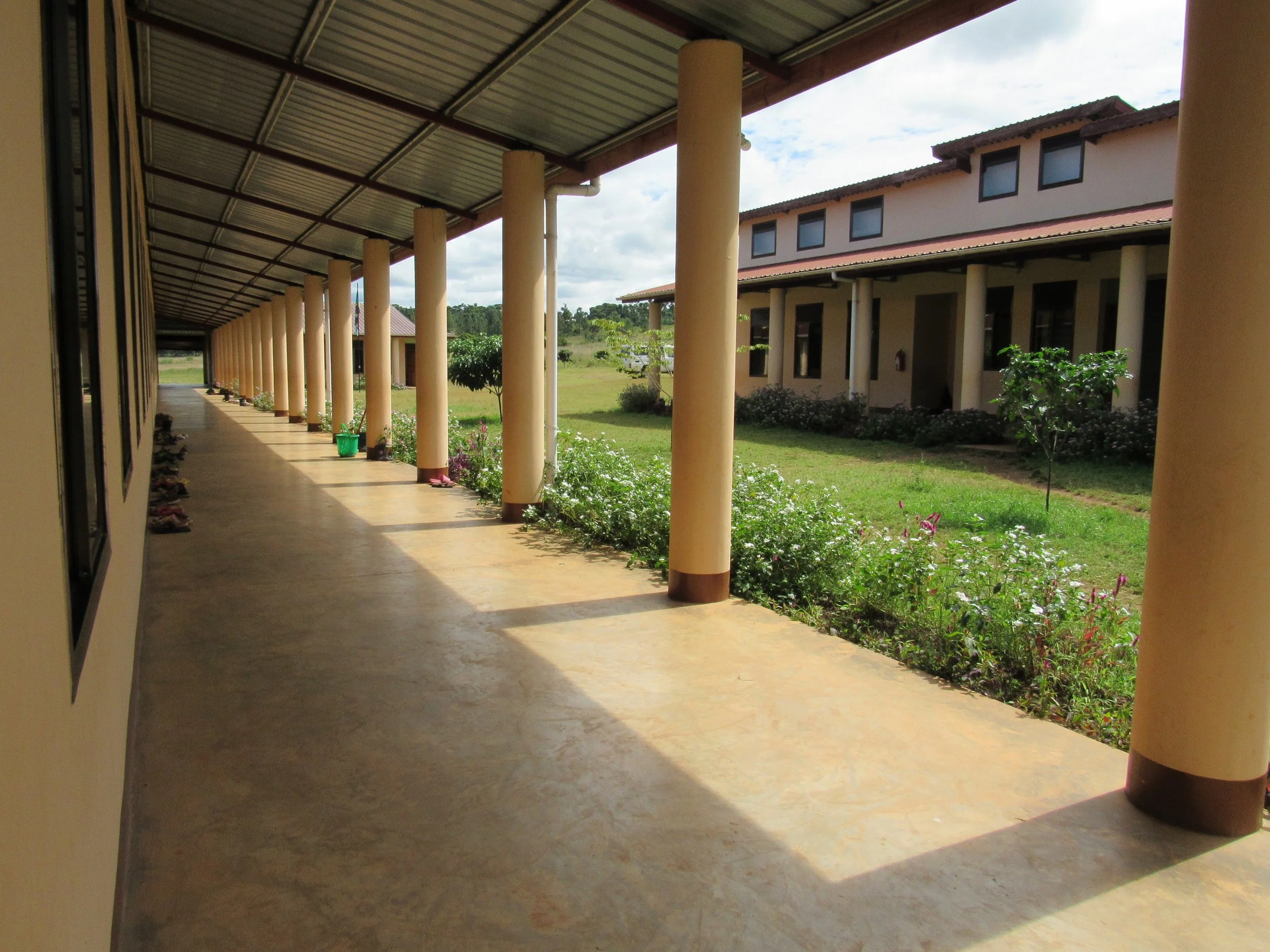
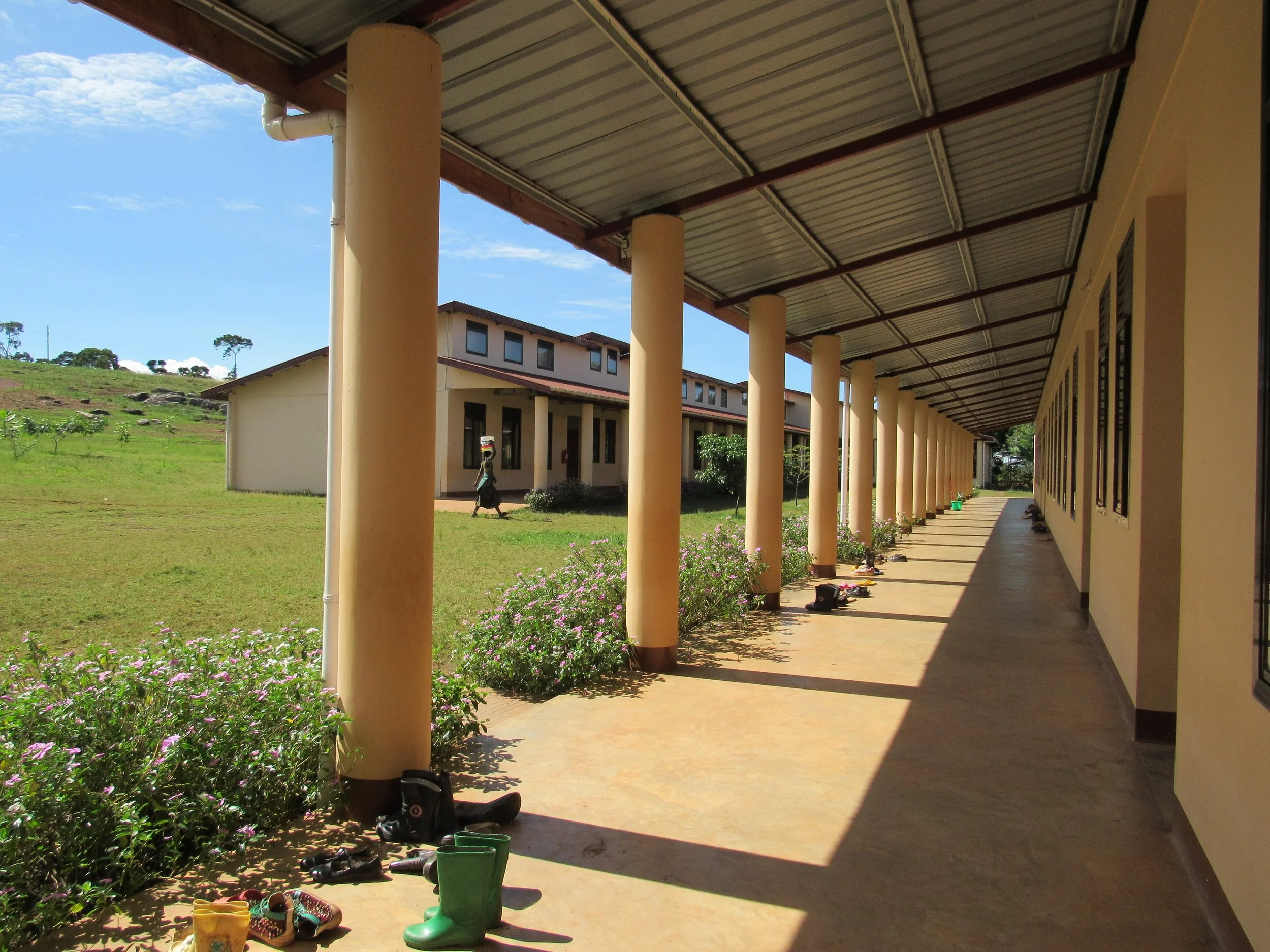
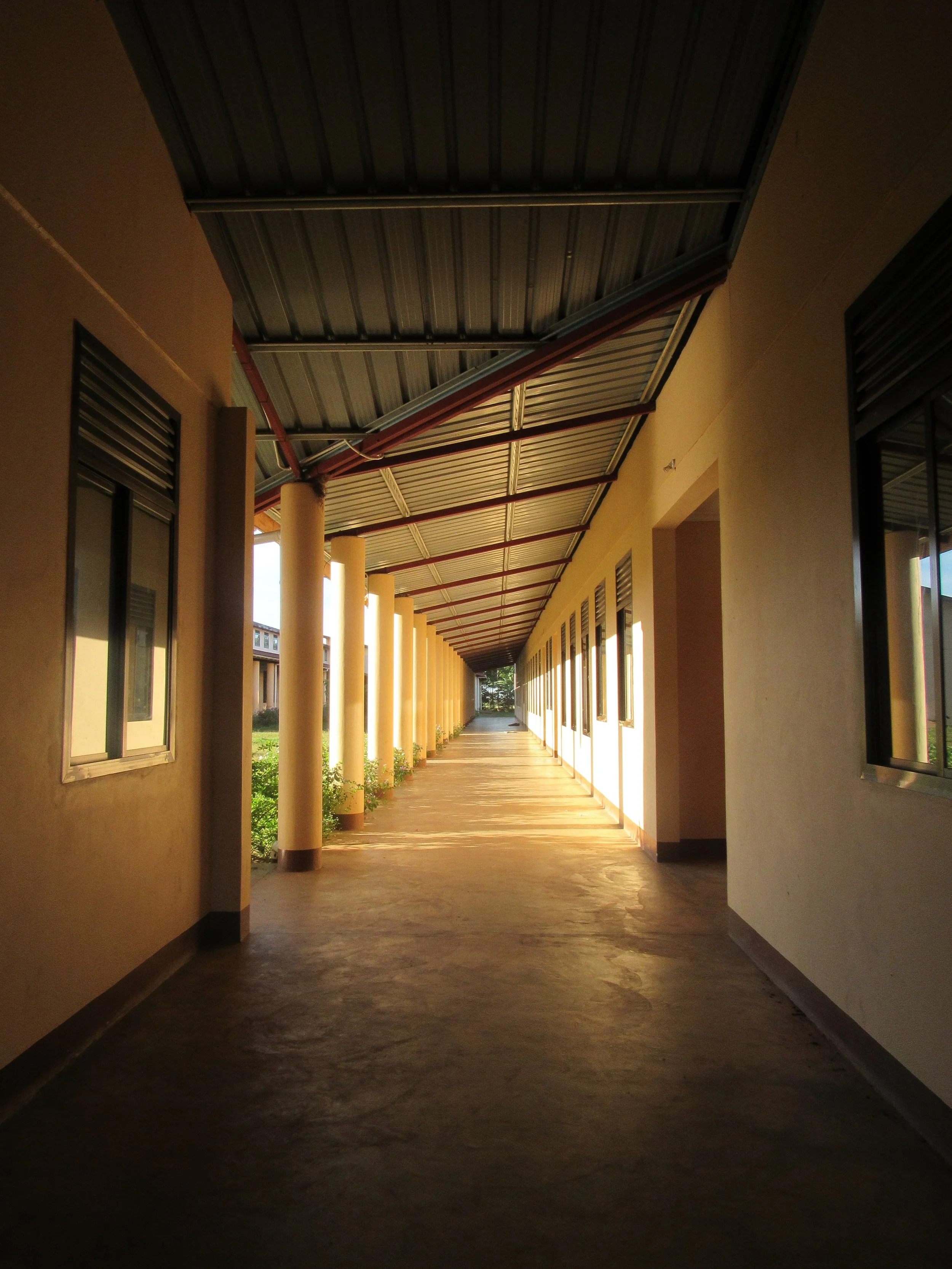
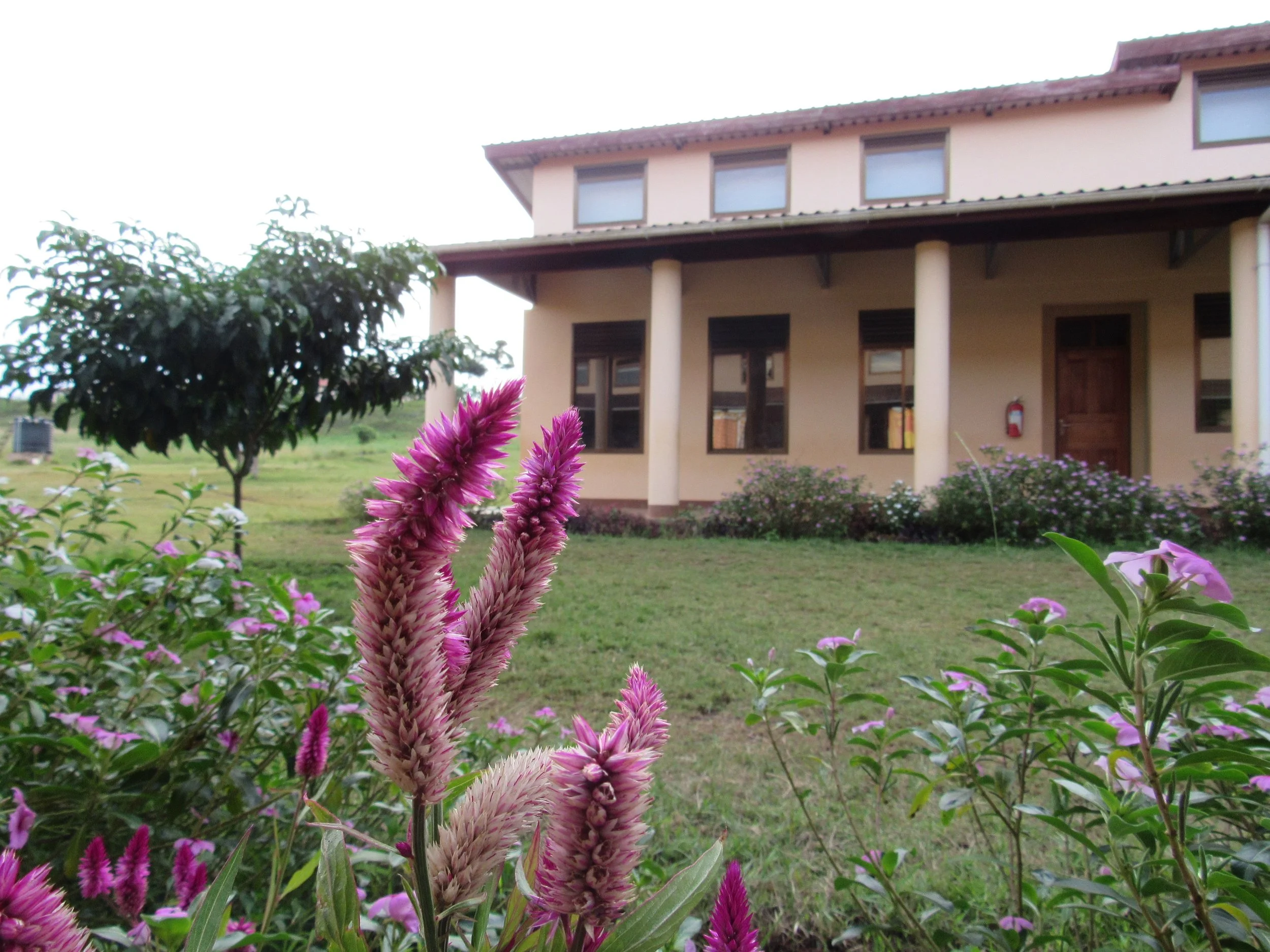
The main school buildings masonry attached to the mortar thought the cement block. They are situated in two L shapes that create a natural courtyard in between. The trim and roofs are all maroon, and slope upward to accommodate the two sets of windows facing inwards, one set at the walkway level and then another above. Each building has its own covered walkway that slopes down from below the second story windows and is supported by round columns framing the courtyard.
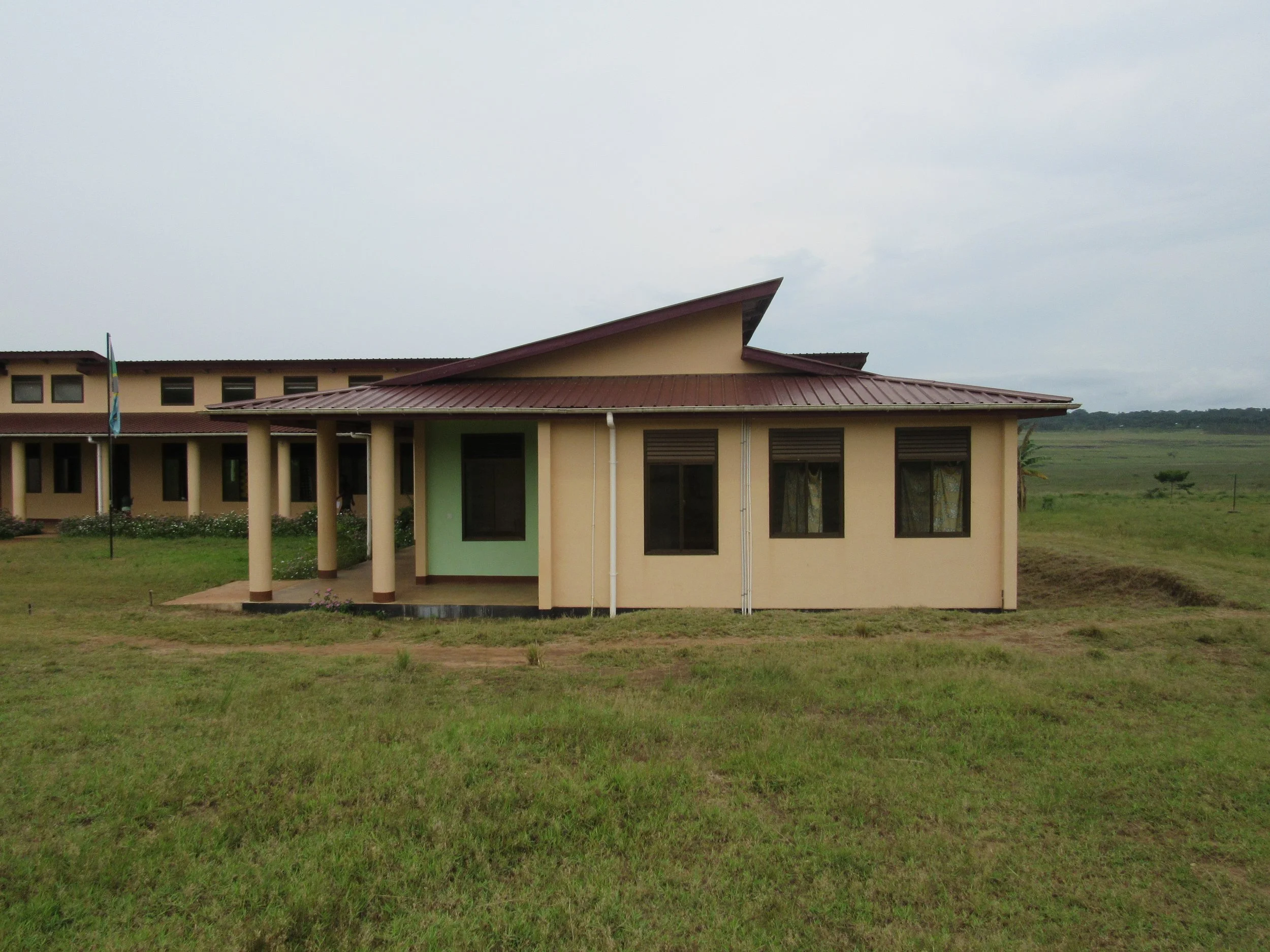
Building 2, which was the second to be built, has the short part of the L to the right, where the admin offices, and teachers lounge are located. Admin consists of a front room where teachers sign in and a small desk - the equivalent of reception in an American school. Across from the entry door there is the principal's office. To the right is the door to the teachers lounge. The lounge, mostly tables in a circle for meetings and supplies, has two doors along the right wall, the Banobi’s office and then a small bathroom with a sink between two flush toilet rooms. Opposite the first door is the second entry/exit to the lounge and shelves where the technology and paper live.
The walkway here extends to a garage door that is kept closed at night for safety and when the rain is really heavy. Along the long part of the L are the Library and classrooms. Directly across the walkway from the Teachers lounge is storage; a stack of mattresses for when the students of Lakeside School in Seattle come and visit and do a summer camp with the kids, extra building materials, and sports equipment. There is also an unused office that connects to the library.
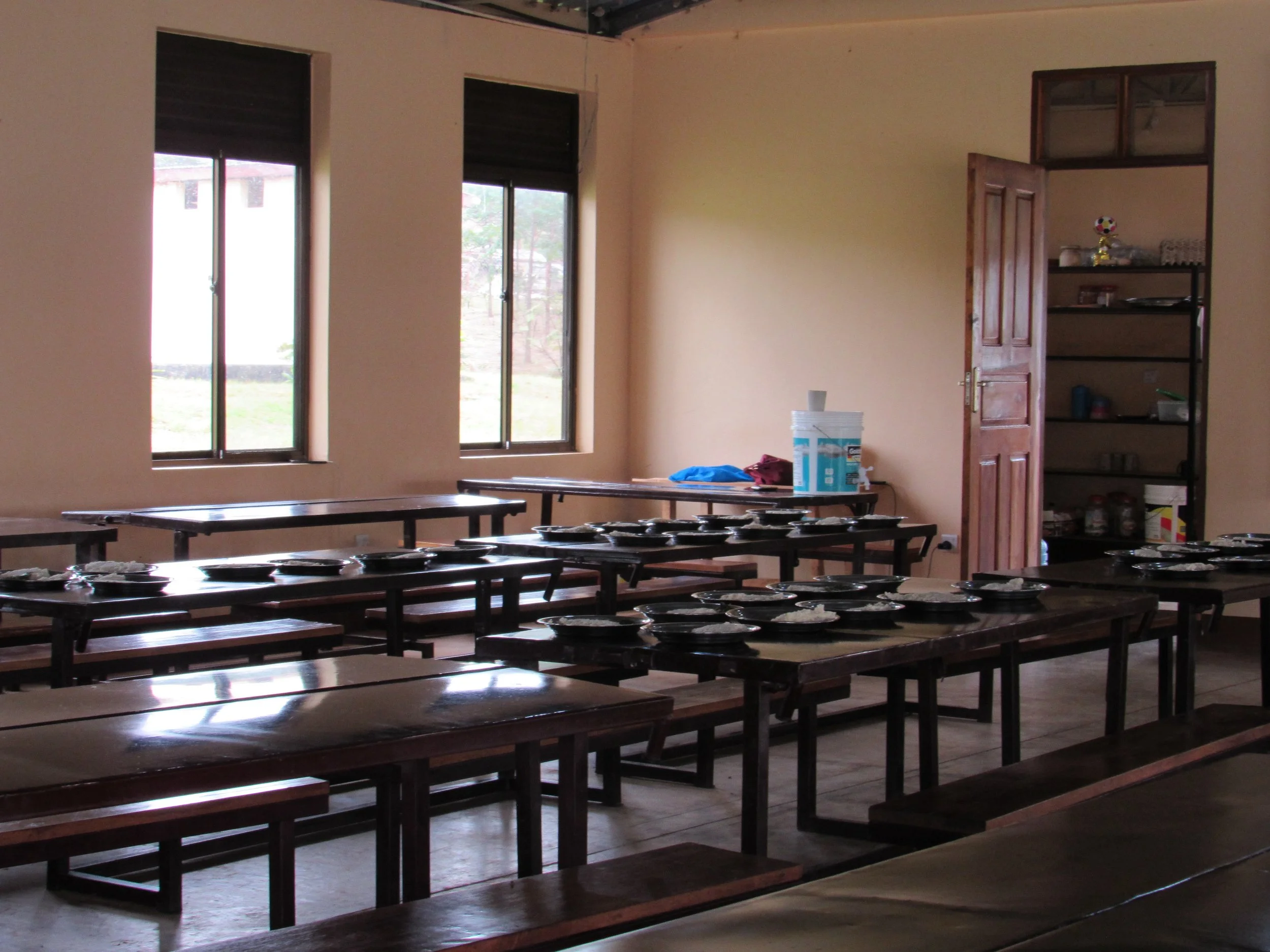
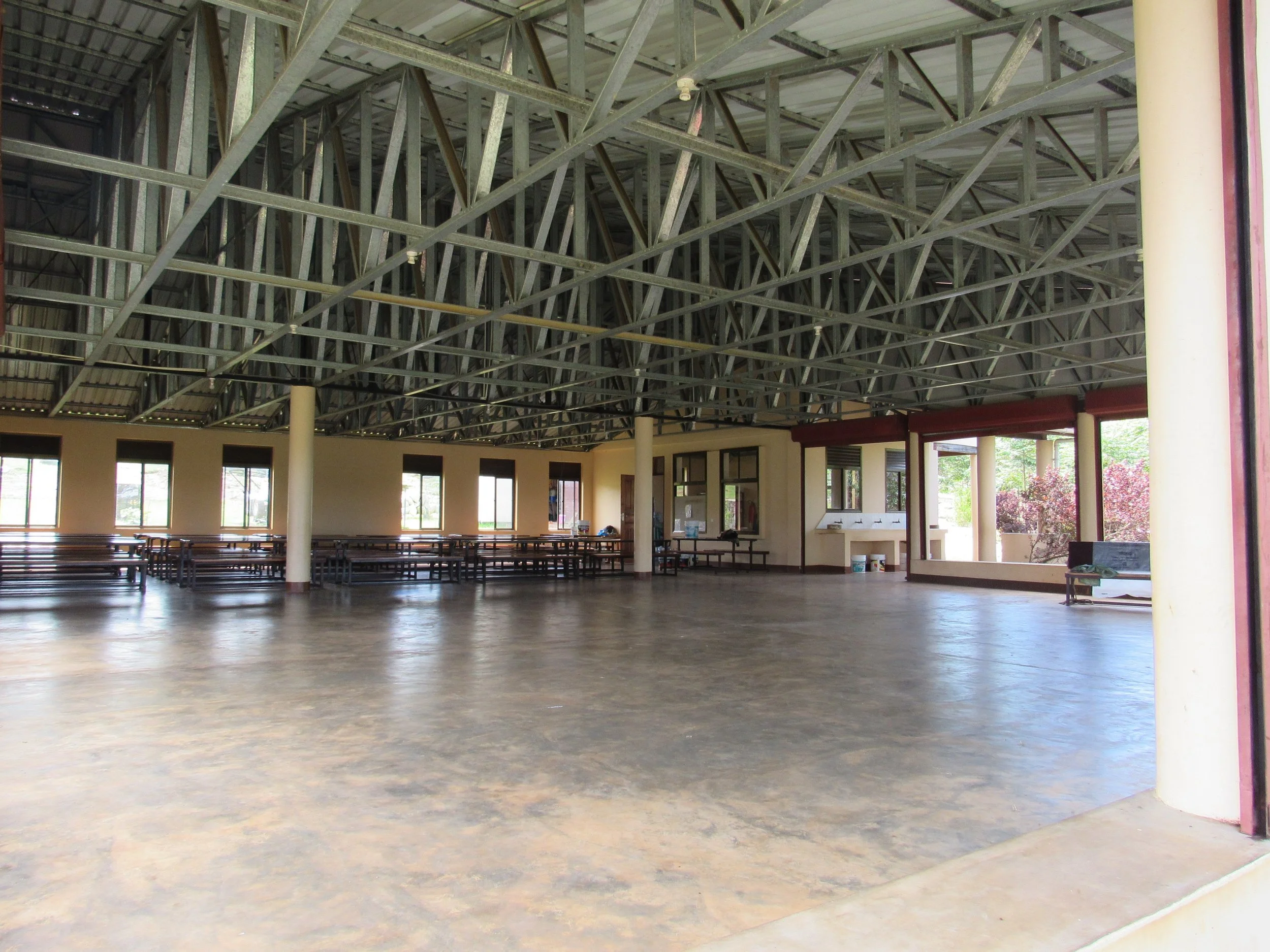
Building 1, to the left where the long part of the L is more classrooms, and the short part contains the cafeteria and kitchen. The cafeteria is a large square. As you approach from the walkway the right half is stacked with seating. Similar to the US they are a table/bench combo, a full table made up of two halves. The frames and top are painted metal, in a dark brown and the seats are wood. The left half is open, with some benches to the side for the PreK to wait for lunch to be over (they usually go home for lunch) and for drying rain gear. There are a series of garage doors here as well.
Originally the plan was to close the cafeteria in with screens so that it could be used as a community space at night. In the end they decided not to, because it did not make sense as it's too far from the village for folks to use it at night, and then they would have had a screen door and that would have just been constantly banging closed as the kids ran though it. So they decided on the garage doors in the end.
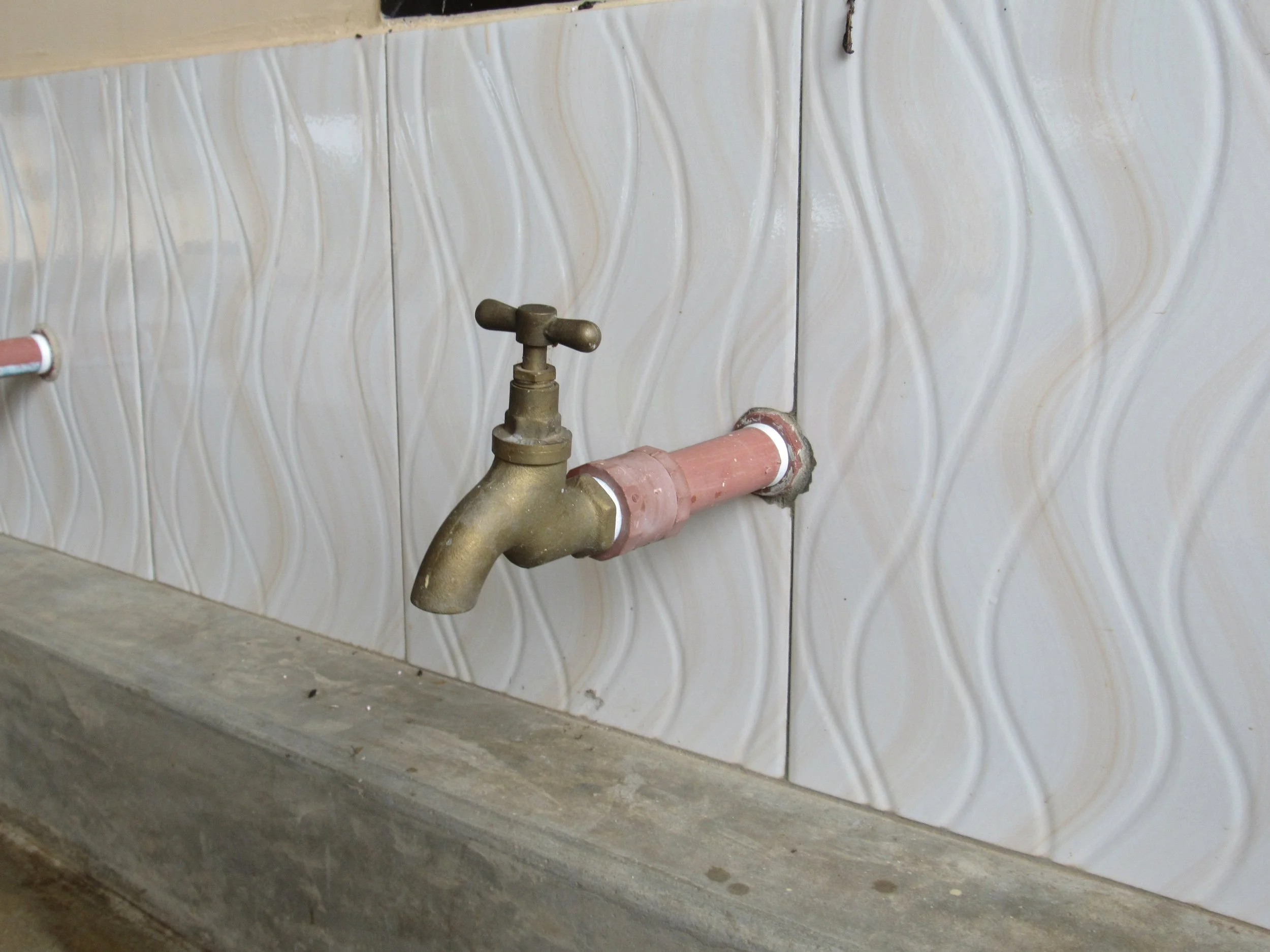
Directly across the walkway are handwashing stations. A lower one on the right with three stations and a taller one on the left with six stations. The troughs are poured concrete and spigot faucets. Right now they do not connect to water, but once the pump and filtration is installed they will. The tall handwashing has a tile backsplash, and is up against the kitchen. This is a small square room, with large windows on three sides.
As you enter to the left is the fridge and stacks of grain, and a shelf of cups, plates and all the supplies for eating they might need. To the right there is the stove against the back wall, which is really an industrial double hot plate on a poured concrete counter. On the wall against the handwashing sink is the kitchen sink and washing station. The wall opposite the hot plates are prep tables, which at the bottom is filled with tomatoes, and the water filling station. They too have a covered walkway in the back, and huge steel tables which are drying racks. They also have a cart to truck water back and forth from the school’s rainwater tank.
Each building has a covered walkway, where handwashing stations and shoes are kept during class time, since they do not wear them inside, and not on the walkways either. The walkways protect from sun in the dry season and rain during the wet season. And considering the downpour that is happening as I write this, it's a good thing these are here. The courtyard is surrounded by bushes of African violets and other plants, plus three small trees that I believe should grow to be very tall and eventually help completely shade the courtyard.
There is a track for cars that runs behind Building 1. This leads to the garden shed, their solar power array, the staff squat toilet and where the animals (goats and rabbits) live in little huts. The goat's pen is on stilts. While I am here, the current project underway is also being dug in this area, a water tank, so they can soon have running water. Continue in that direction and there is another group of three duplexes for staff housing, the third and last currently under construction, more garden and a large newly built permanent goat barn and pen.
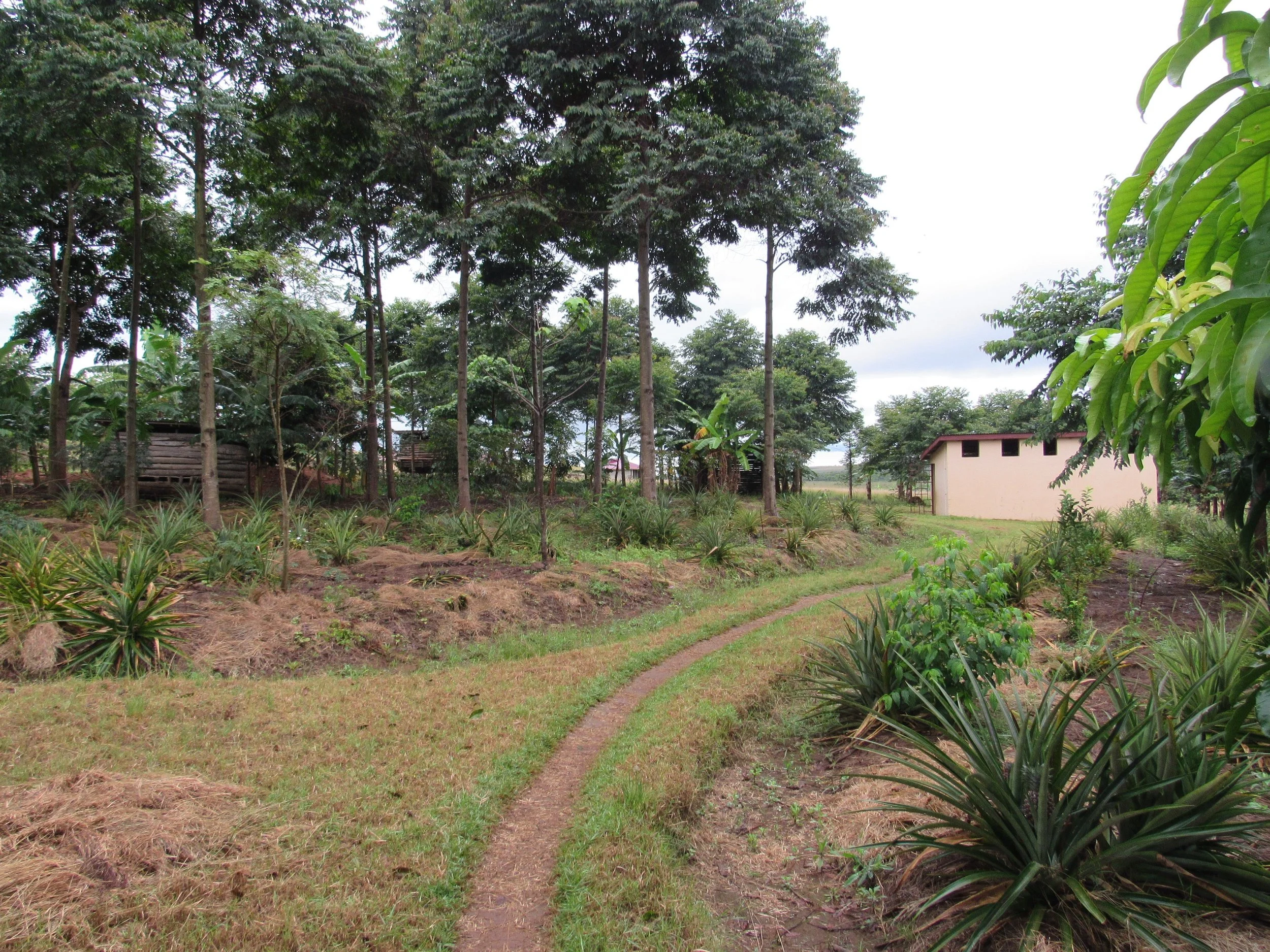
Across from the cafeteria there is a pineapple grove and the paths split toward the two sets of student toilets. There is also a path behind the classrooms of Building 2 which lead out to the soccer and play fields. Crisscrossing paths, which I assume were naturally made by the typical walking patterns of the students, wind their way from the main road, through the courtyard, and toward the student bathrooms. Where these paths meet the many ditches - purposeful and accidental - are small foot bridges made of wood planks or large pavers to bridge the gap.
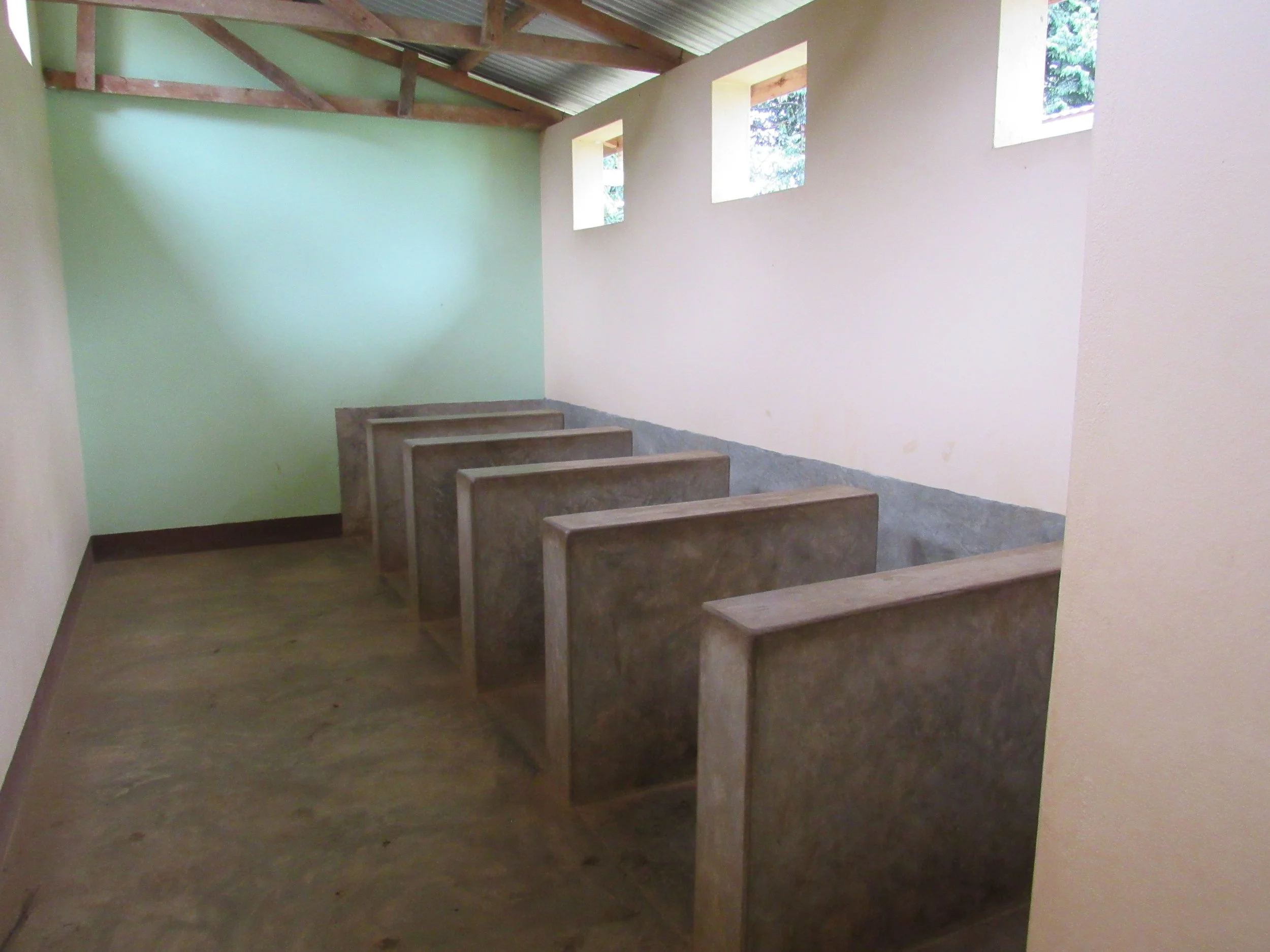
The toilets are innovative for Tanzania; they are worm composting. Most are just a hole that has to be cleaned out one full. At Twegashe, there are 4 restroom buildings. One large one, and then across the pineapple groves, three smaller ones. The first bathroom building I walked into was the first of the three smaller units, and is only for going number one. It is open with 6 “stalls” separated by thick pony walls of poured concrete, which provide enough privacy when a student is using it. Each stall is a flat 3’x5’ square. At the back is a 1’x2’ sloped box that leads to a channel that runs along the back of each stall and down to the worms.
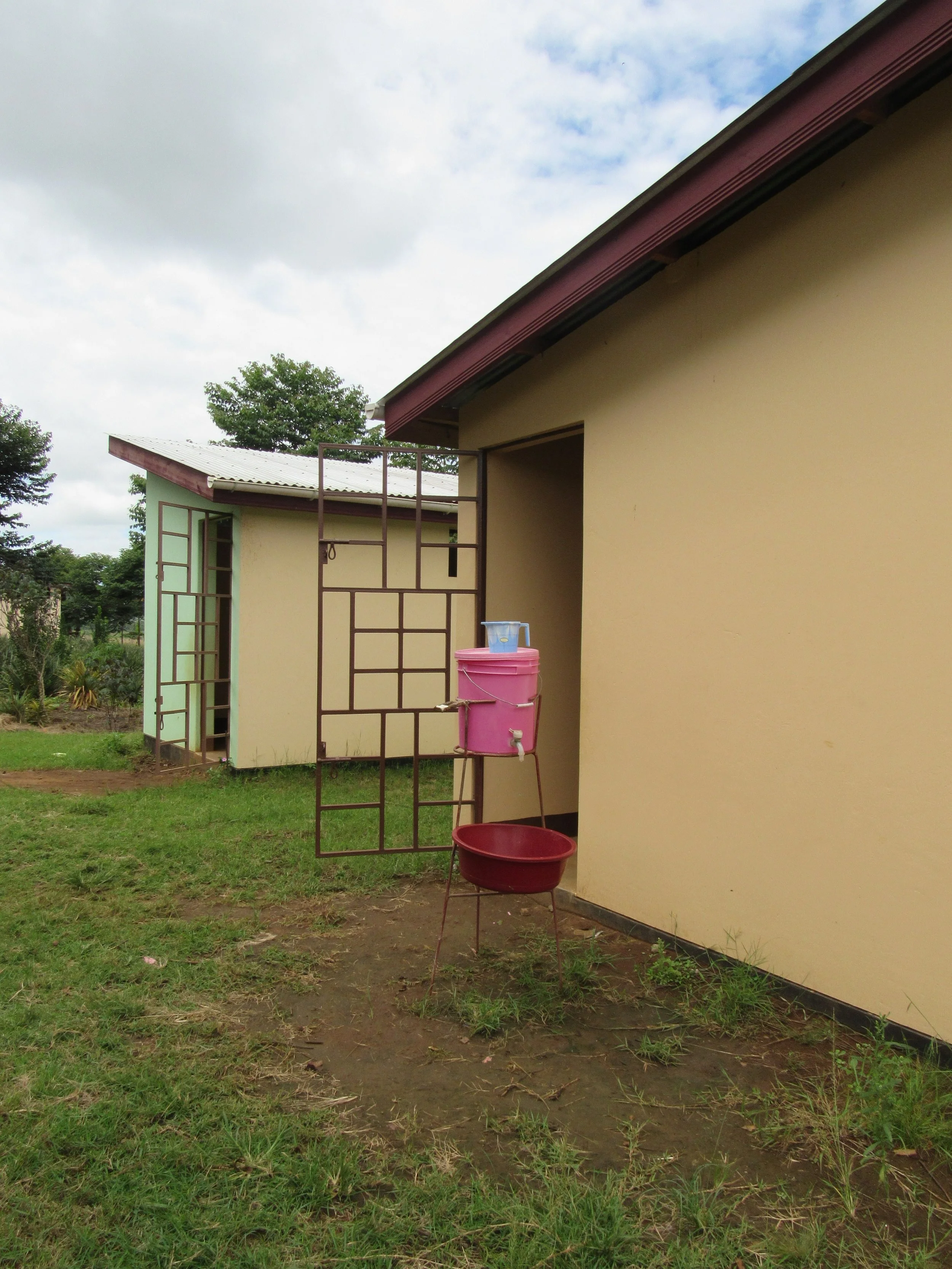
The other two small buildings and the larger one all have individual toilet rooms, which are on platforms about 2’ high, made of concrete as well. The doors are made of steel and large rebar slide locks. Each individual stall has a wooden platform to the right of the door for anything that might need to be set down.
There are windows above the stalls, as well as an opening for the roof struts to help with ventilation. A handwashing station (a painter's bucket with a spigot punched in, and a bin below to catch the water, which sits in a metal frame made of rebar) stands outside the toilet buildings, or right inside on the way out. The other item to note is there are no mirrors anywhere in the school. So far I have only come across one, in front of the sink at the Banobi’s home.
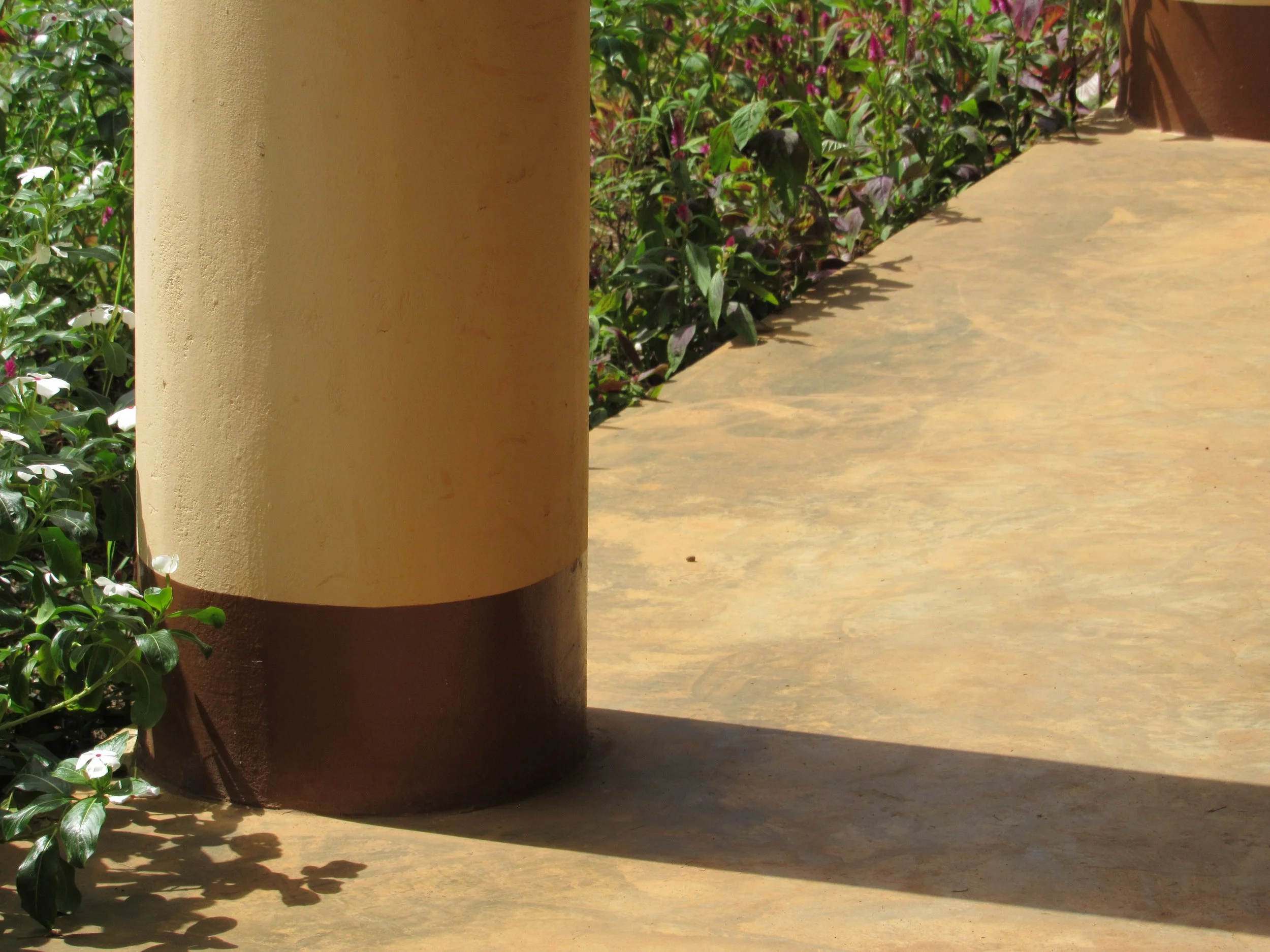
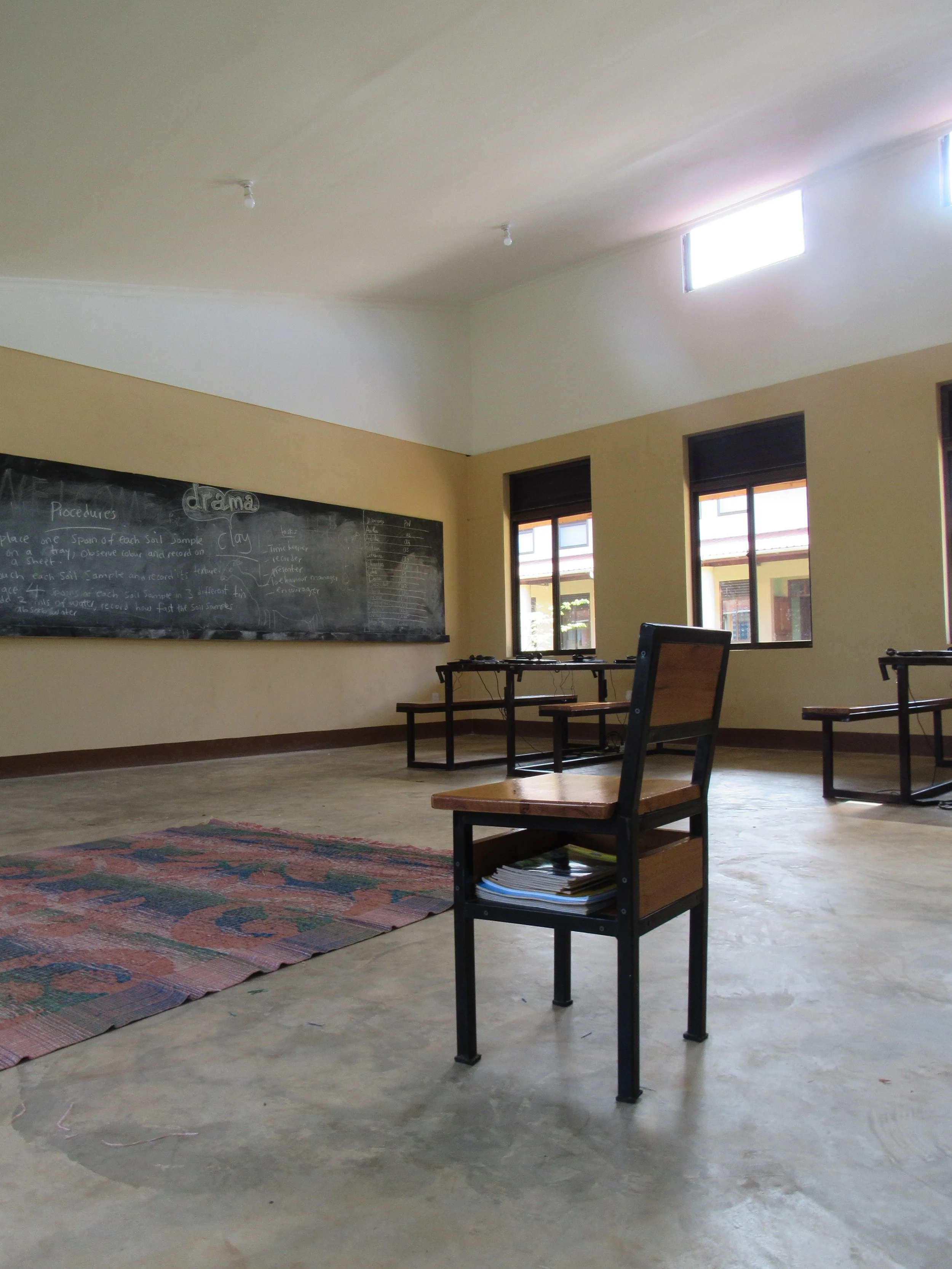
All lighting is just open bulbs, no lampshades, or chandeliers, this applies to the homes as well. Just light bulbs screwed into the socket, whether it's inside or out. The floors are smooth concrete marbled grey and tan, and little rag rugs for wiping feet at most exterior doorways. Walls are brick with plaster over them. Most of the walls (interior and exterior) throughout the buildings are the same tan that is in the floor with each room having an accent wall in a mint green. The doors are all wood which lock with an old school key. Screened windows above each for ventilation. The base is just 6 inches painted on in a medium brown, to help hide the dirt, and matches the 1 ½” door trim.
Windows are the horizontal sliders with venting and screens at the top in the black/brown painted metal. Simple, white crown molding finishes every interior room, and matches the ceilings throughout. The interior ceilings differ, just like the structure.
From the outside the buildings look the same; Tall, L - shaped buildings, with sections of the roofline popped up in a nice rhythm, where the teachers' offices are located between classrooms. Building 1, which holds the cafeteria, was built with triangular metal trusses that are visible under the walkway and throughout the cafeteria. They crisscross along the main support beams, and are almost a feature to the space. The classroom and teachers’ office ceilings in this building are all flat with lightwells at the double story windows.
In Building 2, the structure is not visible, and instead of the trusses, are thin steel beams, more closely placed. The Library and all the classroom ceilings are only flat for about 2 feet before sloping sharply upward to accommodate the second story windows. The teachers offices, and teachers lounge have lightwells.
Outlets and light switches are all at about 4 feet high in some places, and then the typical 18 inches in others. I also noted the staff room has two bulbs, and each has its own switch, instead of being connected, or a 3-way since the switches are each next to the doors as you enter. The classroom lights are all on one switch though. All of the sinks in the building do have faucets and plumbing that will soon be hooked up to the new water pump and filter.
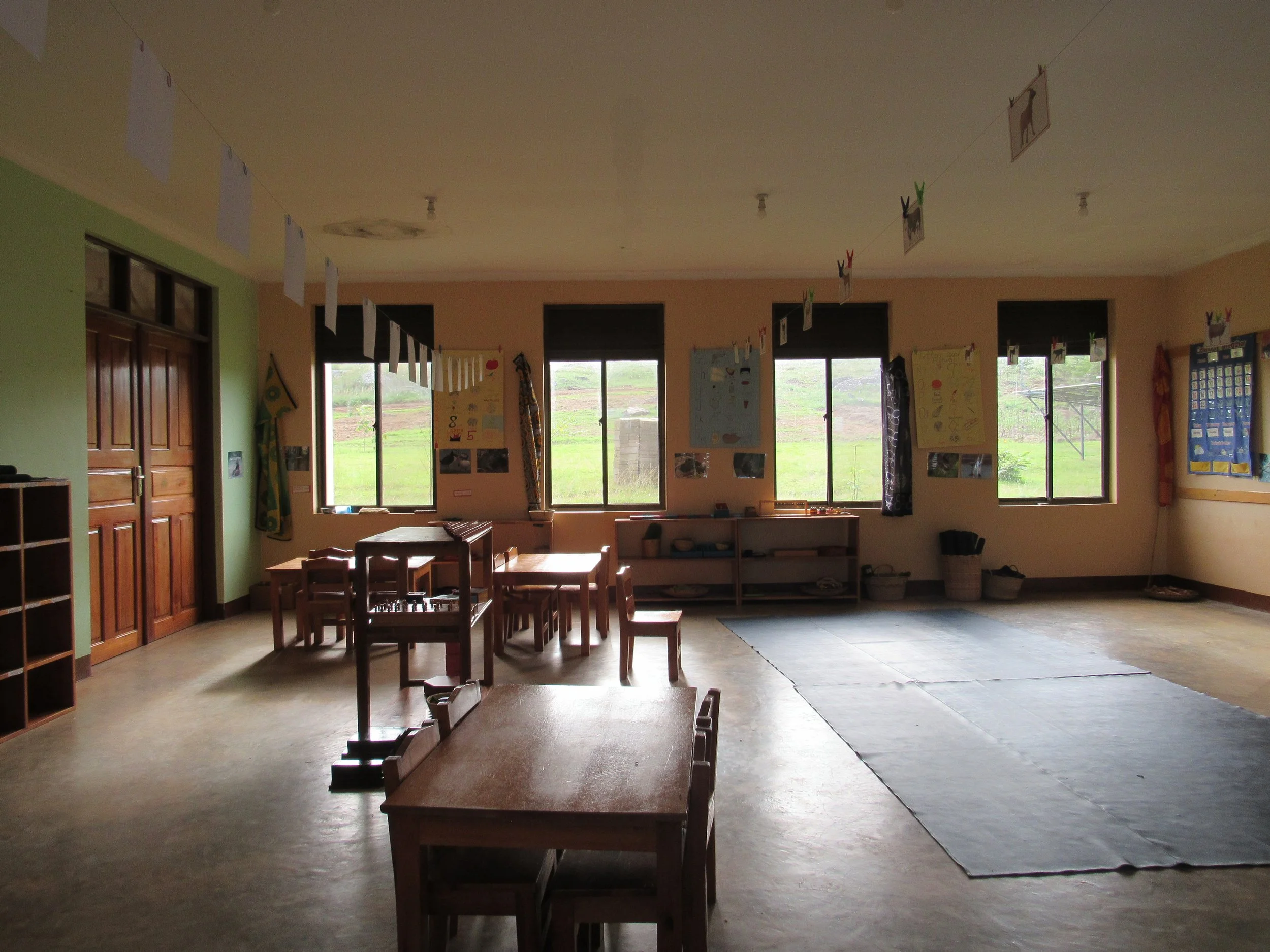
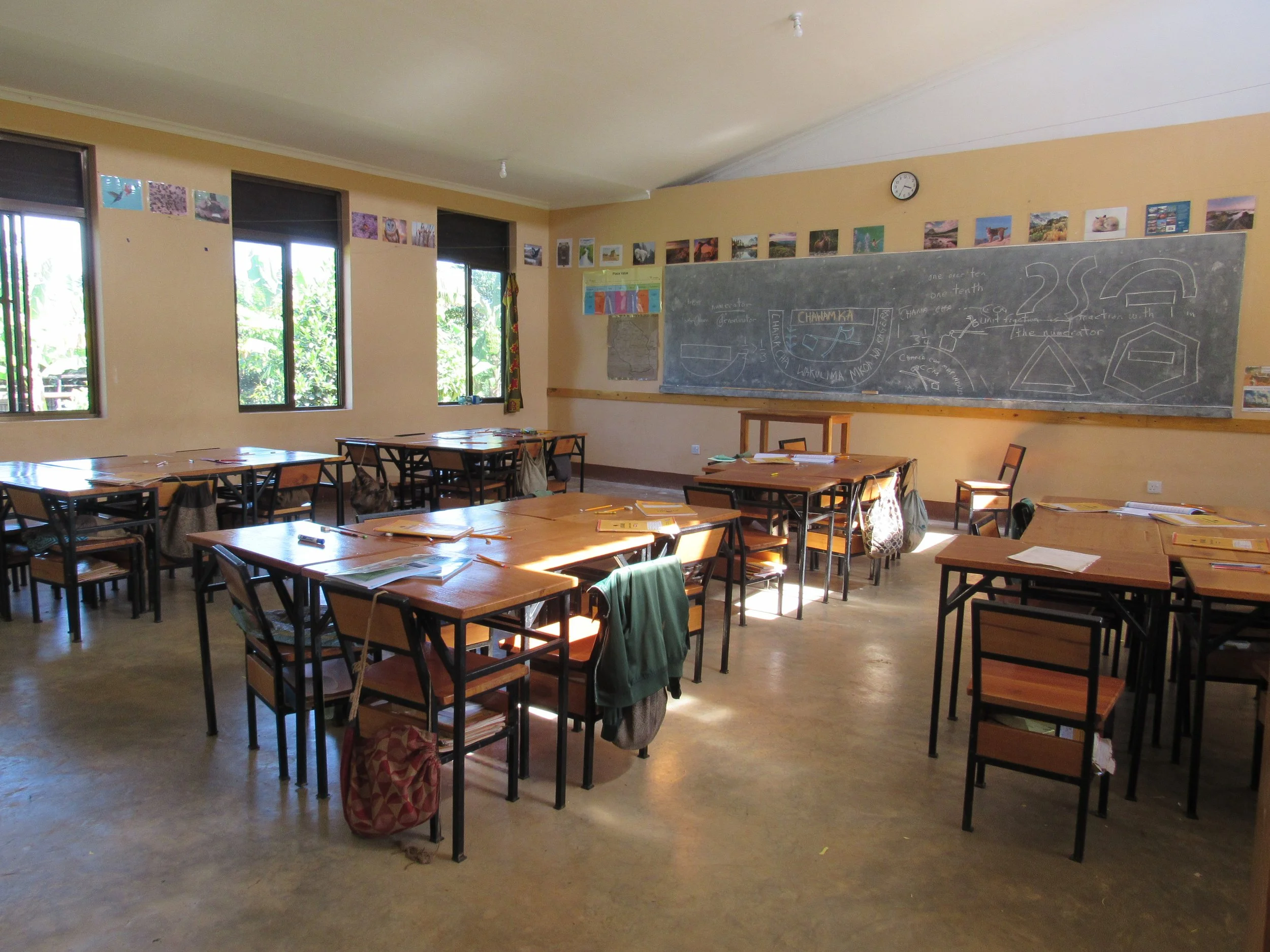
The furniture is mostly wood. The staff room, adult chairs, desks, tables, shelves throughout the school are all the same wood as the doors. The Cafeteria table/bench combo is a very deep dark brown and the seat is the same wood as all the rest. The student desks and chairs are the same finish combo as the cafeteria; metal legs and frame with wood seat and desktop, which has a little groove for pencils. Reminds me of the desks I was in as a kid. The chairs have a small wooden box under the seat for supplies.
The last furniture they are waiting on are chairs for the Library. They use a local supplier, who has been taking their sweet time in finishing because they know they have the business. They also wanted the metal to be a different color than the rest of the student chairs, closer to the maroon color of the roofs. Michael finally had to give them a cutoff at the end of my first week here (which is a Sunday, not Friday). We stopped briefly on our way into Bushaha to check in, and to have them bring samples. On Thursday the supplier did come by with two painted samples. One brown that matched the door trim and a more reddish brown that Jeannette and I liked better. It was fun to do a bit of design thinking for them.
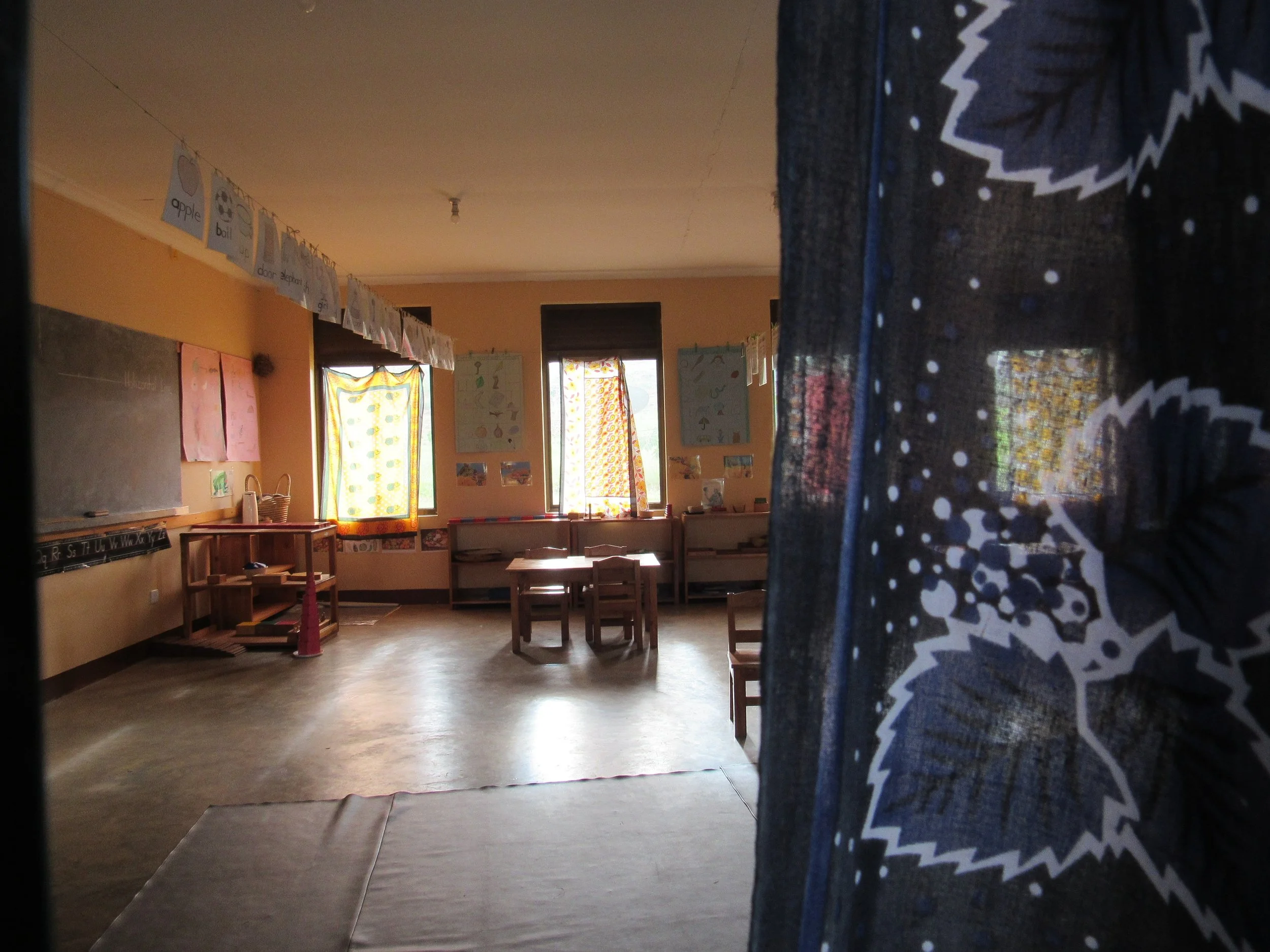
The classrooms themselves are square, and stacked back to back with a breakout room and teachers office in between each. As you enter the accent wall is to the left of the entry door. Along this wall is the teachers office door directly to the left, and then farther along double doors that lead to the shared breakout room. Along the wall opposite from the office is a large chalkboard the length of the wall, and a pull down projector screen. Windows are along both side walls, for natural light and ventilation. There are curtains hung along the windows on a wire strung across the window below the vents. They tie the wire to a screw eye drilled to the wall on either side of the window. Paperclips are punched through the fabric and are used to attach the curtain to the wire.
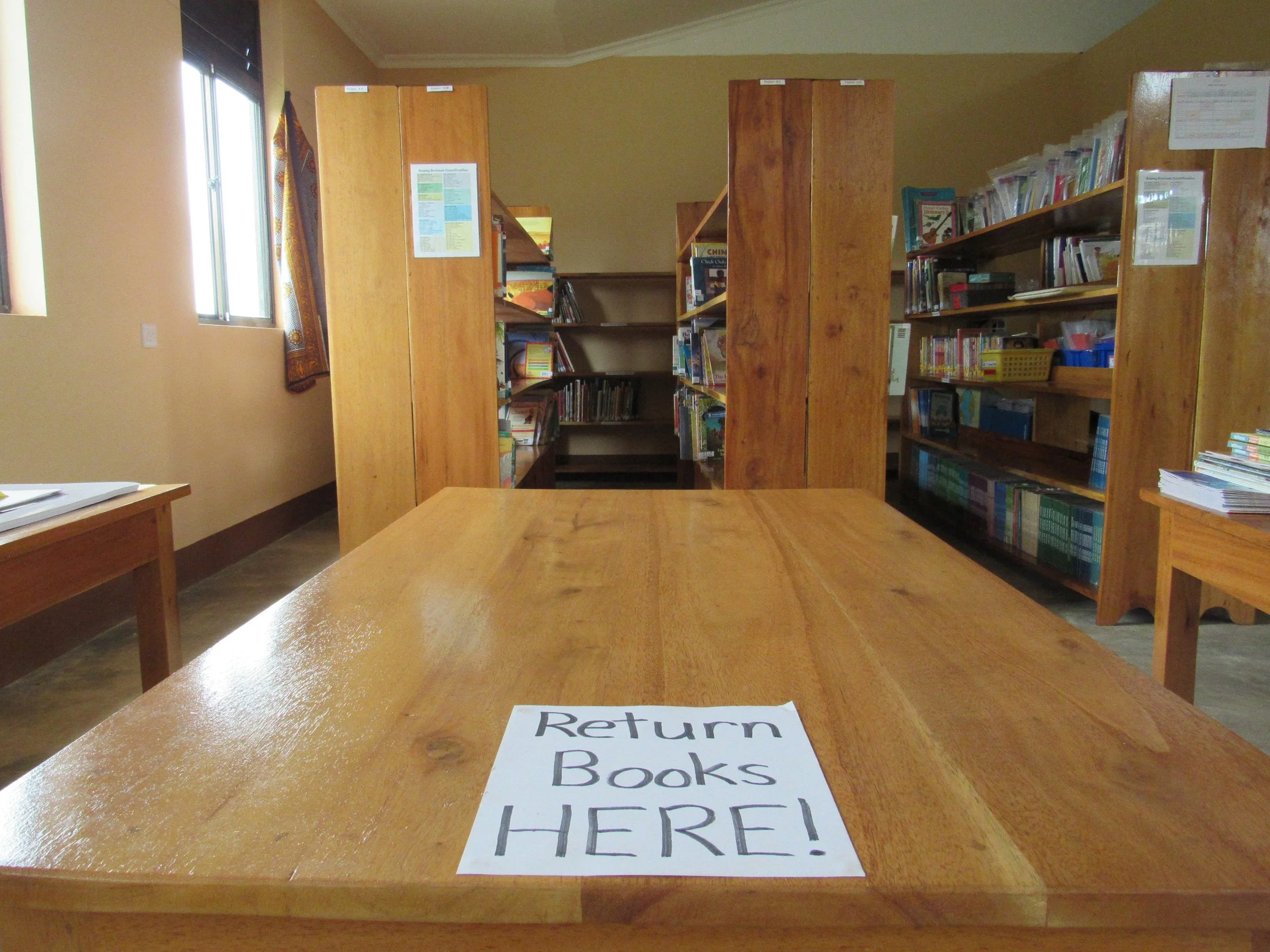
The Library is another large square-ish room. The empty office punches into the back right corner as you enter. The stacks are on this side as well, made of wood, about 6 feet high and shelves about half filled as they build the library. There is a series of tables for returns and games that are kept here. The left side of the room is the same seating as the cafeteria and is set up as a computer lab.
There is a staff member who is in charge of filing books, and tutoring. Whereas the actual Library time is run by the teacher. I watched one of the classes return their books: they walked single file from the classroom and leave on the desk and then walked back.
—
Since it was a Wednesday, the students had already arrived for assembly and were just entering their classrooms to start the day. My e-sim was still not working so I parked myself in the teachers lounge and continued to work on that problem. I also caught up on my podcast episodes for this trip and generally just observe from the window. Around 10am the students get porridge, and then a bit later they bring a thermos full to the Banobis. I tried some, and it's not too bad. Liquid and warm, a nice snack, since lunch for us is not until 1pm. The students eat at noon, and then lunch staff and admin an hour later.
Lunch is typically a corn loaf, is the best I can do to describe it. Like grits but firm, you could squish it into a ball with your hand. This, like with rice, is mixed with beans in a tomato soup and pumpkin greens, or just with a cooked greens mixture. After everyone is finished a cut up pineapple was brought to finish out the meal.
After lunch I took the opportunity to start photographing the architecture. Just stills of the rooms, and the details. Of the ceilings and floors, doorways and windows. I walked around both main buildings and tried to capture as much as possible.
After school was out for the day the teachers had a regular meeting. This is where they bring up issues, concerns, and talk about upcoming things happening at the school. This was also the opportunity to introduce me to the teachers, and explain why I was visiting. It was great to not only hear them talk about school stuff, but personal stuff as well. Since most of the teachers are not from the village, they are building their own community, my favorite being the nightly volleyball game on the soccer field.
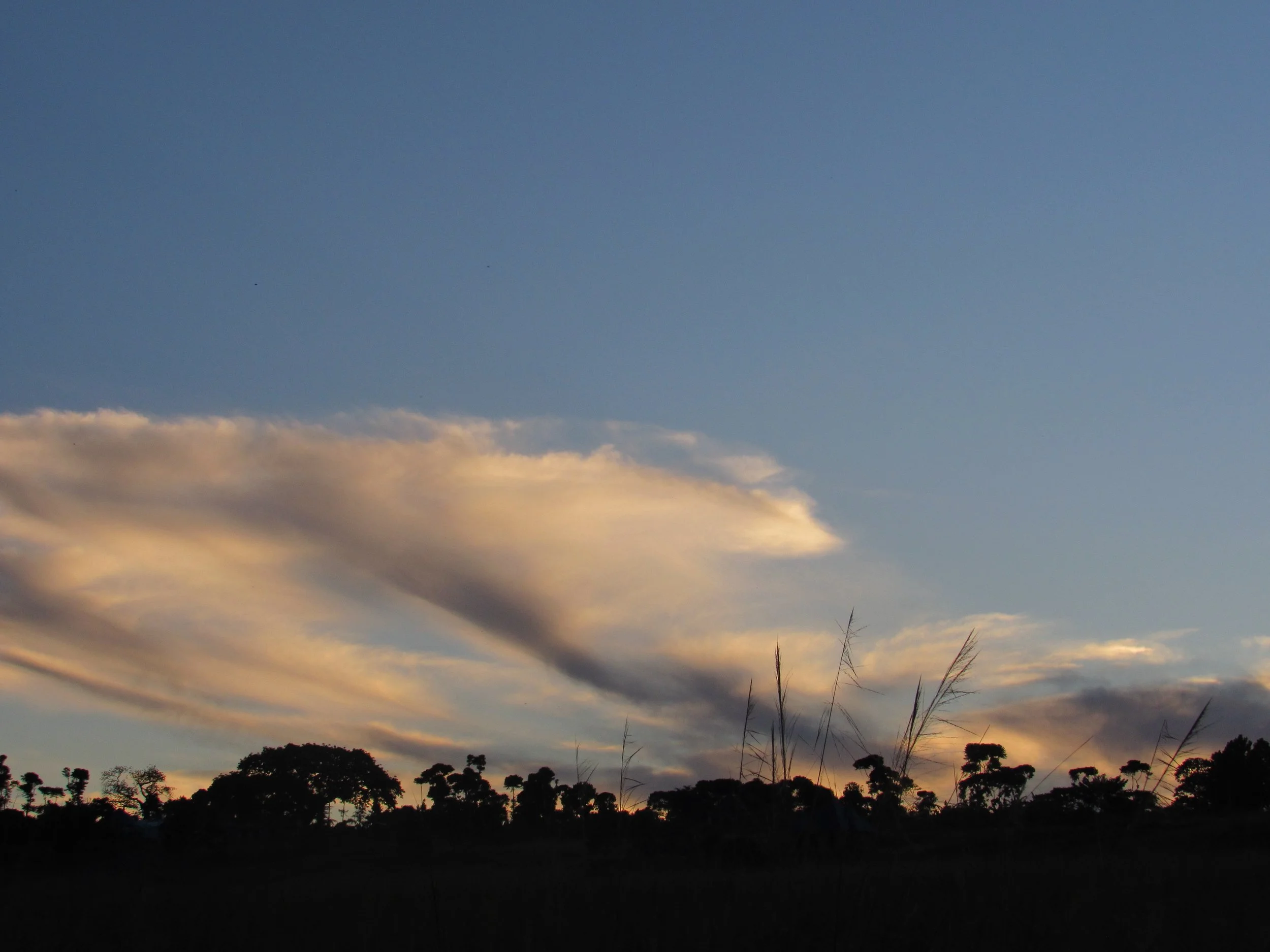
Then there was tea and bananas before the Banobi’s offered for me to join them on their nightly walk around the property. It was an absolutely beautiful place to be at sunset. Long stretches of grass, banana tree groves, and birds everywhere. The sun setting behind the school was spectacular. The end of the loop put us right at the soccer field where we watched the teachers finish their game of volleyball.
Two children of one of the teachers came down to play soccer. They were immediately interested in my camera and me. We kicked the ball around and took some photos. It was fun to help them practice their English and let them look at the photos after they were taken.
Then it was time to head back home for dinner. This time instead of rice, we had bannana, which to me feels more like a squash/potato type texture once cooked. The rest was the same, catfish in tomato, red beans, and pumpkin greens, and a mango for desert. I again showered (walking and eating makes me so sweaty) and crashed hard.
Thursday went along pretty much the same way as the day before. Breakfast, then over to the school. More e-mails about getting my e-sim to work, and messages to my husband that all is well. On Thursdays the parents of the students come in to help clean. The women sweep and mop the floors, and the men help with other labor like hanging the curtains we had bought in town earlier in the week.
All parents must participate, and if they don’t show up for their shift more than twice, their child gets sent home. The Banobi’s originally just used parents who volunteered, but it was always the same group and they got frustrated being the only ones. So they now have a leader, who makes sure they are all doing their part.
On this day, though, I started to record using my video camera. I began when the students went for porridge, shooting as much of the courtyard and walkways as I could, from the entrance to the admin building and then over by the cafeteria. I stared out of the way and could see the curious looks from the students as they walked by.
When lunch came around I did the same, moving to right inside the cafeteria entrance to observe how that went. As soon as students finished eating they went to head toward reccess. Some just passed me by, but it didn’t take long for a group to gather and want to know what I was doing. Many were crowded watching the recording while others ran in front to dance, make faces, and just be silly. This also gave me an opportunity to start talking to them about their school.
This is when I realized I don’t think my written surveys are going to work, especially with the children. The best way to get information is going to be just asking questions. They did not quite understand what I meant by favorite room, but could tell me their favorite subjects and what they liked doing while at school. One liked art, another science and math. Eventually Michael shooed the crowd away toward the playfield, but a few stuck around and walked with me in that direction. They asked if I would play football (soccer in the states but I’m going to use the local vocabulary) and I declined but said I would watch, and I did get some video.
As mentioned before, they are digging a huge hole for a water tank and filtration system. The extra dirt is being dumped and spread out on the soccer field. Labor is done by hand here, there are no backhoes, or bulldozers, just manpower. There is a crew to dig, a crew to move the dirt to the soccer field (via dump truck), and a crew to flatten the dirt. The amount they can accomplish is incredibly impressive. During one of the dump trips the truck fell sideways. The heavy rains had made the mud thick in places and the tires got stuck. Considering they ride in the back on top of the dirt it was a miracle no one was hurt, except for one smushed toe, but my American sensibility was concerned on how they would get it on its wheels again. Using a rope pulled by a second truck, and all the men pushing from the opposite side managed to get it upright. I happened to be in one of the walkways facing that direction and watched it all unfold. And the man with the injured toe, just kept on working like nothing had happened.
After our lunch (same as the day before) I continued to get video footage of the public spaces as the afternoon activities and classes happened. Chess club in the cafeteria, students in the garden on the slope, music time, and other activities throughout the school. One of the teachers, (I am the WORST with names) even stopped to take a look at my filming and chat about what apps I use for editing. We talked about photoshop versus Canva, and how tiny my camera was. No tea, since there was not a teachers meeting, but another beautiful walk around the property before heading back for dinner, a cold shower, and sleep.
Friday ended up being a holiday because of Ramadan ending. Since I was still battling the e-sim problem I opted to go to the school and get some more podcasting work done, and start uploading the pictures and videos I had already taken. After a week of the same troubleshooting not working the e-sim help FINALLY suggested I erase and re-install the e-sim, and lo and behold it WORKED!
The morning went about as expected otherwise. More writing, uploading and organizing myself. We went back to the house for lunch and then I decided to take the afternoon to stay at the house and read. They left me supplies for tea (ginger water, sugar, tea bags) and a roll to hold me over until dinner. After the Banobis returned we went for a walk in the village. At this point we had driven up and down the main drag of the town many times to and from the school, but that is really all I had seen.
They decided to take me to what they call Kishanje Mountain. It’s really just a hill that the cows often graze on, but their language has no word for hill. We walked through the "residential" (I use this so loosely) part, which is really just wide walking paths curving around and between banna groves with homes either right up on the road or tucked back in behind trees, or along other small branching paths.
Homes are small, probably no more than a few hundred square feet, and none are ever very close to one another. They are made of either exposed open brick, mud, a combo, or some even just wood with metal where the cracks are. Not all homes have windows, but if they do they have painted metal security bars, usually in an arabesque like pattern, the color of the red clay. The roofs are metal, they can be silver, blue or red/maroon. No two homes are the same, each a unique combination. Fences are made from branches of fallen trees, and are really only used to keep their livestock (cows) contained. The chickens roam pretty freely. Women and children were working their gardens as we passed.
We came to the base of the hill and met the village chairman. Then as we walked up the hill were plenty of cows grazing and kids playing. Many children go to the Twegashe School and know the Banobis by sight, so as we walked up the hill we were joined by a few students and their siblings. Reaching the top the view was absolutely spectacular. One of those views that could never be captured by a camera no matter how hard you try. It also showed how Bushasha Village sits in a little nook of Lake Victoria. As I took pictures the kids would sneak up behind and see if I would notice, and run away giggling when I did.
I learned that cow watching is a rotation between families. One person spends the day tending to the cows, and then at the end someone comes to pick up their lot and bring them home. After some time atop the “mountain” and chatting with a parent we headed back down and looped back to the main walking road in the "residential" area, and back home. Another rice and beans, fish and greens with a mango for desert, before showering, some handwashing some clothes and falling asleep.
Saturday started the same, breakfast, morning at the school, then back to the house for lunch. Because it was iftar, and the end of Ramadan, the vice principal, Mr. Masumbuko, invited us over. After lunch we drove to the school and walked up the drive to his home. We were warmly welcomed by him and his wife.
The main entrance faces the school, not the road, which the residents find kind of strange even though it looks out over the spectacular view, and has the same paint scheme and overall finishes as well. When you walk in, the kitchen bumps out into the living space on your left. Next to the kitchen is also a washroom and a service porch that faces the road. Out of the middle of the great room there is a short hallway for storage and entrance to a bedroom that butts up against the service porch. Along the back wall there are two doors. One is to get to the second bedroom through a small entryway that connects to the adjoining unit. The second door leads to the shared area for some storage and the toilet.
Marc mentioned the great rooms were too big, and after being here I understand why. The living room was sparsely furnished with two bright sapphire blue couches, a matching armchair (that matched the curtains too) in between all surrounding a large wooden coffee table, with inlay along the sides, that faced a small TV stand where they were watching football.
No rugs, no art, no knick-knacks. The way as Americans we have so much stuff ( super guilty - I am a recovering minor hoarder), they truly only keep what they need. I do wonder if more research could have been done on what the housing needs were. I remember when initially talking about the teachers' houses the thought was bigger would be attractive to teachers, but that is more of an American mindset. Mr. Masumbuko even asked what I would do to add to the house to make it feel less empty, and honestly I was at a bit of a loss.
Traditionally families come over at the end of Ramadan, but since Mr. Masumbuko and his wife are not from the area, they invited us. He also wanted me to be able to see the inside of the teachers' housing, since I was here to study architecture and design. We arrived a bit after 4pm and were greeted warmly by our hosts. There was another gentleman who did not speak English so we switched between the local dialect and English.
Mrs. Masumboka was kind enough to make us a delicious dish of rice and chicken. So flavorful, and I understand why they like to call her “chef”. Before we ate, Mrs. Masumbuko had a handwashing pitcher and bowl and then helped us use it again after eating. We watched the end of the football match (tied 1-1, and boy were the Young Africans pissed about the last minute score by the other team) before heading back to the Banobis home. Funny how no matter the place and the culture, food is shared and sports are watched.
No time for a walk, since we were back at the house close to 6:30 and dark came on fast. Another evening of rice, beans, fish and some leftover beef from earlier in the week, topped off with a mango. I chatted with Michael a bit about differences between Bushaha and the States, before another VERY cold shower and reading before bed.
—
Sunday, like most days, started the same. Breakfast and then head to the school. Work there until lunch and then afterward we walked to Lake Victoria. Because it is the rainy season, I was really worried there would not be enough clear skies to make the walk, and I didn’t have another weekend to go.
This is where my second grade dreams come in. I had an amazing teacher named Mr. Grobman, with whom we did a unit on Africa in his class. A lot stands out from this year, (one of the best teachers I’ve ever had) but I remember a few things from this particular time studying Africa. One is the celebration at the end where we all brought in a dish. Because I have West African ancestors my mom brought in couscous as mine, but there were two pieces of geography I wanted to see someday. First was Mount Kilimanjaro (which might have been partially the name), but the second was Lake Victoria. Why? I don’t remember, but when I was briefly on the project in 2017 I promised myself I would someday get there.
The weather was on our side and cleared up by 4:00 which is when we headed out. The Lake is through another “neighborhood” of Bushaha so we walked the long driveway to the main road, and then quickly veered off to the left. A small trail by a grove of tall trees led to another larger thoroughfare with smaller “shops” and a traditional shade hut: grass roof on a series of poles in a circle.
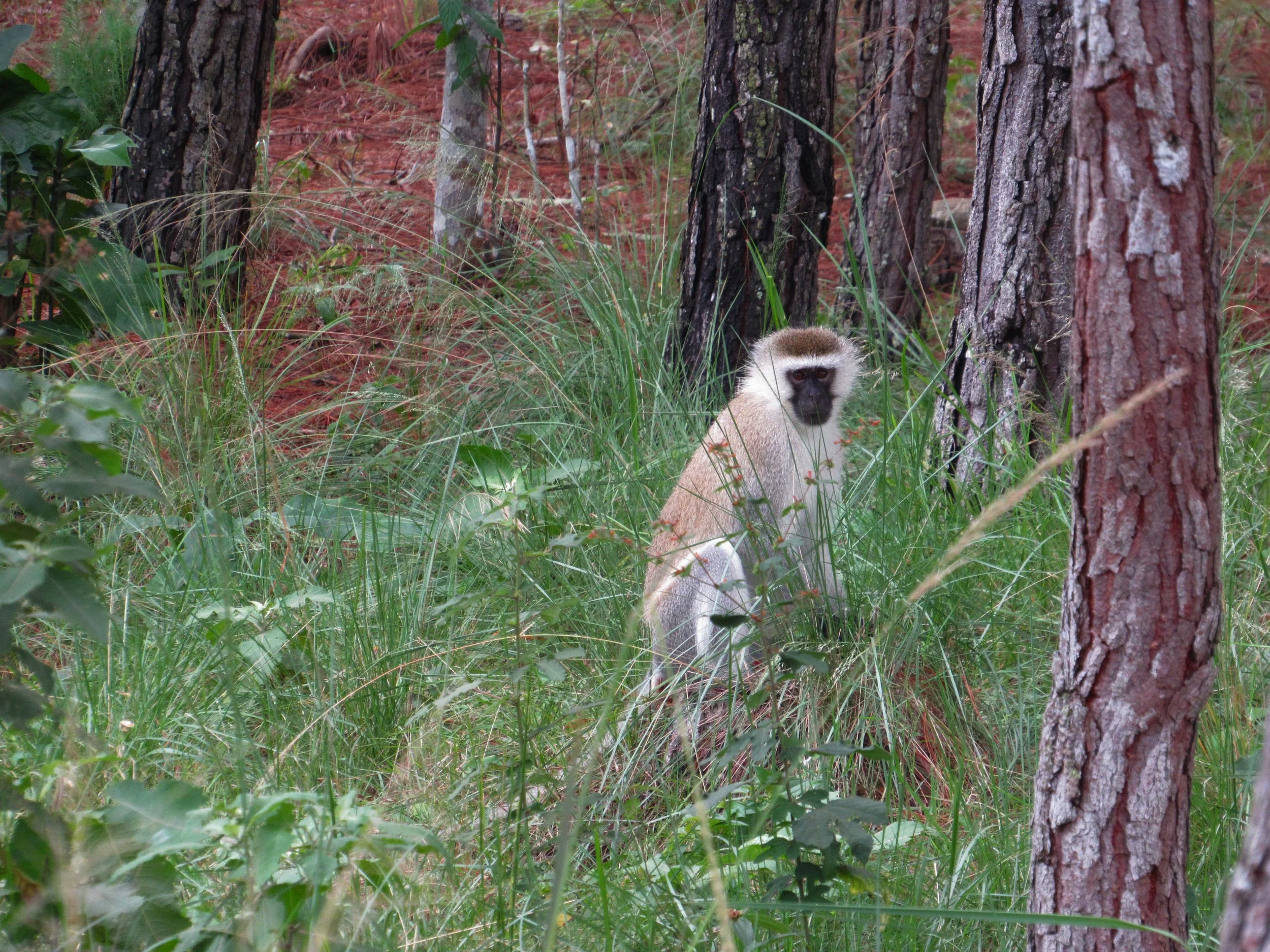
We continued this way and then took another small path to the right that led through this other neighborhood. At the end of it, in a grove of trees we came across a mom monkey and her babies; they were bright white with black faces. As the babies played in the tree, mom moved away to get a better look and see if we were dangerous. Decidedly not she turned her blue butt towards us (wow Lion King was right haha) and walked back to her kiddos.
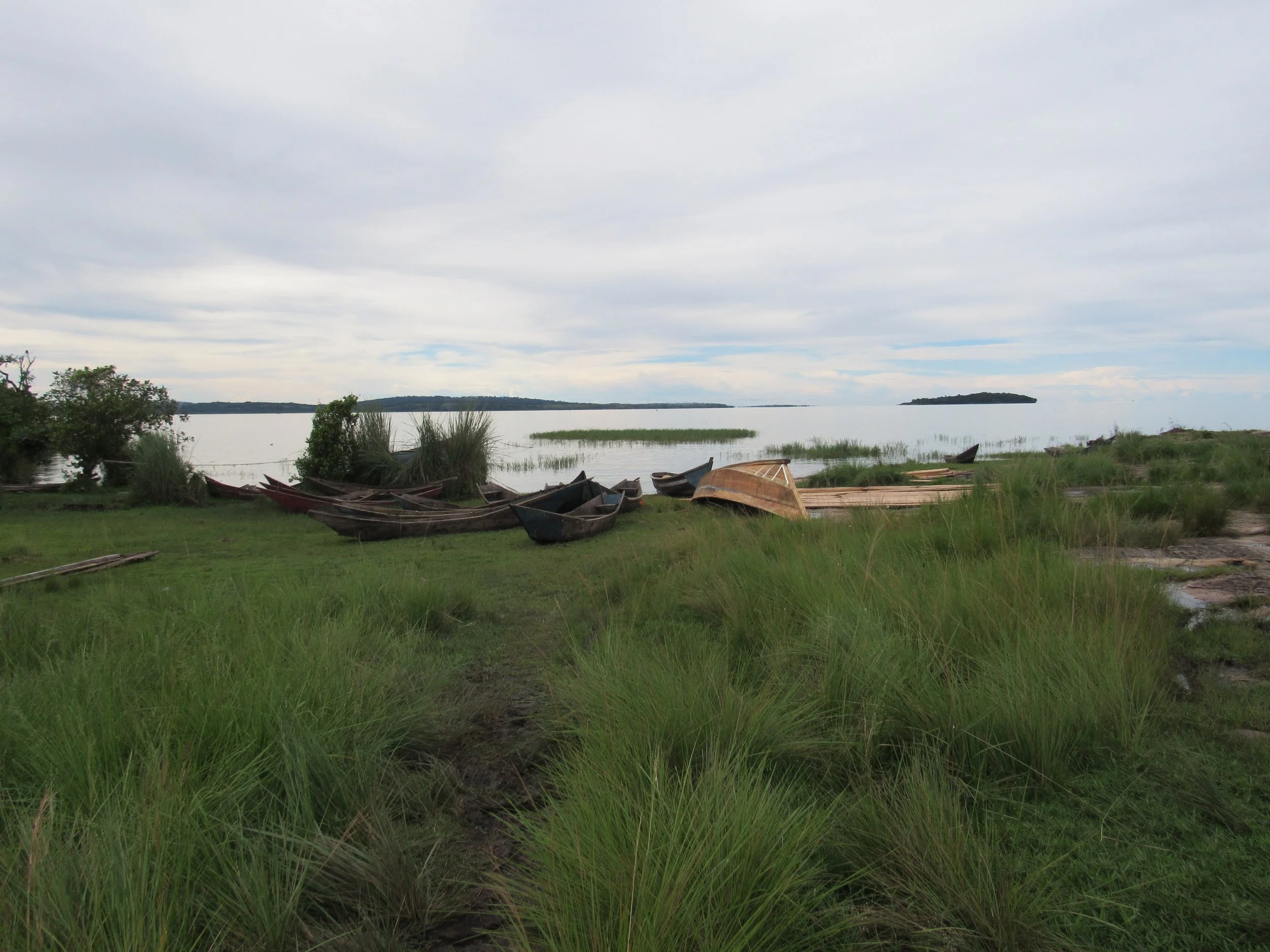
As we continued on the path, dogging mud and streams of biting ants, the forest of tall trees faded and long grass appeared. Large swaths of rock cut through the grass. Because the rain had finally stopped people had left clothes to dry on piles of large stones and the rocks themselves. We continued through the grass at least waist high, and then, she appeared. A large swath of light blue in a sea of green that melded perfectly into the sky.
Continued to follow the path, avoiding muddy spots and puddles. The grass got shorter as we got closer. In a grove of tall trees right before the last stretch of “road” were a couple of wooden boats in progress. Using machetes they cut and chisel the wood, and then bend it into shape.
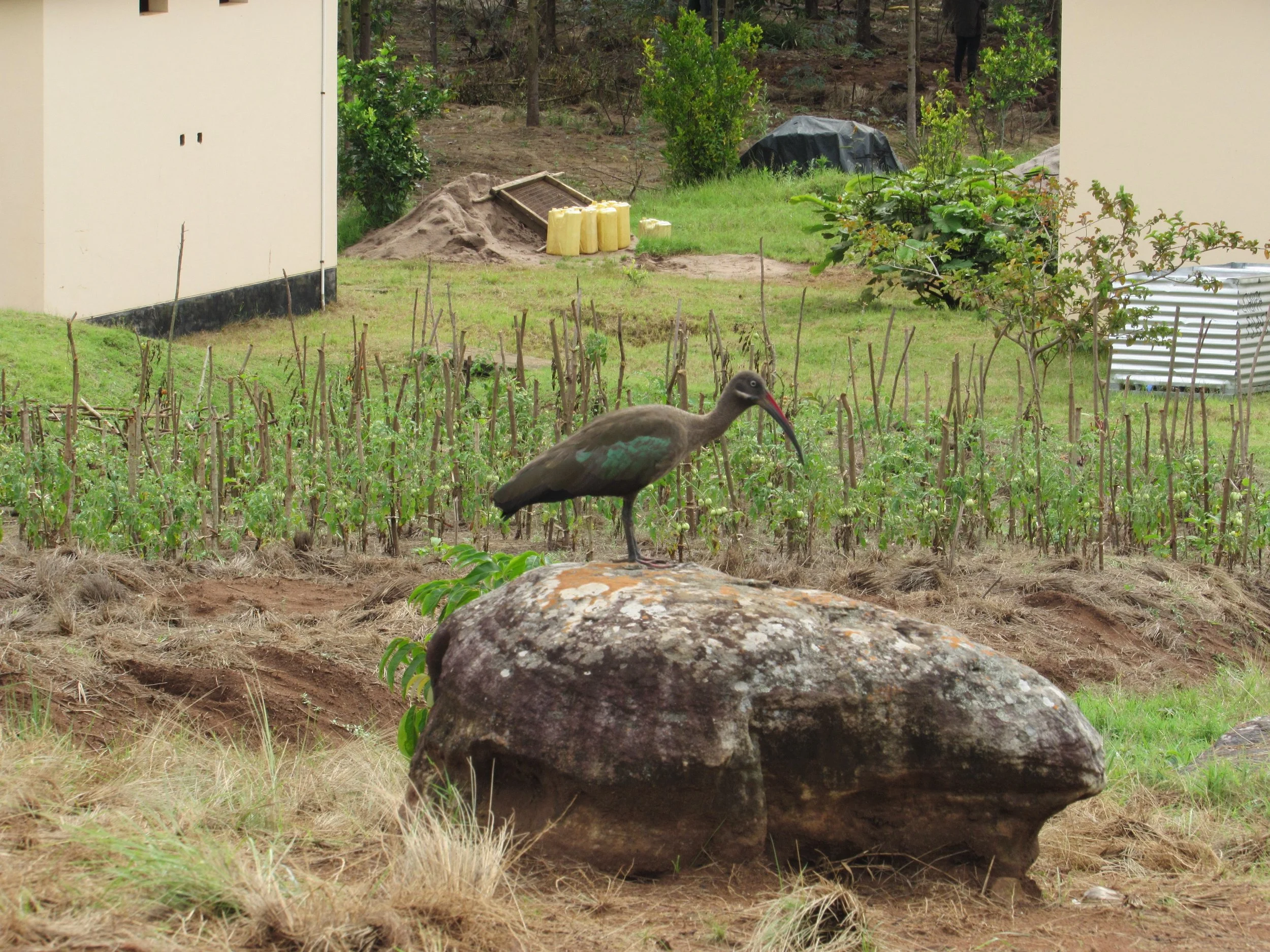
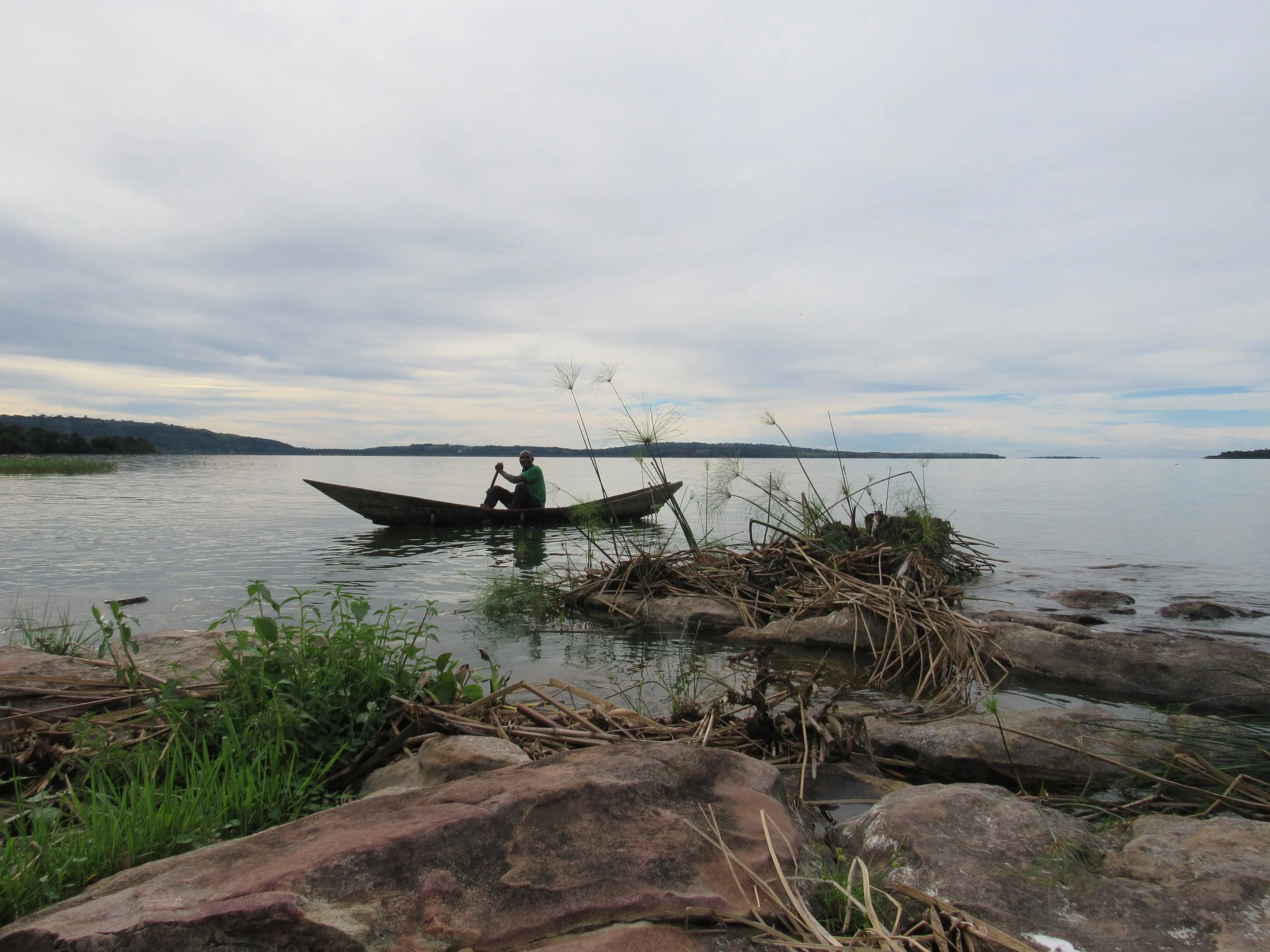
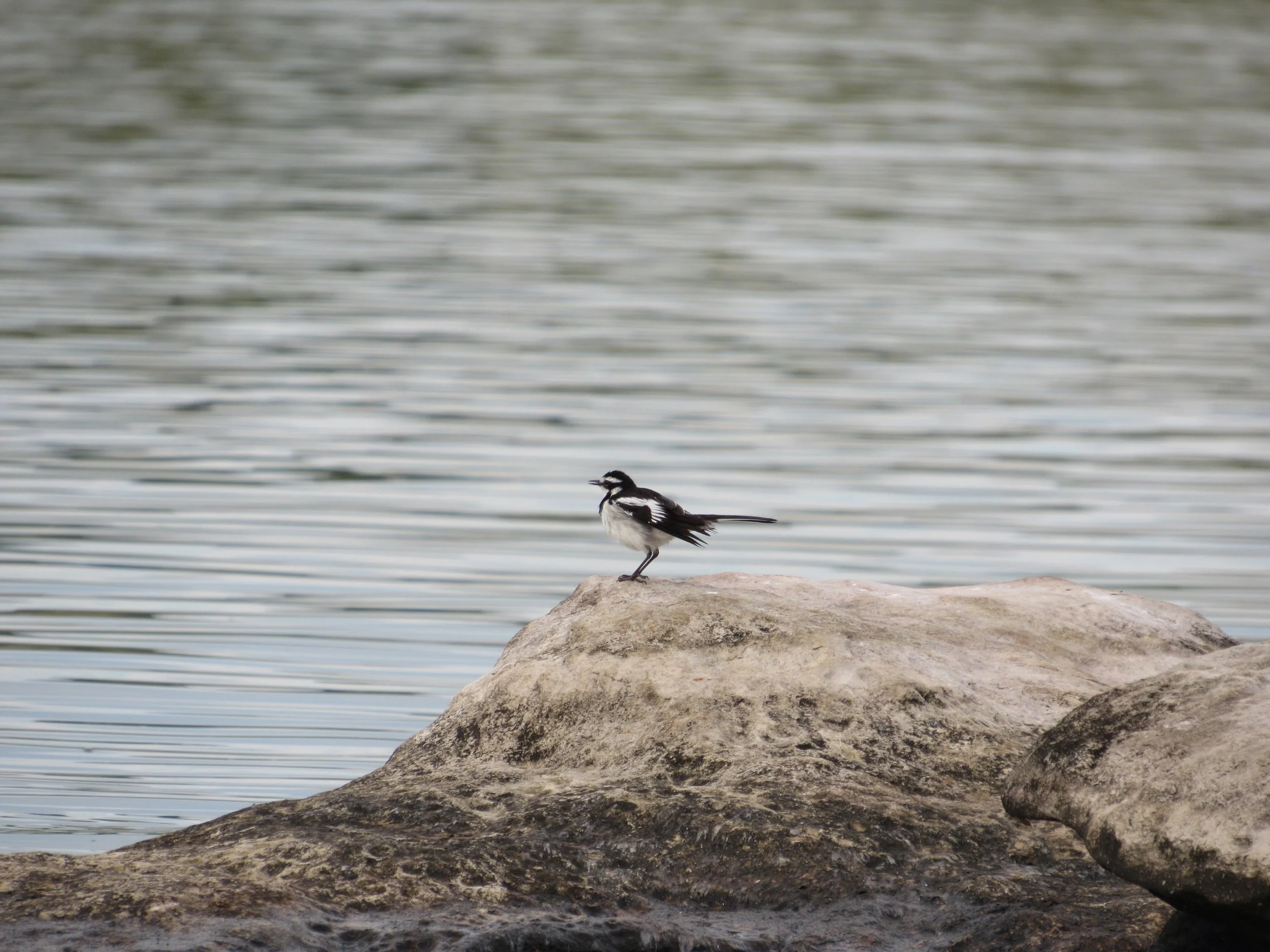
Finally we arrived. The shore consists of large flat rocks that jut out into the lake. There is a small grove of trees dotted along the shore. It was the perfect afternoon to be sitting lakeside, as there were plenty of clouds to keep the sun from being too much. There were kingfishers diving for fish and hanging on rocks. A duck lazily floated by. Some large pelican(?) type of bird flew overhead. On the far shore a flock of seagulls mulled around. We snacked on peanuts and just enjoyed the peacefulness of it all.
There were a few fishermen about, and one even asked to have his picture taken in his boat. He told his friends that he was now going to be on TV and they were not (LOL). Mostly it was their rest time (they fish either early morning or evening), but some were out casting their nets, and another put his small boat (boat turducken?), in a larger boat to deliver it to someone on the far shore.
As a kid who grew up on lakes, and added “Visit Lake Victoria” to her bucket list at the ripe old age of 8, this was truly the highlight of my trip so far. We could not sit all day, as we did need to head back home before it got dark. There are no streetlights, or anything except around the main shopping area, but even those are just mounted on the outside of buildings. We retraced out steps, the grasses grew, the tree groves appeared, we came across some (very dramatic) goats. Back through the neighborhood was busier than when we left. Folks hung by the little shop and chatted under the thatched shade. A young man with fish protected by a banana leaf walked past us, heading to sell his catch.
We made it home, with plenty of time before dinner. I got a bit stinky after walking and took advantage of the time to shower and change before dinner. More rice, and beans and greens with a mango to top it all off. Michael and I talked a bit that evening about the over fishing that is happening on the lake, and some of the ideas that have been utilized to help counteract it. One of the main sources of protein for the community is catfish from the lake, but the locals do not seem to understand that they need to throw back the small fish, and only keep the big ones so they can re-populate.
The first solution was to introduce a new fish that would grow big and provide lots of meat. That worked for awhile, but what was not taken into consideration is that there are other, BIGGER fish, and they ended up eating the entire population of the newly introduced fish. Another option is farm fishing as a stop gap. Still in the lake, large cages of non native fish would be used. The concern here is that if the cage does not hold up then non native fish would get into the ecosystem and that could upset the balance.
There was one other thing that Michael had heard of. A man who worked for the office of the president came to the neighboring village. They had a meeting to introduce the locals to the scheme. Michael was invited by someone he knew in that village. The man claimed to have money from the Obamas/ US Government (this was during his time in office I believe) to help fund farm fishing. There was a large group of folks, from the military, lawyers, etc to answer questions, but for some reason the main guy was the only one who ever spoke. The idea was this; there would be three types of “fishermen”. The first was just investors who would put forth money. The second was the regular fishermen, who would be the ones to tend and maintain the “farms” and the third was everyone else who would band together in groups of 10 people/families to put in money (20,000 TZ each, the rest subsidized by the government) and then would get the profit from their individual cage.
Michael asked questions, while he was there but could not seem to get a straight answer. There was some concern from the community it was not clean money - potentially money laundering - because Michael noted, there was not any fund of this sort he could find. Years went by, Michael kept asking, and nothing seemed to be happening. Then while talking to one of the fishermen at our visit he heard of a family that were trying to buy in. He called before dinner that night and learned they are paying WAY more than was originally told, and there was no subsiding happening. This led him to talk to another person who seemed to imply the scheme was still happening, but it was non locals who were getting the profit.
All in all Michael is suspicious, and I would be too. The man who originally proposed the scheme seems to no longer be around, and does not work for the Tanzanian president anymore. Nobody really knows who he was, and what the actual plan was. If Michael ever finds out, I told him let me know, because the whole thing is definitely a mystery.
—
On Monday we attempted to see the assembly that happens on Monday, Wednesday and Friday mornings. Unfortunately the rains were not cooperating, and the downpour prevented it from happening, since it is held in the open courtyard. As we drove to the school kids were walking and running along the road. Some in big black raincoats where all you could see were their faces and feet. Others used the banna leaves as an umbrella.
I spent the morning continuing to take video and pictures. Walking between classrooms and trying to be as unobtrusive as possible. Easier said than done, since I don’t look like I belong and am using special equipment. I catch some PreK lining up to wash before porridge, and then doing some washing, and the 2nd and 3rd graders singing. Some classrooms were working in small groups in their desk clusters or on the floor and in other classrooms students worked individually.
After lunch I continued my random walk around and photography. I tried to get photos of every classroom and its layout, since each teacher decides how their classroom should be arranged. A also remembered that Marc had mentioned that the Admin roof had added some challenges, and figuring out how the attachment would work. So I walked the perimeter of the buildings to capture what the final outcome was, along with any other details I happened to notice.
As the day ended and their activity period started, I found the preK kids out singing “shaking the mango tree” while the older ones were all at various activities. After school ends there is still a few hours before we head back to the house, so I got a few pictures of myself around the grounds (ya know proof), as well as the kitchen before heading on an evening walk around the grounds. We stopped at the pineapple grove, and Michael picked a ripe one, along with passion fruit that was ready to go, and he didn’t want the animals to eat it. Then back to the house for rice, beans, and greens, our nightly mango, a shower and sleep.
Tuesday arrived, and I have officially been in the Bushaha region for a full week. The morning downpour ended and I had the chance to walk to the top of the hill before it got too hot. I took some photos from that advantage, as well as a full video of the walk from the sign to the school. Another day of writing podcast scripts between filming.
The staff at the school include the teachers, who rotate classrooms depending on what subject is being taught, a principal and vice principal who are also required to teach classes. Two cooks, plus Rose comes and volunteers in the kitchen every day. Two ladies who help maintain the school. There is also a newer employee, Jane, who has multiple roles of school secretary, tutor, and librarian.
I tried to film the lunch rush from different angles. This day was unique because after lunch the teachers had to distribute “medicine” to the kids. Asking Michael later it was worm prevention. It was a problem for a long time and this is how the government keeps it from coming back to the population en masse. This is provided by the government. They lined them all up in the open space and then either called them up individually, or moved through the line giving them the large white chewable pill. A few noted it was sweet, which they do so that they are sure the kids will eat it.
After lunch the day continued about the same as the rest. Switching between photos, and trying to get video from other angles. I walked to the water pump pit to see progress, and chatted with the goats (I was asking about Black Phillip, IYKYK) and said hello to the rabbits. Activity period this day was music, so I got footage of the classes practicing. They sang some in their language, but also in English, and were familiar. The “here we go loop de loo, here we go loop de lai, here we go loop de loo, all on a Saturday niiiight” brought me back to my childhood.
At the end of the day a group of students found me and wanted to be recorded so they could watch it back. They got great joy out of watching themselves. One “meowed” about halfway through and every time it played back there were fits of giggles. They all want to see so I would playback the video, hold the camera low and they all stand around heads bent in a circle, squishing up against each other watching the replay as many times as I would let them.
Eventually I had to get out of the sun (by afternoon it is usually very hot) and went back to the Teachers lounge where I set myself up each day and kept writing this script. Before leaving the school we fed the goats banana peels (there was a new baby only 3 days old! that I had not noticed earlier) and then walked the half loop around the property. They cut a path behind the bathrooms that leads down to the eastern edge of the property so if the teachers wanted to bring the students down there they could without taking up a bunch of class time walking the long way around.
Michael and I stopped and looked for more pineapple and passion fruit so that the animals would not eat them. He also picked a tiny fruit, which looked like a cherry tomato but was sweet. I tried two and it was delicious! They grow in tiny husks that you push the fruit out of. Then back to the house, for dinner of rice, tomato soup with fish, and greens. Our usual mango, and then I showered and slept like a log.
Wednesday was another opportunity to see morning assembly, but the weather gods did not agree. A downpour started around 6:45 am and did not let up until about 9am. Jeannette had noted that the paths were getting muddy and becoming puddles during the rainy season, and that showed today. Especially where paths intersect there were large puddles, a few kids even stepping in it on purpose. The solution they are thinking of using is small rocks to keep the paths walkable, but still allow for water to drain away. Granite was originally suggested, but doesn't seem like something they could affordably and easily get out here.
Otherwise my morning was about the same, some writing time, some time walking around and getting photos. Observing when I can. Some porridge when the time came. The rain continued off and on for most of the morning, so I stuck mostly around the building.
The maintenance ladies were at work on this day sweeping the walkways and then washing rags and plastic water bottles. On sunnier days they cut the grass with handheld scythes and help maintain the courtyard plants. The birds who live in the rafters, mostly sparrows, fly though the Admin walkway to their nest between bouts of rain.
In the afternoon I walked around the property some more, getting photos of the new goat house, and the three duplexes that are not with the rest of the housing. I did my usual walk about every few hours to capture how each classroom is utilized by the teachers, as in the 3-6 grades the students have their home classroom and the teachers rotate depending on the subject being taught. The PreK- 2 uses the same teacher all day, but I’ve noticed the activities do change from day to day.
I feel like I should also note, I said earlier the teachers get to decorate their own classroom, but they also rotate which classroom they are in by subject. There is one class of each grade. Each teacher has their own “home” classroom which is attached to their teachers office. They then decide how that particular classroom is laid out for whichever grade that classroom is for.
I sat in on the teachers meeting, this time they were discussing the “Bring Your Parents to School Day”. Part of the challenge is getting the parents to encourage and talk with their kids about school each day. In the cities of Tanzania it is an important thing, but the rural culture school is not really important. Often a student will get through elementary (to 7th grade) and then on to high school but still just go back to the village to do the same work their parents did, so why waste time on education?
To combat this, they decided to try having the parents experience a shortened day in hopes they can see what their children do while at school, and start engaging with them about it. There was a discussion on if it makes sense to do 1 or 2 days, what about the Kinders who are only here in the afternoon? What is the best day to do it? Should they serve lunch? It was great to watch them all give their opinions, but having no problem if theirs was not chosen.
We had tea, and plantains, afterward, went on the short walk again (the clouds were frickin spectacular) then home for a dinner of fish soup, greens, and rice (topped off with a mango) before I showered and crashed.
—
During Thursday morning breakfast we were discussing the sports/gym activities we did as kids, and alternatives to football, and I brought up my personal favorite; parachute day. It was something they had tried before with the Lakeside visitors, but wasn’t entirely successful. They asked if I would be willing to try - if the teacher was also into it - and I said yes. If I can pass on the legacy of Parachute Day, I’ve done my part. I was going to help teach 3rd period, about 30 minutes, both this day and Friday. Thursday was 4th Grade and Friday 3rd Grade.
We went into the supply closet and found the parachute. It was the smallest version, and each class is 30 students, so I knew we would have to do things in groups. I remembered some of the things we did with the parachute but wanted to be sure I had enough games in my pocket. I did a quick internet search and wrote down a few options.
I headed over at 9:50 to get the parachute laid out on the ground. This was the day that the parents came to work at the school, and there were 5 babies wrapped in cloth on the ground, and a couple other younger ones, the oldest of them tending to the toddler. A couple of the babies were asleep, or happy to just chill, but one was not into it and was screaming at the top of her lungs. There are no soft surfaces and it reverberates around the space. Not a lot we could do about it, since it was still raining. About 5 minutes into starting though the parents work shift had ended and the babies and toddlers were escorted away.
The 4th Graders came in and stood around the parachute. And then we started. First we practiced holding at waist, going up in the air and then down to the floor. Then we practiced working together with the wheel instead of merry-go-round (since that is not something they are familiar with), holding with their right and left hands respectively. We made small and big waves (lots of giggles with big waves).
Then we tried one group lifting up the parachute and the other group running through. The original idea is that you have students across from each other run and switch places. Because we had so many students and not a lot of time, we split them into groups. At first they all just ran from any direction and made a big pile on the floor. After a couple rounds of this, we then moved to gathering the runners on one side and then running across which worked better, and let them do this for a couple more rounds.
Next, we tried making a mountain; where small groups lift it high up and then kneel on it, each group trying to trap the most air. At first it didn’t really work because they had pulled the parachute tight, so we had them step in to give it some slack. That worked better, each group subsequently getting a “higher” mountain. Lots of clapping and support when it worked.
Then it was time for it to end so the teacher and a student folded up the parachute and they headed on to their next period. I’m hoping with all the laughter and fun I imparted the greatness that is Parachute Day.
The afternoon was more of the same. Walking around periodically, taking photos. Went and documented the students garden, and the new goat barn and pen. Definitely feel loved when a herd of goats come your way (even if they just think you have food). The end of the day was nice so students hung out in the courtyard and played in the shade. There are groups who sweep their classroom and put the chairs on the desk, while others bang erasers on a rock to clean off the chalk dust.
After the students had left I worked on uploading and saving photos, which was slow going, as I use icloud to transfer between devices. I would fill up on space (I’m not paying apple monthly just to transfer photos on occasion) have to delete some from one device, and then the other. Sometimes halfway through uploading from the camera to my ipad the whole thing would disconnect and I'd have to start all over again.
I did what I could, had some tea and peanuts while I worked. Then we did the full loop walk around the property before the usual nightly activities.
—
Friday, my last day at Twegashe School. Last change for assembly, but the weather gods said naw, it's the rainy season. On the plus side I had one of the passion fruits we had picked earlier in the week for breakfast. I spent the first part of the day working on uploading pictures since it was a pretty constant downpour for a while. I did manage to connect my devices via wired connection though and that helped my transfers happen at an actual quick pace. There was a bit of maneuvering figuring out what I had and had not uploaded because the day before was so slow.
Then it was time for another Parachute Day with the 3rd graders. We started the same as yesterday but they were slightly better listeners, and participants so we had time for one last game. This one I dubbed the floating cloud where they throw the parachute up in the air and let go, seeing how high they could get it to go. It took a few tries, but in the end they got the hang of it and led to lots of laughter.
At lunch, the rain was still super heavy so instead of the students going out to play, they brought in a drum and chair and started dancing. It started in groups, with the PreK kids, then the beat changed briefly and the next group moved to the front to dance. So on it went, and then as excitement grew they all got up and started dancing and jumping, looking over at the camera to be sure they were being recorded. The noise was a cacophony of laughter and shouting, dancing, and joy.
I kept recording as they got into groups by grade (there is one class of each) and made their way to the classroom, then walked back to the Admin office while recording. Lots of stopping to pose, and be recorded or waving goodbye without actually leaving. I had to stop recording so they would actually go to class.
I had my last lunch of corn loaf and spinach like greens, and the most delicious pineapple to finish it off. In the afternoon I went around taking more pictures. Then right before their last free period, they had all but the PreK sit in the courtyard. They asked them all to be silent before they would be let out, by class, to go play. The closest I could get to morning assembly. While the older students sat quietly, the preK kids walked from their classrooms out to the play field. Then, class by class they were allowed to get up and walk, single file to play before being let out for the day, and for their break.
Teachers had their usual Friday training. I let them do that in peace while I went around and videoed every space I could. Each classroom and their connecting breakout spaces, the library and the cafeteria. Then there was tea and I did take the opportunity to thank the teachers for being so willing to let me film and photograph them for the last week.
Then one last walk around the property, the sun setting, the birds chirping and flying around. Back at the house, I finished up my packing - except what I needed for the morning, took my last cold shower and went to bed.
—-
The next morning we headed out early so I had time to buy a kanga before I left. The trip to town ended up with a full group of people, three female teachers and Jane, heading into Bukoba to do various errands and shopping themselves. We dropped them off, and they did express they would love to have me visit again, which was lovely to hear. And truly I do hope I can find a way to return someday.
The first stop was to find a Kanga. Thanks to Michaels connections we found a shop with lots of options. I picked a black and turquoise, large one with pretty florals. It was pretty quick so we continued on to some housewares shops which were dotted along the alleyways between major streets on the hunt for some bowls for crayons and decent water pitchers. These shops are stuffed to the brim, plastic is thin and all the bright colors from the 80s; dark purple, bright turquoise, hot pink, neon green. Laundry baskets, to cups. There are decorated thermos’, and coffee cups in plastic and porcelain. Pots and pans, Strainers, and more I didn’t even see everything is so packed in.
After that we stopped for school supplies. The man there let them know that the cost of a lot of stuff was about to go up…want to guess why? Yup, the damn War in Iran. They bought extra of what they needed; paper, teacher notebooks, and some other items, and then we were escorted to the car by some shop guys carrying the large boxes.
Then to the airport we went. Before they let us in you have to pay cash (I think you decide how much), and they check under the car with a mirror. As I was unloading, this is when I realized I had Michael book the wrong day for my second stay at the Blue Sapphire. Michael said he would call and get it updated. This being a small regional airport the first part of check-in was outside. I had to get a temp check, and first passport check. Then through the second passport check, and confirmation that I was on the list for the flight. Then right before the time to say goodbye, and head through the first security check we remembered the reservation. Michael called, and got my reservation changed, which I was super grateful for.
Then it was time to leave. Part of me wanted to stay forever. I had gotten comfortable in the routine, and the simplicity of life. Delicious food, and a landscape that was good for my soul. Some places change you - physically and mentally. Tanzania was that place. I had never eaten so well, slept so peacefully, and felt at peace in the same way. But it was time to head to my next destination.
—
I’ve been trying to sum up this experience and am struggling to find the words. My everyday life is so different from how Tanzanians live, especially those in rural villages. From the things I would consider simple, like shopping or drinking water, to more complex things, such as the way community is naturally built, were like nothing I had ever experienced before. Here are the things I found the most different from American culture.
There is a social-ness that we don't have. Stop and chat with people as you pass. A hello to someone you know, or might know, or is related to someone you know. You converse with people as you go about your day. No work is more important than a hello or a quick chat. Even as we drove back to the house each night we would often stop in the center of the village and Micahael would have a quick conversation. Sometimes it was just a hello, but others they would be buying limes, or plan for fish to be delivered.
Everyone works together to get things done. Children support their parents' work by tending cows, or helping in the garden or watching their siblings. The cows are watched by one person during the day, which rotates, and then the cows that belong to each individual family get picked up and brought home at the end of each day.
Folks live more simply. Homes are not stuffed to the gills with art and knick knacks. Walls are bare, rooms sparsely furnished, but not missing the essentials.
Genuine, nice people. There is no backhandedness or slyness. What is said is ment. But they also laugh and joke with each other. I may not have understood but the laughter was always abundant in conversations. Even dishes, pots and pans are functional with little decoration.
The kids walk arm in arm and play outside, not attached to technology or the TV. They don’t have phones, or devices. They occupy themselves by playing with each other, or racing. Drawing, board games like chess) or rolling in the grass or playing between the banana tree groves.
Food is simple and straightforward, you don't really eat out and can't order in. Just eat what you have stocked in the kitchen. There is no packaged food in the way things are mass produced in the states. The closest would be bread, but it is baked by someone in Bukoba, not shipped in. Most meals are cooked from scratch, or leftovers if something is not finished. Desert is fresh fruit - usually an orange, pineapple or mango. Eggs come from chickens that are kept by each family. As mentioned before rice is the staple at almost every meal, unless it's the corn loaf. Protein is beans or fish, but sometimes chicken or goat.
Overall the routine, the joy, the care, the landscape, the rain, the community, are moments I will carry with me forever.
—
When travelling regionally there are usually two security checks. The first when you enter the building. Then I had to check my bag, and the third passport check. I had to transfer my travel scissors to my checked baggage, just in case. Then it was the second security check. I had plenty of time before my flight so I found a spot on the salmon pink-orange metal benches and read for a while. Before the flight I stopped in the bathroom - which was flooded and a weird confusing hallway, a poorly hung sliding door - but with a beautiful handle, which is very Tanzinian.
Finally it was time to board the plane. Travel in Africa has different social norms. Lines are a suggestion, and personal space is not a thing. Before boarding people stopped to take photos in front of the plane, and the airport staff did not seem to be disturbed by it. I got on the plane and found my seat. But I was situated between (what I think) were newlyweds who had never flown before. Instead of letting me get up, the woman just walked over me to her window seat. The man was on the aisle opposite me, and they spent the entire 2 hours passing thor phone back and forth across me. Just holding it in front of my ipad when the other wasn't looking. They did not speak English and I could not ask them to stop. I tried not to be too annoyed, but it was obnoxious.
Once we arrived at the Dar Es Salaam airport the baggage claim was 5-6 people deep. I had to bully my way through the crowd to grab my bag, since they just crowd up without any space. Then you have to go through an x-ray on the way out. I had loaded my checked bag and was in the process of taking off my backpack onto the conveyor belt and some guy walked in front of me and shoved his bag on. On the other side of the x-ray he gave me such a look when I shoved him aside to pick up my stuff, but I was not having it.
Michael made sure the hotel had someone come pick me up and I headed back to the Blue Sapphire. I had about 12 hours until I had to leave for my next leg of the trip so I took the opportunity to take a (warm) shower, order room service and get some sleep. So glad I did, because it was a wild travel day. But, we’ll talk about that in our next episode
Design Over Drinks is Hosted by Kendra Shea
Produced and Edited by Kendra Shea and Simon Shea
Season 3 Graphics and Cover Art by Tano Design
Season 3 Music is by Qreepz
Email: DesignOverDrinksPod@gmail.com
Socials/ Patreon: @DesignOverDrinksPod
BlueSky: @DesignOverDrinks